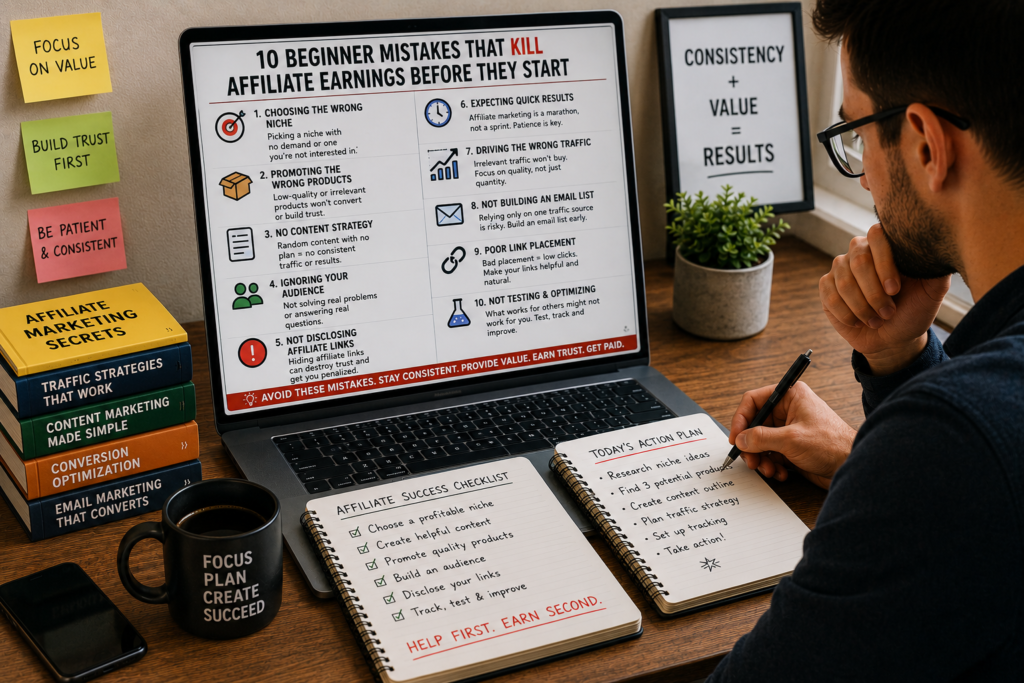
Most people who try affiliate marketing quit within the first six months. Not because the model is broken. Not because the competition is too fierce. But because they walk into a handful of avoidable traps that drain their momentum before they ever see real results.
The frustrating part? These mistakes rarely feel like mistakes while you’re making them. They feel like progress. You’re publishing content, joining programs, sharing links. The activity looks productive. But the results never show up, and eventually the motivation dries up.
This guide covers the ten most damaging mistakes beginners make, why each one quietly sabotages your earnings, and exactly what to do instead.
Mistake #1: Choosing a Niche Based on Commission Rates Instead of Interest
The logic seems airtight: find the highest-paying affiliate programs, build content around those products, and collect large commissions. Finance, insurance, web hosting, and luxury goods all pay well. So that’s where beginners flock.
Here’s what actually happens. You pick a niche you don’t care about because the commissions look attractive. The first few weeks feel fine. You’re excited about the money potential. But by week six, creating another piece of content about credit card balance transfers or managed WordPress hosting feels like dragging a boulder uphill. The content gets thinner. The posting schedule slips. And eventually, you stop altogether.
Why This Kills Earnings
Affiliate marketing is a long game. Meaningful income takes months to build, sometimes longer. If you can’t sustain genuine interest in your topic through that ramp-up period, the commissions never materialize because you quit before they arrive.
Your audience can detect disinterest too. Content from someone who genuinely cares about their topic reads differently than content from someone chasing a payout. Readers sense the difference even if they can’t articulate it, and that gut feeling influences whether they trust your recommendations.
What to Do Instead
Pick a niche that sits at the intersection of three criteria:
- You already spend time on it. If you’re reading about it, watching videos about it, or talking about it with friends without getting paid, that’s a signal.
- Other people spend money on it. Passion alone isn’t enough. The topic needs to involve products or services that people actually buy.
- You can see yourself creating content about it a year from now. Not just next week. Not just next month. A year.
The best niche isn’t the one with the highest commission rates. It’s the one you won’t abandon.
Mistake #2: Promoting Too Many Products at Once
New affiliates often sign up for every program they can find and start recommending dozens of different products across multiple categories. Monday it’s a blender. Wednesday it’s a VPN. Friday it’s a skincare serum. The profile looks like a flea market instead of a trusted resource.
Why This Kills Earnings
When you promote everything, you become an authority on nothing. Audiences follow creators who go deep on a topic, not wide across dozens of unrelated ones. A fitness account that recommends protein powder, workout apps, resistance bands, and recovery tools builds a coherent identity. That same account recommending protein powder, a budgeting app, a vacuum cleaner, and a language course looks scattered and unreliable.
Scattered promotion dilutes your credibility at the exact moment you need to be building it. And without credibility, affiliate links don’t get clicked.
What to Do Instead
Start with three to five products maximum. Choose products that solve related problems within your niche. Become the person your audience trusts for recommendations in that specific area.
Once you’ve established authority and generated consistent sales with your core products, expand thoughtfully. Add products that complement what you’re already recommending, not random items that happen to pay well.
Mistake #3: Creating Content Around Products Instead of Problems
The typical beginner approach: find a product, write a review titled “Product X Review: Is It Worth It?”, drop an affiliate link, and move to the next product. Repeat fifty times. Wonder why nobody’s buying.
Why This Kills Earnings
People don’t search for product names until they’re already close to a purchase decision. And by that point, they’re usually comparing your review against dozens of others from more established creators who’ve been covering that product longer.
The larger opportunity sits earlier in the buyer’s process, when someone has a problem but hasn’t decided on a solution yet. “How to soundproof a home office on a budget” reaches someone who might buy acoustic panels, weatherstripping tape, a white noise machine, and a door sweep. “Acoustic Panel X Review” only reaches someone who already knows about that specific panel.
What to Do Instead
Build your content strategy around problems your audience faces, not products you want to sell. For every piece of product-focused content you create, produce three to four pieces that address specific pain points, answer common questions, or teach your audience something useful.
The problem-focused content attracts people at the beginning of their buying process. You become the trusted source that guided them from confusion to clarity. By the time you recommend a product, they’ve already experienced your value and are primed to follow your suggestion.
A practical content ratio to aim for:
- 70% educational and problem-solving content (no affiliate links, pure value)
- 20% product comparison and recommendation content (affiliate links included)
- 10% direct product reviews (detailed, honest, experience-based)
Mistake #4: Ignoring SEO and Search Intent Entirely
Many beginners focus exclusively on social media because it feels faster and more accessible than learning search engine optimization. They post on Instagram, TikTok, or Twitter and ignore Google, YouTube search, and Pinterest entirely.
Why This Kills Earnings
Social media content has a lifespan measured in hours. A TikTok video might get views for two or three days before the algorithm buries it. An Instagram post is functionally invisible after 48 hours. You’re stuck on a treadmill where yesterday’s content produces zero results today.
Search-optimized content works differently. A well-written article or YouTube video that ranks for a relevant query can drive traffic and commissions for months or years with no additional effort from you. One strong piece of content can outperform hundreds of social media posts over its lifetime.
The other problem with ignoring search intent is that social media audiences are typically browsing, not buying. Someone scrolling through their feed at midnight isn’t in the same mental state as someone typing “best noise-cancelling headphones under $200” into Google. The search user has buying intent baked into their behavior.
What to Do Instead
You don’t have to abandon social media. But you should invest at least a portion of your effort into content that targets search queries, whether that’s blog posts on a website, optimized YouTube videos, or Pinterest pins.
Learn the basics of keyword research. You don’t need to become an SEO expert, but understanding what people are actively searching for in your niche transforms your content strategy from guessing to targeting.
Focus on long-tail keywords, specific multi-word phrases that signal buying intent:
- “best running shoes for plantar fasciitis 2026” (buyer intent, specific problem)
- “Notion vs. ClickUp for small teams” (comparison, decision stage)
- “how to set up a home recording studio under $500” (problem-solving, budget-defined)
These phrases have less competition than broad terms and attract people much closer to making a purchase.
Mistake #5: Not Disclosing Affiliate Relationships
Some beginners hide their affiliate links because they’re worried disclosure will scare people away from clicking. Others simply don’t know disclosure is required. Either way, the result is the same: legal risk, platform violations, and eroded trust.
Why This Kills Earnings
In the United States, the Federal Trade Commission requires clear disclosure of any material relationship between an endorser and a brand, and affiliate commissions absolutely qualify. Similar regulations exist in the UK, EU, Canada, Australia, and most other markets.
Getting caught without proper disclosure can result in:
- FTC complaints and potential fines
- Account termination from affiliate programs
- Content removal or account suspension from social platforms
- Permanent damage to your reputation if your audience discovers hidden financial relationships
Beyond the legal dimension, there’s a practical one: audiences actually respond well to honest disclosure. “I may earn a commission if you purchase through my link, at no extra cost to you” doesn’t scare people away. It signals honesty. Viewers and readers who trust you will click your links precisely because they know you’re being straight with them.
What to Do Instead
Disclose every time, on every platform, in every piece of content that contains affiliate links. Make it visible and clear, not buried in small text or hidden behind a “see more” button.
- YouTube: State it verbally in the video and include it in the description.
- Blog posts: Add a disclosure statement near the top of the article, before the first affiliate link.
- Social media: Include clear language in the caption. “#affiliate” or “#ad” placed at the end of a string of 30 hashtags doesn’t count. Put it where people actually see it.
- Email: Disclose in the body of the email, not just in a footer no one reads.
Make disclosure a non-negotiable part of your workflow, like hitting “publish.” It protects you legally and builds the trust that drives long-term earnings.
Mistake #6: Expecting Results in 30 Days
The affiliate marketing space is flooded with stories about people earning thousands in their first month. Some of those stories are true. Most are misleading, cherry-picked outliers, or outright fabricated to sell courses. When beginners measure their own progress against these narratives, 30 days of modest results feels like failure.
Why This Kills Earnings
Unrealistic expectations create a cycle of premature quitting. You launch, work hard for four to six weeks, check your dashboard, see $12 in commissions, and conclude the whole thing doesn’t work. So you either quit entirely or jump to a different niche and start over, resetting the clock.
Affiliate marketing income follows a compounding curve, not a linear one. The first few months are the flattest part of that curve. Content needs time to get indexed by search engines, discovered by audiences, and shared across networks. Your audience needs time to grow, engage, and develop trust in your recommendations.
Most successful affiliates report that months three through six is when they started seeing consistent traction, and months six through twelve is when the income became meaningful. The people who quit at month two never reach the inflection point.
What to Do Instead
Set process goals instead of income goals for your first six months. Measure things you can control:
- Number of content pieces published per week
- Growth in followers, subscribers, or email list size
- Engagement rates on your content
- Number of affiliate programs applied to and approved for
- Click-through rates on your affiliate links
These metrics tell you whether your strategy is working long before the commissions start reflecting it. If your clicks are growing and your engagement is improving, the sales will follow. Stay the course.
Give yourself a twelve-month commitment minimum before evaluating whether affiliate marketing “works” for you. Anything shorter doesn’t give the compounding effect enough time to kick in.
Mistake #7: Copying Top Creators Instead of Finding Your Own Voice
When beginners study successful affiliate marketers for inspiration, “inspiration” often turns into imitation. They copy the same content formats, use the same phrases, recommend the same products, and try to replicate the same persona. The result is a diluted version of someone else’s brand that offers nothing distinct.
Why This Kills Earnings
The audience already has access to the original creator. They don’t need a second-rate copy. If your content looks, sounds, and reads like a lesser version of an established voice, viewers will gravitate to the source instead of the imitation.
Beyond the audience perspective, imitation prevents you from discovering what makes your content genuinely different. Maybe your strength is dry humor in product reviews. Maybe it’s obsessive detail in comparison charts. Maybe it’s the fact that you’re a parent reviewing products from a parent’s perspective while most competitors aren’t. You’ll never uncover these differentiators if you’re too busy copying someone else’s formula.
What to Do Instead
Study successful creators to understand strategy, not to replicate style. Pay attention to:
- What types of content they produce (reviews, tutorials, comparisons)
- How they structure their calls to action
- Which platforms they prioritize
- How they integrate affiliate recommendations into valuable content
Then apply those strategic lessons through your own lens. Share your genuine opinions, your real experiences, and your actual personality. The creators who build sustainable affiliate income are the ones audiences choose to follow because no one else offers exactly what they offer.
Authenticity isn’t a marketing buzzword here. It’s a competitive advantage that can’t be copied.
Mistake #8: Neglecting Email List Building From Day One
Most beginners pour all their energy into social media and never collect a single email address. They build their entire business on rented land, platforms they don’t control and can’t predict.
Why This Kills Earnings
Social media algorithms change constantly. Organic reach on Facebook has plummeted over the years. Instagram regularly adjusts how it distributes content. TikTok’s algorithm is a black box that can shift overnight. One algorithm update can cut your visibility in half, and there’s nothing you can do about it.
An email list is the only audience channel you fully own. No algorithm sits between you and your subscribers. When you send an email, it arrives, and the open rates and click rates are dramatically higher than any social media post.
For affiliate marketing, email is especially powerful because:
- Subscribers have already expressed interest by opting in, making them warmer leads than random social followers.
- You can segment your list and send targeted product recommendations based on subscriber interests.
- You can build multi-touch sequences that educate subscribers and warm them up to a purchase over days or weeks, which is especially effective for mid-ticket and high-ticket products.
- Your list grows in value over time instead of depreciating with each algorithm shift.
What to Do Instead
Start collecting email addresses from the very beginning, even if your audience is small. You don’t need a website to do this. Tools like ConvertKit, Beehiiv, and Mailchimp let you create simple landing pages with sign-up forms that you can link from any platform.
Offer something genuinely useful in exchange for the email address:
- A free resource guide (“10 Best Free Tools for Starting a Podcast”)
- A checklist or template relevant to your niche
- A short email course that teaches something practical over five to seven days
- Exclusive content or early access to your reviews
Even 100 engaged email subscribers can generate more affiliate revenue than 5,000 passive social media followers. Start building the list now. Future you will be grateful.
Mistake #9: Not Tracking What’s Actually Working
Beginners often publish content, share affiliate links, and check their program dashboard for total earnings without ever understanding which specific content, which products, and which platforms are driving those sales. They operate on gut feeling instead of data.
Why This Kills Earnings
Without tracking, you can’t optimize. You might have one piece of content generating 80% of your commissions while you spend most of your time creating content that produces nothing. You might be promoting five products, one of which converts at 5% while the others sit at 0.2%. Without data, you’d never know.
Gut-feeling marketing leads to wasted effort. You keep doing more of everything instead of more of what works. Over months, this scattered approach costs you hundreds or thousands of dollars in missed optimization opportunities.
What to Do Instead
Implement tracking from the start, even at a basic level:
Use sub-IDs and tracking parameters. Most affiliate programs let you add tracking identifiers to your links. Use different IDs for different pieces of content so you can see which article, video, or post drove each sale.
Track click-through rates. If you’re using a link management tool like ThirstyAffiliates, Pretty Links, or a general link shortener with analytics, monitor which links get clicked most frequently and from which sources.
Monitor conversion rates by product. A product with high clicks but low conversions might indicate a mismatch between your recommendation and the landing page experience. A product with low clicks but high conversions might be worth promoting more aggressively.
Review monthly. Set a recurring calendar event to review your affiliate data every month. Look for patterns:
- Which content formats produce the most sales?
- Which traffic sources send buyers versus browsers?
- Which products have the highest earnings per click?
- Where are the drop-offs in your conversion funnel?
Spend an hour on this monthly review and you’ll make better decisions in the next 30 days than most beginners make in their entire first year.
Mistake #10: Treating Affiliate Marketing as Passive Income From Day One
The phrase “passive income” has done more damage to beginner affiliate marketers than any algorithm change or commission rate cut. People enter the space believing they can set up a few links, sit back, and watch money roll in. When reality doesn’t match that fantasy, they feel cheated and disillusioned.
Why This Kills Earnings
Affiliate marketing can become semi-passive over time. Evergreen content that ranks in search engines can generate commissions with minimal maintenance. But getting to that point is anything but passive. It requires active, consistent work across content creation, audience building, program management, and optimization.
When beginners treat the business as passive from the start, they underinvest in effort. They publish sporadically. They skip audience engagement. They don’t respond to comments, answer questions, or build relationships. The result is a half-built asset that never reaches the tipping point where compounding returns kick in.
What to Do Instead
Reframe your expectations. During the first six to twelve months, affiliate marketing is an active business that demands consistent effort. Think of it like planting an orchard. You’re digging holes, planting trees, watering, fertilizing, and protecting against pests. None of that is passive. But years later, those trees produce fruit season after season with far less intervention.
Your first-year goals should center on building assets that pay off over time:
- A library of high-quality, search-optimized content
- An engaged audience on one or two platforms
- An email list of interested subscribers
- Relationships with affiliate program managers
- A data-driven understanding of what converts in your niche
These assets, once built, do generate income with decreasing effort. But the building phase is real work, and treating it as anything less sets you up for disappointment.
A Quick Self-Audit for Current Beginners
If you’ve already started your affiliate marketing efforts, run through this checklist to see which mistakes might be affecting your results right now:
Niche selection:
- Can you create content about your niche for the next twelve months without dreading it?
- Does your niche have products people actively buy?
Product strategy:
- Are you promoting fewer than ten core products?
- Do those products relate to each other within a coherent theme?
Content approach:
- Is at least half your content solving problems rather than reviewing products?
- Are you creating content that targets search queries with buying intent?
Trust and transparency:
- Do you clearly disclose affiliate relationships in every piece of content?
- Have you personally used the majority of the products you recommend?
Growth infrastructure:
- Are you collecting email addresses?
- Are you tracking which content and products generate your commissions?
Mindset:
- Have you committed to at least twelve months before judging results?
- Are you bringing your own voice and perspective rather than copying established creators?
Any “no” answer on this list points to a specific area you can improve starting this week. You don’t need to fix everything at once. Pick the one or two gaps that seem most impactful and focus there first.
What Separates Beginners Who Succeed From Those Who Don’t
After looking at all ten mistakes, a pattern becomes clear. The beginners who eventually build real affiliate income share a few traits that have nothing to do with technical skill or marketing genius:
They stay consistent when results are invisible. The early months are quiet. Commissions are small or nonexistent. The creators who push through that silence are the ones who eventually break through.
They prioritize trust over transactions. Every piece of content is a deposit into their audience’s trust account. They recommend honestly, disclose transparently, and put their audience’s interests ahead of commission checks.
They treat data as a compass. Instead of guessing what works, they measure, analyze, and adjust. Small optimizations compound into significant earnings differences over time.
They think in years, not weeks. Affiliate marketing rewards patience and consistency more than any other factor. The people who approach it with a long-term mindset outlast the ones chasing quick wins.
None of these traits require special talent. They require decisions, ones you can make today regardless of where you are in your affiliate marketing experience.
The mistakes listed in this guide are common because they’re tempting. They feel logical in the moment. But now that you can see them clearly, you have something most beginners don’t: the ability to sidestep the traps before they cost you months of wasted effort.
Start with the right niche. Stay focused. Create content that serves your audience first. Build assets you own. Track your results. And give the compounding curve enough time to work in your favor.
The earnings will follow.