Introduction
In today’s competitive business landscape, acquiring customers is only part of the equation. Long-term success depends on retaining customers, helping them achieve their goals, and maximizing the value they receive from products and services. This responsibility belongs to the Customer Success Manager (CSM).
Customer Success Managers play a critical role in building strong customer relationships, improving retention rates, increasing customer satisfaction, and driving business growth. They act as trusted advisors who help customers successfully adopt solutions and achieve measurable outcomes.
As subscription-based business models, SaaS platforms, and customer-centric strategies continue expanding, Customer Success Managers have become among the most valuable professionals in modern organizations.
What Is a Customer Success Manager?
A Customer Success Manager (CSM) is a professional responsible for helping customers achieve success with a company’s products or services.
Their primary goals include:
- Customer retention
- Product adoption
- Customer satisfaction
- Account growth
- Customer loyalty
- Revenue expansion
Unlike traditional customer support, Customer Success is proactive rather than reactive. CSMs work to prevent problems before they occur and help customers achieve long-term success.
Why Customer Success Matters
Improves Customer Retention
Retaining existing customers is often more profitable than acquiring new ones.
Increases Customer Satisfaction
Successful customers are more likely to remain loyal.
Drives Revenue Growth
Satisfied customers often expand their accounts and purchase additional services.
Reduces Churn
Proactive engagement helps prevent customer cancellations.
Strengthens Brand Reputation
Positive customer experiences lead to referrals and advocacy.
Key Responsibilities of a Customer Success Manager
Typical responsibilities include:
- Customer onboarding
- Relationship management
- Product adoption support
- Customer training
- Success planning
- Account reviews
- Churn prevention
- Renewal management
- Upselling and cross-selling opportunities
- Customer feedback collection
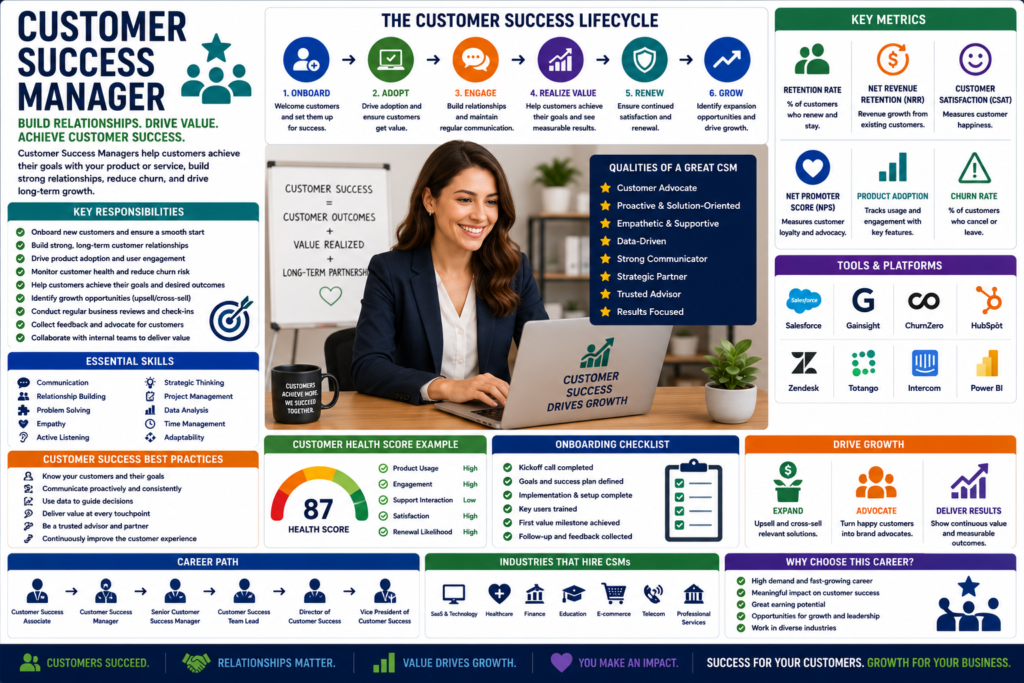
The Customer Success Lifecycle
1. Customer Onboarding
Helping customers get started successfully.
Activities include:
- Product setup
- Training sessions
- Success planning
- Goal alignment
2. Adoption
Ensuring customers actively use the product.
3. Engagement
Maintaining regular communication and support.
4. Value Realization
Helping customers achieve measurable outcomes.
5. Renewal
Securing continued customer partnerships.
6. Expansion
Identifying growth opportunities within accounts.
Customer Success vs Customer Support
Customer Support
Focuses on resolving customer issues and responding to requests.
Customer Success
Focuses on helping customers achieve long-term goals and maximize value.
Both functions are important, but Customer Success takes a more strategic and proactive approach.
Essential Skills for Customer Success Managers
Communication Skills
Building trust through clear and professional communication.
Relationship Building
Developing long-term customer partnerships.
Problem Solving
Helping customers overcome challenges.
Strategic Thinking
Aligning customer goals with business solutions.
Empathy
Understanding customer needs and concerns.
Project Management
Coordinating onboarding, training, and success initiatives.
Data Analysis
Using metrics to identify opportunities and risks.
Customer Onboarding
Successful onboarding is one of the most important responsibilities of a CSM.
Effective onboarding includes:
- Welcome meetings
- Product training
- Success planning
- Goal setting
- Implementation support
Strong onboarding significantly improves customer retention and satisfaction.
Customer Health Scores
Many organizations use Customer Health Scores to measure account performance.
Factors may include:
- Product usage
- Login frequency
- Support activity
- Customer satisfaction
- Renewal likelihood
- Feature adoption
Health scores help identify both risks and opportunities.
Key Customer Success Metrics
Customer Retention Rate
Percentage of customers who remain active.
Customer Churn Rate
Percentage of customers who leave.
Net Revenue Retention (NRR)
Measures revenue growth from existing customers.
Customer Satisfaction Score (CSAT)
Tracks overall customer satisfaction.
Net Promoter Score (NPS)
Measures customer loyalty and advocacy.
Product Adoption Rate
Measures how effectively customers use products and features.
Customer Success Tools
Salesforce
Customer relationship management and account tracking.
HubSpot CRM
Customer communication and lifecycle management.
Gainsight
Specialized customer success platform.
ChurnZero
Customer success and retention software.
Totango
Customer journey management platform.
Zendesk
Customer support and engagement solution.
Intercom
Customer communication and onboarding platform.
Customer Success in SaaS
Customer Success Managers are especially important in SaaS businesses.
Responsibilities often include:
- Subscription renewals
- Product adoption
- Feature education
- Usage monitoring
- Expansion opportunities
- Customer advocacy
SaaS companies depend heavily on customer retention for sustainable growth.
Customer Success Best Practices
Be Proactive
Identify challenges before they become problems.
Understand Customer Goals
Focus on outcomes rather than features.
Build Relationships
Trust is essential for long-term success.
Communicate Regularly
Maintain consistent engagement.
Measure Success
Use data to guide decisions and improvements.
Deliver Value Continuously
Help customers achieve meaningful results.
Career Path for Customer Success Managers
Customer Support Representative
Provides foundational customer experience skills.
Customer Success Associate
Supports onboarding and customer engagement.
Customer Success Manager
Manages customer relationships and retention.
Senior Customer Success Manager
Handles strategic accounts and complex customer needs.
Customer Success Team Lead
Supervises customer success teams.
Director of Customer Success
Develops customer success strategies and programs.
Vice President of Customer Success
Leads organizational customer success initiatives.
Industries Hiring Customer Success Managers
SaaS and Technology
Supporting software adoption and retention.
Financial Services
Helping clients maximize platform value.
Healthcare
Supporting healthcare technology and services.
Education
Managing customer success for learning platforms.
Telecommunications
Improving customer satisfaction and retention.
Professional Services
Supporting long-term client relationships.
Future Trends in Customer Success
Artificial Intelligence
AI assists with customer insights and predictive analytics.
Predictive Customer Health
Organizations identify churn risks earlier.
Personalization
Customer experiences become increasingly customized.
Customer Experience Integration
Customer Success and Customer Experience functions become more connected.
Automation
Routine customer interactions become more automated.
Data-Driven Success Strategies
Analytics play a larger role in customer engagement decisions.
Benefits of Becoming a Customer Success Manager
- High demand in SaaS and technology industries
- Strong earning potential
- Remote work opportunities
- Relationship-focused career
- Leadership growth opportunities
- Direct impact on business success
- Diverse industry applications
Conclusion
Customer Success Managers play a vital role in helping customers achieve their goals while driving retention, loyalty, and business growth. Through proactive engagement, strategic planning, relationship management, and customer advocacy, they create long-term value for both customers and organizations.
As customer-centric business models continue growing, skilled Customer Success Managers will remain highly valuable. Professionals who master communication, customer engagement, analytics, and strategic thinking can build rewarding careers while helping businesses and customers succeed together.