Introduction
Cybersecurity has become one of the most important disciplines in the digital age. As businesses, governments, and individuals increasingly rely on technology, the need to protect sensitive information and digital systems has never been greater. Cybercriminals constantly develop new attack methods, making cybersecurity a critical priority for organizations worldwide.
From preventing data breaches and ransomware attacks to securing cloud environments and protecting personal information, cybersecurity plays a vital role in maintaining trust, privacy, and business continuity.
This comprehensive guide explores cybersecurity fundamentals, common threats, security practices, technologies, and future trends shaping the industry.
What Is Cybersecurity?
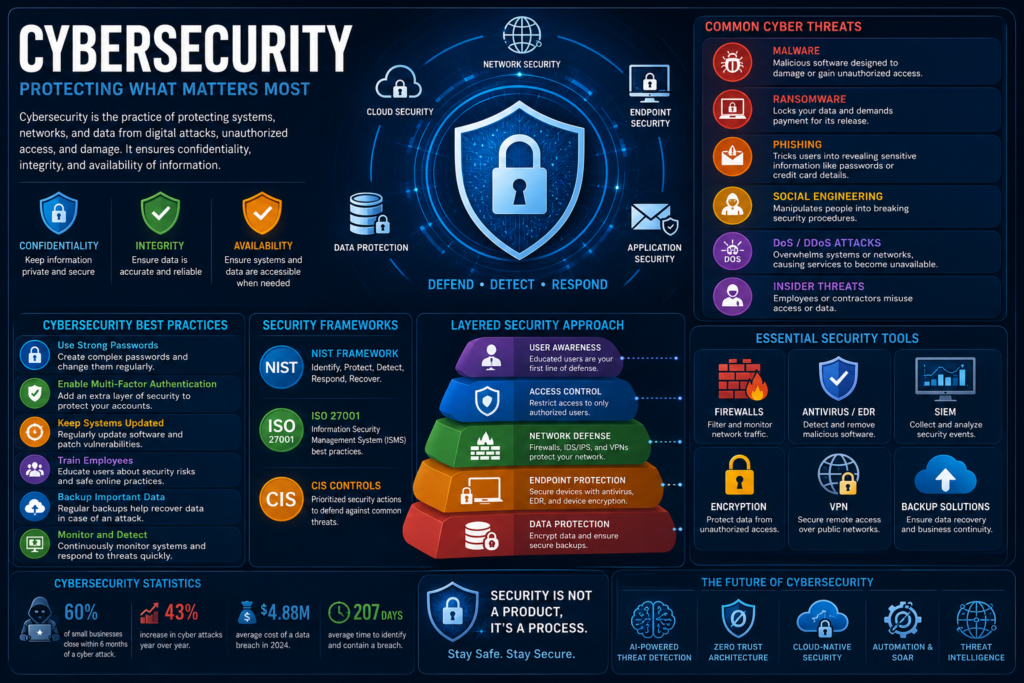
Cybersecurity is the practice of protecting computer systems, networks, applications, and data from unauthorized access, attacks, damage, or theft.
The primary objectives of cybersecurity are:
- Protecting sensitive information
- Preventing unauthorized access
- Ensuring business continuity
- Maintaining data integrity
- Preserving user privacy
- Reducing cyber risks
Cybersecurity combines technology, processes, and human awareness to create a strong defense against digital threats.
Why Cybersecurity Matters
Protects Sensitive Data
Organizations store large amounts of personal, financial, and confidential information that must remain secure.
Prevents Financial Losses
Cyberattacks can result in significant financial damage through fraud, downtime, and recovery costs.
Maintains Customer Trust
Strong security practices help organizations build credibility and customer confidence.
Supports Regulatory Compliance
Businesses must comply with regulations regarding data privacy and information security.
Ensures Business Continuity
Cybersecurity helps organizations continue operating during and after security incidents.
Common Cybersecurity Threats
Malware
Malware refers to malicious software designed to damage or exploit systems.
Examples include:
- Viruses
- Worms
- Trojans
- Spyware
- Adware
Ransomware
Ransomware encrypts files and demands payment for their release.
This type of attack has become one of the most costly cybersecurity threats.
Phishing
Phishing attacks trick users into revealing sensitive information through deceptive emails, websites, or messages.
Social Engineering
Attackers manipulate individuals into providing confidential information or access credentials.
Denial-of-Service (DoS) Attacks
These attacks overwhelm systems with traffic, making services unavailable.
Insider Threats
Employees or contractors may intentionally or accidentally compromise organizational security.
Core Areas of Cybersecurity
Network Security
Protects networks from unauthorized access and cyberattacks.
Common technologies include:
- Firewalls
- Intrusion Detection Systems (IDS)
- Intrusion Prevention Systems (IPS)
- Virtual Private Networks (VPNs)
Application Security
Focuses on securing software applications throughout development and deployment.
Cloud Security
Protects cloud-based infrastructure, applications, and data.
Endpoint Security
Secures devices such as:
- Laptops
- Smartphones
- Tablets
- Workstations
Data Security
Protects sensitive information from theft, corruption, or unauthorized access.
Cybersecurity Frameworks
Organizations often follow established security frameworks.
NIST Cybersecurity Framework
Provides guidelines for identifying, protecting, detecting, responding to, and recovering from cyber incidents.
ISO 27001
An international standard for information security management systems.
CIS Controls
A prioritized set of security best practices designed to improve cyber resilience.
Essential Cybersecurity Technologies
Firewalls
Firewalls monitor and control network traffic based on security rules.
Antivirus Software
Detects and removes malicious software.
Encryption
Encryption protects data by converting it into unreadable formats without proper authorization.
Multi-Factor Authentication (MFA)
Requires multiple forms of verification before granting access.
Security Information and Event Management (SIEM)
SIEM platforms collect and analyze security events across organizations.
Best Practices for Cybersecurity
Use Strong Passwords
Passwords should be complex, unique, and regularly updated.
Enable Multi-Factor Authentication
MFA significantly reduces the risk of unauthorized access.
Keep Systems Updated
Regular updates address security vulnerabilities.
Train Employees
Security awareness training helps reduce human error.
Backup Critical Data
Regular backups support recovery after incidents.
Monitor Network Activity
Continuous monitoring helps identify suspicious behavior.
Implement Access Controls
Users should only have access to resources necessary for their roles.
Cybersecurity Careers
Cybersecurity offers diverse and rapidly growing career opportunities.
Security Analyst
Monitors systems and investigates security incidents.
Penetration Tester
Simulates cyberattacks to identify vulnerabilities.
Security Engineer
Designs and implements security solutions.
Incident Response Specialist
Responds to and mitigates cybersecurity incidents.
Security Architect
Develops secure system architectures and strategies.
Chief Information Security Officer (CISO)
Leads organizational cybersecurity programs and policies.
Cybersecurity and Compliance
Organizations must comply with various regulations and standards.
Examples include:
- GDPR
- HIPAA
- PCI DSS
- SOC 2
Compliance helps protect customer data and reduce legal risks.
Emerging Cybersecurity Trends
Artificial Intelligence
AI enhances threat detection, automation, and incident response.
Zero Trust Security
Zero Trust assumes no user or device should be trusted automatically.
Cloud-Native Security
Organizations increasingly secure cloud-first environments.
Threat Intelligence
Advanced intelligence platforms help organizations anticipate attacks.
Security Automation
Automation improves response times and reduces manual workloads.
Challenges in Cybersecurity
Increasing Threat Complexity
Attackers continuously develop more sophisticated techniques.
Skills Shortages
Many organizations struggle to find qualified cybersecurity professionals.
Remote Work Security
Distributed workforces introduce new security challenges.
Expanding Attack Surfaces
Cloud services, IoT devices, and mobile technologies create additional vulnerabilities.
The Future of Cybersecurity
Cybersecurity will continue evolving as technology advances. Artificial intelligence, machine learning, cloud computing, and emerging technologies will reshape how organizations protect digital assets.
Businesses that invest in proactive security strategies, employee training, and modern cybersecurity technologies will be better positioned to defend against future threats.
Conclusion
Cybersecurity is essential for protecting data, systems, and organizations in an increasingly connected world. As cyber threats continue to grow in sophistication and frequency, strong cybersecurity practices are no longer optional—they are a business necessity.
By implementing robust security measures, following industry best practices, and fostering a culture of security awareness, organizations can reduce risks, protect valuable information, and maintain customer trust in the digital age.