Introduction
In today’s highly competitive digital marketplace, businesses must communicate clearly, effectively, and persuasively to capture attention and drive action. Behind successful advertisements, landing pages, email campaigns, social media ads, and sales funnels is a skilled Copywriter.
Copywriting is the art and science of writing content designed to persuade readers to take a specific action. Whether encouraging a purchase, generating leads, increasing brand awareness, or building customer trust, copywriting plays a critical role in modern marketing.
As businesses continue investing in digital marketing and customer acquisition, professional copywriters remain among the most valuable marketing specialists across industries.
This guide explores the role of a Copywriter, essential skills, copywriting techniques, tools, career opportunities, and best practices for creating high-converting marketing content.
What Is a Copywriter?
A Copywriter is a professional writer who creates persuasive content designed to influence reader behavior and achieve specific marketing goals.
Unlike general content writing, copywriting focuses on driving action, such as:
- Making a purchase
- Signing up for a newsletter
- Downloading a guide
- Booking a consultation
- Requesting a quote
- Clicking an advertisement
Copywriters combine psychology, marketing knowledge, research, and storytelling to create compelling messages that convert audiences into customers.
Why Copywriting Matters
Increases Sales
Effective copy directly influences purchasing decisions and revenue growth.
Improves Marketing Performance
Strong messaging enhances advertising and campaign effectiveness.
Builds Brand Awareness
Consistent communication strengthens brand recognition and identity.
Creates Customer Trust
Clear and valuable messaging establishes credibility and authority.
Improves Conversion Rates
Well-written copy turns visitors into leads and customers.
Types of Copywriting
Website Copywriting
Creating content for websites, including:
- Homepages
- Service pages
- About pages
- Product pages
SEO Copywriting
Combining persuasive writing with search engine optimization strategies.
Email Copywriting
Writing emails designed to nurture leads and drive conversions.
Advertising Copywriting
Creating content for:
- Google Ads
- Facebook Ads
- LinkedIn Ads
- Display advertising
Sales Copywriting
Developing persuasive sales pages and funnels.
Social Media Copywriting
Writing engaging content for social platforms.
Product Copywriting
Creating compelling product descriptions and e-commerce content.
Direct Response Copywriting
Encouraging immediate action through persuasive messaging.
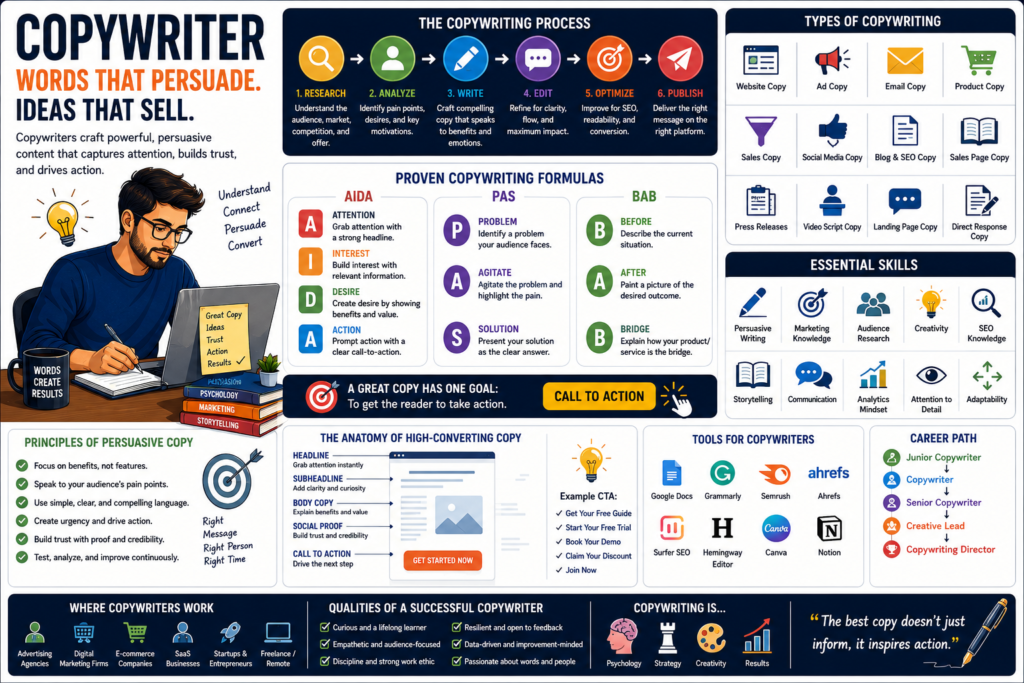
The Copywriting Process
1. Research
Understanding:
- Target audience
- Competitors
- Customer pain points
- Market trends
- Product benefits
Research is often the most important stage of successful copywriting.
2. Audience Analysis
Identifying:
- Demographics
- Motivations
- Challenges
- Goals
- Buying behaviors
3. Message Development
Creating key value propositions and unique selling points.
4. Draft Writing
Transforming research into persuasive marketing content.
5. Editing and Optimization
Improving clarity, readability, and conversion potential.
6. Testing and Refinement
Analyzing performance and optimizing results.
Essential Skills for Copywriters
Persuasive Writing
The ability to influence decisions through language.
Marketing Knowledge
Understanding customer journeys and buying behavior.
Research Skills
Gathering valuable insights to support messaging.
Creativity
Developing unique concepts and compelling ideas.
Storytelling
Using narratives to build emotional connections.
SEO Knowledge
Understanding search engine optimization principles.
Communication Skills
Clearly expressing ideas and value propositions.
Core Principles of Great Copywriting
Focus on Benefits
Customers care more about outcomes than features.
Instead of:
“Includes advanced analytics software.”
Write:
“Gain deeper customer insights and make smarter business decisions.”
Know Your Audience
Successful copy speaks directly to customer needs and desires.
Create Emotional Connections
Emotions often drive purchasing decisions.
Keep It Clear
Simple language often outperforms complicated wording.
Use Strong Calls-to-Action (CTAs)
Guide readers toward the next step.
Examples:
- Get Started Today
- Download Your Free Guide
- Book a Demo
- Request a Free Consultation
Popular Copywriting Frameworks
AIDA
One of the most widely used copywriting models.
Attention
Capture interest immediately.
Interest
Build curiosity and engagement.
Desire
Highlight benefits and value.
Action
Encourage the desired response.
PAS
Problem
Identify a challenge.
Agitate
Emphasize the impact of the problem.
Solution
Present the product or service as the answer.
BAB
Before
Describe the current situation.
After
Paint a picture of the desired outcome.
Bridge
Explain how to get there.
SEO Copywriting
Modern copywriters often combine persuasion with SEO strategies.
Keyword Research
Understanding what potential customers search for online.
Search Intent
Creating content that aligns with user goals.
On-Page Optimization
Including:
- SEO titles
- Meta descriptions
- Headings
- Internal links
- Keyword placement
User Experience
Writing content that is both searchable and valuable.
Popular Tools for Copywriters
Google Docs
Collaborative writing and editing platform.
Grammarly
Grammar and clarity improvement tool.
Semrush
SEO and competitor research platform.
Ahrefs
Keyword research and backlink analysis tool.
Hemingway Editor
Improves readability and clarity.
Notion
Content organization and project management.
AI Writing Tools
Support ideation, outlines, and content development.
Copywriting for Different Channels
Landing Pages
Focused on conversions and lead generation.
Email Marketing
Builds relationships and drives action.
Social Media
Encourages engagement and brand awareness.
Advertising
Captures attention in limited space.
Sales Funnels
Guides prospects through the buying journey.
Each channel requires a unique writing approach.
Career Opportunities for Copywriters
Junior Copywriter
Learns copywriting fundamentals and marketing principles.
Copywriter
Creates marketing content independently.
SEO Copywriter
Specializes in search-optimized copy.
Conversion Copywriter
Focuses on increasing sales and conversions.
Senior Copywriter
Leads projects and mentors team members.
Creative Director
Oversees brand messaging and creative strategy.
Marketing Director
Leads broader marketing initiatives and communication strategies.
Freelance Copywriting
Many copywriters choose freelance careers because of flexibility and earning potential.
Benefits include:
- Remote work
- Flexible schedules
- Global clients
- Diverse industries
- Scalable income opportunities
Successful freelancers often specialize in specific niches such as SaaS, healthcare, finance, e-commerce, or technology.
Best Practices for Copywriting
Write for People First
Focus on human readers rather than algorithms.
Use Clear Headlines
Strong headlines dramatically impact engagement.
Keep Sentences Concise
Shorter sentences improve readability.
Highlight Benefits
Explain how customers will benefit.
Build Trust
Use testimonials, statistics, and social proof.
Test and Improve
Continuously optimize copy based on performance.
Future Trends in Copywriting
Artificial Intelligence
AI tools assist with research, brainstorming, and content generation.
Personalization
Brands increasingly tailor messaging to individual users.
Voice Search Optimization
Copy adapts to conversational search patterns.
Video and Script Writing
Demand for video marketing content continues growing.
Conversion Optimization
Businesses focus more on measurable marketing performance.
Omnichannel Marketing
Copywriters create consistent messaging across multiple platforms.
Benefits of Becoming a Copywriter
- High global demand
- Strong income potential
- Remote work flexibility
- Freelance opportunities
- Creative expression
- Diverse industries
- Continuous learning and growth
Conclusion
Copywriters play a crucial role in helping businesses communicate effectively, build customer relationships, and drive sales. By combining marketing psychology, persuasive writing, research, and creativity, they create content that influences decisions and delivers measurable results.
As digital marketing continues to evolve, skilled Copywriters will remain highly valuable across industries. Professionals who master persuasive communication, SEO, customer psychology, and modern marketing strategies will enjoy rewarding and long-lasting careers in the growing world of copywriting.