Introduction
In today’s technology-driven world, complex products, software systems, and digital services require clear and effective documentation. Whether users are learning a new software platform, developers are integrating APIs, or engineers are following technical procedures, accurate documentation is essential for success.
Behind this documentation is the Technical Writer—a professional who transforms complex technical information into clear, understandable, and user-friendly content.
Technical Writers bridge the gap between technical experts and end users. They help organizations improve product adoption, reduce support costs, enhance user experiences, and ensure knowledge is effectively shared across teams and customers.
As technology continues to evolve, Technical Writing remains one of the most valuable communication careers in software development, engineering, healthcare, manufacturing, and many other industries.
What Is a Technical Writer?
A Technical Writer is a professional who creates clear, accurate, and organized documentation that explains technical concepts, products, processes, or systems.
Their primary goal is to make complex information easy to understand for specific audiences.
Technical Writers create:
- User manuals
- Software documentation
- API documentation
- Installation guides
- Product documentation
- Knowledge base articles
- Standard operating procedures (SOPs)
- Training materials
- Technical reports
- Release notes
They work closely with engineers, developers, product managers, designers, and subject matter experts to gather information and create useful documentation.
Why Technical Writing Matters
Improves User Experience
Clear documentation helps users understand products quickly and efficiently.
Reduces Support Costs
Well-written documentation reduces customer support requests.
Accelerates Product Adoption
Users can learn and implement solutions faster.
Supports Compliance
Many industries require documented procedures and technical information.
Preserves Organizational Knowledge
Documentation helps organizations maintain and transfer critical knowledge.
Key Responsibilities of a Technical Writer
Technical Writers often perform tasks such as:
- Researching technical information
- Interviewing subject matter experts
- Writing documentation
- Editing and proofreading content
- Organizing knowledge bases
- Updating documentation
- Creating diagrams and visuals
- Managing documentation projects
- Reviewing product changes
- Maintaining content standards
Types of Technical Documentation
User Documentation
Content designed for end users.
Examples include:
- User guides
- Quick start guides
- Tutorials
- FAQs
API Documentation
Explains how developers can integrate and use software interfaces.
Common sections include:
- Authentication
- Endpoints
- Requests
- Responses
- Code examples
Software Documentation
Provides instructions for software installation, configuration, and usage.
Internal Documentation
Supports employees and internal processes.
Examples include:
- SOPs
- Process documentation
- Knowledge bases
- Training materials
Product Documentation
Explains product features, capabilities, and workflows.
Technical Specifications
Detailed descriptions of systems, components, and requirements.
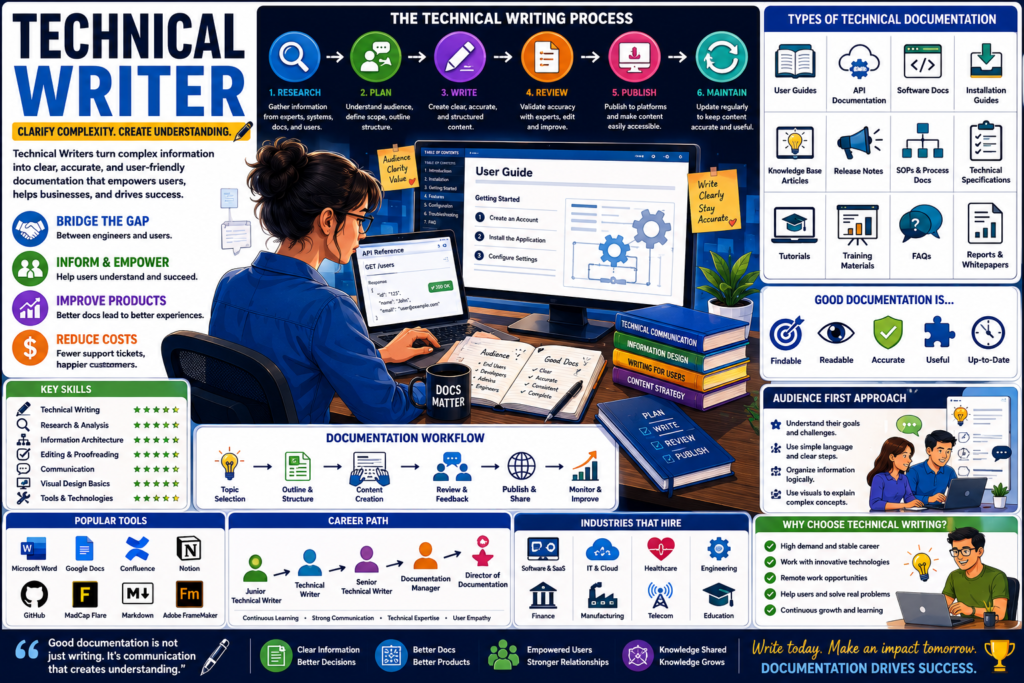
The Technical Writing Process
1. Information Gathering
Collecting technical information from experts, systems, and documentation.
Methods include:
- Interviews
- Product testing
- Research
- Meetings
- Source code reviews
2. Audience Analysis
Understanding who will use the documentation.
Potential audiences include:
- End users
- Developers
- Administrators
- Engineers
- Business stakeholders
3. Content Planning
Defining:
- Documentation structure
- User journeys
- Content hierarchy
- Information architecture
4. Writing
Transforming technical concepts into clear instructions and explanations.
5. Review and Validation
Technical experts verify accuracy and completeness.
6. Publishing
Documentation is distributed through websites, knowledge bases, PDFs, or documentation platforms.
7. Maintenance
Regular updates ensure documentation remains accurate and current.
Essential Skills for Technical Writers
Writing and Communication
Strong writing skills are fundamental.
Technical Writers must communicate clearly and concisely.
Technical Knowledge
Understanding technical concepts helps create accurate documentation.
Common areas include:
- Software development
- APIs
- Cloud computing
- Networking
- Engineering systems
Research Skills
Finding and validating information efficiently.
Information Architecture
Organizing content for easy navigation and usability.
Attention to Detail
Accuracy is critical in technical documentation.
Collaboration
Working effectively with engineers, developers, and stakeholders.
Technical Writing Best Practices
Know Your Audience
Documentation should match the reader’s technical knowledge level.
Use Simple Language
Avoid unnecessary complexity and jargon.
Write Clear Instructions
Use step-by-step formats when appropriate.
Be Consistent
Maintain consistent terminology and formatting.
Include Examples
Practical examples improve understanding.
Use Visuals
Diagrams, screenshots, and illustrations enhance clarity.
Keep Documentation Updated
Outdated documentation can cause confusion and errors.
Popular Tools for Technical Writers
Microsoft Word
Widely used for documentation and reports.
Google Docs
Collaborative writing and editing platform.
Confluence
Popular knowledge management and documentation tool.
Notion
Supports documentation, collaboration, and project organization.
Markdown
A lightweight markup language widely used for technical content.
GitHub
Frequently used for developer documentation and version control.
MadCap Flare
Professional technical documentation platform.
Adobe FrameMaker
Used for large-scale technical publishing projects.
API Documentation Writing
API documentation is one of the fastest-growing areas of technical writing.
Good API documentation includes:
Overview
Introduction to the API.
Authentication
How users access the system.
Endpoint Reference
Available operations and functionality.
Request Examples
Sample API requests.
Response Examples
Expected outputs and data structures.
Error Handling
Common issues and troubleshooting information.
Developer-friendly API documentation significantly improves product adoption.
Technical Writing in Software Development
Technical Writers often work alongside:
- Software Engineers
- Product Managers
- UX Designers
- QA Engineers
- DevOps Teams
Common deliverables include:
- Product documentation
- Release notes
- User guides
- Knowledge base articles
- API references
Career Path for Technical Writers
Junior Technical Writer
Learns documentation standards and industry tools.
Technical Writer
Creates documentation independently.
Senior Technical Writer
Leads documentation projects and mentors team members.
Documentation Manager
Oversees documentation strategy and teams.
Information Architect
Focuses on content organization and user experience.
Documentation Director
Leads enterprise-wide documentation initiatives.
Industries Hiring Technical Writers
Software and SaaS
Product documentation and developer resources.
Engineering
Technical manuals and specifications.
Healthcare
Medical documentation and compliance materials.
Manufacturing
Process documentation and operational procedures.
Finance
System documentation and regulatory content.
Telecommunications
Technical support and service documentation.
Future Trends in Technical Writing
Artificial Intelligence
AI tools assist with content generation, editing, and maintenance.
Interactive Documentation
Dynamic and searchable content experiences continue growing.
Documentation-as-Code
Teams increasingly manage documentation using development workflows.
Video Documentation
Written content is increasingly supported by video tutorials.
Self-Service Knowledge Bases
Organizations continue expanding customer self-help resources.
Developer Experience (DX)
Documentation becomes a critical component of software adoption.
Benefits of Becoming a Technical Writer
- High industry demand
- Strong salary potential
- Remote work opportunities
- Diverse industries
- Continuous learning
- Collaboration with technology teams
- Clear career progression
Technical Writer vs Content Writer
Technical Writer
Focuses on accuracy, instruction, and technical information.
Content Writer
Focuses on engagement, marketing, and audience growth.
Both roles involve writing, but technical writing requires deeper technical understanding and structured documentation practices.
Conclusion
Technical Writers play a crucial role in helping users understand complex systems, products, and technologies. Through clear communication, structured documentation, and collaboration with technical teams, they make information accessible and actionable.
As software, cloud services, APIs, and digital products continue expanding, the demand for skilled Technical Writers will remain strong. Professionals who combine writing expertise with technical knowledge will enjoy rewarding careers while helping organizations improve user experiences, knowledge sharing, and product success.