Introduction
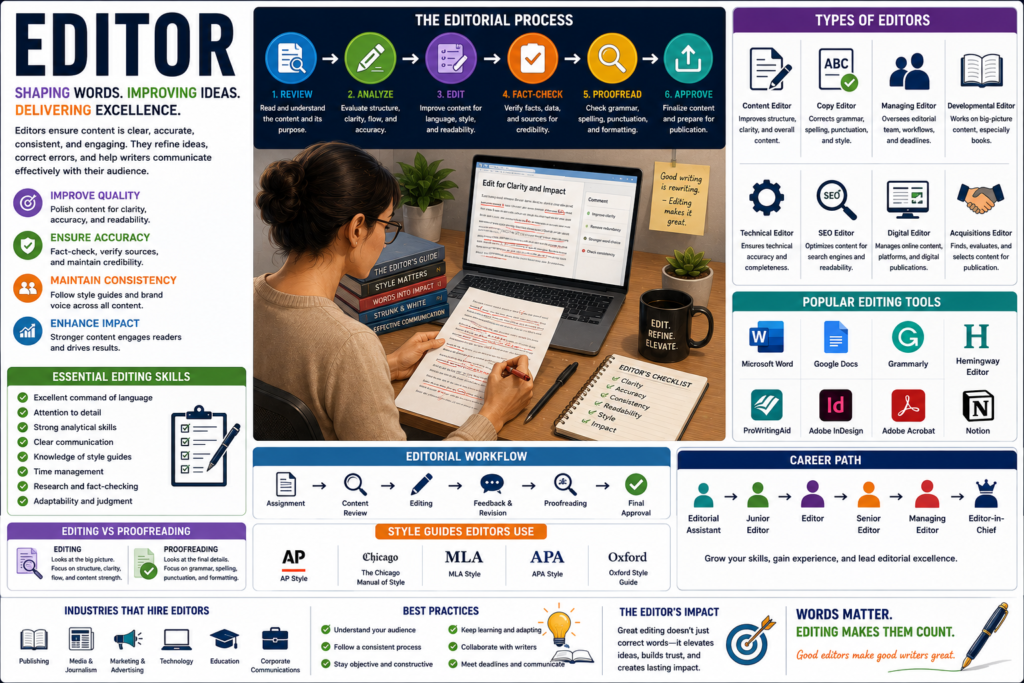
Behind every successful book, article, website, magazine, marketing campaign, and digital publication is a skilled Editor ensuring content is accurate, engaging, polished, and effective. Editors play a critical role in shaping content, maintaining quality standards, and helping writers communicate ideas clearly to their audiences.
In today’s content-driven world, Editors are essential across publishing, media, marketing, technology, education, and corporate communications. They not only correct grammar and spelling but also improve structure, consistency, readability, and overall content quality.
As businesses and organizations continue producing large volumes of content, professional Editors remain highly valuable in ensuring information is accurate, credible, and impactful.
This comprehensive guide explores the role of an Editor, essential skills, editorial processes, tools, career opportunities, and future industry trends.
What Is an Editor?
An Editor is a professional responsible for reviewing, improving, and preparing written content for publication or distribution.
Editors work closely with writers, content creators, publishers, marketers, and stakeholders to ensure content meets quality standards and achieves its intended purpose.
Common responsibilities include:
- Reviewing content
- Correcting grammar and spelling
- Improving readability
- Fact-checking information
- Ensuring consistency
- Managing editorial guidelines
- Coordinating publication schedules
- Providing writer feedback
- Maintaining content quality
Why Editors Are Important
Improve Content Quality
Editors ensure content is professional, polished, and error-free.
Enhance Readability
Well-edited content is easier for audiences to understand and engage with.
Maintain Brand Consistency
Editors help organizations maintain a consistent voice and style.
Protect Credibility
Accurate and error-free content builds trust with readers.
Support Publishing Success
Strong editorial processes improve overall publication quality.
Types of Editors
Content Editor
Focuses on overall content structure, clarity, and effectiveness.
Copy Editor
Reviews grammar, spelling, punctuation, and style consistency.
Managing Editor
Oversees editorial operations, workflows, and publishing schedules.
Developmental Editor
Works on large-scale content improvements, especially for books and manuscripts.
Technical Editor
Reviews technical accuracy and specialized content.
SEO Editor
Optimizes content for search engines while maintaining quality.
Acquisitions Editor
Identifies and selects content for publication.
Digital Editor
Manages online publications and digital content strategies.
The Editorial Process
1. Content Review
Evaluating the content’s purpose, audience, and quality.
2. Structural Editing
Improving organization and content flow.
3. Copy Editing
Correcting grammar, punctuation, and style issues.
4. Fact-Checking
Verifying information, sources, and claims.
5. Proofreading
Performing final reviews before publication.
6. Approval
Obtaining stakeholder and author approvals.
7. Publishing
Preparing content for print or digital distribution.
Key Responsibilities of an Editor
Content Quality Assurance
Ensuring content meets editorial standards.
Style Guide Management
Applying editorial guidelines consistently.
Writer Collaboration
Providing constructive feedback and recommendations.
Fact Verification
Checking sources and maintaining accuracy.
Publication Coordination
Managing deadlines and production schedules.
Audience Optimization
Ensuring content resonates with intended readers.
Essential Skills for Editors
Exceptional Language Skills
Editors must have strong command of:
- Grammar
- Punctuation
- Spelling
- Syntax
- Style
Attention to Detail
Even small errors can impact credibility.
Communication
Providing clear, constructive feedback to writers.
Critical Thinking
Identifying weaknesses and opportunities for improvement.
Time Management
Managing multiple deadlines and projects.
Research Skills
Verifying facts and supporting information.
Adaptability
Working across different industries and content types.
Editing vs Proofreading
Editing
Involves improving content structure, clarity, and quality.
Proofreading
Focuses on identifying final errors before publication.
Editing occurs earlier in the content lifecycle, while proofreading serves as the final quality check.
Popular Editing Tools
Microsoft Word
Widely used for document editing and review.
Google Docs
Supports collaborative editing and feedback.
Grammarly
Helps identify grammar and style issues.
Hemingway Editor
Improves readability and sentence structure.
ProWritingAid
Advanced editing and writing improvement platform.
Notion
Supports editorial planning and content management.
Adobe Acrobat
Useful for reviewing and editing PDF documents.
Editors in Digital Publishing
Modern Editors increasingly work with:
- Blogs
- Online magazines
- News websites
- Content marketing platforms
- Social media content
- E-commerce content
Digital publishing requires understanding:
- SEO
- Analytics
- User experience
- Content performance metrics
SEO Editing
SEO Editors ensure content ranks well in search engines while maintaining editorial quality.
Key tasks include:
Keyword Optimization
Using relevant keywords naturally.
Meta Content Review
Optimizing titles and descriptions.
Content Structure
Improving headings and readability.
Internal Linking
Supporting navigation and SEO performance.
Search Intent Alignment
Matching content to audience needs.
Editorial Style Guides
Editors often follow style guides to maintain consistency.
Popular style guides include:
AP Style
Widely used in journalism and media.
Chicago Manual of Style
Common in publishing and book editing.
MLA Style
Frequently used in academic writing.
APA Style
Popular in research and scientific publications.
Career Path for Editors
Editorial Assistant
Supports editorial teams and learns publishing processes.
Junior Editor
Reviews content under supervision.
Editor
Handles content independently.
Senior Editor
Leads editorial projects and mentors writers.
Managing Editor
Oversees editorial operations and teams.
Editorial Director
Defines content strategy and publishing standards.
Editor-in-Chief
Leads editorial vision for publications or organizations.
Industries Hiring Editors
Publishing
Books, magazines, and journals.
Digital Marketing
Website content and SEO campaigns.
Media and Journalism
News, magazines, and digital publications.
Technology
Product documentation and technical content.
Education
Learning materials and academic content.
Corporate Communications
Internal and external business communications.
Best Practices for Editors
Understand the Audience
Edit with reader needs in mind.
Preserve the Author’s Voice
Improve content without changing its personality.
Be Consistent
Apply style guidelines uniformly.
Verify Facts
Accuracy is essential for credibility.
Focus on Clarity
Simple communication often performs best.
Maintain Objectivity
Evaluate content based on quality and goals.
Future Trends in Editing
Artificial Intelligence
AI tools assist with grammar checking and content analysis.
Content Personalization
Editors increasingly tailor content for specific audiences.
Multimedia Content Editing
Editorial roles expand into video, audio, and interactive media.
SEO Integration
Search optimization remains critical in digital publishing.
Remote Editorial Teams
Global collaboration continues to grow.
Data-Driven Publishing
Editors use analytics to improve content performance.
Benefits of Becoming an Editor
- High demand across industries
- Remote work opportunities
- Strong career growth potential
- Intellectual and creative work
- Diverse content exposure
- Continuous learning
- Leadership opportunities
Editor vs Content Writer
Content Writer
Creates original content.
Editor
Improves, refines, and prepares content for publication.
Many professionals develop skills in both areas throughout their careers.
Conclusion
Editors play a vital role in ensuring content is accurate, engaging, and professionally presented. Through careful review, collaboration, and quality assurance, they help writers communicate effectively and organizations maintain credibility.
As digital publishing, content marketing, and online communication continue expanding, skilled Editors will remain essential across industries. Professionals who master editorial standards, content strategy, SEO, and modern publishing tools can build rewarding careers while shaping the information consumed by audiences worldwide.