Someone told you to “just buy the S&P 500.” Maybe it was a coworker, a Reddit thread, a financial podcast, or your uncle at Thanksgiving dinner who suddenly became a market expert after 2020.
And it’s good advice. Genuinely. Some version of “buy a broad index fund and hold it” is the recommendation that comes from Warren Buffett, Nobel Prize-winning economists, and decades of market data.
But here’s the problem: most people who invest in the S&P 500 don’t actually know what they own. They know the name. They know it “tracks the market.” They might know it has something to do with 500 companies. Beyond that? It gets fuzzy.
You’re putting your money into something. You should know what that something is.
This guide explains the S&P 500 from the ground up: what it is, how it’s built, what’s actually inside it, why it behaves the way it does, where its weaknesses hide, and how to invest in it intelligently. No finance degree required.
The S&P 500 Is Not “The Stock Market”
Let’s clear up the most common misconception first.
The S&P 500 is not the stock market. It’s a slice of it. A big, important, highly representative slice, but still a slice.
There are roughly 4,000 publicly traded companies in the United States. The S&P 500 contains about 500 of them. (The actual number fluctuates slightly and has sat above 500 at times because some companies have multiple share classes.)
These 500 companies aren’t randomly selected. They’re the largest, most established, most liquid publicly traded companies in America. And because of their size, they represent approximately 80% of the total value of the U.S. stock market. So while the S&P 500 doesn’t include every stock, it captures the vast majority of the market’s weight.
That’s why people use it as a stand-in for “the market.” When a news anchor says “the market was up 2% today,” they’re almost certainly talking about the S&P 500. When a fund manager says they “beat the market,” they mean they outperformed the S&P 500.
It’s the benchmark. The measuring stick. The default comparison for nearly every investment professional in the country.
Who Decides What Gets In?
The S&P 500 is maintained by a real committee of real people at S&P Dow Jones Indices, a division of S&P Global. This is not an algorithm. It’s not purely mechanical. A group of analysts meets regularly and decides which companies are added, removed, or kept.
To be considered for inclusion, a company generally needs to meet several criteria:
U.S.-based. The company must be domiciled in the United States. Foreign companies listed on U.S. exchanges (like Alibaba or Toyota) don’t qualify.
Market capitalization above a minimum threshold. This threshold has been adjusted over the years. As of recent standards, a company typically needs a market cap of at least $18 billion, though this number gets updated periodically.
Publicly traded with adequate liquidity. The stock must trade frequently and in sufficient volume that large investors can buy and sell without dramatically moving the price.
Positive earnings. The company should have reported positive earnings in its most recent quarter, and the sum of its earnings over the trailing four quarters should be positive. This profitability requirement is one of the things that distinguishes the S&P 500 from other indices that include pre-profit growth companies.
Adequate public float. At least 50% of the company’s shares must be available for public trading (not locked up by insiders or governments).
The company must have been publicly listed for at least 12 months.
Meeting these criteria doesn’t guarantee inclusion. The committee uses judgment. They look at sector representation, whether the company fills a gap in the index’s coverage, and whether the business is considered representative of the U.S. economy.
This human element means the S&P 500 is curated, not automatic. When a company no longer meets the standards, through declining market cap, financial trouble, or a merger, the committee removes it and selects a replacement. This ongoing maintenance is one of the reasons the index has survived and thrived for nearly 70 years.
How the Index Is Weighted (and Why It Matters a Lot)
This is the single most important concept to understand about the S&P 500, and it’s the one most casual investors get wrong.
The S&P 500 is a market-cap-weighted index. This means each company’s influence on the index is proportional to its total market value (share price multiplied by total shares outstanding).
A company worth $3 trillion has far more influence on the S&P 500 than a company worth $20 billion. Both are “in the S&P 500,” but their impact on the index’s performance is wildly different.
To put this in concrete terms: as of recent data, Apple, Microsoft, Nvidia, Amazon, Alphabet (Google), Meta (Facebook), and a handful of other mega-cap stocks make up roughly 30% of the entire S&P 500’s weight. That means if those 7 companies have a bad day, the S&P 500 goes down, even if the other 493 companies are doing fine.
This concentration has real implications:
When you “buy the S&P 500,” you’re not buying 500 companies equally. You’re buying a portfolio heavily concentrated in the largest technology and communication companies. The bottom 200 companies in the index might collectively account for less than 5% of your investment.
The index’s returns are often driven by a small number of stocks. In years where mega-cap tech stocks surge, the S&P 500 posts huge gains. In years where those same companies struggle, the index can decline even if the majority of its members are performing well.
You’re making a bet on big U.S. companies, especially tech. That’s not necessarily bad. These companies have been some of the most successful businesses in human history. But you should know that “diversified across 500 companies” doesn’t mean what most people think it means when a handful of those companies dominate the weighting.
This isn’t a secret flaw. It’s how the index is designed. Market-cap weighting reflects the actual structure of the stock market: some companies are simply much larger than others. But understanding this concentration helps you set realistic expectations and consider whether you need additional diversification beyond the S&P 500.
What’s Actually Inside: A Sector Breakdown
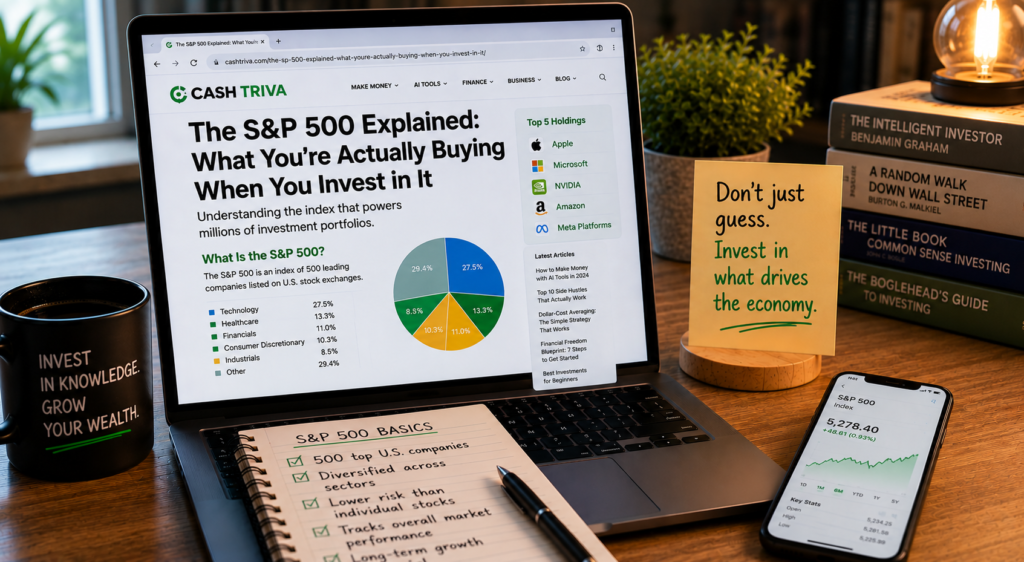
The S&P 500 groups its companies into 11 sectors. The percentage each sector represents shifts over time as companies grow, shrink, get added, or get removed. Here’s an approximate snapshot of how the index has looked in recent years:
Information Technology (~28-32%). The largest sector by a wide margin. Includes Apple, Microsoft, Nvidia, Broadcom, Adobe, Salesforce, Accenture, and dozens of other tech companies. This sector alone drives a disproportionate share of the index’s returns.
Healthcare (~12-14%). UnitedHealth Group, Johnson & Johnson, Eli Lilly, AbbVie, Pfizer, Merck, and Thermo Fisher Scientific are among the largest names. This sector provides defensive stability because healthcare demand persists regardless of economic cycles.
Financials (~11-13%). JPMorgan Chase, Berkshire Hathaway, Bank of America, Visa, Mastercard, and Goldman Sachs. Banks, insurance companies, asset managers, and payment processors. Financial companies are sensitive to interest rates and economic conditions.
Consumer Discretionary (~10-12%). Amazon is the giant here (and yes, Amazon is classified as consumer discretionary, not technology). Tesla, Home Depot, McDonald’s, Nike, and Starbucks are other major members. This sector tends to do well when consumers are confident and spending freely.
Communication Services (~8-9%). Alphabet (Google) and Meta (Facebook) dominate this sector. It used to be called “Telecommunications” and included phone companies. The reclassification in 2018 moved internet and media companies into this group, making it much more tech-adjacent than its name suggests.
Industrials (~8-9%). Caterpillar, Union Pacific, Honeywell, General Electric, Boeing, and Lockheed Martin. Companies that build things, move things, and make things work. This sector tracks closely with economic growth and infrastructure spending.
Consumer Staples (~6-7%). Procter & Gamble, Coca-Cola, PepsiCo, Costco, Walmart, and Philip Morris. Products people buy regardless of economic conditions: food, beverages, household goods, and personal care items. Low growth but high stability.
Energy (~3-5%). ExxonMobil, Chevron, ConocoPhillips, and Schlumberger. This sector’s weighting swings significantly based on oil and gas prices. It was under 3% of the index in 2020 and surged above 5% in 2022 when energy prices spiked.
Utilities (~2-3%). NextEra Energy, Duke Energy, Southern Company. Regulated providers of electricity, gas, and water. Low growth, high dividends, and minimal volatility. Often considered a bond substitute.
Real Estate (~2-3%). REITs like Prologis, American Tower, and Equinix. This sector was carved out of Financials in 2016 and represents companies that own and operate income-producing properties.
Materials (~2-3%). Linde, Air Products, Sherwin-Williams, Freeport-McMoRan. Companies that produce raw materials, chemicals, and packaging. Performance is tied to commodity prices and manufacturing activity.
The distribution of these sectors tells an interesting story. The S&P 500 of today looks nothing like the S&P 500 of 30 years ago. In the mid-1990s, technology was a small piece of the index. Financials, industrials, and energy carried much more weight. The index’s composition has evolved to reflect how the American economy itself has shifted toward technology, digital services, and healthcare.
How the S&P 500 Has Performed Historically
Let’s look at the numbers, because the S&P 500’s track record is what makes it so compelling.
Average annual return since 1957 (when the index expanded to 500 stocks): approximately 10.3% per year, including dividends.
That 10.3% is a long-term average. Individual years vary enormously. Here’s a sample to illustrate the range:
| Year | S&P 500 Return |
|---|---|
| 2008 | -37.0% |
| 2009 | +26.5% |
| 2013 | +32.4% |
| 2018 | -4.4% |
| 2019 | +31.5% |
| 2020 | +18.4% |
| 2022 | -18.1% |
| 2023 | +26.3% |
These swings are severe. In a single calendar year, you might gain 30% or lose 37%. That kind of volatility terrifies people out of the market all the time, and it’s one reason why knowing what you own (and why) matters so much. If you understand the long-term case for the S&P 500, you’re more likely to hold through the painful years.
Some additional context on historical performance:
- The S&P 500 has been positive in roughly 73% of calendar years since its modern inception
- Over every rolling 20-year period in U.S. stock market history, the total stock market has delivered positive returns
- The average bear market (a decline of 20% or more) has lasted approximately 9 to 16 months, while the average bull market has lasted approximately 4 to 5 years
- An investor who put $10,000 into the S&P 500 in 1993 and reinvested all dividends would have over $200,000 thirty years later, without adding another penny
The power of the S&P 500 isn’t any single year. It’s the accumulation of gains over decades, interrupted by painful but temporary declines that ultimately get absorbed by the long-term upward trend.
What You’re Really Betting On
When you invest in the S&P 500, you’re placing a bet. It’s not a bet on any individual company. It’s a bet on a set of ideas:
You’re betting that the U.S. economy will continue to grow over the long term. The S&P 500’s performance is, at its core, a reflection of American corporate profitability. If U.S. companies continue to generate increasing revenues and earnings over decades, the index will rise.
You’re betting that capitalism and innovation will keep working. New companies will emerge, create value, and replace older ones that fade. The index’s self-cleaning mechanism (adding winners, removing losers) means you’re always holding the current leaders of the economy, not yesterday’s.
You’re betting that large, profitable companies will continue to reward shareholders. Through stock price appreciation, dividends, and share buybacks, the S&P 500’s members return hundreds of billions of dollars to investors every year.
You’re betting against the ability of most professional investors to beat this index consistently. And the data overwhelmingly supports this bet. The SPIVA scorecard, published by S&P Global, consistently shows that over 15-year periods, approximately 88% to 92% of actively managed U.S. large-cap funds underperform the S&P 500.
This last point deserves emphasis. When you buy the S&P 500, you’re not accepting “average” performance. You’re accepting a level of performance that beats the vast majority of professionals who spend their careers trying to beat it. That’s a remarkable position for a strategy that requires no skill, no analysis, and about 10 minutes to set up.
How to Actually Invest in the S&P 500
You can’t buy the S&P 500 directly. It’s an index, a mathematical calculation, not a security you can trade. But you can buy funds that track it almost perfectly.
Index Funds (Mutual Funds)
These are mutual funds designed to replicate the S&P 500’s performance. You buy shares at the end of each trading day at the fund’s net asset value (NAV).
Vanguard 500 Index Fund (VFIAX). The granddaddy of index funds. Created by Jack Bogle in 1976, it was the first index fund available to retail investors. Expense ratio: 0.04%. Minimum investment: $3,000.
Fidelity 500 Index Fund (FXAIX). Essentially identical performance to VFIAX. Expense ratio: 0.015%. No minimum investment. Slightly cheaper than Vanguard’s offering.
Schwab S&P 500 Index Fund (SWPPX). Another excellent option. Expense ratio: 0.02%. No minimum investment.
The performance differences between these three funds are negligible. They all track the same index. Choose whichever one is available through your brokerage, and don’t spend more than five minutes on this decision.
ETFs (Exchange-Traded Funds)
ETFs function like index funds but trade on stock exchanges throughout the day, just like individual stocks. You can buy and sell them any time the market is open.
SPDR S&P 500 ETF Trust (SPY). The first and most heavily traded S&P 500 ETF. Launched in 1993. Expense ratio: 0.0945%. It trades millions of shares per day, making it extremely liquid.
Vanguard S&P 500 ETF (VOO). Lower expense ratio than SPY at 0.03%. Slightly less trading volume but more than adequate for any individual investor.
iShares Core S&P 500 ETF (IVV). Expense ratio: 0.03%. Functionally identical to VOO. Pick whichever your brokerage offers with the most favorable terms.
ETF vs. index mutual fund: which should you choose?
For long-term investors making regular contributions, either works. Mutual funds are slightly more convenient for automatic investing because you can set up recurring purchases of exact dollar amounts ($500 per month, for example). ETFs trade at market prices, so you’ll often end up with an odd number of shares. Many brokerages now offer fractional ETF shares, which eliminates this issue.
If you’re investing through a 401(k), you’ll typically have access to an S&P 500 index mutual fund rather than an ETF. Use whatever’s available in your plan.
The expense ratio difference between a fund charging 0.015% and one charging 0.03% is roughly $1.50 per year on a $10,000 investment. Don’t lose sleep over it.
What the S&P 500 Doesn’t Give You
Understanding what the S&P 500 excludes is just as useful as understanding what it includes. If the S&P 500 is your only investment, here are the gaps in your portfolio:
Small-Cap and Mid-Cap U.S. Stocks
The S&P 500 only includes large-cap companies. Roughly 3,500 smaller U.S. companies are left out. Historically, small-cap stocks have delivered slightly higher returns than large-caps over very long periods (the “small-cap premium”), though with significantly more volatility and less consistency.
If you want exposure to the full U.S. market, consider a total stock market fund like Vanguard Total Stock Market ETF (VTI) or Fidelity Total Market Index Fund (FSKAX). These hold the S&P 500 companies plus thousands of smaller ones. The S&P 500 makes up roughly 80% of these total market funds, so the performance is similar, but you get broader coverage.
International Stocks
The S&P 500 is entirely U.S.-focused. It excludes companies based in Europe, Asia, Latin America, and emerging markets. While many S&P 500 companies (Apple, Microsoft, Coca-Cola) generate substantial revenue overseas, owning them is not the same as owning international stocks.
International markets have outperformed U.S. markets during certain decades (the 2000s, for example) and underperformed during others (the 2010s). Holding international stocks alongside the S&P 500 provides diversification that can smooth out returns over very long periods.
Popular international options include Vanguard FTSE All-World ex-U.S. ETF (VEU), Vanguard Total International Stock ETF (VXUS), and iShares Core MSCI International Developed Markets ETF (IDEV).
Bonds
The S&P 500 is 100% stocks. It contains zero bonds, zero cash, and zero fixed-income securities. If you’re within 10 to 15 years of retirement, most financial professionals recommend holding some portion of your portfolio in bonds to reduce volatility and provide stability.
A common starting framework: subtract your age from 110 or 120 to determine your stock allocation. A 30-year-old might hold 80% to 90% stocks and 10% to 20% bonds. A 60-year-old might hold 50% to 60% stocks and 40% to 50% bonds. These are rules of thumb, not laws. Your specific situation matters more than any formula.
Real Assets
The S&P 500 includes REITs and energy companies, which provide some exposure to real assets. But it doesn’t include physical commodities like gold, silver, or agricultural products. Some investors hold a small allocation (5% to 10%) in commodities or commodity-linked funds as an inflation hedge.
The Concentration Risk Nobody Talks About
Here’s a genuinely uncomfortable truth about the modern S&P 500.
As of recent years, the top 10 companies in the index have accounted for approximately 30% to 35% of the total index weight. That’s a level of concentration not seen since the 1970s. And most of those top 10 companies are in related industries: technology, digital advertising, cloud computing, artificial intelligence, e-commerce.
This means the S&P 500, an index that’s supposed to represent the broad U.S. economy, has become increasingly dependent on a narrow group of technology-adjacent giants.
When these companies do well, the S&P 500 looks brilliant. The returns are spectacular. The index beats everything.
When these companies stumble, the S&P 500 can decline even if the majority of its 500 members are performing fine. This played out visibly in 2022, when mega-cap tech stocks fell sharply and dragged the index down, while many value stocks and energy companies had strong years.
What should you do about this?
First, don’t panic. Concentration in the S&P 500 reflects the reality that these are genuinely dominant, profitable companies. The index is doing its job by reflecting the actual structure of the U.S. stock market.
Second, be aware of it. If you hold the S&P 500 and nothing else, you’re more exposed to technology sector risk than you might realize. Adding international stocks, small-cap stocks, or an equal-weight S&P 500 fund (where all 500 companies receive equal weighting regardless of size) can provide a counterbalance.
The Invesco S&P 500 Equal Weight ETF (RSP) gives each company in the index an approximately equal 0.2% weighting. This reduces concentration risk and provides more exposure to mid-size companies within the index. Over some periods, the equal-weight version has outperformed the cap-weighted version, and during others, it has underperformed. It’s a reasonable complement, not a replacement.
The S&P 500 as a Self-Cleaning Machine
One of the most underappreciated features of the S&P 500 is its built-in survival mechanism.
Companies that decline, fail, or become irrelevant get removed from the index. Companies that grow, innovate, and become significant get added.
Kodak, Lehman Brothers, Enron, WorldCom, General Motors (pre-bankruptcy), Sears, and countless other once-dominant companies were part of the S&P 500 at their peak. When they collapsed, they were replaced by companies that were growing and thriving.
This automatic turnover means the S&P 500 is always a snapshot of America’s current corporate leaders, not a static list. You never get stuck holding yesterday’s failures because the index committee removes them.
Consider what the S&P 500 looked like in 2000 versus today:
In 2000, the top companies included General Electric, ExxonMobil, Pfizer, Citigroup, and Walmart. Technology was represented by Microsoft, Intel, Cisco, and a handful of others.
Today, the top spots belong to Apple, Microsoft, Nvidia, Amazon, Alphabet, Meta, and Berkshire Hathaway. Companies that didn’t exist or were tiny in 2000 now sit at the top of the list.
The index adapted. It didn’t require any action from you. If you bought the S&P 500 in 2000 and held it, your investment automatically shifted away from declining companies and toward rising ones through the index’s rebalancing process.
This self-cleaning feature is one of the strongest arguments for long-term index investing. You don’t need to pick winners. The index does it for you, and it charges you almost nothing for the service.
How Often Should You Check Your S&P 500 Investment?
Less than you think.
Serious research backs this up. The more frequently investors check their portfolios, the worse their returns tend to be. Not because checking changes the investment’s performance, but because checking creates emotional responses that lead to bad decisions.
If you check your portfolio daily, you’ll see a loss roughly 46% of the time (the market moves down on close to half of all trading days). If you check monthly, the frequency of seeing a loss drops. If you check annually, you see positive returns roughly 73% of the time. And if you check over 5-year windows, you almost never see negative results.
Same investment. Same returns. But the experience feels radically different depending on how often you look.
A practical schedule for long-term S&P 500 investors:
- Daily: Don’t. Unless watching numbers move on a screen is genuinely entertaining to you, daily checking creates unnecessary anxiety.
- Monthly: Fine for confirming that automatic contributions are processing correctly.
- Quarterly: A good cadence for reviewing your overall financial plan and making sure your allocations still match your goals.
- Annually: Review your total portfolio performance, contribution levels, and any needed rebalancing once per year. This is when to make adjustments, not during a Tuesday afternoon panic triggered by a headline.
The investors who earn the best long-term returns from the S&P 500 are the ones who set up automatic contributions and then largely forget about them. Inaction, in this case, is a strategy.
Common Questions From New S&P 500 Investors
“Is now a good time to invest in the S&P 500?”
This question has been asked every day for the past 70 years, and the answer has always been the same: if your time horizon is 10 years or longer, any day is a reasonable day to start. The risk of investing at a temporary peak is real in the short term, but over long periods, the market’s upward trajectory has overcome every temporary high.
An often-cited study by Schwab examined what would happen if an investor had impossibly bad timing and invested a lump sum at the market’s peak every single year for 20 years. Even this worst-case investor ended up with positive returns, because time in the market overwhelmed the impact of poor entry points.
“Should I invest in the S&P 500 or individual stocks?”
For most people, the S&P 500 should be the foundation. If you want to own individual stocks, a common approach is to put 80% to 90% in index funds and use 10% to 20% for individual stock picks. This way, your core portfolio benefits from the index’s reliability while you scratch the itch of stock picking with a manageable amount.
“Can the S&P 500 go to zero?”
For the S&P 500 to go to zero, every one of the 500 largest American companies would need to simultaneously become worthless. Every bank, every tech company, every hospital system, every retailer, every energy company, all gone. This would require the complete collapse of the U.S. economy, government, legal system, and currency. If that happens, the value of your index fund is the least of your concerns.
“What about the S&P 500 during a recession?”
Recessions cause S&P 500 declines, sometimes severe ones. The 2008 recession saw a drawdown of nearly 57% from peak to trough. The 2020 recession produced a 34% decline (though it recovered within months). These drops are painful but temporary. Every recession in U.S. history has been followed by a recovery that eventually pushed the market to new highs.
If you’re investing regularly through a recession (via dollar-cost averaging), you’re buying shares at discounted prices. Recessions are scary to live through but often turn out to be the periods that generate the strongest future returns for consistent investors.
“Is the S&P 500 better than actively managed funds?”
Statistically, yes. Over 15-year periods, roughly 90% of actively managed large-cap U.S. funds underperform the S&P 500 after fees. Over 20-year periods, the number climbs higher. A small percentage of fund managers do outperform, but identifying them in advance (before they’ve outperformed) has proven nearly impossible. Past outperformance by active managers shows weak correlation with future outperformance.
The S&P 500 wins not because it’s brilliant, but because it’s cheap, consistent, and avoids the human errors that plague active management: overconfidence, herd mentality, excessive trading, and high fees.
The Three-Fund Portfolio: The S&P 500 in Context
The S&P 500 is most powerful when paired with two other investments. This combination, popularized by Vanguard founder Jack Bogle and the Bogleheads community, is called the three-fund portfolio:
- U.S. stock market index fund (S&P 500 or total U.S. market fund)
- International stock market index fund (developed and emerging markets)
- U.S. bond market index fund (for stability and income)
A typical allocation for a younger investor might be:
- 60% U.S. stocks (S&P 500 or total market)
- 25% international stocks
- 15% bonds
For someone approaching retirement:
- 40% U.S. stocks
- 15% international stocks
- 45% bonds
With three funds and an annual 15-minute rebalancing check, you have a globally diversified portfolio that captures the lion’s share of the world’s investable returns, costs nearly nothing in fees, and requires almost zero maintenance.
It’s not the most exciting investment strategy. It’s one of the most effective ones.
A Brief History Worth Knowing
The S&P 500 was launched in its current form on March 4, 1957. Before that, Standard & Poor’s published an index tracking a smaller number of stocks, dating back to 1923.
Here are a few historical moments that shaped the index:
1976: Jack Bogle launches the first retail index fund tracking the S&P 500 at Vanguard. Wall Street called it “Bogle’s folly.” It’s now one of the largest funds on the planet.
1987 (Black Monday): The S&P 500 dropped 20.5% in a single day on October 19, 1987. It remains the largest one-day percentage decline in the index’s history. The market recovered fully within two years.
2000-2002 (Dot-Com Bust): The S&P 500 fell approximately 49% over two and a half years as the technology bubble burst. Companies like Pets.com, Webvan, and dozens of overvalued tech startups collapsed. Solid companies survived, the index recomposed itself, and it reached new highs by 2007.
2008-2009 (Financial Crisis): The worst bear market since the Great Depression. The S&P 500 dropped nearly 57%. Banks failed. Housing markets collapsed. Unemployment surged. The recovery took until 2013 to reach pre-crisis levels, but investors who continued buying throughout the crisis accumulated shares at prices that would never be seen again.
2020 (COVID-19 Crash): A 34% crash in just five weeks, followed by one of the fastest recoveries in history. The S&P 500 reached new all-time highs by August 2020, roughly five months after the crash began.
Pattern to notice: Every single crash, correction, and bear market in the S&P 500’s history has been followed by a full recovery and eventual new highs. The timing varies. The pain varies. But the outcome has been consistent.
Past performance doesn’t guarantee future results. That’s the mandatory disclaimer, and it’s true. But 70 years of data across world wars, oil crises, financial panics, pandemics, political upheavals, and technological disruptions provides a meaningful, if imperfect, basis for long-term optimism.
What to Do With This Information
If you’ve read this far, you know more about the S&P 500 than the majority of people who invest in it. Here’s how to translate that knowledge into action:
If you’re not investing yet: Open a brokerage account or 401(k). Buy an S&P 500 index fund or ETF. Set up automatic contributions. Start with whatever you can afford. The cost of waiting will almost certainly exceed the cost of imperfect timing.
If you already invest in the S&P 500: Check your total portfolio for blind spots. Do you have international exposure? Bonds for stability? Do you understand the concentration in mega-cap tech and how it affects your risk profile?
If you’re tempted to do something complicated: Resist the urge. The evidence is overwhelming: simple, low-cost index investing outperforms sophisticated strategies for the vast majority of people over the vast majority of time periods. Complexity in investing is usually a cost, not a benefit.
If the market is down and you’re nervous: Reread the historical section above. Every crash looks permanent while you’re living through it. None of them have been.
The S&P 500 isn’t perfect. It’s concentrated in a few sectors. It excludes small companies and international markets. It will periodically lose 20%, 30%, or even 50% of its value before recovering.
But it represents ownership in 500 of the most successful companies in the world’s largest economy. It rebalances automatically. It costs almost nothing to own. And it has delivered roughly 10% annual returns across seven decades of chaos, innovation, and change.
You don’t need to find the next Amazon. You already own it, along with 499 of its closest competitors. That’s what you’re buying when you buy the S&P 500.