Wall Street wants you to believe that successful investing is complicated. That you need proprietary algorithms, a team of analysts, and a Bloomberg terminal to build real wealth.
But here’s what decades of data keep proving: a portfolio made up of just three index funds, something you can set up during a lunch break, consistently outperforms the vast majority of professional money managers.
It’s called the 3-fund portfolio. And it might be the most powerful wealth-building tool you’re ignoring.
In this guide, we’ll walk through exactly what a 3-fund portfolio is, how to build one from scratch, how to pick your allocation, and why the math keeps working in its favor year after year.
What Is a 3-Fund Portfolio?
A 3-fund portfolio is an investment strategy that uses just three broad-market index funds to capture the performance of the entire global stock and bond market. That’s it. Three funds. Full global diversification.
The three components are:
- A U.S. total stock market index fund — gives you exposure to thousands of American companies, from massive blue chips to smaller growth stocks.
- An international stock market index fund — covers developed and emerging markets outside the U.S., spreading your risk across global economies.
- A U.S. bond market index fund — adds stability and income, acting as a buffer when stocks drop.
This approach was popularized by John Bogle, the founder of Vanguard and the person who created the first index fund available to individual investors. The strategy has since become a cornerstone of the Bogleheads investing community, a group of investors who follow Bogle’s principles of low-cost, long-term, diversified investing.
The philosophy is straightforward: own a slice of every publicly traded company on the planet, add some bonds for stability, keep costs near zero, and let time do the heavy lifting.
Why Only Three Funds?
At first glance, three funds might feel too simple. Shouldn’t a “real” portfolio have 15 or 20 holdings? Sector ETFs? Maybe some commodities?
Not necessarily. And here’s why.
Diversification has a ceiling. Research from financial economists, including the landmark work by Burton Malkiel and others, shows that adding holdings beyond broad-market index coverage produces diminishing returns in terms of risk reduction. A U.S. total stock market fund already holds over 3,000 stocks. An international fund adds thousands more. At that point, layering in additional niche funds adds complexity without meaningfully reducing risk.
Simplicity reduces mistakes. Behavioral finance research consistently shows that the more moving parts a portfolio has, the more likely an investor is to tinker, panic-sell, or chase performance. A 3-fund portfolio gives you less to second-guess, which means fewer opportunities to sabotage your own returns.
Costs stay minimal. Each additional fund comes with its own expense ratio, trading costs, and tax implications. Three broad-market index funds can be held for expense ratios below 0.10% combined, often as low as 0.03% to 0.05% per fund. That’s pennies on the dollar compared to the 1% or more charged by most actively managed funds.
The Funds You Need (With Real Examples)
Let’s get specific. Here are the actual funds most commonly used to build a 3-fund portfolio, depending on your brokerage.
If You Use Vanguard
| Fund | Ticker | Expense Ratio |
|---|---|---|
| Vanguard Total Stock Market Index Fund | VTSAX / VTI | 0.03% |
| Vanguard Total International Stock Index Fund | VTIAX / VXUS | 0.07% |
| Vanguard Total Bond Market Index Fund | VBTLX / BND | 0.03% |
If You Use Fidelity
| Fund | Ticker | Expense Ratio |
|---|---|---|
| Fidelity Total Market Index Fund | FSKAX | 0.015% |
| Fidelity International Index Fund | FSPSX | 0.035% |
| Fidelity U.S. Bond Index Fund | FXNAX | 0.025% |
If You Use Schwab
| Fund | Ticker | Expense Ratio |
|---|---|---|
| Schwab Total Stock Market Index Fund | SWTSX | 0.03% |
| Schwab International Index Fund | SWISX | 0.06% |
| Schwab U.S. Aggregate Bond Index Fund | SWAGX | 0.04% |
All three brokerages offer these funds with zero transaction fees and near-zero expense ratios. The differences between providers are minimal, so pick whichever brokerage you already use or prefer.
How to Choose Your Allocation
Building the portfolio is one thing. Deciding how much to put in each fund is where the real decision-making happens. Your allocation should reflect two factors: your age and your risk tolerance.
A Starting Framework
A commonly cited rule of thumb is to hold your age in bonds. If you’re 30, that means 30% bonds and 70% stocks. If you’re 50, it’s 50/50.
That said, many modern financial planners argue this rule is too conservative, especially for younger investors with decades until retirement. A more aggressive (and increasingly popular) approach looks like this:
For investors in their 20s and 30s:
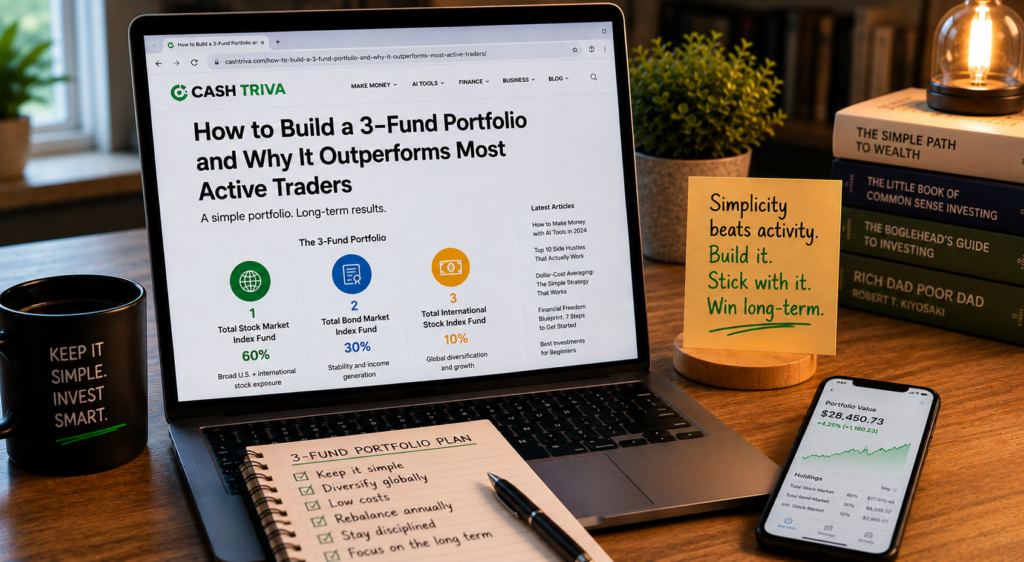
- 60% U.S. total stock market
- 30% International stock market
- 10% Bonds
For investors in their 40s and 50s:
- 45% U.S. total stock market
- 25% International stock market
- 30% Bonds
For investors near or in retirement:
- 30% U.S. total stock market
- 15% International stock market
- 55% Bonds
These aren’t rigid rules. They’re starting points you can adjust based on your personal comfort with volatility. If watching your portfolio drop 30% in a bear market would keep you up at night, increase your bond allocation. If you can stomach short-term losses and have decades ahead, lean heavier into stocks.
The U.S. vs. International Stock Split
One of the most debated decisions within the 3-fund community is how to split your stock allocation between U.S. and international funds.
The global stock market capitalization is roughly 60% U.S. and 40% international. A “market weight” approach would mirror that ratio. Many investors, including Vanguard’s own guidance, suggest putting 20% to 40% of your stock allocation into international funds.
There’s no objectively correct answer here. U.S. stocks have outperformed international stocks over the past decade, which tempts investors to skip international exposure entirely. But the previous decade told the opposite story, with international stocks leading the way. Holding both means you’re covered regardless of which region leads next.
Step-by-Step: Setting Up Your 3-Fund Portfolio
Here’s how to get this done in under an hour.
Step 1: Open a brokerage account. If you don’t have one, open an account at Vanguard, Fidelity, or Schwab. If your employer offers a 401(k), check if similar index fund options are available there first.
Step 2: Decide your allocation. Use the age-based frameworks above as a starting point. Write down the percentage you want in each of the three funds.
Step 3: Buy the three funds. Search for the ticker symbols listed above (or the equivalent at your brokerage), enter the dollar amount for each, and place the order. If buying mutual funds, you can invest exact dollar amounts. If buying ETFs, you’ll buy whole shares and invest any remainder later.
Step 4: Set up automatic contributions. Most brokerages let you automate regular purchases. Set a monthly or per-paycheck contribution schedule so your portfolio grows without you having to remember.
Step 5: Rebalance once or twice a year. Over time, your allocation will drift as different assets grow at different rates. Once or twice a year, check your percentages and move money between funds to get back to your target allocation.
That’s the entire process. No stock screeners. No technical analysis. No watching CNBC at 6 a.m.
Why the 3-Fund Portfolio Beats Most Active Traders
This is where the data gets hard to argue with.
The SPIVA Scorecard Tells the Full Story
Standard & Poor’s publishes a twice-yearly report called the SPIVA (S&P Indices Versus Active) Scorecard. It measures how actively managed funds perform against their benchmark index. The results are consistent and damning for active management:
- Over a 15-year period, roughly 87% to 92% of U.S. large-cap active fund managers fail to beat the S&P 500.
- The numbers are even worse for international and small-cap categories.
- The small minority who do outperform in one period rarely repeat that performance in the next.
When you buy a total stock market index fund, you’re buying the benchmark itself. You don’t need to beat the market. You are the market. And that turns out to be enough to outperform the overwhelming majority of professionals trying to do better.
The Cost Advantage Is Massive Over Time
Let’s run the math on how fees compound.
Imagine you invest $10,000 per year for 30 years, earning an average return of 8% annually before fees.
- With a 0.04% expense ratio (typical index fund): Your portfolio grows to approximately $1,220,000.
- With a 1.00% expense ratio (typical active fund): Your portfolio grows to approximately $1,010,000.
That’s a difference of over $200,000 lost to fees alone. And that’s assuming the active fund matches the index return before fees, which, as SPIVA shows, most don’t.
The fee drag isn’t something you feel in any single year. A 1% fee barely registers on a statement. But compounded over decades, it quietly siphons off a meaningful chunk of your wealth.
Behavioral Advantages Are Underrated
Active trading doesn’t just cost more in fees. It costs more in bad decisions.
Research from Dalbar, a financial research firm, shows that the average equity investor significantly underperforms the market over long time periods. The reason isn’t that people pick bad stocks (though that happens). It’s that they buy high and sell low, driven by emotion.
They pour money into tech stocks after a rally. They sell everything during a crash. They chase last year’s top-performing fund. Each move chips away at returns.
A 3-fund portfolio, by design, gives you very little to react to. There’s no hot stock to chase. No sector bet to second-guess. The boring structure becomes a behavioral shield against your own worst instincts.
Tax Efficiency Adds Another Edge
Index funds generate fewer taxable events than actively managed funds. Because an index fund only buys and sells when the underlying index changes (which happens infrequently), it produces fewer capital gains distributions. Active funds, which trade frequently, often pass along short-term capital gains to shareholders, triggering higher tax bills.
In taxable accounts, this difference matters. Over time, the tax efficiency of index funds can add another 0.5% to 1.0% in annual after-tax returns compared to similar active strategies.
Common Objections (and Honest Answers)
“Isn’t this too simple to actually work?”
Simplicity is the feature, not the bug. The complexity of a strategy has zero correlation with its returns. In fact, the data points in the opposite direction: simpler, lower-cost strategies tend to outperform complex ones over time.
“What about sector funds, REITs, or commodities?”
You can add these if you want. Some investors include a small REIT (real estate investment trust) allocation as a fourth fund. Others tilt toward small-cap value stocks. But these are refinements, not requirements. The core 3-fund portfolio already captures the bulk of global market returns, and adding complexity comes with tradeoffs in cost and behavioral risk.
“What if the U.S. market crashes?”
It will. Multiple times during your investing lifetime. The S&P 500 has experienced drawdowns of 30% or more roughly once per decade. But it has recovered from every single one of them. Your bond allocation provides a cushion during these periods, and your international allocation adds geographic diversification. The key is to keep contributing through downturns, buying more shares at lower prices.
“Should I do this in a 401(k), IRA, or taxable account?”
All three, if possible. Start with tax-advantaged accounts (401(k) and IRA) to maximize tax-deferred or tax-free growth. If your 401(k) doesn’t offer exact total-market index funds, pick the closest equivalents (often an S&P 500 fund and an international fund are available). Use a taxable brokerage account for anything beyond your tax-advantaged contribution limits.
“Can I just use a target-date fund instead?”
Target-date funds are actually built on the same principle. Most contain a mix of domestic stocks, international stocks, and bonds, automatically adjusting the allocation as you approach retirement. The tradeoff is slightly higher expense ratios (typically 0.10% to 0.15%) and less control over your exact allocation. If you want something truly hands-off, a target-date fund is a reasonable alternative. If you want maximum control and the lowest possible costs, the 3-fund approach wins.
Real-World Performance: A Historical Look
Let’s look at how a simple 60/30/10 (U.S. stocks / international stocks / bonds) portfolio has performed over different time periods, assuming annual rebalancing:
- Over the last 10 years (approximately 2016–2025): Average annual return in the range of 8–10%, driven largely by strong U.S. stock performance.
- Over the last 20 years (approximately 2006–2025): Average annual return in the range of 7–8%, which includes the 2008 financial crisis and the 2020 pandemic crash. Both were fully recovered within a few years.
- Over the last 30 years (approximately 1996–2025): Average annual return in the range of 7–9%, spanning the dot-com bust, the Great Recession, and multiple recoveries.
These returns came with minimal effort. No research. No stock picking. No market timing. Just steady contributions and periodic rebalancing.
Compare that to the average active trader. Studies consistently show that day traders and frequent traders lose money over time, with one notable study from the University of California finding that the most active traders underperformed by an average of 6.5 percentage points per year compared to the market.
How to Maintain Your 3-Fund Portfolio Over Time
Building the portfolio is step one. Maintaining it is where long-term wealth is actually built.
Rebalancing
Once or twice a year, check your allocation percentages. If U.S. stocks have surged and now represent 70% of your portfolio instead of your target 60%, sell some U.S. stock fund shares and buy bonds or international funds to get back to your target. Many brokerages offer automatic rebalancing tools.
An even simpler approach: direct your new contributions into whichever fund is currently underweight. This avoids selling (and potential tax consequences) while still keeping your allocation on track.
Adjusting Over Time
As you age, gradually increase your bond allocation to reduce volatility. A common approach is to increase bonds by 5% every five to ten years. There’s no need to make dramatic shifts. Small, gradual adjustments keep your portfolio aligned with your changing risk tolerance.
Staying the Course
This is the hardest part. During a market crash, every instinct will tell you to sell. During a bull market, you’ll be tempted to go all-in on stocks or chase individual winners. The entire value of the 3-fund strategy depends on your ability to stick with it through both extremes.
Write down your investment plan. Put it somewhere you’ll see it during turbulent markets. Having a written plan dramatically increases the likelihood you’ll follow through.
Who Should Use a 3-Fund Portfolio?
This strategy works well for:
- Beginners who want a proven, simple starting point
- Busy professionals who don’t have time to research individual stocks
- Experienced investors who’ve seen the data on active management and want to stop fighting the odds
- Retirees who want a low-maintenance, low-cost portfolio they can draw from predictably
- Anyone who believes their time is better spent on their career, family, or life than on stock picking
The only people this might not suit are those who genuinely enjoy active trading as a hobby and are comfortable with the statistical likelihood of underperformance. If trading brings you satisfaction independent of returns, that’s a valid personal choice. Just go in with eyes open about the expected outcomes.
The Bottom Line
The 3-fund portfolio works because it aligns with how markets actually behave, not how we wish they’d behave. It captures broad market returns, minimizes costs, reduces emotional decision-making, and has decades of data supporting its effectiveness.
You don’t need to be smarter than Wall Street. You don’t need insider knowledge or proprietary tools. You need three funds, a consistent contribution schedule, and the patience to let compounding do its work.
The simplest portfolio in the room keeps winning. And it probably will for a long time.