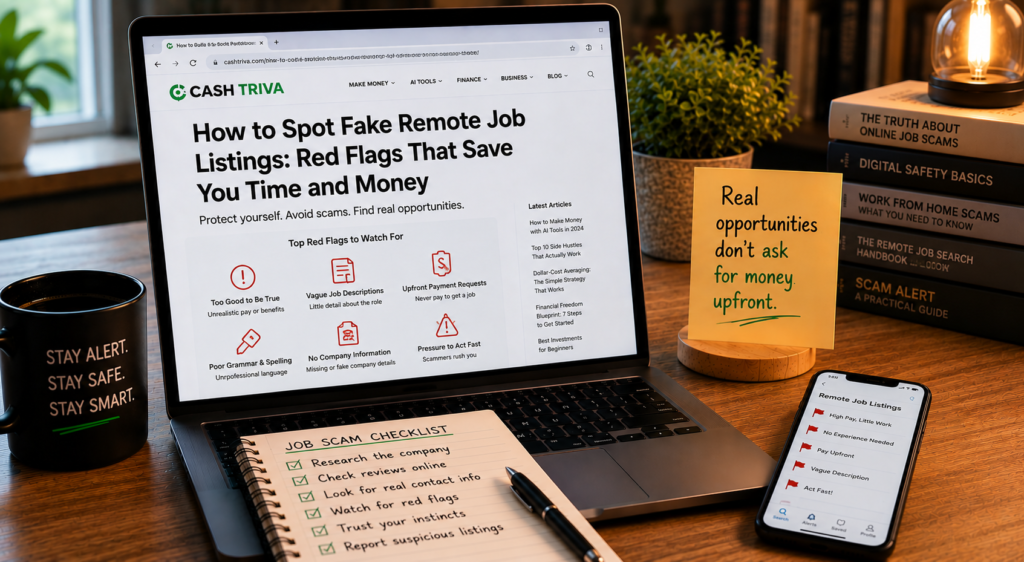
The remote job market exploded over the past few years. Millions of people now search for work-from-home positions every month, and scammers have noticed. The FBI’s Internet Crime Complaint Center reported that employment scams cost victims over $367 million in 2023 alone, and the numbers keep climbing.
Here’s what makes remote job scams so effective: they look real. Polished logos, professional-sounding descriptions, and promises that line up perfectly with what you want to hear. The difference between a legitimate listing and a fraudulent one can be subtle, but once you know what to look for, the patterns become obvious.
This guide breaks down every major red flag, gives you practical steps to verify any listing, and shows you where to find real remote positions you can trust.
Why Fake Remote Job Listings Are So Common Right Now
Remote work created a perfect environment for scammers. Job seekers can’t walk into an office, shake hands with a hiring manager, or see the company firsthand. Everything happens through screens, emails, and messaging apps, which makes it easier for bad actors to hide behind fake identities.
Several factors drive the rise in fraudulent listings:
- High demand, low barrier. Millions of people actively search for remote work, giving scammers a massive pool of targets.
- Low cost to operate. Creating a fake job listing costs nothing. Scammers can post on free job boards, set up fake websites in hours, and use stolen company branding.
- Geographic distance. Victims and scammers are rarely in the same city, state, or even country, making prosecution difficult.
- Emotional vulnerability. People who need work are more likely to overlook warning signs, especially if the “opportunity” sounds too good to pass up.
Understanding why these scams exist helps you approach every listing with the right mindset: cautious optimism, not blind trust.
The 12 Biggest Red Flags in Fake Remote Job Listings
1. The Pay Is Unrealistically High for the Role
A data entry position paying $45 per hour. A customer service role offering $90,000 a year with no experience required. A part-time “assistant” gig promising $5,000 a month for 10 hours of work per week.
If the compensation seems wildly out of step with industry standards, pause. Scammers inflate pay to short-circuit your critical thinking. The excitement of a high salary makes you less likely to question other details.
What to do: Research salary ranges on Glassdoor, PayScale, or the Bureau of Labor Statistics. If the listed pay is 50% or more above the market average for that role and experience level, treat it as a warning sign.
2. The Job Description Is Vague or Copy-Pasted
Legitimate employers spend time writing specific, detailed job descriptions. They outline exact responsibilities, required skills, reporting structure, and team context. Fake listings tend to be either painfully vague or stuffed with generic buzzwords that could apply to any position.
Watch for descriptions that:
- Use broad phrases like “various administrative tasks” without specifics
- Don’t mention the tools, software, or platforms you’d actually use
- Read like they were pulled from a template or another company’s posting
- Contain inconsistent formatting, suggesting the text was copied from multiple sources
3. The Company Has No Verifiable Online Presence
Every legitimate company leaves a digital footprint. A website with real content. LinkedIn profiles for employees. Reviews on Glassdoor or Indeed. Social media accounts with actual engagement.
If you can’t find any of this, that’s a problem. If the company website was registered last month, has stock photos on every page, and lists a generic Gmail address as the contact, you’re likely looking at a front.
Quick verification steps:
- Search the company name plus “reviews” or “scam”
- Check the website’s domain age using a WHOIS lookup tool
- Look for the company on LinkedIn and count how many employees list it as their workplace
- Verify the physical address (if listed) using Google Maps
4. They Contact You First, Out of Nowhere
You didn’t apply anywhere. You didn’t submit your resume. But suddenly, a recruiter reaches out on WhatsApp, Telegram, or through a random email saying they “found your profile” and have the perfect opportunity for you.
While legitimate recruiters do reach out proactively, they typically do so through LinkedIn, established recruiting platforms, or professional email addresses with company domains. Unsolicited messages through personal messaging apps, especially from people you’ve never interacted with, are a major red flag.
Pay close attention to how they found you. A real recruiter can name the specific platform where they saw your profile and reference details from your actual experience. A scammer speaks in generalities.
5. The Interview Process Is Unusual or Non-Existent
Real companies interview candidates. They schedule video calls, ask about your experience, test your skills, and check references. The process takes days or weeks, sometimes longer.
Scam operations do the opposite. They might:
- “Hire” you after a single text-based chat
- Conduct the entire interview over instant messaging with no video or voice call
- Skip the interview entirely and send you an offer letter immediately
- Ask you to interview through an unfamiliar, obscure platform (not Zoom, Google Meet, Microsoft Teams, or other standard tools)
If someone offers you a job after a 15-minute chat on Telegram, that’s not a fast-moving company. That’s a scam.
6. They Ask for Money Upfront
This is the clearest red flag of all, and the one that still catches people off guard. No legitimate employer will ever ask you to pay for:
- Training materials or certification courses
- Background checks or drug tests
- Equipment or software before your start date
- “Processing fees” for your application or onboarding
- A “starter kit” or “business package”
The cost of hiring is the employer’s responsibility, not yours. If money is flowing from you to them before you’ve earned a paycheck, walk away immediately.
7. They Request Sensitive Personal Information Too Early
A real hiring process collects your Social Security number, bank details, and copies of your ID after you’ve been formally hired, during official onboarding. Not before your first interview. Not as part of your application.
Scammers ask for this information early because that’s the whole point. They’re not hiring you. They’re harvesting your data for identity theft.
Be suspicious if they request any of the following before you’ve signed a legitimate offer letter:
- Social Security or national ID numbers
- Bank account or routing numbers
- Copies of your driver’s license or passport
- Credit card information for any reason
- Login credentials to any existing accounts
8. Communication Feels Off
The emails come from a Gmail or Yahoo address, not a company domain. The “recruiter” writes with poor grammar, inconsistent formatting, or an oddly formal tone that doesn’t match American or British business communication norms. They’re available at strange hours but hard to reach during normal business times.
Other communication red flags include:
- Pressure to respond or decide quickly (“This position will be filled by tomorrow”)
- Refusal to speak on the phone or video call
- Switching between different email addresses or messaging platforms
- Using a personal account on a messaging app instead of a company communication tool
9. The Job Posting Appears on Suspicious Platforms
Legitimate remote positions show up on established job boards like LinkedIn, Indeed, FlexJobs, We Work Remotely, and company career pages. They can sometimes appear on Craigslist or social media, but those channels carry higher risk.
Be extra cautious with listings that:
- Appear only on Craigslist or Facebook Marketplace
- Come through direct messages on social media
- Are posted in random online forums or comment sections
- Link to websites you’ve never heard of with no reviews or reputation
10. The Company Name Is Slightly Different from a Real One
This is a tactic called “brandjacking.” Scammers create job listings using names that are almost identical to well-known companies. Think “Amaz0n” instead of “Amazon,” or “Gooogle” instead of “Google.” They might use the real company’s logo and branding while operating from a completely unrelated domain.
Always verify by going directly to the company’s official website and checking their careers page. If the job isn’t listed there, contact the company’s HR department to confirm whether the listing is real.
11. The Role Has No Clear Reporting Structure
Who would you report to? What team would you join? Who’s the hiring manager? Legitimate job postings answer at least some of these questions. They give you enough context to understand where you’d fit within the organization.
Fake listings skip this entirely. They describe a role that seems to exist in a vacuum, with no mention of managers, teammates, or departments. When you ask about the team structure, the responses are evasive or generic.
12. The Offer Comes with Unreasonable Urgency
“We need you to start Monday.” “This offer expires in 24 hours.” “We’re filling this position today, so please confirm immediately.”
Urgency is a manipulation tactic. It pushes you to act before you’ve had time to research, verify, or think critically. Real employers understand that accepting a job is a significant decision. They give you reasonable time to review offer letters, ask questions, and make an informed choice.
Types of Remote Job Scams You Should Know About
Understanding the different scam models helps you recognize them faster.
The Equipment Scam
You’re “hired” and told the company will send you a laptop and equipment. They mail you a check to deposit, then ask you to purchase the equipment from a “preferred vendor.” The check bounces days later, and you’re out hundreds or thousands of dollars.
The Reshipping Scam
You’re hired as a “warehouse coordinator” or “shipping logistics assistant” working from home. The job involves receiving packages at your address and forwarding them elsewhere. What you’re actually doing is laundering stolen goods, which makes you legally liable.
The Data Harvesting Scam
There’s no job at all. The entire listing exists to collect personal information (names, addresses, Social Security numbers, bank details) for identity theft. The “application” or “onboarding” process is the scam itself.
The Fake Check Scam
Similar to the equipment scam, you receive a check for “supplies,” “training,” or “business expenses.” You deposit it, send a portion of the money somewhere via wire transfer or gift cards, and the check bounces. You owe the bank the full amount.
The Pyramid/MLM Disguised as a Job
The listing looks like a normal remote job, but once you apply, you discover it’s a multi-level marketing opportunity. You’re expected to buy products, recruit others, and “build your business.” The language shifts from “employee” to “independent contractor” or “business owner” fast.
How to Verify a Remote Job Listing Step by Step
When you find a listing that interests you, run through this verification checklist before investing serious time in the application.
Step 1: Research the company independently. Don’t rely on links provided in the job listing. Type the company name directly into your browser and find their official website. Check their careers page for the specific position.
Step 2: Look up the recruiter or hiring manager. Search their name on LinkedIn. Do they have a complete profile with connections, endorsements, and a work history that matches the company? Can you find other employees at the same company who seem like real people?
Step 3: Cross-reference the listing. Is the same position posted on the company’s official careers page? Does it appear on reputable job boards? If it only exists in one obscure location, be cautious.
Step 4: Check reviews and complaints. Search for the company name alongside words like “scam,” “review,” “complaint,” or “fraud.” Check the Better Business Bureau, Trustpilot, and Glassdoor.
Step 5: Verify the email domain. If you receive communication from the company, check the sender’s email address. Legitimate companies use their own domain (name@company.com), not free email services.
Step 6: Ask direct questions. During any communication, ask specific questions about the role, team, and company. Scammers struggle with details because the job doesn’t actually exist. Ask about the tech stack, team size, who you’d report to, and what a typical day looks like.
Step 7: Trust your instincts. If something feels wrong, it probably is. No legitimate job opportunity will fall apart because you took an extra day to verify it.
Where to Find Legitimate Remote Jobs
Sticking to reputable platforms dramatically reduces your risk. Here are the most trusted sources for real remote work:
- LinkedIn Jobs — Verified company profiles and recruiter identities
- Indeed — Large database with company reviews and salary data
- FlexJobs — Hand-screened listings; every posting is vetted by their team (paid subscription)
- We Work Remotely — One of the largest remote-only job boards
- Remote.co — Curated remote positions across industries
- AngelList/Wellfound — Startup-focused with transparent salary and equity information
- Company career pages — Going directly to companies you admire is always the safest route
What to Do If You’ve Been Scammed
If you suspect you’ve fallen victim to a fake job listing, take these steps immediately:
- Stop all communication with the scammer. Don’t respond to follow-up messages.
- Document everything. Save emails, chat logs, job listings, and any other evidence.
- Report the scam to the FTC at ReportFraud.ftc.gov and to the FBI’s IC3 at ic3.gov.
- Alert the job board where you found the listing so they can remove it.
- Contact your bank if you shared financial information or deposited a suspicious check.
- Place a fraud alert on your credit reports through Equifax, Experian, or TransUnion if you shared your Social Security number or other identity documents.
- Monitor your accounts closely for unauthorized activity over the following months.
Protecting Yourself Long-Term
Building good habits around your job search keeps you safe beyond any single listing.
Keep your resume public information only. Your resume should include your name, city (not full address), email, phone number, and work history. Never put your Social Security number, date of birth, or bank information on a resume.
Use a dedicated email for job searching. This keeps potential spam and phishing attempts away from your primary inbox and makes it easier to spot suspicious messages.
Set up Google Alerts for your name. If your personal information is being misused, you may catch it early through mentions online.
Update your passwords regularly and use two-factor authentication on every account, especially email and banking.
Talk to other remote workers. Online communities on Reddit (r/remotework, r/workonline), Discord servers, and professional Slack groups are great places to ask about companies and share experiences with specific listings.
The Bottom Line
Fake remote job listings are getting more sophisticated, but they still follow predictable patterns. Unrealistic pay, vague descriptions, upfront fees, rushed timelines, and requests for personal data before a formal offer are the warning signs that matter most.
Take an extra 15 minutes to verify any listing before you apply. Check the company’s website, look up the recruiter, cross-reference the posting, and ask pointed questions. That small investment of time protects your money, your identity, and your peace of mind.
The right remote job is out there. Approaching your search with informed skepticism doesn’t slow you down. It makes sure you’re spending your energy on real opportunities with real companies that actually want to hire you.