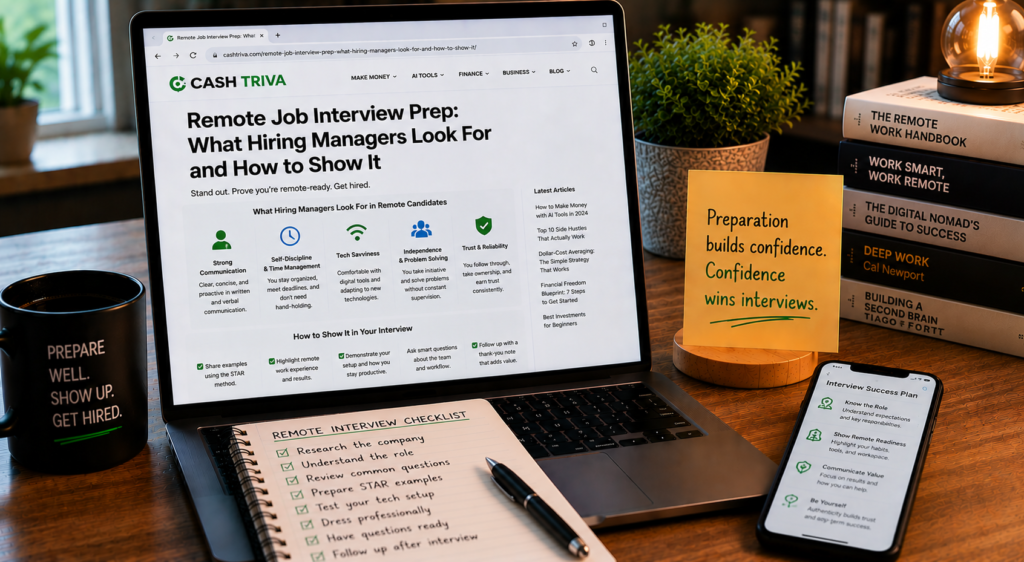
You made it past the resume screen. The recruiter liked what they saw. Now you’re staring at a calendar invite for a video interview, and the pressure is real.
Remote interviews come with their own set of rules. The skills that make someone great on camera don’t always match what works in a conference room. Hiring managers know this, and they’re watching for specific signals that tell them whether you can thrive in a distributed work environment, or whether you’ll struggle without someone looking over your shoulder.
This guide breaks down what those signals are, why they matter, and how to make sure you’re sending the right ones before, during, and after your remote interview.
The Remote Interview Is a Different Game
A few years ago, remote interviews were a backup plan. Today, they’re the default for thousands of companies. And hiring managers have gotten very good at reading candidates through a screen.
That means the bar has shifted. It’s no longer enough to answer questions well. Hiring managers are evaluating how you handle the remote format itself. Your tech setup, your communication clarity, your ability to stay engaged without physical proximity: all of it matters.
Think of it this way. The interview isn’t just about proving you can do the job. It’s about proving you can do the job remotely.
What Hiring Managers Actually Evaluate (Beyond Your Resume)
Let’s get specific. Here are the core areas hiring managers pay attention to during a remote interview, ranked by how often they come up in post-interview debriefs.
1. Communication Clarity
This is the number one thing remote hiring managers care about. In a distributed team, almost everything happens through written messages, video calls, and async updates. If you can’t communicate clearly in a 45-minute interview, that’s a red flag for how you’ll perform day to day.
What they’re watching for:
- Do you answer questions directly, or do you ramble and circle back?
- Can you explain complex ideas in simple terms?
- Do you pause and think before responding, or do you fill every silence with filler words?
- Are you concise without being vague?
How to show it:
Use the “headline first” approach. Start with your main point, then add context. If someone asks why you left your last role, don’t start with a five-minute backstory. Lead with the reason, then fill in the details if they ask follow-up questions.
Practice answering common interview questions out loud, on camera. Record yourself. Watch it back. You’ll catch habits you didn’t know you had: trailing off at the end of sentences, saying “um” every few seconds, or burying your answer inside a long story.
2. Technical Readiness
Nothing kills a first impression faster than a frozen screen, a dead microphone, or five minutes of “Can you hear me now?” at the start of an interview.
Hiring managers interpret tech problems as a preview of your remote work habits. Fair or not, a candidate who shows up with a spotty connection and bad lighting feels less prepared than someone with a clean setup.
What they’re watching for:
- Stable internet connection with minimal lag
- Working camera and microphone (external mics are a plus)
- Good lighting (natural light or a ring light facing you, not behind you)
- A clean, non-distracting background
- Familiarity with the video platform (Zoom, Google Meet, Microsoft Teams)
How to show it:
Test everything 24 hours before the interview, not 10 minutes before. Join a test call with a friend. Check your audio levels, your camera angle, and your background. Make sure your laptop is plugged in so it doesn’t die mid-conversation.
If you’re using a platform you’ve never used before, download it early and explore the interface. Know where the mute button is, how to share your screen, and how to use the chat function. These small details signal that you take preparation seriously.
3. Self-Direction and Ownership
Remote teams run on trust. Managers can’t walk by your desk to see if you’re working. They need to know you’ll take ownership of your tasks, flag problems early, and push projects forward without constant check-ins.
What they’re watching for:
- Examples of times you worked independently and delivered results
- How you handle ambiguity or unclear instructions
- Whether you wait for direction or take initiative
- How you prioritize when no one is telling you what to do next
How to show it:
Prepare two or three stories where you drove a project forward without being told exactly what to do. Use the STAR format (Situation, Task, Action, Result) to keep your answers tight. Focus on what you did, not what the team did.
For example: “At my last company, we had a client onboarding process that took three weeks. I mapped out the bottlenecks, proposed a streamlined workflow to my manager, and implemented it over two sprints. We cut onboarding time down to nine days.”
That kind of answer tells a hiring manager you don’t need hand-holding.
4. Async Communication Skills
This one catches a lot of candidates off guard. Remote companies rely heavily on asynchronous communication: Slack messages, Loom videos, Notion docs, email threads. The ability to communicate clearly without a real-time conversation is a skill, and hiring managers are looking for it.
What they’re watching for:
- Whether your written follow-up emails are clear and well-structured
- How you handle the “any questions?” portion (do you ask thoughtful, well-prepared questions?)
- Whether you over-explain or under-explain when answering behavioral questions
- Your comfort level with documenting your thoughts
How to show it:
After the interview, send a follow-up email that’s specific, not generic. Reference something you discussed, add a thought you didn’t get to share during the conversation, and keep it under 150 words. That email is a writing sample whether you realize it or not.
During the interview, if you’re asked to walk through a project, structure your answer like a written brief: background, your role, what you did, what happened, what you learned. That kind of organized thinking translates directly to async work.
5. Cultural Fit for Remote Work
“Cultural fit” is a loaded term, but in the context of remote teams, it has a specific meaning. Hiring managers want to know if you’ll thrive without an office, or if you’ll feel isolated and disconnected within three months.
What they’re watching for:
- How you talk about remote work (genuine enthusiasm vs. “I guess it’s fine”)
- Whether you’ve thought about how you’ll build relationships with teammates you’ve never met in person
- Your strategies for staying focused and avoiding burnout at home
- How you handle loneliness or the lack of in-person interaction
How to show it:
Be honest about your experience with remote work, but frame it around what you’ve learned. If you’ve worked remotely before, talk about the systems you’ve built: your daily routine, how you separate work from personal time, how you stay connected with teammates.
If you’re new to remote work, show that you’ve done your homework. Mention specific tools you’ve researched, routines you plan to build, or strategies you’ve read about. Hiring managers don’t expect perfection. They expect intentionality.
6. Adaptability and Problem-Solving
Remote work throws curveballs. A client’s timezone is 12 hours ahead of yours. A critical tool goes down during a deadline. A teammate misinterprets your Slack message and runs with the wrong approach for two days.
Hiring managers want to see that you can adapt quickly and solve problems without escalating everything.
What they’re watching for:
- How you’ve handled unexpected challenges in past roles
- Whether you stay calm under pressure or get flustered
- Your ability to adjust your approach when something isn’t working
- How you deal with miscommunication (which happens more often in remote settings)
How to show it:
Prepare a story about a time something went wrong and you fixed it. The best answers follow this pattern: here’s what happened, here’s what I did, here’s what I learned, and here’s what I’d do differently next time. That last part is gold. It shows self-awareness, which is one of the hardest qualities to fake.
The 30-Minute Prep Checklist (Do This Before Every Remote Interview)
Here’s a practical checklist you can run through before any remote interview. Print it out or save it to your phone.
24 hours before:
- Research the company’s remote work culture (check their careers page, Glassdoor reviews, and any blog posts about their distributed team)
- Prepare five questions to ask the interviewer (at least two should be about how the team works remotely)
- Test your internet speed (aim for at least 10 Mbps upload)
- Charge all devices and have a backup plan (phone hotspot, a nearby café with Wi-Fi)
- Lay out what you’ll wear (yes, the full outfit, not just the top half)
One hour before:
- Close unnecessary browser tabs and applications to free up bandwidth
- Silence your phone and any smart home devices
- Check your background and lighting
- Fill a water glass and keep it nearby
- Review your notes on the company and the role
Five minutes before:
- Join the call early (but stay in the waiting room if there is one)
- Do a final mic and camera check
- Take three deep breaths
- Smile before the interviewer appears on screen (it changes your tone)
Common Remote Interview Mistakes (and How to Avoid Them)
Even strong candidates make these errors. Here’s what to watch out for.
Looking at yourself instead of the camera. When you look at your own video feed or even the interviewer’s face on screen, it looks like you’re avoiding eye contact. Train yourself to look at the camera lens when you’re speaking. It feels unnatural, but it creates the impression of direct eye contact on the other end.
Talking too long. Without the physical cues of an in-person conversation (leaning back, glancing at a clock), it’s easy to lose track of time. Keep your answers between 60 and 90 seconds for standard questions, and two to three minutes for behavioral questions. If you’re not sure, ask: “Would you like me to go deeper on that?”
Ignoring the chat function. Some interviewers will drop links, share context, or ask follow-up questions in the chat. Keep the chat window visible so you don’t miss anything.
Not having a backup plan. If your internet drops, what do you do? Have the interviewer’s email address or phone number ready. If something goes wrong, send a quick message within 60 seconds: “My connection dropped. Reconnecting now.” That kind of responsiveness makes a strong impression even in a bad situation.
Forgetting to ask questions. The “do you have any questions for me?” portion isn’t a formality. It’s an evaluation. Hiring managers notice when candidates ask generic questions (“What’s the company culture like?”) versus specific ones (“I saw your team uses two-week sprints. How do you handle scope changes mid-sprint?”). Do your research and come prepared.
Questions You Should Be Ready to Answer
Remote interviews tend to include a mix of standard behavioral questions and remote-specific ones. Here are the ones that come up most often, along with what hiring managers are really asking.
“Tell me about your experience working remotely.”
What they’re really asking: Have you done this before, and did it go well?
“How do you stay organized and manage your time?”
What they’re really asking: Will I need to micromanage you?
“Describe a time you had a miscommunication with a colleague. How did you resolve it?”
What they’re really asking: Can you handle conflict without face-to-face interaction?
“How do you build relationships with teammates you’ve never met in person?”
What they’re really asking: Will you feel isolated and burn out, or will you actively connect with the team?
“What does your ideal workday look like?”
What they’re really asking: Do you have structure, or will you wing it and miss deadlines?
“How do you handle distractions at home?”
What they’re really asking: Is your home setup actually functional for focused work?
For each of these, have a specific, honest answer ready. Avoid vague responses like “I’m very organized.” Instead, say something like: “I block my mornings for deep work and use Notion to track my weekly priorities. Every Friday, I review what I shipped and adjust the following week’s plan.”
What to Do After the Interview
The interview doesn’t end when you close your laptop. What you do in the next 24 hours can separate you from equally qualified candidates.
Send a follow-up email within four hours. Keep it short. Thank the interviewer for their time, reference one specific topic from the conversation, and restate your interest in the role. If you forgot to mention something during the interview, this is the place to add it, briefly.
Connect on LinkedIn (if appropriate). A simple connection request with a short note (“Great speaking with you today about the content strategist role. Looking forward to next steps.”) keeps you top of mind without being pushy.
Reflect on what went well and what didn’t. Write down the questions you struggled with. Prepare better answers for next time. Remote interviewing is a skill, and like any skill, it gets better with practice.
The Bottom Line
Remote interviews reward preparation, clarity, and self-awareness. Hiring managers aren’t looking for perfection. They’re looking for evidence that you can communicate well, work independently, and thrive without the structure of a physical office.
The candidates who stand out are the ones who treat the remote format as an opportunity, not a limitation. They show up with a clean setup, clear answers, and genuine curiosity about how the team works. They prove, in 45 minutes, that they’ve already thought about what it takes to succeed in a distributed environment.
That’s what hiring managers look for. And now you know how to show it.