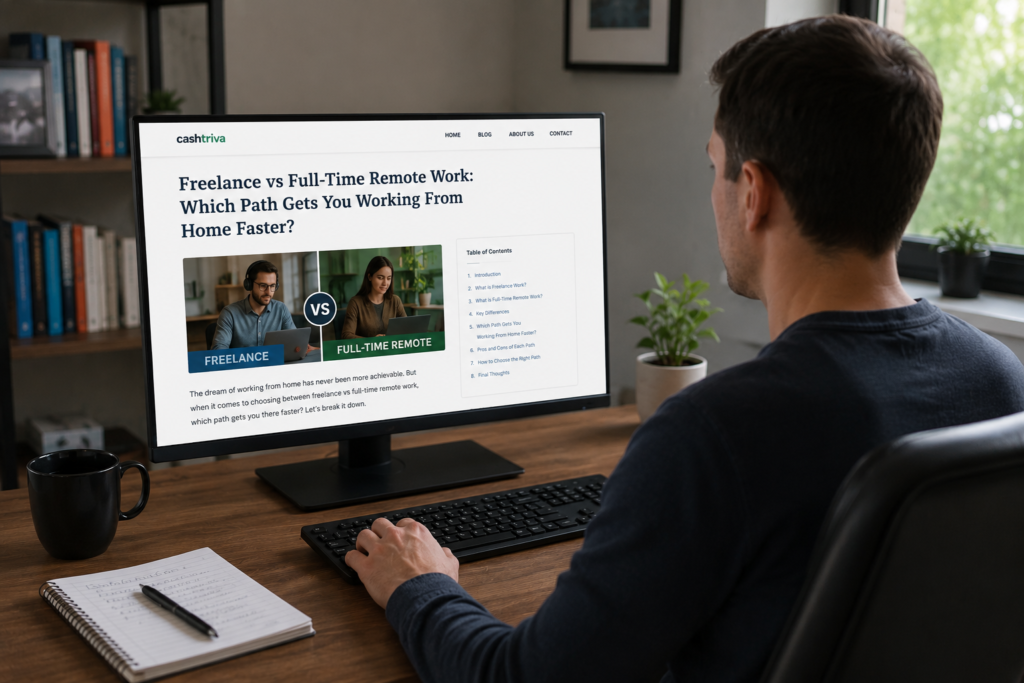
You want to work from home. That part is clear. The question that trips most people up is how to get there.
Two paths lead to the same destination: freelancing and full-time remote employment. Both let you skip the commute, work in your own space, and build a career on your terms. But they operate on completely different timelines, come with different trade-offs, and suit different types of people.
If speed matters to you, and for most people leaving a traditional office job or entering the workforce for the first time, it does, then the answer to “which one gets me working from home faster?” is more nuanced than you’d expect.
This article breaks down both paths in detail, comparing them across every factor that matters: time to first paycheck, earning potential, stability, flexibility, and long-term growth. By the end, you’ll know which one fits your situation, your skills, and your tolerance for risk.
Defining the Two Paths
Before comparing them, let’s get clear on what each one actually means.
Freelancing means working for yourself. You find your own clients, set your own rates, choose your own projects, and manage your own schedule. You might work with one client at a time or juggle five. There’s no employer, no benefits package, and no guaranteed paycheck. You earn what you sell.
Full-time remote employment means working for a single company, just like a traditional job, except you do it from home (or anywhere with Wi-Fi). You have a manager, a team, a fixed salary, and typically a benefits package that includes health insurance, paid time off, and retirement contributions. The company sets your hours, your responsibilities, and your performance expectations.
Both are “remote work.” But the experience of each one is dramatically different.
Speed to First Income: Freelancing Wins, But With Caveats
If your primary goal is earning money from home as quickly as possible, freelancing has a clear advantage in raw speed.
Here’s why: you can sign up for a freelance platform like Upwork, Fiverr, or Toptal today, create a profile, and start bidding on projects within hours. If your skills match what clients are looking for, you could land your first paid gig within days, sometimes within 24 hours.
Full-time remote hiring moves slower. The typical process looks like this:
- Search and apply (1–4 weeks of active searching)
- Initial screening call (1–2 weeks after applying)
- One to three interview rounds (2–4 weeks)
- Offer and negotiation (1 week)
- Background check and onboarding (1–2 weeks)
From application to first paycheck, a full-time remote job can take anywhere from 6 to 12 weeks, and that’s if things go smoothly. Competitive roles at well-known companies can stretch that timeline to three or four months.
The caveat with freelancing: landing your first gig quickly doesn’t mean landing a good gig quickly. Many new freelancers start with low-paying projects to build reviews and credibility. Your first month of freelance income might be $200, not $2,000. Speed to first dollar and speed to sustainable income are two very different things.
The verdict: Freelancing gets you earning faster in absolute terms. Full-time remote work takes longer to start but delivers a full, predictable paycheck from day one.
Income Stability: Full-Time Remote Work Wins Clearly
This is where the two paths diverge most sharply.
A full-time remote job pays you the same amount every two weeks (or monthly, depending on the company). Whether you have a productive week or a slow one, whether the economy dips or your industry shifts, your paycheck arrives on schedule. You can plan around it, budget with it, and sleep at night knowing it’s coming.
Freelancing income is unpredictable, especially in the first year. Some months you’ll land three great projects. Other months, crickets. Client payments can be late. Projects get cancelled. Contracts end without warning.
Here’s what a typical first-year freelancing income curve looks like:
- Months 1–3: Slow. You’re building your profile, pitching constantly, and taking lower-paying work to get reviews and samples.
- Months 4–6: Picking up. You’ve got a few repeat clients, referrals start trickling in, and you’re charging closer to market rates.
- Months 7–12: Stabilizing. Your pipeline is more consistent, but there are still peaks and valleys.
Most freelancers don’t hit truly stable, predictable income until 12 to 18 months in. Some get there faster if they have an existing network or an in-demand skill. Others take longer.
The verdict: If you need reliable income right away, full-time remote work is the safer bet.
Earning Potential: Freelancing Has a Higher Ceiling
Full-time remote salaries are competitive, and they’ve been rising steadily as companies compete for remote talent. But they have a ceiling. Your employer decides your salary range, your raise schedule, and your bonus structure. You can negotiate, but the leverage has limits.
Freelancers, on the other hand, control their pricing. As you build skills, reputation, and a client base, you can raise your rates, take on higher-value projects, and scale your income in ways that aren’t possible within a single employer’s pay structure.
Here’s a rough comparison for a few common remote roles:
| Role | Full-Time Salary (Annual) | Freelance Rate (Hourly) | Freelance Annual Potential |
|---|---|---|---|
| Content Writer | $45,000–$70,000 | $30–$100+ | $60,000–$150,000+ |
| Web Developer | $65,000–$110,000 | $50–$150+ | $100,000–$250,000+ |
| Graphic Designer | $45,000–$75,000 | $35–$100+ | $70,000–$150,000+ |
| Virtual Assistant | $35,000–$50,000 | $20–$50+ | $40,000–$80,000+ |
| Social Media Manager | $40,000–$65,000 | $25–$75+ | $50,000–$120,000+ |
Those freelance numbers come with a massive asterisk: they assume you’re fully booked, billing consistently, and working at mid-to-high market rates. Many freelancers never reach the top end of those ranges. But the possibility exists in a way it doesn’t within a salaried position.
The verdict: Freelancing offers higher earning potential, but it takes time, skill, and business savvy to get there. Full-time remote work offers more predictable, competitive compensation with less effort on the business side.
Benefits and Safety Nets: Full-Time Remote Work Wins
This is the factor that keeps many people from freelancing, even when the money and flexibility appeal to them.
Full-time remote employees typically receive:
- Health insurance (often with employer contributions)
- Dental and vision coverage
- Paid time off (vacation, sick days, holidays)
- 401(k) or retirement plan with employer matching
- Life and disability insurance
- Professional development budgets
- Equipment stipends or allowances
Freelancers get none of that. You’re responsible for:
- Buying your own health insurance
- Setting aside money for taxes (self-employment tax is roughly 15.3% in the U.S., on top of income tax)
- Funding your own retirement
- Covering your own equipment, software, and workspace costs
- Paying yourself during time off (which means no paid vacations)
The financial reality of freelancing is that a $50/hour freelance rate doesn’t compare directly to a $50/hour salaried position. After self-employment taxes, health insurance premiums, retirement savings, and unpaid time off, the freelancer needs to earn significantly more per hour to match the salaried worker’s total compensation.
A common rule of thumb: multiply a full-time hourly rate by 1.3 to 1.5 to find the equivalent freelance rate. So if a full-time role pays $40/hour, you’d need to charge $52–$60/hour as a freelancer to come out even.
The verdict: Full-time remote employment offers a significantly stronger safety net. Freelancers need to build their own, and it costs real money to do so.
Flexibility and Autonomy: Freelancing Wins
This is where freelancing shines brightest.
As a freelancer, you decide:
- When you work (morning person? Night owl? Both?)
- Where you work (home office, coffee shop, Lisbon, Bali)
- Who you work with (you can fire bad clients)
- What you work on (you choose your projects)
- How much you work (scale up during busy seasons, scale down when you need a break)
Full-time remote work offers location flexibility, and that’s a real upgrade from office life. But you’re still on someone else’s schedule. Most remote employers expect you to be online during set hours, attend meetings, respond to messages within a reasonable window, and follow the company’s processes and priorities.
Some remote companies offer truly flexible schedules (async-first cultures, results-only work environments). But they’re the exception, not the rule. Most full-time remote jobs still look like traditional jobs, minus the commute.
The verdict: If autonomy and schedule control are your top priorities, freelancing delivers more of both.
Career Growth: It Depends on What Growth Means to You
Career growth looks very different on each path.
Full-time remote career growth follows a familiar pattern. You start in a junior or mid-level role, prove yourself, get promoted, take on more responsibility, and move up the ladder. You have a manager who (ideally) mentors you, a team you learn from, and a clear structure for advancement. The company invests in your development because they want to retain you.
Freelance career growth is self-directed. There’s no promotion ladder. Growth means charging higher rates, attracting better clients, specializing in a profitable niche, or scaling into an agency model where you hire other freelancers to work under you. You’re building a business, not climbing a corporate structure.
For some people, the structured path of full-time employment is motivating and reassuring. For others, it feels limiting. Neither is objectively better; it depends on how you define growth for yourself.
The verdict: Full-time remote work offers structured, supported career development. Freelancing offers unlimited growth potential but requires you to define and drive your own path.
The Learning Curve: What Each Path Demands
Both paths require you to learn new skills, but the skills are different.
To succeed in full-time remote work, you need to learn:
- Asynchronous communication (writing clear messages, documenting your work)
- Self-management without in-person oversight
- Virtual collaboration tools (Slack, Zoom, Notion, Asana, etc.)
- How to stay visible and build relationships remotely
- Time management in an environment full of home distractions
To succeed as a freelancer, you need to learn all of the above, plus:
- How to find and pitch clients
- How to price your services
- How to write proposals and contracts
- How to manage invoicing, taxes, and basic accounting
- How to market yourself consistently
- How to handle client relationships, including difficult conversations about scope, deadlines, and payments
Freelancing asks you to be two things at once: a skilled professional and a business owner. That dual role is what makes freelancing both exciting and exhausting, particularly in the early months.
The verdict: Full-time remote work has a shorter, more focused learning curve. Freelancing demands a broader skill set that goes well beyond your core profession.
Which Path Gets You Working From Home Faster? A Decision Framework
The honest answer is: it depends on your situation. Here’s a framework to help you decide.
Choose freelancing if:
- You have a marketable skill you can offer immediately (writing, design, development, video editing, virtual assistance)
- You need income quickly and are willing to start small
- You value schedule flexibility and autonomy above stability
- You’re comfortable with inconsistent income, at least temporarily
- You enjoy the business side of work: pitching, networking, negotiating
- You have savings or another income source to cover the ramp-up period
- You want to test remote work before committing to a full-time role
Choose full-time remote employment if:
- You want a predictable paycheck from day one
- Benefits like health insurance and retirement contributions matter to you
- You prefer structure, clear expectations, and team collaboration
- You’re transitioning from a traditional office job and want a familiar format
- You don’t want to manage the business side of your career (invoicing, client acquisition, taxes)
- You’re looking for mentorship and structured career development
- You’re willing to invest 6–12 weeks in the job search process
Consider a hybrid approach if:
- You want the best of both paths
- You can freelance part-time while searching for a full-time remote role
- You want to build skills and a portfolio through freelance work, then leverage that experience to land a salaried position
- You have a full-time remote job but want to test freelancing on the side before making a full transition
The hybrid approach is more common than most people realize. Many successful remote workers started by freelancing nights and weekends while holding a traditional job, used that experience to build credentials, and then transitioned into either full-time freelancing or a remote salaried position.
Real Timelines: How Fast Can Each Path Get You Home?
Let’s put concrete numbers on this.
Freelancing timeline to working from home:
- Day 1–3: Set up profiles on freelance platforms, create a basic portfolio
- Week 1–2: Start bidding on projects, send cold pitches
- Week 2–4: Land your first paid gig
- Month 2–3: Build enough consistent work to call it part-time income
- Month 4–6: Approach full-time freelance income (if you’re focused and your skills are in demand)
Full-time remote job timeline:
- Week 1–2: Update resume, optimize LinkedIn, start applying
- Week 3–6: Begin getting interview callbacks
- Week 6–10: Complete interview rounds
- Week 8–12: Receive and accept an offer
- Week 10–14: Complete onboarding and start working
Freelancing can get you earning from home within 2–4 weeks. A full-time remote job typically takes 8–14 weeks from the moment you start searching. But the full-time paycheck, when it arrives, is almost always larger and more stable than what freelancing delivers in the same early period.
The Skills That Transfer Between Both Paths
Here’s something worth noting: the skills you build on one path make you stronger on the other.
Freelancing builds skills that make you a better full-time employee:
- Self-motivation and discipline
- Client communication (which translates to stakeholder management)
- Project management
- Time estimation and deadline management
- Comfort with ambiguity and problem-solving
Full-time remote work builds skills that make you a better freelancer:
- Working within established systems and processes
- Team collaboration and communication
- Industry-specific expertise and training
- Understanding how companies think, budget, and make purchasing decisions
- Professional network connections that become future freelance clients
No matter which path you start on, the experience compounds. Many of the most successful remote professionals have done both at different stages of their careers.
Common Pitfalls on Each Path
Freelancing pitfalls to watch for:
- Undercharging. New freelancers often set rates too low out of insecurity. Research market rates and price based on the value you deliver, not your experience level.
- Saying yes to everything. Bad clients and misaligned projects drain your energy and hurt your reputation. Learn to say no.
- Neglecting the pipeline. When you’re busy with projects, it’s tempting to stop marketing yourself. Then the projects end, and you have no new leads. Keep prospecting even when you’re fully booked.
- Ignoring taxes. Self-employment taxes catch many new freelancers off guard. Set aside 25–30% of every payment for taxes, and consider making quarterly estimated payments.
- Working in isolation. Freelancing can be lonely. Join communities, attend virtual events, and build relationships with other freelancers.
Full-time remote work pitfalls to watch for:
- Overworking. When your office is your home, the boundary between work and life blurs. Set clear start and stop times.
- Becoming invisible. In a remote company, out of sight can mean out of mind. Communicate proactively, share your wins, and stay engaged with your team.
- Skipping the workspace setup. A kitchen table is not a home office. Invest in a proper desk, chair, and monitor. Your body and your productivity will thank you.
- Assuming all remote jobs are equal. Some “remote” jobs are actually hybrid, require specific time zones, or have return-to-office clauses. Read the fine print before accepting.
- Isolating yourself socially. Working from home full-time can shrink your social world. Make a deliberate effort to maintain relationships and get out of the house regularly.
The Bottom Line
Both freelancing and full-time remote work can get you working from home. The right path depends on what you’re optimizing for.
If you need income fast and want maximum control over your schedule, freelancing gets you there sooner. You can start earning within weeks, but you’ll trade stability for speed and need to build your business infrastructure from scratch.
If you want a reliable paycheck, benefits, and a structured work environment, full-time remote employment is the stronger choice. It takes longer to land, but it delivers financial predictability from day one and lets you focus entirely on doing your job rather than running a business.
And if you’re unsure? Start freelancing on the side while you search for full-time remote roles. That way, you’re building skills, earning income, and keeping your options open, all at the same time.
The best path isn’t the one that sounds more appealing in theory. It’s the one that matches your financial situation, your risk tolerance, and your personal definition of what a good work life looks like.
Pick the path that fits. Then commit to it long enough to see results.