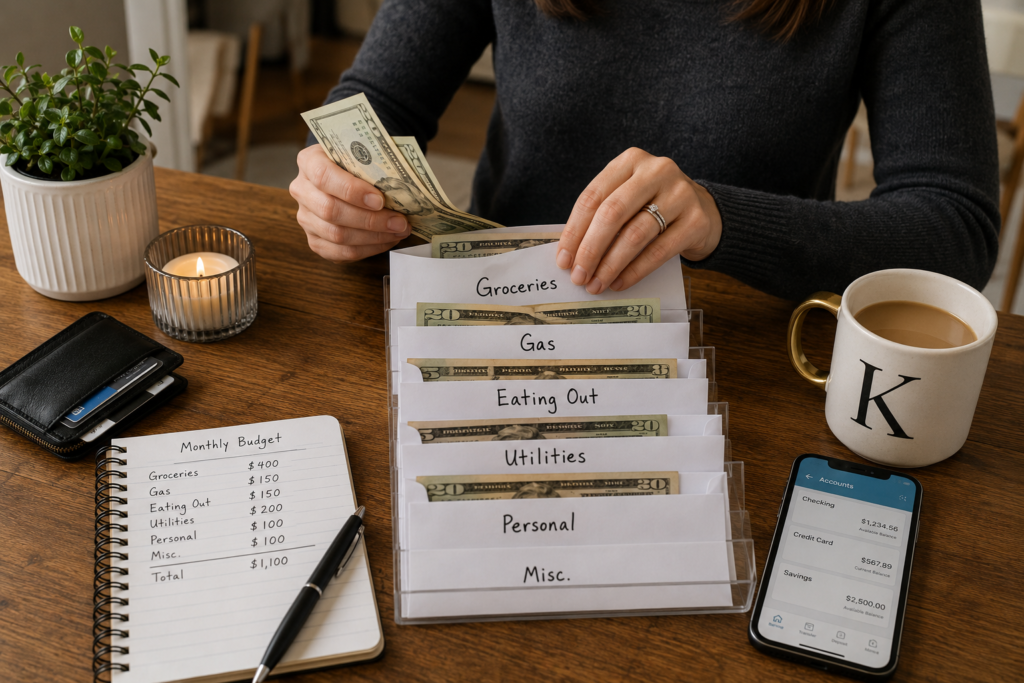
Swiping a card doesn’t feel like spending money. Tapping your phone at checkout feels even less like it. And that’s exactly the problem.
When spending is invisible, it’s easy to overshoot your budget by hundreds of dollars without realizing it until the statement arrives. The cash envelope method exists to make spending feel real again. You pull physical bills from a labeled envelope, watch the stack shrink, and know exactly how much is left. No guessing. No surprises.
But here’s the obvious question: can a budgeting method built around paper money survive in a world where cash is practically extinct? Where subscriptions auto-renew, rent gets paid by ACH, and half the places you shop don’t even have a cash register?
The answer is yes, but it takes some adapting. This guide covers the original cash envelope system, the psychology behind why it works so well, and the modern hybrid strategies that make it practical even if you haven’t visited an ATM in months.
What Is the Cash Envelope Method?
The cash envelope method is a budgeting system where you divide your spending money into physical envelopes, each labeled with a specific category. When the cash in an envelope runs out, you stop spending in that category until the next month.
It’s beautifully simple.
At the start of each month (or pay period), you withdraw a set amount of cash from your bank account and distribute it across envelopes based on your budget. One envelope for groceries. One for dining out. One for gas. One for entertainment. One for clothing. Whatever categories make sense for your life.
Throughout the month, you pay for things in each category using only the cash from that envelope. When you buy groceries, you pull from the grocery envelope. When you grab dinner with friends, you pull from the dining-out envelope. When an envelope is empty, that category is done for the month.
No transfers from other envelopes (unless you make a deliberate decision to move money). No dipping into savings. No “I’ll make up for it next month.”
The method has been around for decades, popularized by financial educators who recognized that physical cash creates a spending friction that cards completely eliminate.
How the Original System Works: Step by Step
Step 1: Build your monthly budget
Before you can stuff envelopes, you need a budget. List your monthly after-tax income and all of your expenses. Separate them into two groups:
Fixed expenses (paid digitally or by check):
- Rent/mortgage
- Utilities
- Insurance premiums
- Loan payments
- Subscriptions
- Phone and internet bills
These stay in your bank account and get paid the way they always do, through autopay, online bill pay, or direct debit.
Variable expenses (paid with cash envelopes):
- Groceries
- Dining out
- Gas/transportation
- Entertainment
- Clothing
- Personal care
- Household supplies
- Coffee shops
- Gifts
- Miscellaneous spending
These are the categories that tend to fluctuate and where overspending sneaks in. They’re your envelope candidates.
Step 2: Assign dollar amounts to each envelope
Based on your budget, decide how much goes into each category. Be realistic. If you’ve been spending $600 on groceries, don’t drop it to $300 overnight. Start with $550 and work down gradually.
Example envelope allocations for a $5,200 monthly income:
| Envelope | Amount |
|---|---|
| Groceries | $500 |
| Dining out | $150 |
| Gas | $160 |
| Entertainment | $100 |
| Clothing | $75 |
| Personal care | $50 |
| Household items | $40 |
| Coffee shops | $40 |
| Gifts | $50 |
| Miscellaneous | $60 |
| Total cash withdrawal | $1,225 |
The remaining $3,975 stays in your bank account to cover fixed expenses, savings contributions, and debt payments.
Step 3: Withdraw cash and fill your envelopes
On payday (or the first of the month), go to your bank or ATM and withdraw your total envelope amount. Bring it home, divide it up, and put the right amount into each labeled envelope.
Some people use actual letter envelopes. Others buy envelope wallet systems designed for this purpose (you can find them online for a few dollars). Some use zippered pouches or accordion-style organizers.
The container doesn’t matter. The labels and the separation do.
Step 4: Spend only from the right envelope
This is the rule that makes the system work. When you buy something, you use cash from the matching envelope. No mixing. No borrowing from other categories without a conscious decision.
At the grocery store: Open the grocery envelope, count out cash, pay, put the change back.
At a restaurant: Open the dining-out envelope. If there’s $22 left and the bill is $35, you either skip this meal out, choose something cheaper, or make the deliberate choice to move $13 from another envelope.
That moment of friction, looking in the envelope, counting what’s there, deciding if the purchase is worth the remaining balance, is the entire point.
Step 5: Track and adjust at month’s end
At the end of the month, see where you stand. Some envelopes might be empty (that’s fine, you stuck to the limit). Some might have cash left over (great, that’s unspent money you can roll forward or redirect to savings).
Use what you learn to adjust next month’s allocations. If you consistently run out of grocery money, bump it up and trim somewhere else. If your clothing envelope always has leftover cash, reduce it.
The Science of Why Cash Hurts More Than Cards
This isn’t just folk wisdom. Researchers have studied the difference between paying with cash and paying with cards, and the findings are striking.
A landmark study published in the Journal of Consumer Research by Priya Raghubir and Joydeep Srivastava found that people spend significantly more when using credit or debit cards compared to cash. The researchers called it the “payment transparency” effect: cash makes the cost of a purchase feel immediate and concrete, while cards create psychological distance between the act of buying and the act of losing money.
Another study from MIT, led by Drazen Prelec and Duncan Simester, found that participants were willing to pay up to 100% more for the same item when using a credit card versus cash. The researchers auctioned off items like sports tickets and found that card-paying bidders consistently bid higher.
Why does this happen? Neuroscience offers a clue. Paying with cash activates the brain’s pain centers, the same areas that light up during physical discomfort. Handing over bills triggers a micro-dose of loss aversion. Cards bypass that response almost entirely.
The cash envelope method leverages this psychological wiring on purpose. Every time you open an envelope, count out bills, and hand them to a cashier, your brain registers the transaction as a real loss. That sensation makes you more careful, more deliberate, and less likely to impulse-buy.
There’s a visual component too. Seeing a full envelope at the start of the month and a thin one halfway through tells a story that no banking app can replicate with the same emotional impact. Numbers on a screen are abstract. A shrinking pile of twenties is visceral.
The Problem: Cash Doesn’t Fit Modern Life
For all its psychological power, the traditional cash envelope method hits some serious friction points in a card-dominated economy.
Online shopping is cash-proof. You can’t slide a $20 bill into your laptop screen. With e-commerce representing a growing share of consumer spending, a cash-only system automatically excludes a massive category of purchases.
Many businesses prefer cards. Some restaurants, coffee shops, and retailers have gone cashless entirely. Farmers’ markets and food trucks increasingly use Square readers and Venmo. Paying with cash at certain establishments now feels more disruptive than convenient.
Carrying cash has security concerns. Walking around with $500+ in your wallet creates real risk. Lost wallets, theft, and misplaced envelopes are genuine downsides that card-based payments eliminate.
ATM visits take time. Withdrawing cash every pay period, breaking bills into the right denominations, and physically distributing them into envelopes adds a layer of effort that many people find hard to sustain beyond the first few months.
Splitting checks is awkward. In a group dinner where everyone else is putting cards on the table, counting out cash and asking for change creates social friction some people want to avoid.
These aren’t trivial objections. They’re real barriers that have caused many people to abandon the envelope method entirely, even when they know it helped them spend less.
The solution isn’t to give up. It’s to adapt.
The Hybrid Approach: Cash Envelopes Meet Digital Tools
The most practical version of the cash envelope method in today’s world is a hybrid system. You use physical cash for the categories where overspending is your biggest risk, and digital tools for everything else.
Here’s how to set it up.
Identify your “danger” categories
Look at your spending over the past three months. Which categories consistently run over budget? Which ones trigger impulse purchases? Those are your cash envelope categories.
For most people, the high-risk categories are:
- Groceries (easy to over-buy)
- Dining out (impulsive by nature)
- Entertainment (concerts, movies, outings)
- Coffee shops (small amounts that add up fast)
- Clothing (emotional spending trigger for many)
These go in physical envelopes.
Keep structured categories digital
Some spending categories don’t lend themselves to cash. Keep them in your bank account and manage them with a digital tracking system:
- Online subscriptions
- Utilities
- Insurance
- Loan and debt payments
- Online shopping (with strict, pre-set limits)
- Gas (if you prefer pay-at-the-pump convenience)
Use a tracking app for the digital side
Pair your physical envelopes with a digital tool that mirrors the envelope concept for your non-cash categories. Several apps do this well:
- Goodbudget: Specifically designed around the envelope method. You create digital “envelopes” and track spending against each one. The free version supports 10 envelopes.
- YNAB (You Need a Budget): While technically a zero-based budgeting app, YNAB’s category system works exactly like digital envelopes. Every dollar gets assigned to a category, and the app tracks spending against those limits in real time.
- Mvelopes: Another envelope-inspired app that syncs with your bank accounts and lets you allocate income into virtual envelopes.
- A simple spreadsheet: If you don’t want another app, a Google Sheet with columns for category, budgeted amount, spent, and remaining does the same job. Update it every time you make a digital purchase.
Set the withdrawal schedule
Decide when you’ll withdraw cash. Common options:
- Monthly: Withdraw the full amount on the 1st. Simple, but requires carrying more cash early in the month.
- Bi-weekly (aligned with paychecks): Split your envelope amounts in half and refill every two weeks. Reduces the amount of cash you carry at any given time.
- Weekly: Withdraw one-quarter of the monthly amount each week. Maximum control, but more ATM visits.
Bi-weekly tends to be the sweet spot for most people. It syncs naturally with payday and keeps envelope balances manageable.
Digital-Only Envelope Budgeting: The Full Cashless Version
If physical cash truly doesn’t work for your lifestyle, you can replicate the envelope method entirely with digital tools. You’ll lose some of the psychological “pain of paying” effect, but you’ll keep the structural benefits of category-based spending limits.
Here’s how the digital-only version works:
1. Set up separate “envelopes” in your budgeting app. Create a category for every spending area, just as you would with physical envelopes. Assign each one a dollar amount.
2. Use a dedicated debit card for discretionary spending. Some people open a separate checking account with its own debit card, funded only with their total “envelope” amount. This creates a hard spending ceiling that mimics the cash constraint.
3. Log every transaction manually. This is the key friction that replaces the physical act of counting cash. Every time you swipe your card, open your app or spreadsheet and deduct the amount from the matching category. Yes, it’s an extra step. That’s the point. The act of logging creates the awareness that automatic bank syncing doesn’t.
4. Set phone notifications for spending. Most banking apps let you enable push notifications for every transaction. Turn them on. Each ping is a small reminder that money just left your account.
5. Review daily (at least at first). For the first month or two, check your digital envelopes every evening. A 2-minute scan of where you stand helps you course-correct before a small overspend becomes a big one.
The digital version requires more discipline than the physical one because you don’t get the tactile feedback of a shrinking envelope. But for people who’ve committed to the habit, it works well.
Cash Stuffing: The Social Media Trend Explained
If you’ve seen videos of people carefully arranging bills into binders, labeling dividers with category names, and filling clear zippered pouches with specific denominations, you’ve encountered “cash stuffing.”
Cash stuffing is essentially the cash envelope method repackaged for visual platforms. The core mechanics are identical: withdraw cash, divide it by category, spend only from the designated pouch. The main difference is the aesthetic, custom binder systems, color-coded tabs, stickers, and trackers that make the process feel like a craft project.
The trend has brought millions of new people into envelope budgeting, particularly younger adults in their 20s and 30s who might not have encountered the method otherwise. That’s a genuine positive. Anything that makes budgeting feel engaging rather than punishing has value.
A few cautions with the cash stuffing trend, though:
Don’t spend more on the system than you save. Some custom binder setups cost $50-$100+. A set of plain envelopes costs less than a dollar. The system works the same regardless of how pretty it looks.
Beware of performative budgeting. Some people get so focused on the ritual of stuffing cash and filming it that they lose sight of the actual financial outcomes. The goal isn’t a satisfying video. It’s spending less than you earn and directing money toward your goals.
Security matters. Keeping large amounts of cash at home in a binder carries risk. If you’re storing several hundred dollars or more, consider a small fireproof safe or limiting how much cash you keep on hand at any given time.
That said, if the visual and tactile experience of cash stuffing keeps you engaged with your budget, it’s doing its job. The best system is the one that holds your attention long enough to change your habits.
Handling Specific Scenarios with the Envelope Method
Grocery delivery and online food orders
You can’t pay Instacart or a grocery delivery app with cash. Two options:
Option A: Use your card for delivery orders, but immediately remove the equivalent amount of cash from your grocery envelope and set it aside (in a “spent” envelope or a separate container). This keeps your visual tracking accurate.
Option B: Include a separate “online groceries” digital envelope in your tracking app with its own limit, while your physical envelope covers only in-store shopping.
Gas stations
Pay-at-the-pump is a hard habit to break. If you prefer to keep gas on your card, track it digitally with a strict monthly cap. If you want the cash discipline, most gas stations still accept cash inside. Walk in, pre-pay the amount you want, pump, and you’re done. Bonus: pre-paying a fixed amount ($30, $40) naturally limits how much you spend.
Splitting bills with friends
When everyone is paying with cards and you’re the one counting out cash, it can feel cumbersome. A few approaches:
- Pay the full bill in cash and have friends Venmo you their share. This empties your envelope as planned and keeps things simple for the group.
- Use your card for group meals and deduct from your dining-out envelope later. Not pure, but practical. The key is making the deduction immediately so the envelope balance stays accurate.
- Alternate methods. Pay cash when dining alone or with a partner, and use your card for group outings only.
Sales, deals, and unexpected bargains
You find a coat on clearance for 70% off. It’s a great deal. But your clothing envelope only has $30 left. What do you do?
This is where the envelope method does its best work. The limit forces a decision. Is this purchase worth pulling money from another category? If yes, make the transfer consciously. If no, walk away. The deal will come around again, or you’ll budget for it next month.
That pause, the moment between wanting something and checking the envelope, is where impulse spending dies.
Travel
Cash envelopes on vacation can work, but they require pre-planning. Before your trip:
- Estimate your daily spending budget (food, activities, transportation, souvenirs).
- Multiply by the number of trip days.
- Create a “travel” envelope set, either daily envelopes or category-based ones for the trip.
- Withdraw the total and organize it before you leave.
For international travel, this obviously gets complicated with currency exchange. In those cases, a digital envelope system or a prepaid travel card with a spending limit is more practical.
Envelope Method vs. Other Budgeting Systems
Cash envelopes vs. zero-based budgeting
Zero-based budgeting assigns every dollar a job, but it doesn’t require cash. The envelope method is a cash-based execution of that same principle. Many people combine them: build a zero-based budget on paper, then use envelopes to enforce the variable spending categories.
Cash envelopes vs. the 50/30/20 rule
The 50/30/20 rule gives you three broad buckets (needs, wants, savings) without granular category tracking. Envelopes break spending into 8-15 specific categories with hard limits. The envelope method is more hands-on but catches overspending that the 50/30/20 framework might miss.
Cash envelopes vs. automatic budgeting apps
Apps like Mint or Copilot track your spending automatically and categorize transactions after the fact. The envelope method requires active participation before and during spending. Automatic tracking is passive and informational. Envelopes are active and behavioral. Both have value, but if your problem is spending too much (not just tracking too little), envelopes tend to produce better results.
Tips for Making the Envelope Method Stick
Start with just 3-4 envelopes. Don’t create 15 categories on day one. Pick the 3-4 areas where you overspend the most and envelope those. Keep everything else digital. You can add more envelopes later once the habit feels natural.
Use visual cues. Write the budgeted amount on the front of each envelope. Some people add a running tally on the outside, subtracting each purchase so they can see the remaining balance at a glance without opening the envelope and counting.
Keep a small “oops” envelope. Budget $20-$50 for the random expenses that don’t fit anywhere, a parking meter, a vending machine snack, a last-minute birthday card. This prevents you from raiding other envelopes for tiny, unpredictable costs.
Involve your household. If you share expenses with a partner or family member, the system only works if everyone is on board. Discuss the categories and amounts together. Give each person their own set of envelopes for personal spending if needed.
Celebrate leftover cash. When you reach the end of the month with money still sitting in an envelope, that’s a win. Decide in advance what happens to leftovers: roll them into next month’s envelope, move them to savings, or put them toward a specific goal. Having a plan for surplus cash keeps the momentum going.
Don’t carry all your envelopes everywhere. Take only the one or two you’ll need for that day’s errands. Leave the rest at home in a safe spot. This reduces the risk of loss and the temptation to pull from the wrong envelope.
Pair it with a “no-spend day” challenge. Try to have 2-3 days per week where you don’t spend anything from any envelope. This builds the muscle of pausing before purchasing and can extend the life of your envelope balances significantly.
Who Benefits Most from This Method?
The cash envelope method tends to produce the strongest results for:
- People who consistently overspend in specific categories. If dining out or groceries blow your budget every single month, the hard cap of an envelope creates a boundary that willpower alone can’t.
- Visual and tactile learners. If numbers on a screen don’t feel real to you, handling physical money and watching it decrease creates the concrete feedback loop your brain needs.
- Couples working on financial alignment. Envelopes make spending visible and shared. There’s no ambiguity about what’s left in a category when you can both see the cash (or the lack of it).
- People paying off debt. When you limit your variable spending with envelopes, the money you save doesn’t drift into random purchases. It stays available for extra debt payments, accelerating your payoff timeline.
- Anyone recovering from a period of financial chaos. If you’ve gone through a stretch of reckless spending, medical bills, job loss, or just general disorganization, the envelope method provides an immediate sense of structure and control. It’s concrete. It’s simple. And it works from day one.
A Month-by-Month Progression for Beginners
Month 1: The learning month. Set up your envelopes. Follow the system. Don’t beat yourself up when you run out of cash in a category early. Treat this month as data collection. What did you learn about your spending patterns?
Month 2: The adjustment month. Reallocate based on what you learned. If groceries needed $50 more and entertainment needed $50 less, make the swap. The numbers should reflect your real life, not an idealized version of it.
Month 3: The momentum month. By now, the habit is forming. You’re checking envelopes before you buy. You’re pausing at checkout to consider whether this purchase is worth the remaining cash. You might start to see leftover money at month’s end.
Month 4 and beyond: The optimization phase. Gradually tighten categories where you have consistent surplus. Redirect the savings toward your highest-priority financial goal, whether that’s an emergency fund, debt payoff, or a specific savings target.
Most people who commit to three full months report a noticeable shift in their relationship with money. The friction that felt annoying in month one starts to feel empowering by month three.
Addressing the Critics
Some financial advisors argue against the envelope method on practical grounds: it’s inconvenient, it misses out on credit card rewards, and it doesn’t build credit history. These are fair points, and they deserve honest responses.
“You’re losing credit card rewards.” True. If you’re disciplined enough to pay your credit card in full every month and never overspend, you can earn 1-5% back on purchases. But if you’re reading an article about budgeting methods, there’s a good chance that discipline hasn’t been consistent. The average American household carries over $6,000 in credit card debt. The interest on that debt dwarfs any cash-back rewards. For most people, the money saved by spending less with cash far outweighs the 2% they’d earn swiping a card.
“It doesn’t build credit.” This is true for the cash portion of your spending. But remember, your fixed expenses (rent, loan payments, insurance) are still being paid through your bank account. If you have a credit card, you can keep one small recurring charge on it (like a streaming subscription) set to autopay. That maintains your credit history without requiring you to use the card for daily spending.
“It’s not convenient.” No argument there. Carrying cash, visiting ATMs, and counting bills takes more effort than tapping a phone. But the inconvenience is a feature, not a bug. The friction is what makes you spend less. If convenience were the goal, you wouldn’t need a budget at all.
Making It Your Own
The cash envelope method is a framework, not a rigid prescription. The original version, all physical cash in paper envelopes, works perfectly for some people. The hybrid version, cash for high-risk categories plus digital tracking for everything else, works better for others. The fully digital version, using apps that simulate envelopes without any physical cash, suits people who’ve gone completely cashless.
What matters is the underlying principle: set a spending limit for each category, make the limit visible, and stop when you hit it.
Whether you enforce that limit with paper bills in a labeled envelope, a balance in a budgeting app, or a prepaid debit card loaded with a fixed amount, the behavioral result is the same. You spend with intention. You notice every purchase. And you stop making financial decisions on autopilot.
Pick the version that fits your life, give it a genuine three-month trial, and adjust as you go. The method has survived for decades because the psychology behind it doesn’t change, even as the tools we use to pay for things keep evolving.
Your money still needs boundaries. Envelopes, physical or digital, are one of the simplest ways to draw them.