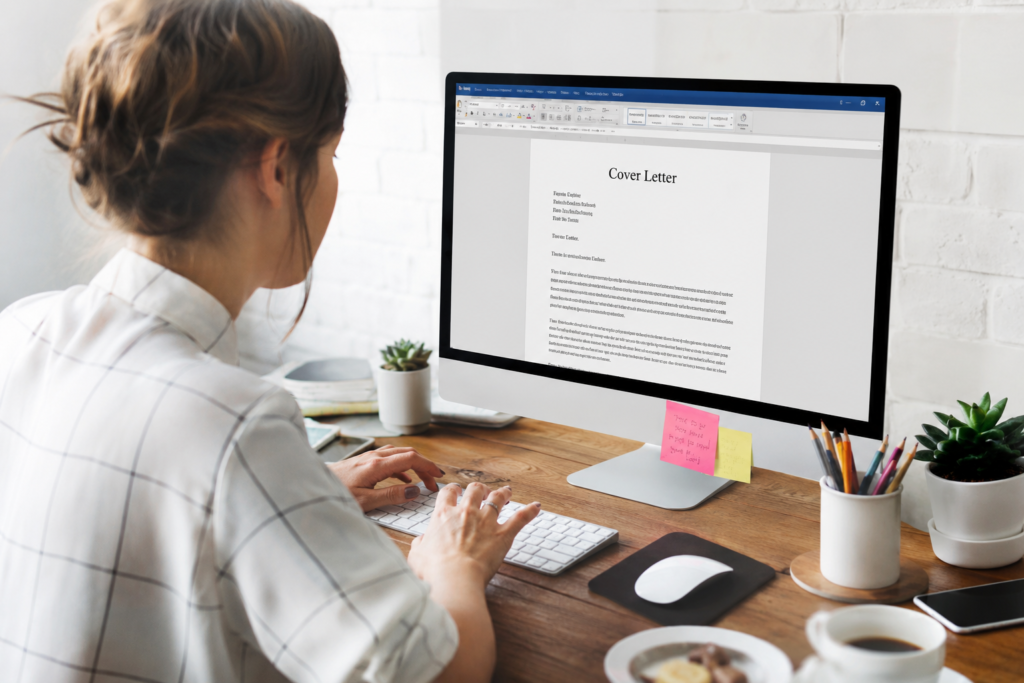
Remote job postings attract hundreds of applicants. Sometimes thousands. The competition is brutal because the talent pool is global, the flexibility is desirable, and the barriers to applying are almost nonexistent.
Your resume gets you into the conversation. Your cover letter is what separates you from the 200 other qualified candidates who can do the job. And for remote positions specifically, the cover letter carries more weight than it does for traditional roles, because it answers a question that resumes can’t:
Can this person actually succeed without someone looking over their shoulder?
Hiring managers for remote teams aren’t just evaluating your skills. They’re evaluating your independence, your communication instincts, your self-discipline, and your ability to produce results without the scaffolding of a physical office. A cover letter that addresses those concerns directly, with evidence, puts you ahead of every applicant who submitted a generic “I’m excited about this opportunity” letter.
This guide breaks down exactly how to write that cover letter, what remote hiring managers are scanning for, what to include and what to cut, and how to demonstrate remote-readiness in a way that feels genuine rather than performative.
Why the Cover Letter Matters More for Remote Roles
For in-office positions, a cover letter is often a formality. Many hiring managers skim them or skip them entirely. The interview does the heavy lifting.
Remote roles are different for three reasons:
Written communication is the job. In a distributed team, almost everything happens through writing: Slack messages, emails, project updates, async status reports, documentation, and proposals. A cover letter is a live sample of how you communicate in writing. If it’s clear, concise, and well-structured, the hiring manager thinks: “This person will write good Slack messages and clear project updates.” If it’s rambling, vague, or filled with filler, they think the opposite.
Trust has to be established before day one. When a manager hires someone for an office, they can observe work habits, offer real-time guidance, and course-correct quickly. Remote managers don’t have that luxury. They need to trust that you’ll perform without supervision, and that trust-building starts with your application materials. A cover letter that proactively addresses remote-specific concerns signals awareness and maturity.
Self-selection is part of the evaluation. Many companies include the cover letter requirement specifically to filter out applicants who aren’t willing to put in effort. Submitting a thoughtful, role-specific cover letter when half the applicant pool sends a generic template (or nothing at all) is a competitive advantage before anyone reads a single word.
What Remote Hiring Managers Are Actually Looking For
Before writing anything, understand what’s going through the mind of someone hiring for a remote position. Their fears and priorities shape what your cover letter needs to address.
Their Top Concerns
“Will this person disappear?” Remote managers can’t walk past your desk to see if you’re working. Their biggest fear is hiring someone who’s responsive during the interview process and then becomes a ghost. They want evidence that you’re proactive about visibility and communication.
“Can they manage their own time?” Without structured office hours and in-person meetings to create rhythm, remote workers need to build their own structure. Hiring managers want to see that you’ve done this before, or that you have a clear understanding of what it requires.
“Will they communicate enough, but not too much?” Remote work has a communication Goldilocks zone. Too little, and the team doesn’t know what you’re doing. Too much, and you clog every channel with unnecessary updates. Managers look for people who intuitively understand when to communicate synchronously (a quick call) versus asynchronously (a written update).
“Do they have the right environment?” A reliable internet connection, a quiet workspace, and the discipline to separate work from personal life. These aren’t trivial concerns. Managers have been burned by hires who technically worked remotely but were functionally unavailable due to environment issues.
“Will they mesh with the team without hallway conversations?” Culture fit in remote teams depends on intentional relationship-building: participating in virtual social channels, joining optional team calls, contributing to conversations beyond your immediate tasks. Managers want people who won’t become isolated nodes.
The Skills They’re Scanning For
When a remote hiring manager reads your cover letter, they’re looking for signals of these specific competencies:
- Async communication skills: Can you convey information clearly in writing without real-time back-and-forth?
- Self-direction: Can you identify what needs to be done and do it without waiting for instructions?
- Time management: Can you meet deadlines and manage competing priorities independently?
- Tool fluency: Are you comfortable with the collaboration stack (Slack, Zoom, Notion, Asana, Jira, Google Workspace, etc.)?
- Documentation habits: Do you default to writing things down, creating processes, and sharing knowledge proactively?
- Results orientation: Can you demonstrate output and progress without someone checking in daily?
Your cover letter needs to provide evidence of at least three or four of these. Not by listing them as buzzwords, but by showing them through specific examples.
The Structure That Works
A remote-specific cover letter follows a five-part structure. Each section has a clear purpose and should be tight, purposeful, and free of filler.
Part 1: The Opening (2 to 3 Sentences)
Purpose: Hook the reader, name the role, and immediately signal remote-specific value.
Skip the generic openings. “I’m writing to express my interest in the [role] position” tells the reader nothing they don’t already know. They’re holding your application for that exact role. Start with something that earns the next sentence.
Weak opening:
“I am excited to apply for the Marketing Manager position at [Company]. I believe my skills and experience make me an excellent fit for this role.”
Strong opening:
“I’ve spent the last four years managing content strategy for a fully distributed team across three time zones, and the results we produced, a 140% increase in organic traffic and a content library that generates 40% of pipeline, were built entirely through async collaboration and self-directed execution. The Marketing Manager role at [Company] aligns with how I work best, and I’d like to show you why.”
The strong opening does four things simultaneously: establishes remote experience, provides measurable results, demonstrates relevant skills, and creates curiosity.
Part 2: The Remote-Specific Value Proposition (3 to 5 Sentences)
Purpose: Directly address why you’re equipped to succeed in a remote environment, with proof.
This is the section that most cover letters miss entirely. It’s where you transition from “I can do this job” to “I can do this job without an office, and here’s evidence.”
Pull from your actual experience. If you’ve worked remotely before, describe what you did and how you handled the specific challenges of distributed work. If you haven’t worked remotely but have relevant experience (freelancing, managing remote team members, working independently on long-term projects), connect those experiences to remote competencies.
Example for someone with remote experience:
“At [Previous Company], I worked as the only team member in my time zone, which meant most of my collaboration was asynchronous. I developed a habit of documenting decisions, recording short Loom walkthroughs for complex projects, and posting daily standups in Slack before my colleagues came online. My manager consistently noted that she had more visibility into my work than anyone on the co-located portion of the team.”
Example for someone without formal remote experience:
“While my previous roles were office-based, my workflow has been functionally remote for the past two years. I managed a team of four freelance writers spread across the U.S. and Europe, coordinating all work through Asana, Slack, and Google Docs with no in-person interaction. I built the editorial calendar, review process, and feedback loops that allowed us to publish 12 articles per month without a single missed deadline.”
Example for a career changer or new graduate:
“During my final year at [University], I completed my capstone project with a team of five students across three states. We never met in person. I took the lead on setting up our project management workflow in Notion, scheduling weekly video check-ins, and creating a shared documentation system that kept everyone aligned. We delivered the project two weeks ahead of schedule, and our professor cited our collaboration process as a model for future cohorts.”
Part 3: The Role-Specific Proof (4 to 6 Sentences)
Purpose: Demonstrate that you can do the actual job, with specific, measurable achievements.
This section mirrors a traditional cover letter’s body paragraph. Connect your experience to the role’s requirements. Use numbers, outcomes, and concrete results whenever possible.
The key difference for remote applications: frame your achievements in terms of independent execution and outcomes rather than team proximity or access to resources.
Example:
“In my current role as a Product Marketing Manager, I own the full go-to-market process for new feature launches, from positioning and messaging through launch-day execution. In Q3 of last year, I led the launch of [feature], which generated 2,300 trial signups in the first two weeks and contributed $180K in new ARR within 90 days. I managed this launch across four internal teams, all remote, coordinating through shared Notion briefs, async feedback rounds, and two 30-minute alignment calls per week.”
Notice how the remote context is woven into the achievement, not bolted on as an afterthought. The reader sees both competence and remote fluency in the same paragraph.
Part 4: The Culture and Values Connection (2 to 3 Sentences)
Purpose: Show that you’ve researched the company and understand what makes their remote culture specific.
Generic flattery (“I love your company’s mission”) is worse than saying nothing. Instead, reference something specific about how the company operates remotely, and connect it to your own working style.
Where to find this information:
- The company’s careers page (many remote companies describe their culture and async practices in detail)
- Their engineering or company blog
- Glassdoor reviews mentioning remote work practices
- The job posting itself (look for clues like “async-first,” “documentation-heavy,” “results-oriented,” or specific tools mentioned)
- LinkedIn posts from current employees about their remote work experience
Example:
“I noticed that [Company] describes its culture as ‘async by default,’ with a strong emphasis on written communication and self-directed project ownership. That matches how I’ve done my best work: I default to writing things down, I over-communicate progress rather than waiting to be asked, and I treat documentation as a product, not an afterthought. Your emphasis on outcomes over hours mirrors the philosophy that’s driven my career for the past five years.”
Part 5: The Close (2 to 3 Sentences)
Purpose: End with confidence, not desperation. Make the next step easy.
A strong close restates your fit briefly and expresses genuine interest without groveling.
Weak close:
“Thank you for your time and consideration. I hope to hear from you soon. Please don’t hesitate to reach out if you have any questions.”
Strong close:
“I’d welcome the chance to walk you through how I’d approach the first 90 days in this role and share more about the systems I’ve built for async collaboration. I’m available for a conversation at your convenience, and I’m happy to work across any time zone your team operates in. Thank you for your time.”
The strong close accomplishes three things: it offers something specific for the next conversation, it signals flexibility on scheduling (a remote-relevant detail), and it ends with gratitude without sounding passive.
Full Cover Letter Example
Here’s a complete example pulling all five sections together, written for a hypothetical remote Content Marketing Manager position:
Dear [Hiring Manager’s Name],
Over the past five years, I’ve built and scaled content programs for two fully remote SaaS companies, growing organic traffic by 210% at [Company A] and building a content engine at [Company B] that now generates 35% of qualified leads, all without setting foot in an office or working in the same city as my team. The Content Marketing Manager role at [Company] is the kind of challenge I’m looking for, and my track record in distributed content teams makes me confident I can deliver results from day one.
Remote work isn’t just something I’ve adapted to. It’s where I do my best thinking. I structure my days around deep work blocks for writing and strategy, and I batch communication into focused windows so my team always has context without waiting for a synchronous response. At [Company B], I managed a team of three writers and two freelancers across four time zones using Notion for editorial planning, Slack for daily async standups, and Loom for creative briefs. My director told me my documentation habits “set the standard for how the whole marketing team should operate.”
On the content side, I’ve led end-to-end strategy for B2B SaaS products in the fintech and HR tech spaces. At [Company B], I redesigned the content strategy around bottom-of-funnel search intent, which increased blog-to-trial conversions by 68% in six months. I personally wrote or edited 150+ pieces of long-form content last year while managing our editorial calendar, freelancer relationships, and cross-functional launches with product marketing and demand gen. Every project was coordinated asynchronously, with synchronous check-ins reserved for creative brainstorms and quarterly planning.
I’ve followed [Company]’s blog for the past year, and I’m genuinely impressed by how you balance technical depth with accessibility. Your “async-first, meetings-last” philosophy resonates deeply with how I’ve structured every team I’ve managed. I’d bring that same discipline, along with a content strategy perspective shaped by real pipeline impact, to your team.
I’d love to discuss how I’d approach scaling [Company]’s content program in the first 90 days and share specific examples of the async workflows I’ve built for distributed editorial teams. I’m flexible on timing and comfortable working across any time zone overlap that suits your team. Thank you for considering my application.
Best regards,
[Your Name]
What to Include That Most People Forget
Beyond the core structure, several details can strengthen a remote cover letter significantly. Weave these in naturally where they fit.
Your Home Office Setup (One Sentence)
A brief mention signals professionalism and eliminates a common hiring concern.
“I work from a dedicated home office with high-speed fiber internet, a professional audio/video setup for calls, and a quiet environment with no distractions during working hours.”
One sentence. No need to list your monitor specs. Just enough to communicate: “I have a real workspace and I take this seriously.”
Your Time Zone and Flexibility
Remote roles often involve time zone coordination. Addressing this proactively removes friction.
“I’m based in MST (UTC-7) and I have experience maintaining 4 to 5 hours of overlap with European teams by adjusting my schedule. I’m flexible on core working hours and comfortable with early or late meetings when collaboration requires it.”
If the job posting specifies a required time zone overlap, confirm you can meet it. If it doesn’t specify, mention your zone and your willingness to be flexible.
Your Remote Tool Proficiency
Don’t list every app you’ve ever opened. Mention the ones relevant to the role, especially if they’re called out in the job posting.
“My daily toolkit includes Slack for team communication, Notion for project management and documentation, Figma for design collaboration, and Google Workspace for shared documents. I’m comfortable adopting new tools quickly and have onboarded onto three different project management platforms in the past two years.”
Your Async Communication Style
If you can describe your communication approach in one to two sentences, do it. This gives the hiring manager a preview of what working with you feels like.
“I default to written updates for status and context-sharing, short Loom videos for anything visual or complex, and live calls only when real-time discussion will genuinely move things forward faster than async. My teams have consistently said they never have to wonder what I’m working on.”
What to Leave Out
A remote cover letter should be tight. Every sentence should earn its place. Cut these common space-wasters:
Your entire work history. That’s what the resume is for. The cover letter should highlight two to three relevant achievements, not rehash every job you’ve held.
Generic personality claims. “I’m a hard worker,” “I’m a team player,” “I’m passionate about [industry].” These are filler. Everyone says them. Nobody believes them. Replace claims with evidence.
Apologies for what you lack. “Although I don’t have direct experience with…” immediately frames you as underqualified. If you’re missing a stated requirement, either address it by showing a transferable skill that compensates, or don’t mention it at all.
Salary expectations (unless asked). Don’t introduce compensation into the cover letter. If the application asks for it, put it in a separate field or address it in one line at the end.
Reasons you want to work remotely. “I love the flexibility of remote work” and “I want to avoid a commute” are about your benefit, not the company’s. Focus on why you’re effective remotely, not why you prefer it.
Humor, cleverness, or gimmicks. A cover letter is a professional document. A joke that lands wrong is worse than no joke at all. Clarity and competence are more impressive than wit.
Adapting for Different Remote Scenarios
Fully Remote, Async-First Companies
These companies (GitLab, Automattic, Zapier, Buffer, Doist) operate across many time zones with minimal synchronous meetings. Emphasize your documentation habits, async communication skills, and ability to work independently for long stretches.
Key phrases to incorporate: “documentation-first approach,” “async updates,” “deep work blocks,” “written decision-making,” “minimal meeting culture.”
Hybrid-Remote Roles
Some remote roles still expect occasional in-person time (quarterly offsites, monthly team meetings, or flexible office attendance). Address your willingness to travel and your experience transitioning between remote and in-person collaboration.
“I’m comfortable with [Company]’s hybrid model and available for quarterly team gatherings. I’ve found that in-person time is most valuable for relationship-building and strategic planning, while day-to-day execution runs most efficiently async.”
Remote With Required Time Zone Overlap
Many remote roles specify “must be available during EST business hours” or “4+ hours overlap with CET.” Address this head-on.
“I’m based in PST and have structured my schedule to maintain full overlap with EST core hours (9 AM to 5 PM ET) for the past two years. I’m accustomed to this rhythm, and it works well with my personal productivity patterns.”
First-Time Remote Applicants
If you’ve never held a formally remote position, focus on transferable evidence: managing remote vendors or freelancers, completing projects independently, working across locations within a company, or any period where you worked from home consistently.
“While my previous positions were based in an office, the workflows I built were functionally distributed. I managed vendor relationships across three states entirely through video calls and shared documents, and I led a six-month system migration project where I worked independently from home for 60% of the timeline, delivering all milestones on schedule.”
Don’t pretend you have remote experience you don’t. Honesty paired with transferable evidence is far more convincing than inflated claims.
Formatting and Logistics
Length
Keep it under one page. Aim for 350 to 500 words. Hiring managers for remote roles read hundreds of applications. Respect their time. If you can say it in 400 words, don’t stretch it to 600.
Format
- Plain text or clean PDF. No elaborate designs, colored headers, or infographic-style layouts unless you’re applying for a design role.
- Standard professional font (Arial, Calibri, Garamond, or similar) in 10 to 12 point.
- Adequate white space. Dense blocks of text feel exhausting, and remote hiring managers already spend their entire day reading screens.
- Address it to a specific person if possible. Check the job posting, the company’s team page, or LinkedIn for the hiring manager’s name. “Dear Sarah Chen” beats “Dear Hiring Team” every time.
File Naming
Name the file clearly: FirstName_LastName_CoverLetter_CompanyName.pdf
Not coverletter_final_v3.docx. Not document (2).pdf. File naming is a small detail that signals organizational competence, which is exactly what remote hiring managers are watching for.
Submission Notes
If the application allows a message or notes field in addition to the cover letter upload, use it. A one to two sentence note that references the role and adds a personal touch can catch attention:
“I’ve attached my cover letter and resume for the Content Marketing Manager position. I’m a longtime reader of your company blog and would love the chance to contribute to the team that produces it.”
The Cover Letter as a Preview of Your Remote Work
Here’s the frame that ties everything together: your cover letter isn’t just describing your ability to work remotely. It’s demonstrating it in real time.
A well-written, clearly structured, appropriately concise cover letter is itself an act of async communication. You’re sending a written document to someone you’ve never met, conveying complex information (your qualifications, your working style, your fit for the role) without the benefit of tone of voice, body language, or real-time dialogue.
If that document is clear, well-organized, and easy to act on, the hiring manager thinks: “This is how they’ll write project updates. This is how they’ll communicate with the team. This is how they’ll represent us to clients and stakeholders.”
The cover letter is the audition. Make it read like the best async message they’ve received all week.
Every word choice, every structural decision, every piece of evidence you include is proof that you understand what remote collaboration demands. Not just that you can work from home, but that you can communicate, produce, and connect with a team without ever sharing a room.
That’s what gets remote job offers. Not a list of tools you know or a paragraph about how much you love working in pajamas.
Proof that you’ve done the work, delivered the results, and communicated the whole way through, all in writing, all from wherever you happened to be sitting.