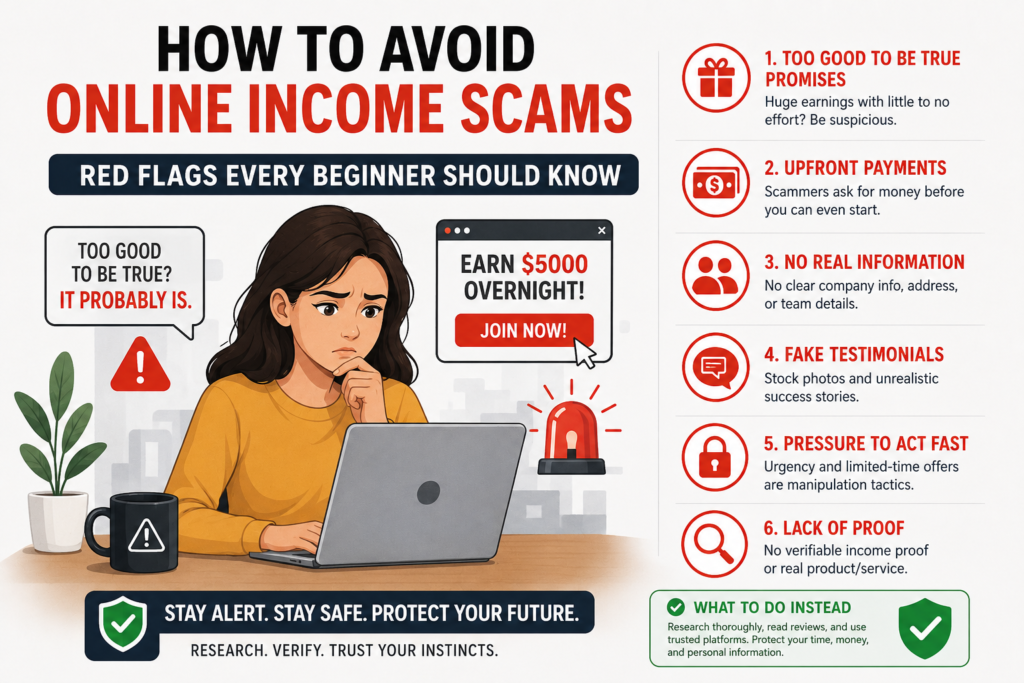
The internet has created real, legitimate ways to earn money from almost anywhere. Freelancing, e-commerce, content creation, remote employment: the opportunities are out there. But so are the people who want to steal your money, your data, or both.
Online income scams cost victims billions of dollars every year. According to the Federal Trade Commission, consumers reported losing over $10 billion to fraud in 2023 alone, with a significant portion tied to fake income opportunities. And beginners are the most common targets.
If you’re just starting to explore ways to earn money online, this guide will show you exactly what to watch for, how scammers operate, and what steps you can take to protect yourself.
Why Beginners Are the Biggest Targets
Scammers don’t go after experts. They go after people who are new, eager, and still learning how things work. Here’s why beginners make easy targets:
- Lack of experience. If you’ve never earned money online before, you don’t have a mental framework for what a real opportunity looks like versus a fake one.
- Urgency and desperation. Many people turn to online income because they need money quickly, maybe after a job loss, during a financial crisis, or while looking for a side hustle. That urgency clouds judgment.
- Trust in authority. Scammers often pose as successful entrepreneurs, coaches, or established companies. Beginners are less likely to question those credentials.
- Information overload. The sheer volume of “make money online” content makes it hard to separate legitimate advice from carefully disguised sales pitches.
Understanding why you’re a target is the first step in protecting yourself.
The 10 Biggest Red Flags of Online Income Scams
Not every scam looks the same, but most of them share a handful of warning signs. If you spot even one of these, slow down and investigate before committing any time, money, or personal information.
1. Promises of Guaranteed or Unrealistic Income
“Earn $5,000 a week with no experience!” “Make $500 a day from your phone!”
No legitimate business or opportunity can guarantee a specific income. Earnings depend on your skills, effort, market conditions, and dozens of other variables. When someone promises a specific dollar amount (especially a large one) with little or no effort, they’re selling a fantasy.
What to do: Compare the income claims to real-world data. If a job typically pays $15 to $25 per hour and someone promises you $200 per hour for the same work, walk away.
2. You Have to Pay to Start Working
This is one of the oldest and most common scam tactics. You find a “job” or “opportunity,” but before you can start earning, you need to pay for training, a starter kit, software access, or a membership fee.
Legitimate employers pay you. They don’t charge you for the privilege of working.
There are a few exceptions: some freelance platforms charge a small subscription fee, and legitimate franchise models require investment. But those are transparent, well-documented business arrangements, not vague “pay $99 to unlock your earning potential” schemes.
What to do: If anyone asks you to pay money upfront before you can earn, treat it as a red flag. Research the company independently before spending a cent.
3. Vague or Missing Details About the Actual Work
Scammers love to talk about results (“financial freedom,” “passive income,” “laptop lifestyle”) while staying deliberately vague about what you’ll actually be doing.
Ask yourself: what is the product or service? Who are the customers? What does a typical workday look like? If the person or company can’t give you clear, specific answers to those questions, something is wrong.
What to do: Press for details. A legitimate opportunity will have a clear description of the work, the pay structure, and the expectations. If you get deflected with motivational language instead of facts, move on.
4. High-Pressure Tactics and Artificial Urgency
“Only 3 spots left!” “This offer expires at midnight!” “If you don’t act now, you’ll miss out!”
Scammers create urgency because they don’t want you to stop and think. They don’t want you to do research, ask questions, or talk to someone you trust. They want you to act on impulse.
Real opportunities don’t vanish overnight. A legitimate employer or business isn’t going to pressure you into a decision within minutes or hours.
What to do: Any time you feel rushed, stop. Give yourself at least 24 to 48 hours before making any financial commitment. If the “opportunity” disappears during that time, it wasn’t real in the first place.
5. No Verifiable Company Information
Can you find a physical address? A phone number? Names of real people who run the company? A history of the business?
Scam operations hide behind polished websites, stock photos, and generic email addresses. They rarely provide verifiable information because they don’t want you to trace them.
What to do: Search for the company name along with words like “scam,” “review,” or “complaint.” Check the Better Business Bureau, Trustpilot, and Reddit. Look for the company on LinkedIn. If you can’t find any real information about who’s behind it, don’t engage.
6. Testimonials That Feel Too Perfect
Scam pages are loaded with glowing testimonials. Smiling people holding checks, screenshots of bank deposits, short video clips of grateful “members” talking about how their life changed.
The problem? Many of these are completely fabricated. Stock photos with fake names, paid actors on Fiverr, or manipulated screenshots are standard tools in a scammer’s playbook.
What to do: Reverse image search the testimonial photos. Look for the same testimonials being used on multiple, unrelated websites. Check if the people leaving reviews actually exist on social media with real, active profiles.
7. The Business Model Relies on Recruiting Others
If the primary way to earn money is by getting other people to sign up (and they earn by getting more people to sign up, and so on), you’re looking at a pyramid scheme.
Pyramid schemes are illegal in most countries, but they often disguise themselves as multi-level marketing (MLM) companies, network marketing opportunities, or “affiliate programs.”
The key difference between a legitimate affiliate program and a pyramid scheme: in a real affiliate program, you earn commissions by selling products to end customers. In a pyramid scheme, the product is almost irrelevant. The money flows from new recruits to the people above them.
What to do: Ask where the money actually comes from. If the answer is “from new members” rather than “from customers buying a product or service,” stay away.
8. Requests for Sensitive Personal Information Too Early
A legitimate employer might ask for your Social Security number or banking details after you’re hired and onboarded. A scammer will ask for that information during the “application” process.
Identity theft is a massive business, and fake job postings are one of the easiest ways to collect personal data. If someone is asking for your SSN, bank account numbers, copies of your ID, or credit card details before you’ve done any actual work, be extremely cautious.
What to do: Never share sensitive information until you’ve verified the legitimacy of the company and have a written employment agreement or contract. Even then, share information through secure channels, never over email or chat.
9. No Online Presence or Negative Reviews Everywhere
Legitimate businesses build a reputation over time. They have websites with real content, social media profiles with actual engagement, and customer or employee reviews that include a mix of positive and negative feedback.
Scams tend to have one of two online footprints: either no presence at all (newly created website, empty social profiles, zero reviews) or overwhelmingly negative reviews (complaints about not getting paid, lost money, inability to contact support).
What to do: Google everything. Search the company name, the founder’s name, and the specific opportunity. Look at the domain registration date (you can use a WHOIS lookup). A site that was created last month promising years of expertise is a clear warning sign.
10. Communication Only Through Unofficial Channels
If a “company” only communicates through WhatsApp, Telegram, personal Gmail accounts, or social media DMs, be cautious. Legitimate businesses typically use professional email domains, official job portals, and structured communication channels.
Scammers prefer platforms where messages can disappear, accounts can be deleted quickly, and there’s little accountability.
What to do: Insist on communicating through official channels. If the company claims to be a major brand but contacts you from a personal Hotmail address, that’s a problem.
Common Types of Online Income Scams
Knowing the red flags is the first layer of protection. Knowing the most common scam formats adds another.
Fake Freelance Job Postings
Scammers post jobs on legitimate freelance platforms (or sites that mimic them) offering high pay for simple tasks. After you “get hired,” they ask you to pay for training, send them money to “test” a payment system, or complete work that they never pay you for.
Fake Check Scams
You receive a check for more than the agreed amount and are asked to “refund” the difference. The check bounces days later, and you’re out the money you sent.
Investment and Crypto Scams
Promises of guaranteed returns on crypto investments, forex trading bots, or “automated trading systems” that generate passive income. These schemes often use fake dashboards showing your “growing balance” to keep you invested (and to get you to invest more) before disappearing with your money.
Fake Online Courses and Coaching Programs
Someone who claims to be a successful online entrepreneur sells you an expensive course or coaching program that teaches outdated, generic, or completely useless information. The real product is the course itself, not the skills it claims to teach.
Data Entry and Survey Scams
Offers to pay generous amounts for simple data entry or filling out surveys. These often require an upfront fee, a paid “certification,” or end up harvesting your personal data without ever paying you.
Social Media Manager Scams
Fake postings for social media management roles that require you to buy software, pay for training, or provide access to your own social media accounts (which are then hijacked).
How to Verify an Online Income Opportunity
Before you commit time, money, or personal information to any online opportunity, run through this checklist:
- Search for reviews independently. Don’t rely on testimonials on the company’s own website. Search on Reddit, Trustpilot, the BBB, Glassdoor, and industry-specific forums.
- Verify the people behind it. Look up the founders, leadership, or the person who contacted you. Check LinkedIn for real profiles with real connections and employment history.
- Check the website’s age and legitimacy. Use a WHOIS lookup tool to see when the domain was registered. A brand-new site making bold claims deserves extra scrutiny.
- Read the fine print. Look for terms and conditions, refund policies, and income disclaimers. Legitimate companies are transparent about these. Scammers either skip them entirely or bury unfavorable terms deep in long documents.
- Ask for proof of earnings. If someone claims to make a specific income, ask for verifiable proof: tax returns, audited financial statements, or at least a portfolio of real client work. Vague screenshots don’t count.
- Talk to current or former participants. If it’s a program, course, or MLM, find people who have been through it and ask about their experience. Look beyond the company’s handpicked success stories.
- Trust your gut. If something feels off, it probably is. Scammers are skilled at creating just enough legitimacy to make you doubt your instincts. Don’t ignore that feeling.
What to Do If You’ve Already Been Scammed
It happens. Even cautious people fall victim to well-crafted scams. If it’s happened to you, take these steps immediately:
- Stop all communication with the scammer. Don’t engage further, don’t send more money, and don’t try to “win back” what you lost.
- Document everything. Save emails, messages, screenshots, receipts, and any other evidence.
- Report the scam. File a report with the FTC (reportfraud.ftc.gov), the FBI’s Internet Crime Complaint Center (ic3.gov), and your state attorney general’s office. If you’re outside the U.S., check your country’s equivalent consumer protection agency.
- Contact your bank or payment provider. If you paid by credit card, debit card, or through a service like PayPal, you may be able to dispute the charge or initiate a chargeback.
- Monitor your credit. If you shared personal information, place a fraud alert or credit freeze with the three major credit bureaus (Equifax, Experian, and TransUnion).
- Share your experience. Posting about the scam on forums, review sites, or social media can warn others and sometimes help identify the scammers.
Legitimate Ways to Start Earning Money Online
To close on a constructive note, here are real, proven ways beginners can start earning money online, none of which require upfront payments or guaranteed returns:
- Freelancing: Writing, graphic design, web development, virtual assistance, and dozens of other skills are in demand on platforms like Upwork, Fiverr, and Toptal.
- Remote employment: Many companies hire fully remote employees. Job boards like We Work Remotely, Remote.co, and FlexJobs list verified positions.
- Selling products: Platforms like Etsy, Amazon, and Shopify let you sell physical or digital products with relatively low startup costs.
- Content creation: Building an audience on YouTube, a blog, or a podcast can generate income through ads, sponsorships, and product sales, though it takes time and consistent effort.
- Teaching and tutoring: If you have expertise in a subject, platforms like Skillshare, Udemy, and Preply let you teach and earn.
The common thread? All of these require real effort, real skills, and real time. None of them promise overnight wealth, and that’s exactly how you know they’re legitimate.
Protect Yourself by Staying Informed
Online income scams aren’t going away. As technology evolves, scammers adapt their tactics. AI-generated content, deepfake videos, and increasingly sophisticated phishing techniques make scams harder to spot than ever.
Your best defense is ongoing education. Follow consumer protection resources, stay active in communities where scams are discussed and exposed, and keep a healthy dose of skepticism whenever someone promises you fast, easy money.
The opportunities to earn money online are real. So are the people trying to exploit your ambition. Learn the difference, and you’ll save yourself a lot of money, stress, and wasted time.