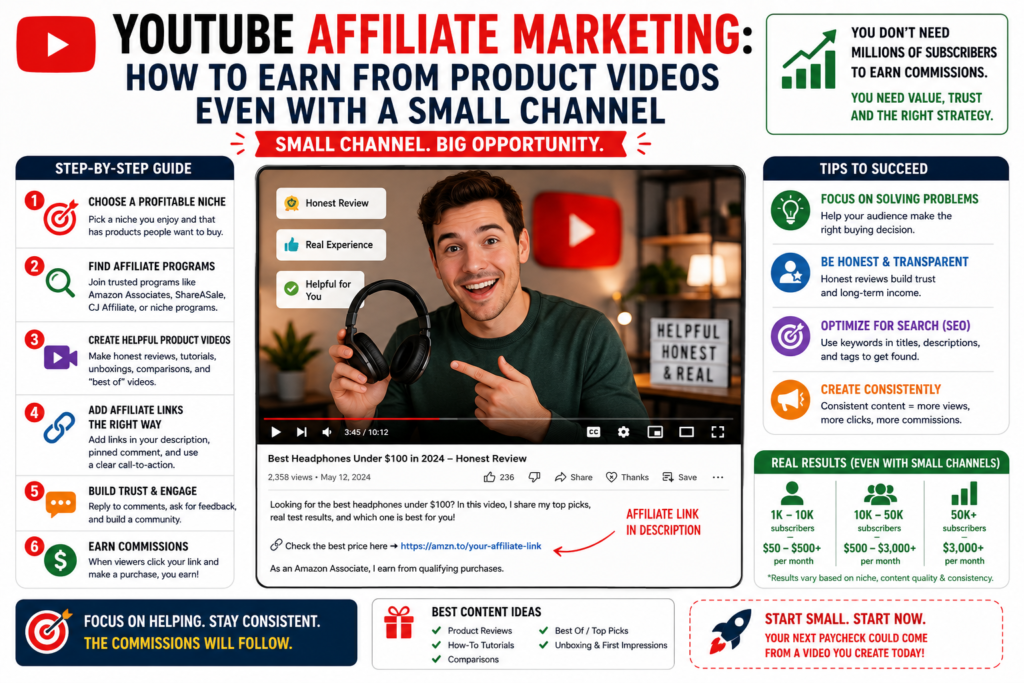
There’s a common belief in affiliate marketing circles that you need a massive YouTube following to earn anything meaningful. Hundreds of thousands of subscribers. Viral videos. A studio setup that costs more than most people’s cars.
That belief is wrong.
Some of the most profitable affiliate marketers on YouTube have channels with fewer than 10,000 subscribers. A few are earning full-time income with under 5,000. The difference between channels that earn and channels that don’t has almost nothing to do with audience size and everything to do with strategy.
YouTube is the second largest search engine on the planet. People go there every single day to research products before they buy. They type in “best laptops under $1,000” or “is the Dyson V15 worth it” or “Notion vs. Clickup” and watch videos from creators they’ve never heard of. If your video answers their question and your affiliate link is in the description, you earn a commission. Whether you have 500 subscribers or 500,000.
This guide breaks down exactly how to build a YouTube affiliate marketing strategy that generates commissions from product videos, even if you’re starting from zero.
Why YouTube Works So Well for Affiliate Marketing
Most affiliate content lives on blogs. And blogs work. But YouTube has a few distinct advantages that make it a powerhouse for product-based affiliate income.
People trust video recommendations more than written ones. When someone watches you hold a product, demonstrate it, and share your honest opinion, they feel like they’re getting advice from a real person, not reading a sales pitch. That trust translates directly into higher conversion rates.
YouTube videos rank in Google search results. Your video doesn’t just compete on YouTube. It can show up on the first page of Google for product-related searches, giving you two traffic sources from one piece of content.
Videos have a long shelf life. A well-optimized product review video can generate views, clicks, and commissions for years. Unlike social media posts that disappear within hours, YouTube content compounds over time.
Buying intent is baked into product searches. Someone searching “best noise-canceling headphones 2026” is far closer to making a purchase than someone scrolling Instagram. They’re actively looking for a recommendation. Your job is simply to give them one.
The Subscriber Count Myth (And What Actually Matters)
Let’s put the subscriber myth to rest with a concrete example.
Channel A has 200,000 subscribers and posts lifestyle vlogs. Their audience watches for entertainment. When they drop an affiliate link for a random product, maybe 0.1% of viewers click it. Of those, a fraction buy.
Channel B has 3,000 subscribers and posts focused comparison videos of project management software. Their audience watches because they’re actively deciding which tool to buy. Click-through rates on affiliate links run 5% to 10%. Conversion rates are high because viewers are ready to purchase.
Channel B earns more in affiliate commissions despite having 98.5% fewer subscribers.
The metrics that actually predict affiliate income on YouTube:
- Search volume for your target topics. Are people searching for the products you review?
- Buyer intent of your viewers. Are they watching to buy or watching to be entertained?
- Click-through rate on your affiliate links. Are you placing links effectively and giving viewers a reason to click?
- Relevance of your product recommendations. Are you recommending products your specific audience needs?
A small channel with high buyer intent will outperform a large channel with casual viewers every single time.
Step 1: Choose a Profitable Niche for YouTube Affiliate Content
Your niche determines your ceiling. Pick a niche with expensive products, strong affiliate programs, and an audience that researches on YouTube before buying.
High-performing niches for YouTube affiliate marketing:
- Tech and software. Laptops, phones, cameras, SaaS tools, apps. High price points, strong affiliate programs, and a massive audience that watches reviews before purchasing.
- Home office and productivity gear. Desks, chairs, monitors, keyboards, lighting. The remote work boom created a hungry audience that refreshes their setup regularly.
- Health and fitness equipment. Home gym gear, supplements, wearables, recovery tools. People want to see these products in action before spending money.
- Outdoor and travel gear. Backpacks, tents, hiking boots, camera gear for travelers. Passionate audiences that trust video demonstrations over written specs.
- Creative tools. Video editing software, design tools, audio equipment, online course platforms. Creators watch other creators to decide what tools to use.
- Financial products. Credit cards, investment platforms, budgeting apps. High commissions (some credit card affiliates pay $50 to $200 per sign-up) with audiences actively comparing options.
Niches that struggle on YouTube for affiliates:
- Low-cost consumables (hard to earn meaningful commissions on $5 products)
- Niches where the audience doesn’t search YouTube for purchase decisions
- Overly broad niches where you can’t establish any authority
Pick a niche narrow enough that you can become a go-to resource within six months, but wide enough that you won’t run out of products to review.
Step 2: Understand the Video Types That Drive Affiliate Sales
Not all YouTube videos are equal when it comes to affiliate commissions. Some formats are built for selling. Others are built for views and engagement. You want to focus on the formats that attract viewers with purchase intent.
The Money-Making Video Formats:
1. Product Reviews
The classic affiliate video. You review a single product in depth, covering features, pros, cons, who it’s best for, and your honest verdict.
Example titles:
- “Sony A7IV Review After 6 Months: Worth It in 2026?”
- “I Tried the Standing Desk Everyone’s Talking About (Uplift V2 Review)”
- “Kajabi Honest Review: The Good, the Bad, and Who Should Skip It”
Why they work: viewers watching a product review are usually one step away from buying. They want confirmation that the product is right for them.
2. Comparison Videos
Two or more products, side by side. These videos capture viewers who’ve narrowed their options but can’t decide.
Example titles:
- “Notion vs. Obsidian: Which Note App Should You Pick?”
- “MacBook Air vs. MacBook Pro for Video Editing (Real-World Test)”
- “ConvertKit vs. MailerLite: Best Email Platform for Beginners?”
Why they work: comparison searchers have extremely high buying intent. They’ve already decided to buy something. They just need help picking which one. And whichever product you recommend, they click your link.
3. “Best Of” Roundup Videos
Curated lists of top products in a category. These videos cast a wide net and capture early-stage researchers.
Example titles:
- “Best Budget Cameras for YouTube in 2026 (Under $500)”
- “Top 5 Project Management Tools for Freelancers”
- “The 7 Best Protein Powders I’ve Actually Tested”
Why they work: you include affiliate links for every product mentioned. Even if only 20% of viewers click, the variety means different viewers click different links based on their preferences.
4. Tutorial and “How I Use It” Videos
Show a product in action. Walk through your workflow, setup, or results using the product.
Example titles:
- “How I Edit YouTube Videos in DaVinci Resolve (Full Workflow)”
- “My Complete Home Office Setup Tour and Why I Chose Each Piece”
- “How I Use Canva Pro to Create All My Thumbnails (Step-by-Step)”
Why they work: tutorials demonstrate real value. Viewers see the product solving a real problem and think, “I want that same result.” The affiliate link becomes a natural next step.
5. “X Months Later” Follow-Up Videos
Revisit a product after extended use. These are gold mines because they answer the question every buyer has: “Does this product hold up over time?”
Example titles:
- “iPhone 16 Pro: 6 Months Later, Do I Regret It?”
- “My $300 Standing Desk After 1 Year (Honest Update)”
- “Flodesk Review After 12 Months: Did I Switch Back?”
Why they work: these videos build enormous trust. Viewers know you’re not just giving a first-impression review. You’ve lived with the product. Your opinion carries more weight, and that weight turns into clicks and commissions.
Step 3: Research Keywords Before You Film
This is the step most small creators skip, and it’s the reason their videos get zero views.
YouTube is a search engine. If nobody is searching for the topic you’re covering, your video will sit there collecting dust regardless of how good it is.
How to find keywords with affiliate potential:
Use YouTube’s search suggest. Start typing a product name or category into YouTube’s search bar and see what auto-completes. These suggestions are based on what real people are actually searching for.
Type “best laptop for” and you’ll see completions like “best laptop for college students,” “best laptop for video editing,” “best laptop for programming.” Each of those is a video idea with built-in search demand.
Check competitor channels. Find channels in your niche that are doing well with affiliate content. Sort their videos by “Most Popular.” Study which product videos got the most views. If a competitor with a similar-sized channel got 50,000 views on a comparison video, that topic has demand.
Use keyword research tools. Tools like TubeBuddy, VidIQ, or Ahrefs’ YouTube keyword tool show you estimated search volume and competition for specific queries. Look for keywords with decent search volume (1,000+ monthly searches) and moderate competition.
Target long-tail keywords. Instead of “best camera” (impossibly competitive), target “best camera for YouTube beginners under $500.” Longer, more specific queries have less competition and higher buyer intent.
Check Google trends. If a product just launched or is gaining popularity, early reviews can capture a wave of search traffic before bigger channels get their videos up.
A keyword research workflow for affiliate videos:
- List 10 products or product categories in your niche.
- For each, search YouTube and note the auto-suggest completions.
- Check competitor channels for popular product videos.
- Use TubeBuddy or VidIQ to estimate search volume.
- Prioritize topics with solid search demand and low to moderate competition.
- Save these topics in a spreadsheet with columns for keyword, estimated volume, competition level, and affiliate program/commission rate.
This research takes a few hours upfront but saves you from creating videos nobody will ever find.
Step 4: Create Videos That Build Trust and Drive Clicks
You don’t need a Hollywood production setup. You need clear audio, decent lighting, and honest opinions. Here’s how to structure affiliate videos that convert.
The First 30 Seconds Decide Everything
YouTube’s algorithm watches how many viewers stay past the first 30 seconds. If people click away, your video gets buried.
Open strong. Skip the lengthy intros. Don’t start with “Hey guys, welcome back to my channel, don’t forget to like and subscribe…” That’s a fast track to the back button.
Instead, start with the value:
- “I’ve been using this desk for six months, and I need to tell you about the one feature that almost made me return it.”
- “If you’re choosing between these two cameras, this video will save you a $400 mistake.”
- “I tested every project management tool on this list for at least 30 days. Here’s what actually worked.”
Hook them with a specific, intriguing claim. Then deliver on it.
Structure Your Review Around What Buyers Care About
Buyers have predictable questions. Your video should answer them in a logical order:
- What is this product and who is it for? (10 seconds)
- What’s your overall verdict? (Give it early. Don’t make them wait 15 minutes. Viewers appreciate when you respect their time.)
- Key features and benefits (Focus on the 3 to 5 features that matter most, not every spec on the data sheet)
- Real-world performance (Show the product in use. Screen recordings for software. Footage or photos for physical products.)
- Honest downsides (This is where you build trust. Every product has weaknesses. Mention them.)
- Who should buy this and who shouldn’t (Specificity increases trust. “This camera is perfect for YouTube creators who shoot mostly at a desk, but if you need something for outdoor run-and-gun shooting, look at [alternative] instead.”)
- Call to action (Tell them where to find the link. Keep it natural.)
Show, Don’t Just Tell
The biggest advantage video has over written content is the ability to demonstrate. Use it.
- For physical products: show unboxing, setup, daily use, and results.
- For software: record your screen walking through the interface, showing your actual workflow.
- For services: show the sign-up process, your dashboard, and your results.
When viewers see a product working in real life, their confidence in the purchase (and your recommendation) goes up dramatically.
Be Genuinely Honest
This deserves its own section because it’s the single most powerful conversion tactic on YouTube.
If a product has a flaw, say so. If you wouldn’t recommend it for certain use cases, say so. If a competitor makes a better product for half the price, say so.
Counterintuitive as it sounds, honest criticism sells more products through affiliate links than blind praise. When you point out a product’s weaknesses and still recommend it for the right audience, your recommendation carries real weight. Viewers think, “This person isn’t just trying to sell me something. They’re giving me their real opinion.”
That trust turns into clicks, purchases, and long-term subscribers who come back to your channel every time they need to buy something new.
Step 5: Optimize Your Videos for Search and Discovery
Creating a great video is step one. Making sure people can find it is step two.
Title Optimization
Your title should include your target keyword while sounding natural and click-worthy.
Good: “Best Budget Microphone for YouTube 2026 (I Tested 7)”
Bad: “Budget Microphone YouTube Best Microphone Budget Review 2026”
Place the keyword near the beginning of the title when possible. Keep titles under 60 characters so they don’t get cut off in search results.
Description Optimization
YouTube’s algorithm reads your description to understand what your video is about. Use it strategically.
- Write a 150 to 200 word description that naturally includes your target keyword and related terms.
- Place your affiliate links near the top of the description (viewers shouldn’t have to click “show more” to find them).
- Include timestamps for different sections of your video. This improves user experience and can earn you timestamp-based search results.
- Add a brief affiliate disclosure at the bottom.
Tags
Tags are less influential than they used to be, but still worth including. Use your main keyword, variations of it, and related terms. 8 to 15 tags per video is a reasonable range.
Thumbnails
Your thumbnail is the most powerful ranking factor you can control, because it directly affects click-through rate, which YouTube’s algorithm weighs heavily.
Effective affiliate video thumbnails:
- Show the product clearly
- Include readable text (3 to 5 words maximum)
- Use contrasting colors that pop against YouTube’s white background
- Show your face with an expressive reaction (if you’re on camera)
- For comparison videos, show both products side by side
Test different thumbnail styles and track which ones get higher CTR in your YouTube analytics.
Chapters and Timestamps
Adding chapters (timestamps in your description) serves two purposes:
- Viewers can jump to the sections they care about, which improves satisfaction and watch time.
- Google sometimes shows individual chapters in search results, giving you multiple chances to capture clicks.
Format them like this in your description:
0:00 Introduction
0:45 Unboxing and First Impressions
2:30 Key Features
5:15 Real-World Testing
8:00 Pros and Cons
9:30 Who Should Buy This
10:15 Final Verdict
Step 6: Place Affiliate Links Where They Get Clicked
Having an affiliate link in your description doesn’t mean anyone will click it. Placement and presentation matter.
Link placement best practices:
- Put affiliate links above the fold. The “show more” fold in YouTube descriptions hides everything below the first two to three lines. Your most relevant affiliate link should be in the very first line of your description.
- Label links clearly. Don’t just paste a raw URL. Write something like: “Get the Sony A7IV here: [link]” or “Try ConvertKit free for 14 days: [link]”
- Use link shorteners or branded links. Tools like Geniuslink, Amazon’s built-in shortener, or a custom domain shortener make your links cleaner and more trustworthy. A branded link like yourname.com/camera looks more professional than a 200-character Amazon URL.
- Pin a comment with your top link. YouTube lets you pin a comment to the top of your comment section. Pin one that includes your main affiliate link. Many viewers check comments before the description.
- Mention links verbally in the video. At natural points in your video, tell viewers: “I’ll put a link in the description if you want to check the current price.” Simple verbal cues dramatically increase click-through rates.
When to mention links in your video:
- After you deliver your verdict on a product
- After demonstrating a feature that creates a “wow” moment
- At the end of the video during your wrap-up
- In comparison videos, after declaring your recommended pick
Don’t overdo it. Two to three verbal link mentions per video is the sweet spot. More than that starts to feel pushy.
Step 7: Build a Content System That Compounds
Random uploads won’t build a channel. You need a content system, a repeatable process that produces consistent videos targeting high-intent keywords.
The Affiliate Content Calendar
Plan your videos around three categories:
Evergreen reviews (60% of your content). Products that stay relevant for 12+ months. These videos accumulate views and commissions over time. A “best email marketing tool” video from six months ago can still drive daily commissions if the tools haven’t changed much.
Trending and new release reviews (25% of your content). When a new product launches, early reviewers capture a surge of search traffic. If you can get your hands on a product within the first week of release and publish a quality review, you’ll grab views from a wave of buyers doing research.
Comparison and roundup videos (15% of your content). These videos target viewers who are comparing options. They tend to have slightly lower search volume per keyword but extremely high conversion rates because the viewer is actively choosing between products.
A sustainable upload schedule for a small channel:
- One video per week is enough to build momentum
- Two videos per week accelerates growth significantly
- Consistency matters more than frequency. One video every week for a year beats three videos per week for two months followed by silence.
Batch your production. Research and script three to four videos at once. Film them in one or two sessions. Edit and upload on a schedule. This is far more efficient than starting from scratch each week.
Step 8: Leverage YouTube’s Ecosystem Beyond Search
Search is your primary traffic source, but YouTube offers other discovery channels that can amplify your reach.
Suggested Videos
YouTube recommends videos in the sidebar and after a video ends. Getting your product review suggested alongside a competitor’s review can send significant traffic your way.
To increase your chances of appearing in suggested videos:
- Create videos on the same products that popular creators review
- Use similar (not identical) titles and tags
- Encourage viewers to watch more of your videos (suggest related content at the end)
- Maintain high watch time and engagement metrics
YouTube Shorts
Short-form vertical videos (under 60 seconds) can introduce new audiences to your channel. Create quick “30-second review” or “one thing I love/hate about [product]” Shorts that link to your full review.
Shorts won’t drive direct affiliate clicks efficiently, but they can funnel viewers to your long-form content where your links live.
Community Tab
Once you hit 500 subscribers, you gain access to the Community tab. Use it to:
- Poll your audience on which products they want you to review next
- Share quick product recommendations with affiliate links
- Post updates about deals or sales on products you’ve reviewed
Playlists
Organize your product videos into playlists by category. “Best Cameras 2026,” “Home Office Gear Reviews,” “Software Comparisons.” Playlists increase session watch time and make it easy for new viewers to binge your content. More watch time means YouTube promotes your channel more aggressively.
Step 9: Monetize Beyond a Single Affiliate Link
Smart YouTube affiliates don’t stop at one link per video. They build a monetization stack.
Link to a comparison or resources page on your website. Instead of (or in addition to) direct affiliate links, link to a blog post where you list all the products mentioned with detailed breakdowns and multiple affiliate links. This approach captures people who want to research further and gives you multiple chances to earn a commission.
Build an email list from your YouTube audience. Mention a free resource (checklist, guide, template) in your videos and link to an opt-in page. Once someone is on your email list, you can recommend affiliate products for months and years through automated sequences.
Stack multiple affiliate programs. For the same product, check if there’s a direct affiliate program (through the company) and a marketplace program (like Amazon or ShareASale). Direct programs often pay higher commissions but have shorter cookie durations. Test both and use whichever performs better.
Negotiate sponsored deals as you grow. When companies see you’re already driving sales through affiliate links, they often reach out about sponsored content. This adds a flat fee on top of your affiliate commissions for the same type of content you’d make anyway.
Step 10: Common Mistakes That Kill Affiliate Revenue on YouTube
Reviewing products you’ve never used. Viewers can tell when someone is reading specs off a website versus sharing genuine experience. If you haven’t used the product, your review will lack the specific, personal details that drive trust and conversions.
Burying your affiliate links. If viewers have to scroll through five paragraphs of description text and click “show more” to find your links, most won’t bother. Put links at the very top.
Ignoring SEO completely. A video with no keyword strategy is a video that relies entirely on luck for discovery. Even spending 10 minutes on keyword research per video makes a measurable difference.
Copying bigger channels’ format exactly. What works for a channel with 500,000 subscribers won’t necessarily work for you. Large channels can post vague, personality-driven content and still get views. Small channels need the precision of keyword-targeted, search-optimized content to gain traction.
Giving up after 20 videos. Most successful YouTube affiliates didn’t see meaningful results until they had 30 to 50 videos published. The first 20 videos are practice, experimentation, and building a library of content that compounds over time.
Promoting products only for the commission. If you recommend something you wouldn’t personally buy, your audience will eventually figure that out. The short-term commission isn’t worth the long-term damage to your credibility. Choose products you genuinely stand behind.
Step 11: What to Do When You Don’t Have the Product
Not every product review requires you to own the product, though owning it is always preferred. Here’s how to create valuable content when you can’t get your hands on the product directly.
Software and digital products: Most SaaS tools offer free trials. Sign up, use the product for a week, and record your screen as you walk through the features. Your review will be based on real experience, even if you don’t pay for the full subscription.
Physical products you can’t afford: Consider reaching out to the company and asking if they’ll send a review unit. Even with a small channel, many brands (especially newer ones and direct-to-consumer brands) will send products in exchange for an honest review. Frame your pitch around the value you provide: a detailed, honest video review targeting buyers who are searching for the product.
Products from industry data: For roundup videos (“best X for Y”), you can combine publicly available specifications, user reviews, expert opinions, and any personal experience you have with similar products. Be transparent about which products you’ve personally tested and which you’re evaluating based on research.
The key is honesty. If you haven’t used a product hands-on, say so. Your audience will respect the transparency, and you can still provide genuine value through thorough research and comparison.
Step 12: Track Your Performance and Double Down on Winners
You can’t improve what you don’t measure. Set up tracking from day one.
What to track:
- Views per video. Which topics attract the most viewers?
- Watch time and retention. Which videos keep people watching longest? YouTube promotes these more aggressively.
- Click-through rate on affiliate links. Use a link tracker (or your affiliate program’s dashboard) to see which videos drive the most clicks.
- Conversion rate. Of the people who clicked, how many bought? This tells you which products resonate most with your audience.
- Revenue per video. Calculate the total affiliate income each video generates. This is your most valuable metric for deciding what to create more of.
How to use this data:
If your comparison videos earn three times more per view than your roundup videos, make more comparison videos. If a certain product category converts at twice the rate of another, shift your content calendar to cover more products in that category. If one video is generating steady daily commissions, create follow-up content: an update video, a tutorial using that product, or a comparison with its top competitor.
The pattern is straightforward: find what works, do more of it, and cut what doesn’t.
A Realistic Timeline for a New YouTube Affiliate Channel
Months 1 to 2: You’re learning. Video quality will be rough. SEO instincts will be off. You might make $0 to $20 in affiliate commissions. That’s fine. Focus on publishing consistently (one video per week minimum) and improving with each upload.
Months 3 to 4: Some videos start picking up search traffic. You’ve learned what topics get views and what falls flat. Commissions might reach $50 to $200 per month. Your production quality has noticeably improved.
Months 5 to 8: Your library of content is working for you. Older videos are accumulating views. You understand your audience’s buying patterns. Monthly commissions could reach $500 to $2,000 depending on your niche and product price points.
Months 9 to 12: You have 40+ videos, a recognizable presence in your niche, and a system for producing content efficiently. Monthly affiliate income could range from $1,000 to $5,000+. Brands start reaching out for collaborations. You’ve built something that generates income whether or not you upload this week.
These numbers aren’t guarantees. They’re based on realistic scenarios for creators who pick a solid niche, publish consistently, and optimize based on data. Your specific results will vary based on niche, commission rates, and execution quality.
The Long Game
YouTube affiliate marketing isn’t a quick-money scheme. It’s a content business. Every video you publish is an asset that can generate commissions for years. A product review you record this weekend could still be earning you money in 2029.
The creators who succeed treat their channels like a business: they research before they create, they optimize after they publish, and they think in terms of systems, not one-off videos.
You don’t need a million subscribers. You don’t need expensive equipment. You don’t need to be a natural on camera.
You need a niche where people search for product recommendations, a camera (your phone works fine), and the discipline to show up every week with honest, well-researched content.
Start with one video. Review one product you already own and love. Optimize it for search. Put your affiliate link in the description. Hit publish.
Then do it again next week.
What product do you already own that you could review this week? Starting with something you know inside and out makes your first video easier, faster, and more authentic than anything else you could film.