Affiliate marketing is a legitimate business model. Real people earn real money recommending products and earning commissions. That part isn’t a scam.
But the industry that has grown up around teaching affiliate marketing? That’s where things get ugly.
Type “how to start affiliate marketing” into any search engine or social media platform and you’ll be buried under an avalanche of ads, webinars, free masterclasses, and course launches. A confident person on camera, usually standing next to a rented sports car or sitting in a suspiciously pristine home office, tells you they cracked the code to earning $10,000 per month in passive income. And for a limited-time price of $997 (marked down from $4,997, of course), they’ll share their exact system with you.
Some of these courses are genuinely good. A small number are excellent. The problem is that a significant percentage of them are overpriced, underdelivering, deliberately misleading, or outright fraudulent. And for a beginner who doesn’t yet know enough to tell the difference, spending $500 to $2,000 on the wrong program can be financially painful and demoralizing enough to kill their interest in affiliate marketing entirely.
This article is the guide you read before you buy anything. It covers how the scam ecosystem works, the specific red flags that reveal a bad actor, how legitimate programs differ from predatory ones, and what you should actually spend money on (if anything) when you’re starting out.
Why Affiliate Marketing Attracts So Many Scams
Understanding why this space is particularly prone to scams helps you recognize the patterns faster.
The Knowledge Gap Is Enormous
People entering affiliate marketing are, by definition, beginners. They don’t know what they don’t know. They can’t evaluate whether a course’s promised strategy is sound because they haven’t tried any strategy yet. They can’t tell whether an income claim is realistic because they have no reference point.
This knowledge gap creates the perfect environment for bad actors. When the buyer can’t assess the quality of what they’re purchasing until after they’ve paid, the seller’s incentive shifts from delivering value to delivering persuasion. The product doesn’t need to be good. The sales pitch does.
The Product Is Information, Which Is Easy to Repackage
Creating a physical product requires manufacturing, inventory, and quality control. Creating an information product requires a screen recorder and some slides. The barrier to creating an affiliate marketing course is almost zero, which means anyone can create one regardless of whether they have genuine expertise or results.
Many low-quality courses are simply repackaged free content. The “guru” watches 20 YouTube videos about affiliate marketing, compiles the information into a slide deck, records themselves presenting it, and sells it for $497. The content isn’t wrong, exactly. It’s just freely available information wrapped in a premium price tag.
Income Claims Are Unverifiable
When someone shows you a screenshot of their affiliate dashboard showing $47,000 in monthly earnings, you have no way to verify it. Screenshots can be inspected and edited in a browser’s developer tools in about 30 seconds. Dashboard numbers can represent gross revenue before expenses and refunds. Earnings can be from a single exceptional month presented as if they’re typical. And even legitimate high earnings don’t prove the person can teach you to replicate them.
The affiliate marketing space relies heavily on income proof as a selling tool, and the ease of fabricating or misrepresenting that proof is a fundamental vulnerability that scammers exploit.
The “Make Money Online” Meta-Loop
This is the most insidious pattern in the space, and understanding it inoculates you against a huge percentage of scams.
Here’s how it works:
- Person A creates a course teaching affiliate marketing
- Person A’s primary income isn’t from affiliate marketing, it’s from selling the course about affiliate marketing
- Person A offers an affiliate program for their own course, paying 30% to 50% commissions
- Person A’s students (Person B, C, D) can’t replicate Person A’s affiliate marketing results because the strategy taught is mediocre
- But Person B, C, and D can earn money by promoting Person A’s course to new beginners
- Person B starts creating content about “how I make money online,” and the answer is: by selling Person A’s course
- Person B then creates their own course about making money online, and the cycle repeats
In this loop, the actual product being sold is the dream of affiliate marketing success, not a genuine path to achieving it. The only people making money are the ones selling courses about making money. The students who succeed do so by becoming sellers of the same type of course, not by building real affiliate marketing businesses.
When you see someone teaching affiliate marketing whose primary income source is the course itself (and not from affiliate marketing in a specific niche like tech, cooking, fitness, or finance), you’re likely looking at this pattern.
The Anatomy of a Typical Scam or Low-Value Course
Scammy affiliate marketing programs follow a remarkably consistent playbook. Once you’ve seen the template, you’ll recognize it everywhere.
Stage 1: The Hook
You encounter a piece of content designed to pull you into the funnel. This could be:
- A YouTube ad showing luxury cars, tropical locations, and laptop lifestyle footage
- A Facebook or Instagram ad with text like “I was broke 6 months ago. Now I earn $30K/month from my laptop. Want to know how?”
- A TikTok video showing a phone screen with affiliate dashboard numbers, overlaid with text about quitting a 9-to-5
- A “free training” or “free masterclass” advertised across social media
- A blog post or podcast interview where the guru shares just enough to seem credible, then directs you to their program
The hook always contains two elements: a transformation story (from broke/stuck/miserable to rich/free/fulfilled) and an implied promise (you can do this too, if you get the right system).
Stage 2: The Free Content / Webinar
The hook leads to a free webinar, video series, or “challenge.” This content serves two purposes:
Purpose 1: Establish authority. The presenter shares some genuine information, enough to demonstrate that they know something about the topic. This might be a basic overview of how affiliate marketing works, some real terminology, and a few legitimate tips. The information isn’t wrong, but it’s deliberately incomplete. It’s designed to make you feel like you’re learning while also making you feel like there’s a much bigger picture you’re missing.
Purpose 2: Build urgency. Throughout the free content, emotional triggers are layered in:
- “Most people never learn this” (exclusivity)
- “I wish I’d known this when I started” (implied time savings)
- “The people in my program are already seeing results” (social proof)
- “This opportunity won’t last” (scarcity)
- “You’ve been lied to by everyone else” (us-vs-them framing)
By the end of the free content, you’ve been primed to believe that: (a) the presenter has cracked a code most people don’t know, (b) you need their specific system to succeed, and (c) acting now is critical.
Stage 3: The Pitch
The free content transitions into a sales pitch for the paid program. The pitch typically includes:
An anchored price. “The real value of this program is $9,997. But because I want to help regular people, I’m offering it today for just $997.” The inflated “real value” makes the actual price feel like a bargain, even when $997 is far more than the content is worth. This anchoring technique is one of the most common pricing manipulations in digital product sales.
Income testimonials. Screenshots and video testimonials from students who earned impressive amounts. These testimonials are often real but cherry-picked: they represent the top 1% of students (or the students who earn by promoting the course itself). The experience of the median student, who earned little or nothing, is never shown.
A countdown timer. “This price expires in 24 hours.” “Only 50 spots available.” “Registration closes tonight.” These urgency mechanics pressure you to buy before you’ve had time to research the program, read reviews, or think critically about whether you need it. The timer often resets when you revisit the page, which tells you everything about how genuine the “limited availability” is.
A money-back guarantee. “Try it for 30 days. If you don’t see results, get a full refund.” The guarantee sounds risk-free, but the refund conditions often have catches: you must “prove” you completed all modules, submit assignments, show evidence that you tried the strategies, etc. Many buyers who request refunds find the process difficult, slow, or ultimately denied based on technicalities.
Bonuses. “Order today and you’ll get these 7 bonuses worth $3,000.” The bonuses are typically low-value additions: a generic ebook, access to a Facebook group, a templated spreadsheet, or a pre-recorded Q&A session. They’re listed with inflated dollar values to make the “total package” seem more impressive. A “bonus” valued at $497 might be a 15-page PDF that took an afternoon to write.
Stage 4: The Upsell
After purchasing the initial course, many programs immediately present upsells:
- “Upgrade to the VIP tier for personal coaching: $2,997”
- “Join the mastermind group for advanced strategies: $199/month”
- “Get the done-for-you templates and funnels: $497”
Some programs are designed so that the base course is deliberately incomplete, pushing you toward the more expensive tiers to get the “real” value. The $997 course gives you the theory. The $2,997 upgrade gives you the implementation details. The $199/month mastermind gives you ongoing support. The total cost to get everything you were originally promised can exceed $5,000 to $10,000.
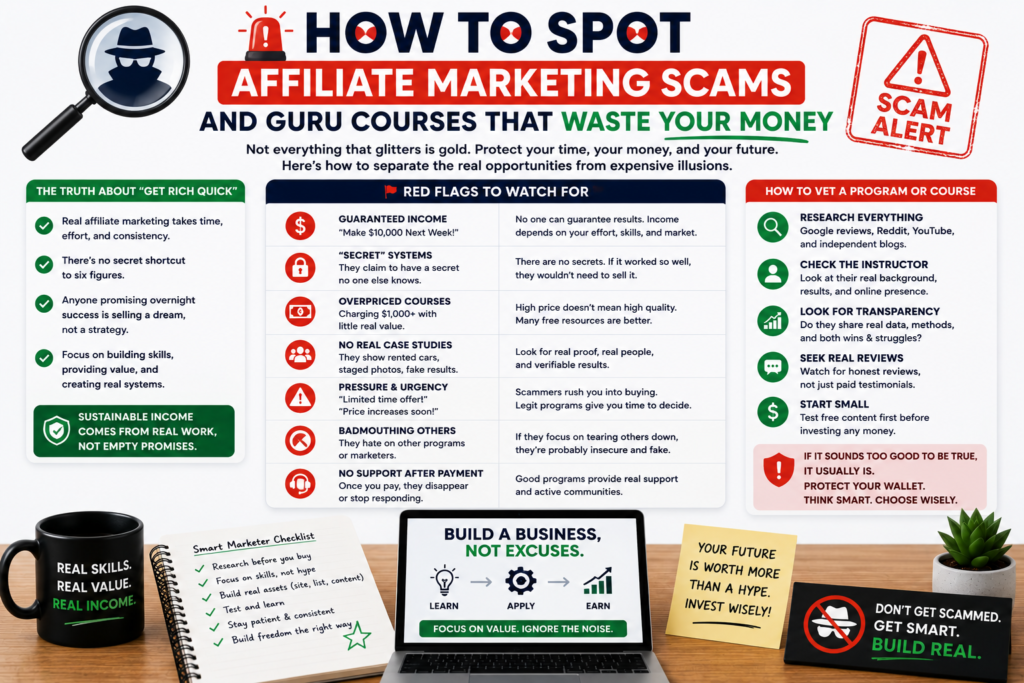
Red Flags: How to Identify a Scam or Low-Value Program
Not every expensive course is a scam, and not every free course is legitimate. The following red flags help you distinguish between programs worth your money and programs designed to extract it.
Red Flag 1: Income Claims Without Context
What it looks like: “I earn $47,000 per month from affiliate marketing.” Screenshot of a dashboard showing impressive numbers. No additional context.
Why it’s a red flag: Raw income numbers without context are meaningless. What are the expenses? What’s the profit margin? Is this a typical month or the best month ever? How long did it take to reach this level? How much money was invested in ads, tools, and outsourcing? Is this revenue from affiliate marketing or from selling the course about affiliate marketing?
What a legitimate creator does instead: They share revenue and profit (not just gross numbers). They provide timelines (“It took me 18 months to reach $5,000/month”). They show the trajectory, including the slow early months, not just the peak. They acknowledge that results vary and that their specific numbers aren’t typical. They’re transparent about all income sources, including course sales.
Red Flag 2: Emphasis on Lifestyle Over Strategy
What it looks like: Videos featuring luxury cars, beachfront locations, first-class flights, designer clothing, and expensive dinners. The presenter talks more about what they bought than what they built.
Why it’s a red flag: Legitimate affiliate marketers who earn high incomes generally don’t lead with lifestyle flexing when they teach. They lead with strategy, data, case studies, and specific tactics. When the primary marketing angle is “look at my lifestyle,” the product being sold isn’t education, it’s aspiration. You’re paying for the dream, not for skills.
The lifestyle footage is often fabricated or rented. Luxury car rental services that cater specifically to content creators exist in every major city. Airbnb mansions can be rented for a day of filming. A $200 investment in props can create the illusion of millions in wealth.
What a legitimate creator does instead: They might show their lifestyle occasionally, but their primary content focuses on the actual work: screen shares of their analytics, walkthroughs of their content strategy, honest discussions of failures and setbacks, and specific tactical advice that you can evaluate for quality.
Red Flag 3: Vague or Non-Specific Strategies
What it looks like: “My system uses a proven 3-step formula that generates passive income while you sleep.” “I’ll show you the exact blueprint I used to go from zero to six figures.” The actual method is described in broad, impressive-sounding terms with no specifics.
Why it’s a red flag: If the strategy were genuinely valuable and specific, sharing a concrete detail or two in the free content would make the paid version more appealing, not less. Vagueness is a shield for programs that don’t contain anything beyond what’s freely available on YouTube or in blog posts. The “proprietary system” is often just “start a blog, write product reviews, do SEO” repackaged in branded terminology.
What a legitimate creator does instead: They share specific, actionable information in their free content. They name the tools they use. They show real examples from their own sites. They explain their process in enough detail that you could start implementing it before buying anything. Their paid content goes deeper, but the free content proves they have genuine expertise.
Red Flag 4: Pressure to Buy Immediately
What it looks like: Countdown timers. “Only 23 spots remaining.” “This price expires at midnight.” “I can’t guarantee this offer will be available tomorrow.” “The next cohort doesn’t start for 6 months.”
Why it’s a red flag: Legitimate educational programs don’t need high-pressure sales tactics. If the program is genuinely valuable, it will still be valuable next week after you’ve had time to research it, read reviews, and make an informed decision. Artificial urgency exists specifically to prevent you from doing that research, because the research would reveal the program’s weaknesses.
If the countdown timer resets when you clear your browser cookies or open the page in incognito mode, the scarcity is manufactured.
What a legitimate creator does instead: They let the product sell on its merits. They encourage potential students to read reviews and testimonials. They don’t punish you for taking time to decide. They might offer enrollment periods (legitimate cohort-based programs do have start dates), but they don’t create fake urgency to pressure an immediate purchase.
Red Flag 5: The Primary Income Is From Selling the Course
What it looks like: When you research the guru’s actual affiliate marketing business, you can’t find it. Their blog doesn’t rank for product keywords. Their YouTube channel is entirely about making money online. Their affiliate income comes from promoting other people’s courses and tools for affiliate marketers, not from promoting products to consumers.
Why it’s a red flag: If someone teaches affiliate marketing but their only successful affiliate marketing is promoting courses about affiliate marketing, they haven’t proven the skill they’re selling. They’ve proven they can sell a course. Those are different skills.
The best analogy: a cooking teacher who has never worked in a restaurant or cooked for real dinner guests. They might be able to teach recipes they’ve read about, but they lack the real-world experience that separates theory from practice.
What a legitimate creator does instead: They have a visible, verifiable affiliate marketing business outside of course sales. You can find their niche sites. You can see their content ranking in Google. Their income reports (if they share them) show revenue from multiple affiliate programs in a specific niche, not just from course and tool sales. Their course income might be a significant revenue stream, but it’s not their only one.
Red Flag 6: Testimonials That Don’t Add Up
What it looks like: Video testimonials of students saying “I made $10,000 in my first month!” Social proof screenshots showing dozens of people celebrating massive earnings. The testimonials sound scripted, use similar language, or focus entirely on income without describing what the student actually did.
Why it’s a red flag: Fake testimonials are easy to produce. You can buy video testimonials on Fiverr for $20 to $50. You can fabricate text screenshots. You can incentivize real students to provide glowing reviews in exchange for bonuses or continued access.
Even when testimonials are real, they’re cherry-picked. A program with 1,000 students might have 15 who earned significant money (often by promoting the course itself). Those 15 are featured prominently. The 985 who earned little or nothing are never mentioned.
What a legitimate creator does instead: They share a range of outcomes, including students who struggled or had modest results. They don’t promise specific income levels. They show the work the students did, not just the result. Their testimonials describe the skills learned and the process followed, not just the money earned.
Red Flag 7: The Refund Policy Has Hidden Conditions
What it looks like: “100% money-back guarantee! Try it risk-free!” But the refund terms buried in the fine print require you to complete all modules, submit proof of implementation, attend all coaching calls, and demonstrate that you “gave the system a fair try” before requesting a refund.
Why it’s a red flag: These conditions make the “guarantee” practically unusable. If you realize by module 3 that the content is garbage, you can’t get a refund because you didn’t complete all 12 modules. If you implemented some strategies but not all, the creator can argue you didn’t follow the system completely.
The conditions serve a specific purpose: they dramatically reduce the number of people who actually request refunds, regardless of how unsatisfied they are. Many buyers who want refunds give up because the process is too burdensome.
What a legitimate creator does instead: They offer a straightforward refund policy. “Not satisfied? Email us within 30 days for a full refund. No questions asked.” Legitimate creators know that their content delivers value and that unrestricted refund policies don’t result in mass refund requests.
Red Flag 8: Private Communities With Controlled Information Flow
What it looks like: The course includes access to a private Facebook group, Discord server, or community platform. Within the community, negative experiences are deleted or discouraged. Dissenting opinions are labeled as “negative energy” or “not having the right mindset.” Students who question the methodology are subtly (or overtly) shamed.
Why it’s a red flag: Controlled communities create an echo chamber where the only visible experiences are positive ones. New students see a wall of success stories and assume the program works for everyone. The students who failed quietly leave or are removed, creating a survivorship-biased environment.
In healthy communities, people share struggles, ask critical questions, and discuss what doesn’t work alongside what does. If a community feels like everyone is succeeding except you, and negative experiences seem to evaporate, the community is curated, not genuine.
What a legitimate community does instead: Students openly discuss challenges, failures, and frustrations. The creator or moderators respond to criticism constructively. Negative experiences are treated as opportunities to help, not as inconveniences to suppress. The overall tone is supportive but honest, not relentlessly positive.
Red Flag 9: “Secret” or “Little-Known” Strategies
What it looks like: “I’m about to reveal a secret traffic source that nobody is talking about.” “This little-known loophole lets you earn commissions without creating content.” “The gurus don’t want you to know this strategy.”
Why it’s a red flag: There are no secrets in affiliate marketing. The strategies that work, SEO, content creation, email marketing, social media promotion, paid advertising, are all well-documented, widely discussed, and freely taught by hundreds of legitimate creators. Anyone claiming to have a secret system is either rebranding a common strategy with proprietary terminology or promoting a tactic that’s questionable, unsustainable, or against program terms of service.
The “gurus don’t want you to know” framing is a manipulation technique. It positions the seller as your ally against a corrupt establishment, creating an emotional bond that bypasses rational evaluation.
What a legitimate creator does instead: They teach established, proven strategies and explain why they work. They reference their sources. They acknowledge that many other people teach similar methods. Their value-add is in the depth of their explanation, their specific experience, and their ability to simplify complex topics, not in claiming exclusive access to hidden knowledge.
Red Flag 10: No Verifiable Track Record
What it looks like: The guru appeared recently with no traceable history. Their “about” page is vague. They don’t share the URLs of their affiliate sites. Their LinkedIn profile doesn’t match their claims. Googling their name returns nothing before their course launch.
Why it’s a red flag: People who have genuinely built successful affiliate marketing businesses over years have a footprint. Their sites exist. Their content ranks. Their social media history predates their course launch. Other people in the industry know them.
When someone appears from nowhere with claims of massive success but no verifiable evidence of the work behind it, the most likely explanation is that the claims are exaggerated or fabricated.
What a legitimate creator does instead: They have a traceable career path. You can find their content going back years. They’re known in their niche before they launch a course. They’ll show you their actual sites (even if they don’t share every detail publicly). Their expertise is demonstrable, not just claimed.
The Gray Area: Courses That Aren’t Scams But Aren’t Worth the Price
Not everything falls neatly into “scam” or “legitimate.” A large portion of affiliate marketing courses sit in a gray area: they contain real information, taught by people with some genuine experience, but the value delivered doesn’t justify the price.
The $997 Course That Contains $50 of Value
This is the most common gray-area scenario. The course content is accurate. The instructor has real experience. But 80% of the material is available for free in blog posts, YouTube videos, and podcast episodes. The remaining 20%, the unique insights and specific strategies, might be worth $50 to $100 as a premium resource. The $997 price tag pays for the marketing, the production quality, and the community access, not for proportionally more or better information.
How to identify this pattern:
Before buying any course, search YouTube for the course creator’s free content and the topics covered in the course syllabus. If you can find free videos covering most of the same topics (even from other creators), the paid course is probably overpriced for the incremental value it provides.
The Legitimate Creator With Misaligned Incentives
Some creators built real affiliate marketing businesses and then discovered that selling courses about their success is more profitable than the affiliate marketing itself. Gradually, their focus shifted from practicing affiliate marketing to teaching it. Their course content reflects strategies that worked when they were actively doing affiliate marketing, but they may not be actively testing, updating, or refining those strategies anymore.
The course isn’t a scam. The information was valid at some point. But the creator’s attention has moved to course marketing, and the course content may be slowly falling out of date.
How to identify this pattern:
Check whether the creator still maintains active affiliate sites. Look at how frequently the course content is updated. Read recent reviews (not just launch reviews) to see whether students are reporting that the strategies still work.
The Good Course at the Wrong Time
Some legitimately good courses are a waste of money for beginners because they teach intermediate or advanced strategies. Learning about link-building outreach, conversion rate optimization, and email automation is valuable, but not before you’ve published your first 50 pieces of content and earned your first $100 in commissions.
Buying an advanced course as a beginner is like buying a racing engine before you’ve learned to drive. The product is real. The value is real. But the timing makes it useless.
How to identify this pattern:
Read the course prerequisites honestly. If it assumes you already have traffic, an email list, or existing affiliate income, it’s not a beginner course regardless of how it’s marketed. A course isn’t a good fit just because you want it to be.
How to Research a Course Before Buying
If you’re considering an affiliate marketing course, spend 30 to 60 minutes researching it before spending money. This due diligence process will save you from most bad purchases.
Step 1: Search for Independent Reviews
Search Google for “[course name] review” and “[course name] scam.” Read reviews from people who aren’t affiliates of the course. This is the tricky part: many “honest reviews” of courses are actually affiliate content. The reviewer earns a commission if you buy through their link. Their review is inherently biased toward recommending the purchase.
How to spot an affiliate review disguised as an honest review:
- The review concludes with a recommendation to buy, regardless of any criticisms mentioned
- The review contains affiliate links or “special bonus” offers tied to purchasing through the reviewer’s link
- The review is on a site that exclusively reviews make-money-online products (this is their monetization strategy)
- The reviewer uses phrases like “my exclusive bonus bundle” or “click my link below for the best deal”
How to find genuinely unbiased reviews:
- Search Reddit for discussions about the course. Reddit’s culture of skepticism toward self-promotion means you’re more likely to find honest opinions
- Look for reviews from people who bought the course and describe what’s inside, not from people who are affiliating it
- Check the course creator’s name on forums like BlackHatWorld, AffiliateFix, or Warrior Forum (keeping in mind that these communities can be harsh and not every critical comment is valid)
- Look for refund discussions, people sharing their experience trying to get money back are usually honest about the product quality
Step 2: Evaluate the Creator’s Track Record
- Do they have verifiable affiliate sites? Can you find them ranking in Google?
- How long have they been active in the affiliate marketing space?
- What did they do before selling courses?
- Do other respected people in the industry reference or endorse them?
- Is their social media history consistent with their claims? (Someone who was posting about their retail job 8 months ago and now claims to make $50,000/month in affiliate income is suspect)
Step 3: Assess the Free Content Quality
Consume the creator’s free content (YouTube videos, blog posts, podcast appearances) and evaluate it critically:
- Do they share specific, actionable tactics, or is everything vague and hype-driven?
- Can you verify their claims with independent sources?
- Do they acknowledge the difficulty and timeline of affiliate marketing, or do they make it sound easy and fast?
- Is the free content genuinely helpful on its own, or does every piece end with “but to get the full strategy, join my course”?
A creator whose free content is detailed, specific, honest about challenges, and provides standalone value is more likely to deliver the same quality in a paid product.
Step 4: Check the Refund Policy Carefully
Read the actual terms, not the marketing page’s summary. Look for:
- Conditions that must be met before requesting a refund
- Time limits on refund eligibility
- The process for requesting a refund (email? Form? Phone call?)
- Whether partial refunds or credits are offered instead of full refunds
- Whether the guarantee applies to all tiers or only the base product
If the refund policy is buried, confusing, or filled with conditions, treat it as a warning sign.
Step 5: Calculate the Opportunity Cost
Before buying any course, ask: “What else could I do with this money and the time it takes to go through the course?”
$997 alternative uses:
- 12 months of web hosting and a domain ($120)
- A premium WordPress theme ($60)
- A keyword research tool for a year ($100 to $200)
- A quality microphone and lighting for YouTube ($80)
- That leaves $500 to $700 for investing in your actual business (content creation tools, outsourcing, product purchases for reviews)
The information in most courses is available free through YouTube, blog posts, and podcasts. The course’s value proposition is usually organization and curation: the same information, structured in a logical sequence with a community for support. Whether that organization is worth $997 when you could self-study for free is a personal judgment call, but be honest about what you’re paying for.
What’s Actually Worth Paying For (And What Isn’t)
Worth paying for:
Tools that directly support your business
- Web hosting ($3 to $10/month)
- A domain name ($10 to $15/year)
- A keyword research tool ($0 to $30/month, free tiers exist)
- An email marketing platform (free tiers available, $15 to $30/month for paid)
- A link management plugin ($0 to $100/year)
- A decent microphone if you’re doing video ($30 to $60, one-time)
These are business expenses that directly enable your work. Total year-one cost: under $300.
Books from established practitioners
Several excellent books on affiliate marketing, SEO, content marketing, and online business cost $15 to $30 each. Authors who publish through traditional publishers have been vetted by editors and have reputational risk tied to their claims. A $25 book from a respected author often contains more value than a $997 course from an unknown guru.
Individual, affordable courses from verified experts
Some legitimate creators sell focused courses at reasonable prices ($50 to $200) on platforms like Udemy, Skillshare, or their own sites. These courses teach specific skills (keyword research, on-page SEO, email marketing, YouTube optimization) rather than promising a complete system. The focused scope and lower price point reduce the risk.
Look for courses where:
- The creator has a verifiable track record in the specific skill being taught
- The price is proportional to the scope (a 3-hour course on keyword research shouldn’t cost $500)
- Reviews come from verified purchasers on independent platforms
- The content is regularly updated
Premium communities with ongoing value
Some legitimate communities charge $20 to $50/month for access to experienced affiliates, active Q&A, site reviews, and collaborative learning. The value is in the community’s knowledge base and the feedback you receive on your specific work, not in pre-recorded video content.
The key indicator of a valuable community: members are doing the work and sharing real results (including failures), not just promoting the community itself.
Not worth paying for (in most cases):
$500+ “comprehensive” affiliate marketing courses as a complete beginner
You don’t yet know enough to evaluate the course’s quality, implement advanced strategies, or benefit from specialized knowledge. Start with free resources. Build your foundation. After 3 to 6 months of hands-on experience, you’ll know what specific skills you need to improve, and you can find targeted educational resources for those specific gaps.
Mentorship programs costing $2,000+
One-on-one mentorship can be valuable, but at these price points, the ROI for a beginner is almost always negative. You’d need to earn $2,000+ in additional affiliate income directly attributable to the mentorship to break even. For most beginners, that takes longer than the mentorship lasts.
Done-for-you systems (pre-built websites, funnels, campaigns)
These products promise to eliminate the hard work by giving you a ready-made affiliate business. The reality: duplicate content doesn’t rank in Google, pre-built funnels require paid traffic to function, and you don’t learn anything by using someone else’s system. When the system stops working (and it will), you have no skills to fix it or build a replacement.
Recurring-fee masterminds with no clear deliverables
“Join my mastermind for $197/month” often means “pay me monthly for access to a group chat where I occasionally answer questions.” If the deliverables are vague (“exclusive strategies,” “insider access,” “community support”), the value is probably vague too.
Free Resources That Outperform Most Paid Courses
The irony of the affiliate marketing education space is that the best learning resources are often free. Here’s where to learn without spending money:
YouTube
Search for specific topics rather than general “how to make money” videos. “[How to do keyword research for affiliate marketing],” “[WordPress SEO setup walkthrough],” and “[writing product reviews that convert]” will surface detailed, actionable tutorials from experienced practitioners.
Channels that teach affiliate marketing by showing their own real sites, real analytics, and real results (including slow months and failures) are worth following. Channels that show income screenshots and promote their own courses in every video are worth avoiding.
Free blog content from established affiliate marketers
Many successful affiliate marketers write detailed breakdowns of their strategies on their own blogs. These posts are often more comprehensive and more honest than paid courses because the author’s reputation is attached to the content.
Reddit communities
Subreddits like r/juststart, r/affiliatemarketing, and r/SEO contain years of archived discussions from real practitioners. You can read case studies from beginners who documented their progress month by month, including the failures. This unfiltered view of affiliate marketing is more educational than any polished course.
Affiliate program resources
Amazon Associates, ShareASale, and other affiliate networks provide their own educational resources, including strategy guides, webinars, and optimization tips. These resources are created by the platforms themselves and are available free to program members.
Google’s own documentation
Google’s Search Quality Evaluator Guidelines, Google Search Central documentation, and their SEO starter guide are free and authoritative. Understanding how Google evaluates content quality is foundational knowledge for any affiliate marketer, and the source material is available at no cost.
Podcasts
Long-form podcast interviews with affiliate marketers often contain more actionable detail than an entire course module. The conversational format encourages specifics, follow-up questions, and honest discussion of challenges. And podcasts are free.
How to Protect Yourself Going Forward
Rule 1: Never Buy Under Pressure
If a course or program is using countdown timers, limited spots, or “doors closing” language to rush your decision, walk away. Come back in a week. If the offer is gone, that’s okay. A genuine educational program will be available again. If the urgency was fake (it almost always is), the offer will still be there.
Any purchase you make should survive the question: “If I wait a week and research this more, would I still want to buy it?” If the answer is uncertain, don’t buy.
Rule 2: Research the Business Model, Not Just the Sales Page
Before buying anything, determine how the seller makes money. If their income is primarily from selling the course rather than from doing the thing the course teaches, weight their advice accordingly. Ask: “Does this person practice what they preach, and can I verify it?”
Rule 3: Start With Free, Graduate to Paid
Spend your first 3 to 6 months learning from free resources and building your affiliate marketing business with minimal investment. After you’ve earned your first commissions, understand the basics, and can identify your specific knowledge gaps, you’ll be in a much better position to evaluate whether a paid course addresses a real need or just sells you information you could have found yourself.
Rule 4: Be Skeptical of Testimonials and Income Claims
Treat every income claim you see online with the same skepticism you’d apply to a stranger on the street telling you about a great investment opportunity. Assume the best case is being shown to you. Ask what the average or median result is. Look for the data that’s not being shared.
Rule 5: Trust the Boring Advice
The affiliate marketing strategies that actually work are straightforward and well-documented: choose a niche, create helpful content consistently, optimize for search engines, build an email list, recommend products you’ve genuinely evaluated, and be patient while the compounding effect takes hold.
If someone is selling you a shortcut around this process, they’re selling you a fantasy. The boring, proven path works. The exciting, secret shortcut almost never does.
Rule 6: Your Best Investment Is Creating Content
Every hour spent watching guru videos, browsing courses, or consuming motivational content about affiliate marketing is an hour not spent creating your own content. And your content is what generates income.
The most successful first-year affiliate marketers aren’t the ones who found the best course. They’re the ones who spent the most time creating content, analyzing their results, and iterating on what works. The knowledge they needed came from doing the work, not from watching someone else talk about doing it.
A beginner who spends $0 on courses but publishes 150 pieces of content in their first year will almost certainly outperform a beginner who spends $2,000 on courses but publishes 30 pieces of content. The content creates the income. The courses, at best, create a slightly more efficient path to creating the content. At worst, they delay the content creation by months.
The affiliate marketing industry has a genuine value to offer: real people earn real income by recommending real products. That opportunity doesn’t require a $997 course to access. It requires work, patience, and a healthy resistance to anyone who tells you there’s a faster way. There usually isn’t.