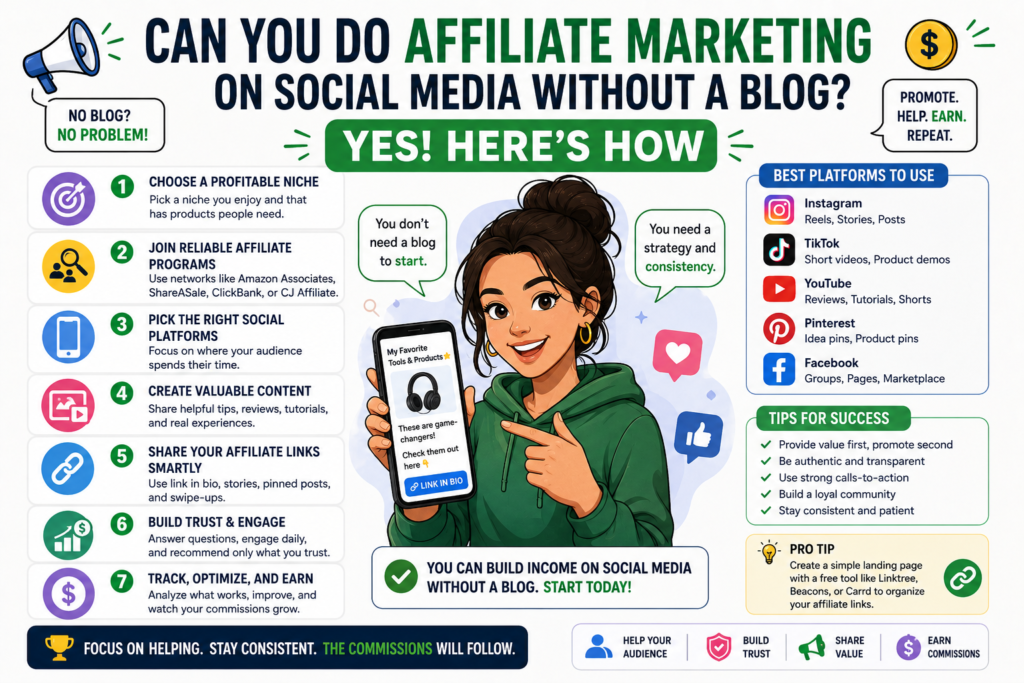
The short answer? Absolutely.
You don’t need a blog, a website, or even a domain name to start earning money through affiliate marketing. Social media platforms have become full-blown sales channels, and thousands of creators are already cashing in on affiliate commissions without ever publishing a single blog post.
But there’s a right way and a wrong way to do it.
This guide breaks down exactly how affiliate marketing works on social media without a blog, which platforms give you the best shot at real income, and the strategies that separate people who earn pocket change from those building a real revenue stream.
Why Social Media Works for Affiliate Marketing (Even Without a Blog)
A few years ago, the standard advice was simple: start a blog, write SEO content, drop affiliate links, and wait for Google traffic. That model still works, but it’s slow. It can take 6 to 12 months before a new blog sees meaningful organic traffic.
Social media flips that timeline. You can post content today and get eyes on it within hours. Platforms like TikTok, Instagram Reels, and YouTube Shorts are actively pushing content to new audiences through algorithmic feeds, which means you don’t need an existing following to get reach.
Here’s what makes social media a strong fit for affiliate marketing:
- Speed to audience. You can reach thousands of people on day one if your content resonates.
- Built-in trust signals. People see your face, hear your voice, and watch you use the product. That builds trust faster than a text-based review.
- Low barrier to entry. No hosting fees, no domain costs, no technical setup. You sign up, post content, and start promoting.
- Multiple content formats. Video, stories, carousels, live streams, and pins all give you different ways to present affiliate offers.
The catch? You don’t own the platform. Algorithm changes, account suspensions, and policy updates can affect your reach overnight. That’s a real risk. But for getting started quickly with zero upfront cost, social media is hard to beat.
How Affiliate Marketing on Social Media Actually Works
The mechanics are straightforward:
- You join an affiliate program or network (Amazon Associates, ShareASale, Impact, CJ Affiliate, individual brand programs, etc.)
- You get a tracking link for the product or service you want to promote.
- You create content on social media that references, reviews, or recommends that product.
- You share your affiliate link where the platform allows it (bio, stories, descriptions, comments, or link-in-bio tools).
- When someone clicks your link and makes a purchase, you earn a commission.
The key difference from blog-based affiliate marketing is how you drive traffic to those links. Instead of relying on search engine rankings, you’re relying on content performance within a social platform’s ecosystem.
Best Social Media Platforms for Affiliate Marketing Without a Blog
Not every platform treats affiliate links the same way. Some make it easy. Others make it frustrating. Here’s a realistic breakdown of each major platform.
Why it works: Instagram is one of the strongest platforms for affiliate marketing, especially if you’re in niches like fashion, beauty, fitness, home decor, or food. The visual format lends itself naturally to product showcases.
Where to place affiliate links:
- Your bio (use a link-in-bio tool like Linktree, Stan Store, or Beacons to house multiple links)
- Instagram Stories (the link sticker is available to all accounts)
- Instagram Shopping tags (if you’re approved for Instagram’s native affiliate program)
- Captions (links aren’t clickable here, but you can direct people to your bio)
Content strategies that work:
- “Get ready with me” or “outfit of the day” reels featuring affiliate products
- Product comparison carousels (Product A vs. Product B)
- “Things I bought that were actually worth it” roundups
- Honest reviews in story format with before-and-after results
- Tutorial-style reels showing a product in action
What to watch out for: Instagram’s algorithm favors Reels and carousel posts. Static image posts with affiliate pitches tend to underperform. Focus on creating content that entertains or educates first, and weave the product recommendation into that content naturally.
TikTok
Why it works: TikTok’s algorithm is the great equalizer. A brand-new account with zero followers can get a video in front of hundreds of thousands of people if the content hits. For affiliate marketers, that kind of reach potential is gold.
Where to place affiliate links:
- Your bio (you need at least 1,000 followers to add a clickable link, though this threshold changes periodically)
- TikTok Shop (if you’re approved, you can tag products directly in videos)
- Link-in-bio tools as a workaround for new accounts
- Comments (links are clickable in some regions)
Content strategies that work:
- “TikTok made me buy it” style product demos
- Unboxing videos with genuine reactions
- “Things you didn’t know you needed from Amazon” lists
- Side-by-side product comparisons
- Day-in-the-life content where affiliate products appear naturally
- Duet or stitch videos responding to product-related questions
What to watch out for: TikTok’s audience skews younger, and attention spans are short. You have about 1 to 3 seconds to hook someone. Your content needs to feel native to the platform, meaning casual, authentic, and fast-paced. Overly polished or salesy content gets scrolled past.
YouTube (Including YouTube Shorts)
Why it works: YouTube is the closest thing to a blog replacement for affiliate marketers. Video descriptions allow clickable affiliate links. Content has a long shelf life (a good review video can generate clicks for years). And YouTube’s search function means people are actively looking for product reviews and recommendations.
Where to place affiliate links:
- Video descriptions (the most common and effective placement)
- Pinned comments
- YouTube Shopping shelf (for approved creators)
- Community posts
- End screens and cards linking to products (indirectly, through a landing page)
Content strategies that work:
- “Best [product category] in 2026” roundup videos
- In-depth product reviews with real usage footage
- “X months later” follow-up reviews (these perform extremely well for trust-building)
- Comparison videos (this product vs. that product)
- Tutorial videos where you use affiliate products as tools
- “What’s in my bag/desk/kitchen” showcase videos
What to watch out for: YouTube requires more production effort than TikTok or Instagram. You don’t need a Hollywood studio, but decent audio quality and clear visuals matter. The upside is that YouTube content compounds over time. A video you publish today can keep earning affiliate commissions for years without any extra work.
Why it works: Pinterest is a visual search engine, and that distinction is critical. People on Pinterest are actively searching for solutions, ideas, and products to buy. Purchase intent is higher on Pinterest than on most other social platforms.
Where to place affiliate links:
- Directly on Pins (Pinterest allows direct affiliate links, though they must be disclosed)
- Pin descriptions
- Idea Pins (with link stickers or tagged products)
Content strategies that work:
- Product roundup pins (“10 best kitchen gadgets under $30”)
- Step-by-step tutorial pins featuring affiliate products
- Seasonal gift guide pins
- Before-and-after transformation pins
- Infographic-style pins with product recommendations embedded
What to watch out for: Pinterest rewards consistency. Pinning sporadically won’t build momentum. Aim to create fresh pin designs regularly, use keyword-rich descriptions, and organize your boards by niche topic. Pinterest SEO matters a lot here, so research what terms people are actually searching for on the platform.
Why it works: Facebook groups remain one of the most underrated channels for affiliate marketing. If you’re active in niche-specific groups (or run your own), you can become a trusted voice that people turn to for product recommendations.
Where to place affiliate links:
- Facebook group posts (check group rules first)
- Your personal profile or page posts
- Facebook Stories
- Facebook Reels
- Comments (when someone asks for a recommendation)
Content strategies that work:
- Answering product questions in niche groups with genuine recommendations (and disclosing your affiliate link)
- Creating your own Facebook group around a topic (e.g., “Budget Home Gym Builders”) and recommending products within it
- Running Facebook Live sessions demonstrating products
- Posting reviews with photos on your page
What to watch out for: Many Facebook groups have strict rules against affiliate links. Always check before posting. Running your own group gives you full control, but it takes time to grow a community. The organic reach on Facebook pages has dropped significantly over the years, so groups and Reels tend to outperform traditional page posts.
Affiliate Programs That Work Well Without a Blog
Not every affiliate program requires a website. Here are some that are social-media-friendly:
- Amazon Associates – Accepts social media creators. You can use links on YouTube, Instagram, TikTok, Facebook, and other platforms. The commission rates are modest (1% to 10% depending on the category), but the trust factor of Amazon drives strong conversion rates.
- ShareASale – A large network with thousands of merchants. Many brands on ShareASale accept social media-only affiliates.
- LTK (formerly LIKEtoKNOW.it) – Built specifically for social media creators, primarily in fashion, beauty, and lifestyle. You share shoppable links and earn commissions through the app.
- Impact – Hosts affiliate programs for brands like Adidas, Canva, Hostinger, and many others. Several of these accept social media promoters.
- CJ Affiliate – One of the largest affiliate networks. Some merchants require a website, but many accept social media channels.
- Individual brand programs – Many DTC (direct-to-consumer) brands run their own affiliate programs and are happy to work with social media creators. Check the footer of brand websites for “Affiliate Program” or “Partner Program” links.
- TikTok Shop Affiliate – If you’re on TikTok, you can browse products in the TikTok Shop marketplace and promote them directly within your videos.
Step-by-Step: Getting Started With Social Media Affiliate Marketing (No Blog Needed)
Here’s a practical roadmap:
Step 1: Pick your niche.
Choose a topic you know well and enjoy creating content about. Broad niches (like “tech” or “beauty”) are competitive. Narrower angles (“budget tech for college students” or “clean beauty for sensitive skin”) give you a better chance of standing out.
Step 2: Choose 1 to 2 platforms.
Don’t try to be everywhere at once. Pick the platform where your target audience spends time and where you feel most comfortable creating content. TikTok and YouTube are strong for video-first creators. Pinterest is great for visual, evergreen content. Instagram works well if you’re building a personal brand.
Step 3: Set up your profile for conversions.
Your bio should clearly communicate what your account is about and include a link (either a direct affiliate link or a link-in-bio page). Use a profile photo that looks trustworthy and professional. Write a bio that speaks to your target audience’s needs.
Step 4: Join affiliate programs.
Apply to 2 to 3 affiliate programs that carry products relevant to your niche. Start with Amazon Associates (easy approval, wide product range) and one niche-specific program.
Step 5: Create content first, promote second.
This is where most beginners go wrong. They start by pushing affiliate links before they’ve built any audience or trust. Flip the order. Create 10 to 20 pieces of genuinely helpful content in your niche before you start weaving in affiliate recommendations. Build the audience first.
Step 6: Integrate affiliate products naturally.
The best affiliate content doesn’t feel like a sales pitch. It feels like a friend telling you about something they genuinely use and like. Show the product in context. Talk about what you like and what you don’t. Be specific about who it’s for and who it’s not for.
Step 7: Always disclose your affiliate relationship.
This is a legal requirement in most countries (FTC guidelines in the US, ASA in the UK, etc.). Use clear language like “This post contains affiliate links, which means I may earn a commission if you make a purchase through them” or “#ad #affiliate” in your captions.
Step 8: Track what’s working.
Pay attention to which types of content drive the most clicks and conversions. Most affiliate programs provide dashboards with click and conversion data. Double down on what performs and adjust what doesn’t.
Common Mistakes to Avoid
Promoting too many products at once. If every post is a different product recommendation, your audience won’t trust any of them. Be selective. Promote products you’ve actually used or can genuinely vouch for.
Ignoring platform rules. Each platform has its own policies around affiliate links and sponsored content. Violating them can get your account restricted or banned. Read the terms of service.
Choosing products based on commission rate alone. A 50% commission means nothing if the product is overpriced, low-quality, or irrelevant to your audience. Prioritize relevance and quality. A lower commission on a product your audience actually wants will outperform a high commission on something nobody’s interested in.
Being vague about why someone should buy. “This product is amazing, link in bio!” doesn’t convert. Specificity converts. “This $15 desk lamp has three brightness levels, a USB charging port, and it fits perfectly on a small desk, here’s what it looks like on mine” converts.
Skipping the call to action. Don’t assume people know what to do. Tell them: “Tap the link in my bio to grab this,” “I’ll drop the link in the description below,” or “Comment LINK and I’ll send it to you.” Make the next step obvious.
Not building an email list. This is the one area where having no blog can hurt you long-term. Social media platforms can change their algorithms or policies at any time. An email list is an audience you own. Even without a blog, you can use a free landing page tool (ConvertKit, Mailchimp, Beehiiv) to collect email addresses and promote affiliate offers through newsletters.
Can You Actually Make Good Money This Way?
Let’s be honest about expectations.
Affiliate marketing on social media without a blog can absolutely generate income, but the amount depends on several factors:
- Your niche. Financial products, software, and online courses tend to have higher commission rates ($50 to $200+ per sale). Physical products from Amazon might earn you $1 to $10 per sale.
- Your audience size and engagement. A small, highly engaged audience of 5,000 followers in a specific niche can outperform a disengaged audience of 100,000.
- Your content quality and consistency. Posting once a week won’t cut it. Most successful affiliate creators on social media post daily or near-daily.
- The trust you’ve built. People buy from people they trust. The more authentic and transparent you are, the higher your conversion rates will be.
Realistic income ranges for social media-only affiliate marketers:
- Months 1 to 3: $0 to $100/month (building audience and testing content)
- Months 4 to 6: $100 to $500/month (if you’re consistent and improving)
- Months 6 to 12: $500 to $2,000/month (with a growing, engaged audience)
- Year 2+: $2,000 to $10,000+/month (with a strong personal brand and diversified affiliate partnerships)
These numbers aren’t guarantees. They represent what’s achievable for someone who treats this like a real business and puts in consistent effort.
The Hybrid Approach: Social Media + Simple Landing Pages
If you want the best of both worlds, consider this middle ground: use social media as your primary content and traffic source, but set up simple landing pages for your top affiliate offers.
You don’t need a full blog for this. Tools like Carrd ($19/year), Stan Store, or even free options like ConvertKit landing pages let you create a single page that:
- Pre-sells the product with a short review or recommendation
- Hosts your affiliate link
- Collects email addresses for future promotions
This approach gives you more control over the user experience and helps you build an owned audience alongside your social media presence.
Final Thoughts
You don’t need a blog to do affiliate marketing. Social media has opened the door for anyone with a phone and something genuine to say about the products they use.
The platforms are there. The affiliate programs accept social media creators. The audiences are actively looking for product recommendations from people they relate to.
What separates the people who earn real money from those who don’t comes down to three things: consistency in creating content, authenticity in the products they promote, and patience to let the compounding effect of content creation work over time.
Pick a platform. Pick a niche. Start creating content that helps people make better buying decisions. The affiliate income follows.