Introduction
In the modern digital landscape, creating content is no longer enough. Businesses need a clear plan to ensure their content reaches the right audience, supports business goals, improves search visibility, and drives measurable results. This is where the Content Strategist plays a crucial role.
A Content Strategist is responsible for planning, organizing, managing, and optimizing content across multiple platforms. They combine marketing expertise, audience insights, SEO knowledge, analytics, and strategic thinking to ensure every piece of content serves a purpose.
As organizations increasingly invest in content marketing and digital transformation, Content Strategists have become essential for building brand authority, improving customer engagement, and generating sustainable growth.
This guide explores the responsibilities, skills, processes, tools, career opportunities, and future trends that define the role of a Content Strategist.
What Is a Content Strategist?
A Content Strategist is a professional who develops and manages content strategies that align with business objectives and audience needs.
Rather than focusing solely on content creation, Content Strategists oversee the entire content ecosystem, including planning, optimization, distribution, governance, and performance measurement.
Their responsibilities often include:
- Content planning
- Audience research
- SEO strategy
- Editorial management
- Content audits
- Brand messaging
- Performance analysis
- Content optimization
- Team collaboration
- Content governance
Their goal is to ensure content delivers value to both audiences and businesses.
Why Content Strategy Matters
Improves Content Effectiveness
Strategic planning ensures content supports specific goals.
Supports SEO Growth
Well-structured content strategies improve search visibility.
Enhances User Experience
Users find relevant information more easily.
Increases Brand Authority
Consistent content builds trust and expertise.
Maximizes Marketing ROI
Content investments generate stronger returns when guided by strategy.
Key Responsibilities of a Content Strategist
Audience Research
Understanding customer needs, behaviors, and preferences.
Methods include:
- Customer interviews
- Surveys
- Analytics analysis
- User behavior tracking
- Market research
Content Planning
Developing content roadmaps and editorial calendars.
SEO Strategy
Aligning content with search engine optimization best practices.
Content Audits
Reviewing existing content to identify opportunities and gaps.
Performance Analysis
Monitoring metrics and improving content effectiveness.
Content Governance
Maintaining consistency, standards, and workflows.
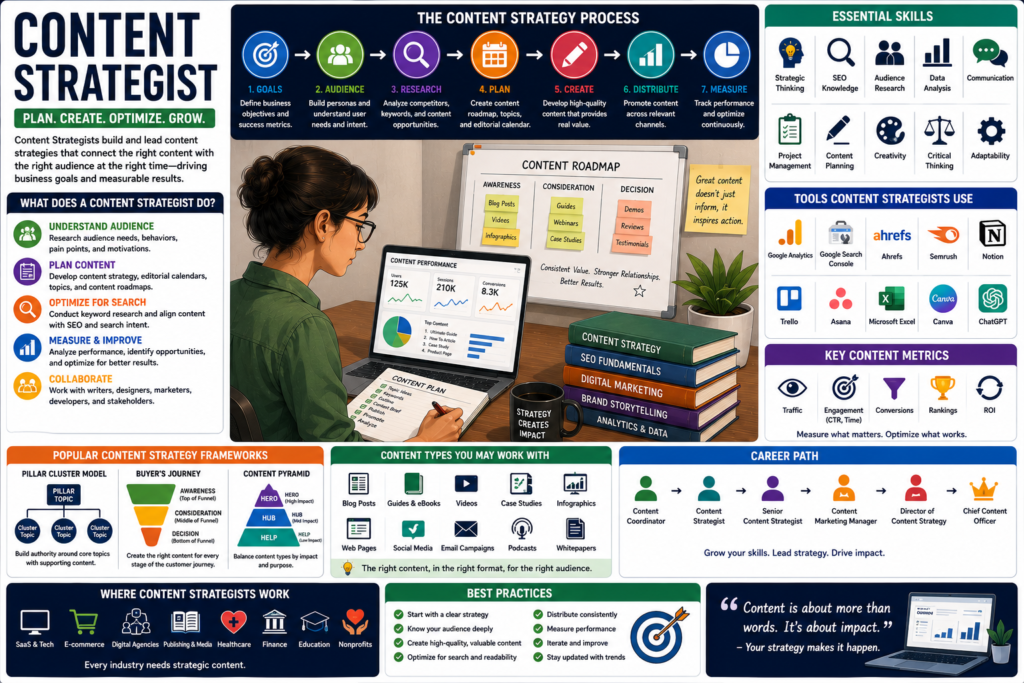
The Content Strategy Process
1. Business Goal Definition
Identify objectives such as:
- Brand awareness
- Lead generation
- Customer retention
- Revenue growth
2. Audience Analysis
Create detailed audience personas.
Information may include:
- Demographics
- Interests
- Pain points
- Search behavior
- Buying motivations
3. Content Audit
Evaluate existing content performance.
Key factors include:
- Traffic
- Engagement
- Rankings
- Conversions
- Content quality
4. Keyword Research
Identify search opportunities and user intent.
5. Content Planning
Develop content calendars and publishing schedules.
6. Content Creation
Collaborate with writers, designers, and subject matter experts.
7. Distribution
Promote content across:
- Websites
- Blogs
- Email campaigns
- Social media
- Paid advertising
8. Measurement and Optimization
Analyze results and improve performance continuously.
Essential Skills for Content Strategists
Strategic Thinking
Connecting content efforts to business goals.
SEO Expertise
Understanding how search engines rank content.
Research Skills
Gathering audience and market insights.
Data Analysis
Using metrics to guide decision-making.
Project Management
Coordinating teams and content workflows.
Communication
Collaborating effectively across departments.
Creativity
Developing innovative content ideas and campaigns.
Content Strategy and SEO
SEO is a critical component of modern content strategy.
Keyword Research
Identifying valuable search opportunities.
Search Intent Analysis
Understanding what users want when they search.
Topic Clusters
Organizing content around central themes.
Internal Linking
Improving content discoverability and SEO performance.
Content Optimization
Enhancing existing content for better rankings.
Audience Personas
Content Strategists often develop audience personas to guide decision-making.
A persona may include:
- Age range
- Occupation
- Goals
- Challenges
- Preferred content formats
- Buying behaviors
Personas help ensure content remains relevant and audience-focused.
Editorial Calendars
Editorial calendars organize content production and publishing schedules.
Benefits include:
- Better planning
- Consistent publishing
- Improved collaboration
- Clear accountability
- Strategic alignment
A strong editorial calendar supports long-term content success.
Content Audits
Content audits help evaluate and improve existing assets.
Typical audit activities include:
- Identifying outdated content
- Updating SEO opportunities
- Consolidating duplicate content
- Improving user experience
- Measuring performance gaps
Regular audits keep content relevant and effective.
Content Governance
Content governance establishes standards and processes for content management.
Includes:
- Style guides
- Approval workflows
- Publishing procedures
- Quality standards
- Brand guidelines
Governance ensures consistency across channels and teams.
Popular Tools for Content Strategists
Google Analytics
Tracks website performance and user behavior.
Google Search Console
Provides SEO and search visibility insights.
Ahrefs
Supports keyword research and competitor analysis.
Semrush
Offers SEO, content planning, and marketing insights.
Notion
Content planning and team collaboration.
Trello
Workflow and project management.
Asana
Task tracking and content operations.
ChatGPT and AI Tools
Support ideation, planning, and content development.
Content Strategist vs Content Writer
Content Writer
Focuses on creating content.
Content Strategist
Focuses on planning, managing, and optimizing content ecosystems.
Content Strategists often oversee multiple content creators and campaigns.
Career Path for Content Strategists
Content Coordinator
Supports content operations and publishing.
Content Specialist
Handles content planning and optimization.
Content Strategist
Leads strategic content initiatives.
Senior Content Strategist
Manages large-scale content programs.
Content Marketing Manager
Oversees content marketing teams and performance.
Director of Content Strategy
Defines enterprise-level content strategies.
Chief Marketing Officer (CMO)
Leads overall marketing and growth initiatives.
Industries Hiring Content Strategists
Digital Marketing Agencies
Develop content campaigns for clients.
SaaS Companies
Support inbound marketing and customer education.
E-Commerce
Drive product discovery and conversions.
Media and Publishing
Manage editorial content and audience growth.
Healthcare
Develop educational and informational content.
Financial Services
Support customer education and thought leadership.
Best Practices for Content Strategy
Start With Business Goals
Content should always support measurable objectives.
Understand Your Audience
User needs must guide content decisions.
Focus on Quality Over Quantity
High-value content outperforms content volume alone.
Measure Everything
Use analytics to guide optimization.
Keep Content Updated
Refresh content regularly to maintain relevance.
Align Teams
Encourage collaboration across departments.
Future Trends in Content Strategy
Artificial Intelligence
AI assists with research, planning, optimization, and personalization.
Personalized Experiences
Content increasingly adapts to individual user preferences.
Voice Search Optimization
Strategies evolve for conversational search behavior.
Interactive Content
Quizzes, calculators, and dynamic experiences continue growing.
Content Operations
Organizations invest more heavily in scalable content systems.
Data-Driven Decision Making
Analytics become increasingly central to content planning.
Benefits of Becoming a Content Strategist
- High demand across industries
- Excellent salary potential
- Remote work opportunities
- Leadership career paths
- Creative and analytical work
- Strong growth potential
- Influence on business outcomes
Conclusion
Content Strategists are the architects behind successful content ecosystems. By combining audience research, SEO expertise, analytics, planning, and strategic thinking, they ensure content delivers measurable business value.
As content marketing continues to evolve, skilled Content Strategists will remain essential for helping organizations attract audiences, build authority, and drive sustainable growth. Professionals who master content planning, optimization, and performance analysis can build rewarding careers at the intersection of marketing, technology, and business strategy.