Introduction
Data Scientists are among the most sought-after professionals in today’s digital economy. As organizations generate massive amounts of data every day, the ability to extract meaningful insights from that information has become a major competitive advantage.
A Data Scientist combines statistics, programming, machine learning, and business knowledge to analyze data and solve complex problems. Their work helps businesses make smarter decisions, predict future trends, optimize operations, and create innovative products and services.
From healthcare and finance to e-commerce and technology, data science is transforming industries worldwide.
What Is a Data Scientist?
A Data Scientist is a professional who collects, processes, analyzes, and interprets large datasets to generate actionable insights and predictive models.
Data Scientists use a combination of:
- Statistics
- Programming
- Machine Learning
- Data Visualization
- Business Intelligence
- Artificial Intelligence
Their goal is to convert raw data into valuable information that supports strategic decision-making.
Why Data Science Matters
Better Decision Making
Organizations can make data-driven decisions instead of relying on assumptions.
Increased Efficiency
Data analysis helps identify inefficiencies and opportunities for optimization.
Improved Customer Experience
Businesses gain deeper insights into customer behavior and preferences.
Competitive Advantage
Companies that leverage data effectively often outperform competitors.
Predictive Insights
Machine learning models help forecast future outcomes and trends.
Key Responsibilities of a Data Scientist
Typical responsibilities include:
- Collecting and cleaning data
- Analyzing large datasets
- Building predictive models
- Creating dashboards and reports
- Developing machine learning algorithms
- Identifying business opportunities
- Presenting findings to stakeholders
- Supporting data-driven strategies
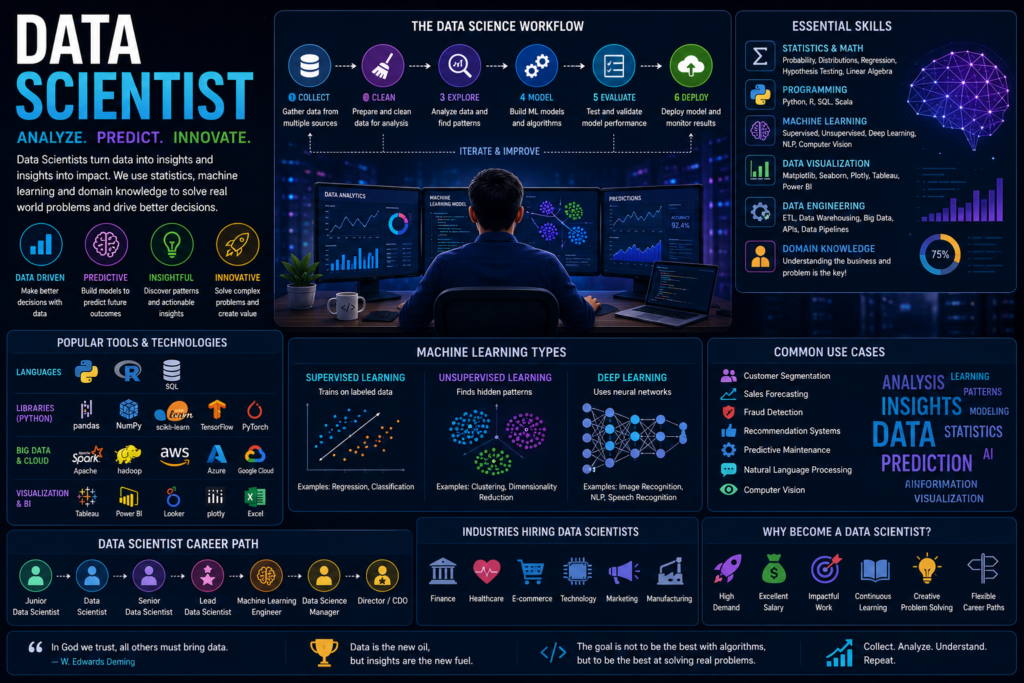
The Data Science Workflow
1. Data Collection
Gathering data from multiple sources such as:
- Databases
- APIs
- Websites
- CRM systems
- IoT devices
- Cloud platforms
2. Data Cleaning
Preparing data for analysis by:
- Removing duplicates
- Fixing errors
- Handling missing values
- Standardizing formats
3. Exploratory Data Analysis (EDA)
Understanding patterns, trends, and relationships within data.
4. Feature Engineering
Transforming data into useful variables for machine learning models.
5. Model Development
Creating statistical or machine learning models to solve problems.
6. Evaluation
Testing model accuracy and performance.
7. Deployment
Integrating models into production systems for real-world use.
Essential Skills for Data Scientists
Statistics and Mathematics
Understanding statistical concepts is fundamental to data science.
Important topics include:
- Probability
- Regression
- Hypothesis testing
- Statistical inference
- Linear algebra
Programming
Data Scientists frequently use:
- Python
- R
- SQL
- Scala
Machine Learning
Machine learning enables systems to learn from data and improve over time.
Popular algorithms include:
- Linear Regression
- Decision Trees
- Random Forests
- Gradient Boosting
- Neural Networks
Data Visualization
Communicating findings effectively through visualizations.
Popular tools include:
- Tableau
- Power BI
- Matplotlib
- Plotly
- Seaborn
Popular Data Science Tools
Python
The most widely used programming language in data science.
Popular libraries include:
- Pandas
- NumPy
- Scikit-learn
- TensorFlow
- PyTorch
SQL
Used for querying and managing data stored in databases.
Jupyter Notebook
Provides an interactive environment for data analysis and experimentation.
Apache Spark
Processes large-scale datasets efficiently.
Tableau
Creates interactive dashboards and reports.
Machine Learning in Data Science
Machine learning is a major component of modern data science.
Supervised Learning
Models learn from labeled datasets.
Examples:
- Spam detection
- Price prediction
- Customer churn prediction
Unsupervised Learning
Models discover hidden patterns without labeled data.
Examples:
- Customer segmentation
- Clustering
- Anomaly detection
Deep Learning
Uses neural networks to solve complex problems such as:
- Image recognition
- Natural language processing
- Speech recognition
Data Scientist vs Data Analyst
Data Analyst
Focuses on reporting, dashboards, and historical insights.
Data Scientist
Builds predictive models, machine learning solutions, and advanced analytics systems.
While both roles work with data, Data Scientists typically perform more advanced statistical and predictive analysis.
Industries Hiring Data Scientists
Data Scientists are needed across many industries.
Technology
Develop recommendation engines and AI systems.
Finance
Analyze risk, fraud, and investment opportunities.
Healthcare
Improve patient outcomes and medical research.
Retail and E-Commerce
Optimize pricing, inventory, and customer experiences.
Manufacturing
Improve production efficiency and predictive maintenance.
Marketing
Enhance campaign performance and customer targeting.
Career Path for Data Scientists
Junior Data Scientist
Focuses on learning tools, techniques, and business processes.
Data Scientist
Builds models and performs advanced analytics independently.
Senior Data Scientist
Leads projects and mentors team members.
Machine Learning Engineer
Deploys and manages machine learning systems.
Data Science Manager
Leads analytics teams and strategic initiatives.
Chief Data Officer (CDO)
Oversees organizational data strategy.
Best Practices in Data Science
- Focus on data quality
- Understand business objectives
- Validate model performance
- Communicate insights clearly
- Document processes thoroughly
- Monitor deployed models
- Continuously learn new technologies
- Prioritize ethical AI practices
Future Trends in Data Science
Artificial Intelligence
AI continues expanding the capabilities of data-driven systems.
Generative AI
Large language models and generative tools are creating new opportunities.
Automated Machine Learning (AutoML)
Simplifies model development and deployment.
Real-Time Analytics
Businesses increasingly require instant insights.
Responsible AI
Organizations focus on fairness, transparency, and accountability.
Cloud-Based Data Science
Cloud platforms make advanced analytics more scalable and accessible.
Benefits of Becoming a Data Scientist
- High demand globally
- Excellent salary potential
- Diverse career opportunities
- Remote work flexibility
- Continuous learning
- Strong growth prospects
- Ability to solve meaningful problems
Conclusion
Data Scientists play a critical role in helping organizations unlock the value of data. By combining technical expertise, statistical knowledge, and business understanding, they transform information into actionable insights that drive innovation and growth.
As artificial intelligence, machine learning, and big data continue to evolve, Data Science remains one of the most exciting and future-focused careers in technology. Professionals who master data science skills will be well-positioned to lead the next generation of digital transformation and intelligent decision-making.