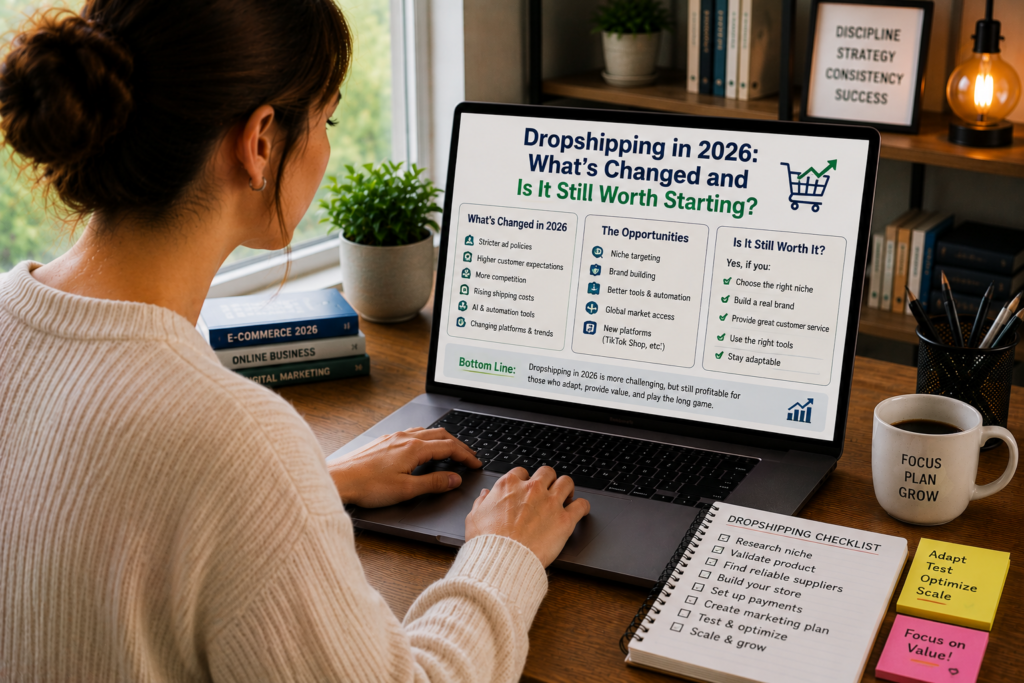
Every year, the same question circulates through forums, YouTube comment sections, and Reddit threads: is dropshipping dead?
And every year, the answer is the same frustrating mix of yes and no. The version of dropshipping that worked in 2018, slapping a random AliExpress product into a Shopify store and running Facebook ads to a broad audience, has been functionally dead for years. But the underlying business model, selling products online without holding inventory, is alive, evolving, and generating real revenue for sellers who’ve adapted to how the market works now.
The dropshipping landscape in 2026 looks almost nothing like it did five years ago. Customer expectations have shifted dramatically. Advertising costs have restructured who can afford to compete. Platform policies have tightened. Supplier ecosystems have matured. AI tools have rewritten the playbook for product research, content creation, and customer service. And the line between “dropshipping” and “real ecommerce brand” has blurred to the point where the most successful dropshippers don’t even identify with the label anymore.
This guide breaks down exactly what’s changed, what still works, what’s gotten harder, and whether starting a dropshipping business in 2026 is worth your time and money.
What Dropshipping Looked Like Before (And Why That Model Collapsed)
To understand where dropshipping is now, you need to understand what stopped working and why.
The 2017 to 2020 Gold Rush
The original dropshipping playbook was deceptively simple:
- Find a cheap, interesting product on AliExpress (typically $2 to $8 wholesale)
- Build a single-product Shopify store in an afternoon
- Mark the product up to $19.99 to $39.99
- Run Facebook ads targeting broad interest audiences
- When orders come in, purchase from the AliExpress supplier who ships directly to the customer
- Pocket the difference minus ad spend
It worked because Facebook ads were cheap (CPMs of $5 to $10 in many niches), customer awareness of dropshipping was low, and the novelty of seeing a “cool gadget” ad on social media was enough to drive impulse purchases. Margins of 30 to 50% were common, and a single winning product could generate $10,000 to $50,000 per month.
Why It Fell Apart
Customers got wise. Enough people received flimsy products in unmarked packaging three to six weeks after ordering, and the pattern became recognizable. The cheap-looking one-product Shopify store with a “.myshopify.com” domain, the too-good-to-be-true pricing, the product photos clearly taken from a Chinese marketplace. Consumers learned to spot dropshipping stores, and trust evaporated.
Shipping times became unacceptable. When AliExpress was the primary supplier, shipping from China took 15 to 45 days via ePacket or AliExpress Standard Shipping. In a world where Amazon delivers in one to two days, a month-long wait isn’t just inconvenient. It’s a reason to file a chargeback. The gap between customer expectations and dropshipping delivery performance became the model’s biggest liability.
Ad costs skyrocketed. Facebook and Instagram CPMs climbed from $5 to $10 in 2018 to $15 to $30 by 2022 and have continued rising. TikTok ads followed a similar trajectory as the platform matured and competition increased. Higher ad costs mean higher customer acquisition costs, which compress margins and make low-ticket impulse products unprofitable.
Platform crackdowns. Facebook, Instagram, and TikTok all tightened policies around ecommerce advertising. Accounts running low-quality ads to low-quality stores got flagged, restricted, or banned. PayPal and Stripe began holding funds from high-chargeback merchants. Shopify implemented fraud detection that flagged suspicious stores.
Refund and chargeback rates climbed. Poor product quality, long shipping times, and misleading product descriptions created refund rates of 10 to 20% for many dropshippers. Credit card processors penalized high-chargeback merchants with holds, increased fees, and account terminations.
The model didn’t die overnight. It eroded as every advantage it relied on, cheap ads, naive customers, tolerance for slow shipping, was systematically eliminated by market maturation.
What’s Changed in 2026
The dropshipping model has survived by adapting. The sellers who are profitable today operate in ways that the 2018 version would barely recognize.
Change 1: Supplier Infrastructure Has Matured
The biggest structural shift in dropshipping is the supplier ecosystem. The AliExpress-direct model, while still technically possible, has been largely replaced by faster, more reliable alternatives.
Domestic and near-shore suppliers. Platforms like Zendrop, CJ Dropshipping, Spocket, and AutoDS have built networks of suppliers with warehouses in the US, Europe, Canada, and Australia. Products ship from domestic locations in 3 to 7 business days, not 3 to 7 weeks. This single change addressed the most fatal flaw of the old model.
Private agent sourcing. Experienced dropshippers now work with private sourcing agents in China who handle supplier vetting, quality control, custom packaging, and faster shipping through dedicated logistics lines. A private agent consolidates the supply chain, reducing defect rates and shipping times while maintaining the cost advantages of manufacturing in China.
Supplier vetting standards. Platforms like Spocket verify suppliers before listing them, checking product quality, shipping times, and return policies. This pre-vetting reduces the “supplier lottery” problem where dropshippers had no way to verify quality before a customer received the product.
Branded and white-label options. Many suppliers now offer custom packaging, branded inserts, and white-label products at minimal additional cost. A product that arrives in custom packaging with a branded thank-you card doesn’t feel like a random AliExpress order. It feels like a purchase from a real brand.
Change 2: Customer Expectations Have Permanently Shifted
The Amazon effect has restructured what every online shopper considers baseline acceptable:
- Shipping: 3 to 7 business days is the new maximum for standard shipping. Anything longer requires explicit communication and customer buy-in before purchase.
- Tracking: Real-time tracking with carrier integration is expected, not optional. “Your order has shipped” with no tracking number is no longer acceptable.
- Returns: A clear, accessible return policy is non-negotiable. Stores with no return policy or a deeply buried one trigger immediate distrust.
- Product quality: The product must match the listing photos. Any discrepancy between the advertised product and the received product results in a return, a negative review, or a chargeback.
- Communication: Customers expect responses to inquiries within 24 hours. Slow or nonexistent customer service kills repeat business and generates negative reviews that sink store credibility.
These aren’t premium expectations. They’re baseline. Dropshipping stores that meet them compete effectively. Stores that don’t meet them fail regardless of how good their marketing is.
Change 3: Ad Costs Have Restructured the Economics
Advertising costs in 2026 have made low-margin, low-ticket dropshipping significantly harder:
Facebook and Instagram: Average CPMs range from $15 to $40 depending on niche, audience, and placement. A $20 CPM means 1,000 impressions cost $20. If your click-through rate is 2%, that’s 20 clicks for $20, or $1 per click. If your conversion rate is 2%, that’s one sale per 50 clicks, or $50 in ad spend per sale.
If your product sells for $29.99 and your cost of goods is $12, your gross profit before ad spend is $17.99. At $50 per acquisition, you’re losing $32 on every sale.
The math problem: In 2018, that same acquisition might have cost $10 to $15 in ad spend. The product was profitable. Today, the same product at the same price with the same margins is a money-losing operation at current ad costs.
The solution the market has found: Higher average order values. Dropshippers in 2026 focus on products in the $50 to $200 range where the margin per sale can absorb a $30 to $60 customer acquisition cost and still leave profit. Alternatively, they build organic traffic channels (SEO, YouTube, TikTok organic) that reduce or eliminate the cost of customer acquisition entirely.
TikTok’s role: TikTok Ads have added a competitive advertising channel, but CPMs have risen as the platform matured. More significantly, TikTok Shop has created a new organic sales channel where products go viral through creator content and sell directly within the app without traditional ad spend. This channel has been one of the most significant developments for dropshipping economics in 2025 and 2026.
Change 4: Platform and Payment Processor Policies Are Stricter
Shopify has increased enforcement against stores with high chargeback rates, misleading product claims, and customer complaints. Stores that generate excessive disputes risk being flagged, fined, or terminated.
PayPal holds funds for new merchants and high-risk categories for 21 days or longer. This cash flow delay means you’re paying suppliers out of pocket before receiving your revenue, which changes the capital requirements of the business.
Stripe monitors chargeback rates and can terminate accounts that exceed their threshold (typically 1% of transactions). Losing your payment processor mid-operation is functionally a business shutdown.
Facebook and Google advertising policies now require clear, accurate product representations, visible shipping timeframes, and accessible return policies. Ads that misrepresent delivery times (“Free shipping, arrives fast!”) or use misleading before/after images get rejected or result in account restrictions.
The net effect: running a shady operation has become materially harder. Platforms and payment processors have aligned their enforcement with consumer protection, which is bad for scammy operators and good for legitimate businesses.
Change 5: AI Has Changed Every Part of the Workflow
AI tools have compressed timelines and reduced costs across the entire dropshipping workflow:
Product research. AI-powered tools analyze sales velocity, social media trends, competitor pricing, and market saturation to identify winning products faster than manual research. What used to take days of browsing AliExpress and spying on competitor stores now takes minutes with the right tools.
Store building. AI copywriting tools generate product descriptions, about pages, and email sequences in minutes. AI design tools create logos, ad creatives, and product imagery. The technical barriers to creating a professional-looking store have essentially disappeared.
Ad creation and optimization. AI generates ad copy variations, tests creative elements, and optimizes campaign targeting in ways that would have required a dedicated media buyer five years ago. Dynamic creative testing, automated bid management, and AI-generated video ads have become standard tools.
Customer service. AI chatbots handle the majority of common customer inquiries (order status, shipping updates, return requests) 24/7 without human intervention. This reduces the operational burden of customer service while maintaining fast response times.
The double-edged sword: These tools lower the barrier to entry, which means more competition. If anyone can build a professional-looking store in a day, the differentiator is no longer the store itself. It’s the brand, the product selection, the customer experience, and the marketing strategy behind it.
Change 6: The Line Between Dropshipping and Brand Has Blurred
The most significant philosophical shift in dropshipping is the move from “arbitrage operation” to “brand building.”
In the old model, the dropshipper was an anonymous middleman who added no value beyond connecting a Chinese factory to a Western consumer through a Facebook ad. The store had no identity, no repeat customers, and no long-term equity. When the ad stopped working, the revenue stopped.
The 2026 model looks different:
- Branded stores with custom domains, professional design, and a clear brand identity
- Curated product selections that tell a coherent story (not a random assortment of trending gadgets)
- Content marketing that builds audience relationships independent of paid advertising
- Email lists that enable repeat sales without additional acquisition costs
- Customer loyalty programs that incentivize second and third purchases
- Social media presences that create community around the brand, not just the product
The stores that thrive today are indistinguishable from traditional ecommerce brands in the customer’s eyes. The fulfillment model (dropshipping vs. warehoused inventory) is an operational detail, not a customer-facing identity. When a customer has a great buying experience, receives a quality product in branded packaging within a week, and gets responsive customer service, they don’t know or care whether the store held inventory or used a dropshipping supplier.
This convergence between dropshipping and traditional ecommerce is the most bullish signal for the model’s future. It means dropshipping has matured from a shortcut into a legitimate supply chain strategy.
Is It Still Worth Starting in 2026?
The honest answer: yes, but with significant caveats that didn’t apply five years ago.
The Case for Starting
Zero inventory risk. The core advantage of dropshipping remains intact and permanently valuable. You never buy products before selling them. You never risk $5,000 on a product shipment that doesn’t sell. Every product in your store is a free experiment: if it sells, you profit. If it doesn’t, you lose nothing but the time spent listing it.
Lower starting capital than any other physical product business. A functioning dropshipping store can launch for $50 to $200. A traditional ecommerce business requires $2,000 to $20,000 in inventory alone before making a single sale. Dropshipping remains the most accessible entry point into ecommerce.
The supplier ecosystem is better than ever. Faster shipping, better quality control, branded packaging, and domestic fulfillment options have eliminated the worst pain points of the old model. The infrastructure available to a new dropshipper in 2026 would have been available only to six-figure operators five years ago.
Multiple sales channels. Beyond Shopify + Facebook ads, dropshippers can sell through TikTok Shop, Amazon (via FBA or merchant fulfilled), Etsy, eBay, Walmart Marketplace, and social media native storefronts. Multi-channel distribution reduces dependence on any single platform and captures customers wherever they shop.
AI tools compress the learning curve. Tasks that required specialized knowledge or expensive outsourcing (ad copywriting, product photography, market research, customer service) can now be handled faster and cheaper through AI tools. A solo operator in 2026 can run a more sophisticated operation than a small team managed in 2020.
The Case for Caution
Higher customer acquisition costs. Ad-dependent dropshipping businesses face tighter margins than ever. If your strategy depends entirely on paid traffic, you need higher price points, better conversion rates, and stronger unit economics to make the math work.
More competition. Lower barriers to entry mean more stores competing for the same customers. Standing out requires genuine differentiation: better branding, better products, better content, or a more specific niche focus.
Higher operational standards. Meeting 2026 customer expectations (fast shipping, quality products, responsive service, easy returns) requires more operational sophistication than the “set it and forget it” model of the past. You’re running a real business, not a passive income experiment.
Platform dependency risk. A Facebook ad account ban, a Shopify policy change, or a TikTok algorithm shift can disrupt revenue overnight. Building multiple traffic channels and owning your customer relationships (email list) mitigates this risk but requires more effort upfront.
Reputation risk. The word “dropshipping” still carries negative connotations from years of low-quality stores. You won’t call your business a dropshipping store, and you’ll need to actively build trust through quality products, transparent policies, and genuine brand presence.
The Verdict
Dropshipping in 2026 is worth starting if you approach it as building an ecommerce brand that happens to use dropshipping for fulfillment, rather than running a dropshipping operation that pretends to be a brand.
The operators making real money treat it as a serious business: researching products carefully, building genuine brands, creating organic content, providing excellent customer service, and reinvesting profits into growth. Their fulfillment model is dropshipping, but their business model is brand-building.
The operators who struggle are still trying to run the 2018 playbook: generic stores, low-quality products, misleading ads, and no customer relationship beyond the initial transaction. That approach generates chargebacks, negative reviews, and eventual platform bans.
How to Start a Dropshipping Business in 2026 (The Updated Playbook)
If you’re going to start, here’s the approach that matches today’s market conditions.
Step 1: Choose a Niche, Not a Product
The single-product, viral-gadget model has been replaced by niche-focused stores that curate a collection of related products for a specific audience.
Why niches win in 2026:
- A niche store builds topical authority and SEO value over time (a kitchen gadgets store ranks for kitchen-related searches; a random product store ranks for nothing)
- Curated product collections increase average order value (customers buy multiple related items)
- Niche audiences are easier to target with both paid and organic marketing
- Brand identity and customer loyalty develop naturally within a defined niche
- Repeat purchase rates are higher when customers trust you as a specialist in their area of interest
Niche selection criteria:
- Passionate buyers: People who spend money regularly on products in this category (pet owners, fitness enthusiasts, home decorators, hobbyists, parents)
- Problem-solving products: Items that fix an annoyance, improve a routine, or serve a functional purpose. Problem-solving products have higher conversion rates than novelty items because the purchase is justified by need, not impulse.
- $30 to $150 price range: High enough to support profitable margins after ad costs. Low enough for relatively low-friction purchasing decisions.
- Repeat purchase potential: Consumables, accessories, and seasonal products bring customers back. A store selling yoga accessories has repeat potential (new mats, blocks, straps, bags). A store selling a single novelty item does not.
- Low fragility and simple logistics: Avoid products that break in shipping, require batteries (shipping restrictions), or have complex sizing that generates returns.
Niche examples that perform well in 2026:
- Home organization and storage solutions
- Pet accessories for specific breeds or pet types
- Kitchen tools and gadgets for specific cooking styles (air fryer accessories, meal prep tools)
- Outdoor and camping gear accessories
- Home office and desk accessories
- Baby and toddler safety products
- Eco-friendly and sustainable household products
- Car interior accessories and organization
- Fitness accessories for specific activities (resistance training, yoga, home gym)
- Garden tools and accessories
Step 2: Find Reliable Suppliers (The 2026 Standard)
Supplier quality is the single biggest differentiator between profitable dropshipping stores and stores that drown in refunds and chargebacks.
Where to find suppliers in 2026:
Spocket: Curates suppliers primarily from the US and Europe with 2 to 5 day shipping. Supplier vetting process verifies product quality and shipping reliability. Free plan available with limited product access. Paid plans start at $39.99/month.
Zendrop: Offers US-based warehousing with 5 to 8 day shipping for many products. Custom branding and packaging available. Strong product catalog with quality control processes. Starter plan is free with per-order fees.
CJ Dropshipping: Massive product catalog with global warehousing (US, EU, China). Offers product sourcing, quality inspection, custom packaging, and competitive pricing. Free to use with no monthly fees (you pay per order). Shipping from US warehouses typically takes 5 to 10 business days.
AutoDS: An automation-focused platform that connects to 25+ suppliers including Amazon, Walmart, AliExpress, and specialty distributors. Automates order processing, price monitoring, and inventory sync. Plans start at around $26/month.
Private sourcing agents: For sellers doing consistent volume ($5,000+/month), a private sourcing agent in China provides dedicated supplier relationships, custom product modifications, quality inspections before shipping, and negotiated pricing below platform rates. Find agents through referrals in dropshipping communities, Alibaba contact outreach, or specialized sourcing services.
Supplier evaluation checklist:
Before committing to a supplier for any product, verify:
- Shipping time from the nearest warehouse: Confirm actual delivery times, not estimated. Order a sample yourself and track the delivery experience.
- Product quality: Order one to three samples of every product you plan to sell. Photograph them for your store (real photos outperform supplier-provided images). Test durability, functionality, and packaging quality.
- Communication responsiveness: Send the supplier a question before ordering. If they take three days to respond to a pre-sale inquiry, imagine how they’ll handle a shipping problem during peak season.
- Return and defect policy: Understand what happens when a customer receives a damaged or incorrect item. Does the supplier reship? Refund? Who pays return shipping?
- Inventory reliability: Ask about stock levels and what happens if an item goes out of stock after a customer orders it. Backorder delays are a customer service nightmare.
Step 3: Build a Brand, Not Just a Store
In 2026, the store itself is a brand asset. It needs to look, feel, and function like a legitimate business from day one.
Brand elements to build before launching:
Custom domain. A “.com” domain costs $10 to $15 per year and signals legitimacy. A store operating on “my-store.myshopify.com” signals a hobby project. Buy a domain that matches your niche and brand name.
Visual identity. Use Canva (free) to create a logo, color palette, and consistent visual style that appears across your store, social media, packaging inserts, and email communications. You don’t need a $2,000 brand identity package. You need consistency.
Brand story. Write an About page that explains why your store exists and who it serves. This doesn’t need to be a novel. Two to three paragraphs about your passion for the niche and your commitment to curating quality products is enough to differentiate you from the anonymous stores with no human presence.
Professional product pages. Every product page should include:
- Multiple high-quality images (mix of supplier images and your own sample photos)
- A detailed, benefit-focused product description written in your brand voice (not copy-pasted from the supplier)
- Specifications (dimensions, materials, weight)
- Shipping timeframes (honest and specific)
- Size guides where applicable
- Customer reviews (after you begin generating sales)
Clear policies. Shipping policy, return policy, and privacy policy pages are non-negotiable. They protect your business legally and reduce customer anxiety. State your shipping timeframes honestly. If standard delivery takes 5 to 8 business days, say so. Underpromise and overdeliver.
Step 4: Build Organic Traffic Channels First
The most consequential strategic shift in dropshipping since 2020 is the move from paid-traffic-first to organic-traffic-first.
Running profitable paid ads requires testing budgets, conversion data, and optimized funnels, all of which cost money you may not have at launch. Building organic traffic is slower but free, and it creates assets that continue driving sales indefinitely.
TikTok and Instagram Reels (Short-Form Video)
Short-form video is the most powerful organic channel for product-based businesses in 2026. A single video showing your product in action, solving a problem, or demonstrating a satisfying use case can reach hundreds of thousands of viewers organically and drive significant traffic to your store.
Content types that work for dropshipping stores:
- Product demonstrations: Show the product being used in real life. A kitchen gadget peeling a vegetable in 3 seconds. A storage organizer transforming a messy drawer. The visual transformation captures attention and communicates value instantly.
- Problem-solution format: Start with the problem (“Tired of tangled cables on your desk?”), show the frustration, then reveal the product as the solution. This format consistently performs well because it mirrors the viewer’s own experience.
- Unboxing and first impressions: Film yourself opening the product, examining it, and giving an honest reaction. This builds trust by showing the actual product rather than polished marketing photos.
- Comparison content: “I tried three different [product type] and here’s which one is actually worth it.” Position your product alongside alternatives to demonstrate value.
- User-generated content (UGC) style: Videos that look like a real customer sharing a genuine recommendation, not a polished advertisement. UGC-style content consistently outperforms traditional ad creative in both organic reach and conversion rate.
You don’t need millions of followers. TikTok’s algorithm distributes content based on engagement, not follower count. A new account with 50 followers can have a video reach 100,000 viewers if the content resonates. Post 1 to 2 videos daily for 30 days, analyze which formats get the most views and engagement, and double down on what works.
TikTok Shop Integration
TikTok Shop has become a significant sales channel for dropshippers. Products can be sold directly within TikTok through in-video product links, live shopping events, and your TikTok Shop storefront. The integration allows viewers to purchase without leaving the app, dramatically reducing the friction between discovery and purchase.
Setting up a TikTok Shop and linking products from your supplier (several POD and dropshipping platforms now integrate directly) creates a seamless path from content to conversion.
SEO and Blogging
For long-term organic traffic, a blog on your Shopify store targeting product-related search queries creates a compounding source of visitors.
Write articles targeting searches your potential customers make:
- “Best [product category] for [specific use case]”
- “How to organize your [space] with [product type]”
- “[Product A] vs [Product B]: which is better for [specific need]”
- “X tips for [activity related to your niche]”
Each article targets a search query, attracts visitors through Google, and funnels them to your product pages through contextual links. A single well-ranking article can drive 500 to 2,000 visitors per month indefinitely.
Pinterest functions as a visual search engine where users actively browse for products and solutions. Product pins, lifestyle images, and infographic-style content about your niche drive traffic to your store for months after posting. Pinterest’s audience skews toward high-intent buyers, particularly in home, kitchen, organization, fashion, and lifestyle niches.
Step 5: Add Paid Advertising Strategically (Not First)
Once you have validated products (organic sales proving demand), a functioning store with reviews, and conversion data showing that your product pages convert visitors into buyers, paid advertising amplifies what’s already working.
The 2026 paid advertising hierarchy for dropshippers:
TikTok Ads: Currently offer the lowest CPMs among major platforms for product-based advertising. Spark Ads (boosting organic content that’s already performing well) deliver strong ROI because the creative is proven and the format feels native to the platform.
Meta Ads (Facebook and Instagram): Still the largest digital advertising platform by reach. Higher CPMs than TikTok, but more mature targeting and optimization tools. Advantage+ Shopping Campaigns use AI to automate targeting, placement, and creative optimization, reducing the manual management burden.
Google Ads: Shopping campaigns and Performance Max campaigns capture high-intent search traffic (people actively searching for your product). Higher conversion rates than social media ads because the buyer is already looking. Google’s AI-driven bidding has made these campaigns more accessible to beginners.
The testing budget: Start with $20 to $30 per day on a single product with a single ad creative. Run for 5 to 7 days. If the cost per purchase is below your target (typically 30 to 40% of your selling price), scale the budget. If not, test a different creative, a different audience, or a different product. Kill losing campaigns fast and redirect budget to winners.
The critical rule for paid ads in 2026: Never scale ad spend on a product that hasn’t been validated organically or through a small test budget. Scaling a losing campaign faster just loses money faster.
Step 6: Optimize for Lifetime Value, Not Just First Sale
The economics of dropshipping in 2026 often don’t work on the first sale alone. A $50 customer acquisition cost on a product with $20 profit looks like a losing proposition. But if that customer makes three purchases over the next 12 months, the lifetime value is $60 in profit against a one-time $50 acquisition cost.
Building repeat purchase systems:
Email marketing. Capture every customer’s email address and build automated sequences: post-purchase thank you, shipping update, delivery confirmation, review request, cross-sell recommendation, and loyalty offer. A returning customer costs $0 to acquire. Tools like Klaviyo (free up to 250 contacts), MailerLite, or Mailchimp automate this entirely.
SMS marketing. With customer consent, SMS notifications for order updates, exclusive offers, and new product launches generate high open rates (98% for SMS vs. 20% for email) and drive repeat purchases effectively.
Loyalty programs and discount codes. A 10% returning customer discount or a points-based loyalty program incentivizes second and third purchases. Apps like Smile.io (free plan available) integrate directly with Shopify.
Product bundles and upsells. “Customers who bought this purchased these” recommendations, bundle discounts, and post-purchase upsell offers increase average order value and incentivize larger purchases.
The fundamental shift: In 2018, dropshipping was a one-transaction business. In 2026, the profitable model is a relationship business where the first sale is the beginning of a customer lifecycle, not the entirety of it.
Step 7: Handle Customer Service Like a Real Brand
Customer service is the operational area where dropshipping businesses most often fail, and where the biggest competitive advantage exists for stores willing to do it well.
2026 customer service standards:
- Respond to all inquiries within 12 to 24 hours (faster is always better)
- Provide proactive shipping updates (automated tracking emails reduce “where’s my order” inquiries by 50% or more)
- Handle complaints with generosity (a $5 refund or a replacement product costs less than a negative review that deters dozens of future buyers)
- Use AI chatbots for common questions (order status, shipping times, return policy) and route complex issues to human response
- Follow up after delivery to confirm satisfaction and request reviews
The refund decision framework: When a customer complains about a product, the math almost always favors resolving in their favor. A $15 product refund saves you from: a negative review (which reduces future conversions), a chargeback (which incurs a $15 to $25 fee plus the refund amount), and a lost customer (whose lifetime value could be $50 to $100+). Generous customer service is the cheapest insurance policy in ecommerce.
Dropshipping vs. Alternatives in 2026
Before committing to dropshipping, it’s worth comparing it to adjacent models that share some of the same advantages.
Dropshipping vs. Print-on-Demand
| Factor | Dropshipping | Print-on-Demand |
|---|---|---|
| Product type | Existing manufactured products | Custom-designed products |
| Margins | 15-40% typical | 20-50% typical |
| Differentiation | Product curation and branding | Original designs |
| IP risk | Low (you’re selling existing products) | Low (your own designs) |
| Competition | Very high on popular products | High, but designs are unique |
| Best for | Problem-solving products, gadgets, accessories | Apparel, mugs, art, niche identity products |
Many successful stores combine both models: curated dropshipped products alongside custom-designed print-on-demand items, creating a differentiated catalog with both functional and identity-based products.
Dropshipping vs. Amazon FBA
| Factor | Dropshipping | Amazon FBA |
|---|---|---|
| Startup cost | $50-$200 | $2,000-$10,000+ |
| Inventory risk | None | Significant (you buy inventory upfront) |
| Shipping speed | 3-10 days (domestic suppliers) | 1-2 days (Prime) |
| Brand control | Full (your own store) | Limited (Amazon’s marketplace) |
| Traffic source | You build it | Amazon’s built-in audience |
| Profit margins | 15-40% | 15-30% after FBA fees |
| Scalability | High (no inventory constraints) | High (Amazon handles fulfillment) |
Amazon FBA offers faster shipping and massive built-in traffic, but requires significant upfront inventory investment and operates within Amazon’s restrictive ecosystem. Dropshipping offers lower risk and more brand control but requires you to generate your own traffic.
Some sellers start with dropshipping to test and validate products, then transition winning products to Amazon FBA or self-fulfilled inventory for better margins and faster shipping. The models aren’t mutually exclusive.
Dropshipping vs. Digital Products
| Factor | Dropshipping | Digital Products |
|---|---|---|
| Margins | 15-40% | 70-95% |
| Fulfillment | Handled by supplier | Automated digital delivery |
| Customer service needs | Moderate to high | Low |
| Scalability | High | Very high (zero marginal cost) |
| Startup difficulty | Low-medium | Low |
| Customer acquisition | Paid and organic | Primarily content-driven |
Digital products (courses, templates, ebooks, software) offer dramatically higher margins and simpler operations, but require expertise or creative assets to produce. If you have knowledge to teach or tools to create, digital products may offer a more profitable path. If your strength is product curation and marketing, dropshipping leverages those skills more directly.
The Realistic Timeline for a New Dropshipping Store in 2026
Month 1: Foundation
- Niche selected and validated through research
- Supplier identified and samples ordered
- Store built and branded (Shopify or alternative)
- First 15 to 30 products listed with optimized descriptions and images
- Social media accounts created (TikTok and Instagram minimum)
- First content published (5 to 10 short-form videos)
Month 2: Content and Testing
- Daily content creation on primary social channel
- First organic traffic and potentially first sales
- Product page optimization based on visitor behavior
- Email capture setup (pop-up with discount incentive)
- Small-scale paid ad testing ($100 to $200 total budget) on top-performing products
Month 3: Optimization
- Products with zero traction removed or reworked
- Winning products identified and expanded (new variations, bundles, complementary items)
- Content strategy refined based on engagement data
- First customer reviews collected
- Email sequences activated for post-purchase follow-up
Months 4 to 6: Growth
- Consistent daily content driving organic traffic
- Paid ads scaled on validated products
- Repeat customer systems generating second and third purchases
- Product catalog expanded to 50 to 100 items based on sales data
- Monthly revenue target: $1,000 to $5,000 depending on niche, traffic, and ad spend
Months 7 to 12: Scaling
- Multi-channel expansion (add a second sales platform: TikTok Shop, Amazon, or Etsy)
- Advanced email and SMS marketing driving 20 to 30% of revenue
- Influencer partnerships or UGC creator collaborations
- Monthly revenue target: $3,000 to $15,000+
These timelines assume consistent daily effort (2 to 4 hours on content, store management, and customer service). Part-time effort produces proportionally slower results.
The Bottom Line
Dropshipping in 2026 is not a get-rich-quick scheme. The people selling it as one are selling courses, not running stores. It’s a legitimate ecommerce business model with real advantages (low risk, low startup cost, location independence, massive product flexibility) and real challenges (high competition, compressed margins, operational complexity, traffic acquisition costs).
The model rewards patience, brand thinking, and operational excellence. It punishes laziness, dishonesty, and short-term thinking.
If you’re willing to treat it as a real business, build a real brand, source quality products, create genuine content, serve customers well, and reinvest profits into growth, dropshipping offers one of the lowest-risk entry points into ecommerce that exists.
The people making money in dropshipping today didn’t find a secret product or a magic ad strategy. They built something their customers are happy to buy from again. In a market flooded with disposable stores and forgettable shopping experiences, that willingness to build something real is the only competitive advantage that lasts.
What specific niche or product category are you most curious about testing? The best way to answer “is dropshipping worth it” isn’t to read more articles. It’s to pick a niche, source three products, list them in a store, create 30 days of content, and let the data answer the question for you. The information you gain from one month of real execution is worth more than a year of research.