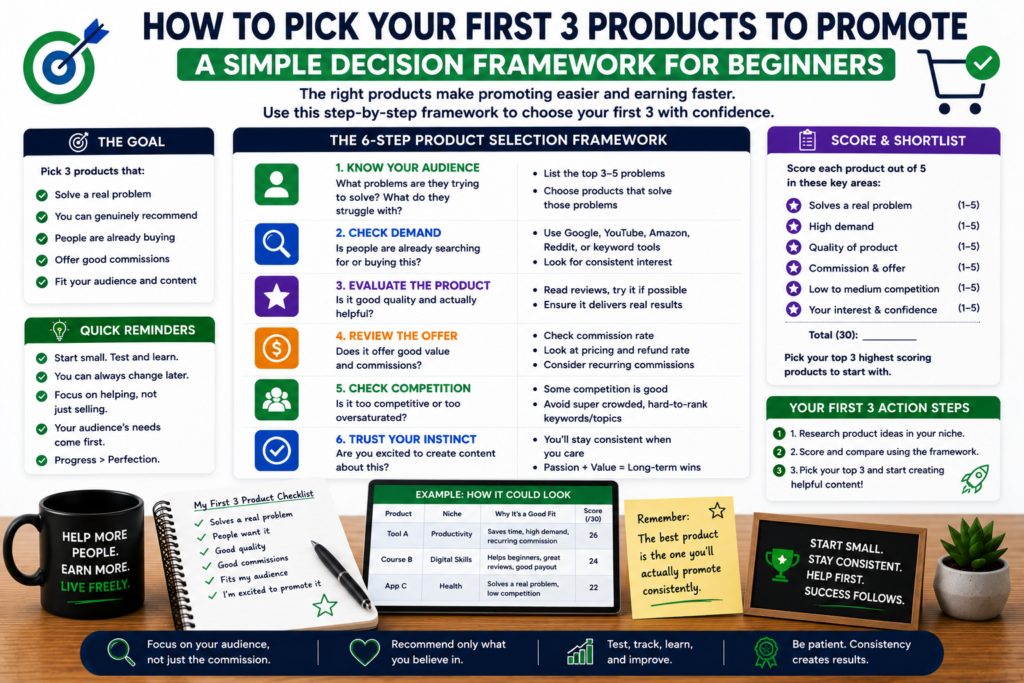
Starting an affiliate marketing journey is often exciting, but the sheer volume of available products can quickly become paralyzing. New marketers frequently make the mistake of trying to promote everything at once or picking the first product they see with a high commission rate. This approach leads to confusion, inconsistent messaging, and ultimately, zero conversions.
The secret to success isn’t finding the perfect product immediately; it’s using a structured Decision Framework to narrow down your options to your first three high-potential products. These initial picks are critical because they set the tone for your brand, teach you the mechanics of conversion, and determine your early cash flow.
In this guide, we’ll walk you through a step-by-step framework designed to help you select three complementary products that align with your audience, maximize your earnings, and minimize your risk.
Why Limit Yourself to Just Three?
You might wonder why we suggest starting with only three products instead of building a massive catalog immediately. The answer lies in focus and learning.
- Cognitive Load: Managing more than three distinct offers spreads your content efforts thin. It’s better to master the promotion of one product deeply than to do a shallow job on ten.
- Audience Trust: Your audience trusts you when you provide specific, curated solutions. Recommending a “kitchen sink” of unrelated products makes you look like a spammy billboard rather than a trusted advisor.
- Data Collection: With fewer variables, you can accurately track what works. If Product A converts and Product B doesn’t, you know exactly where to pivot.
- Synergy: Three well-chosen products can cover different stages of the customer journey (awareness, consideration, decision), creating a seamless ecosystem for your readers.
The “3-Product” Decision Framework
To pick your winners, run every potential product through these four filters. Only products that pass all four filters should make your shortlist.
Filter 1: Audience Alignment & Problem-Solving Power
The Question: Does this product solve a specific, urgent problem my audience already has?
Before looking at commissions, look at the problem. Your audience follows you for answers, not just for random links.
- Relevance: If your blog is about “Home Gardening,” promoting a coding course fails the relevance test, even if it pays $500 per sale.
- Urgency: Does the product solve a pain point right now? (e.g., “How to fix a leaky pipe” vs. “How to start a garden in 5 years”). Urgent problems convert faster.
- Brand Fit: Would you personally use or recommend this to a friend? If the answer is no, your audience will smell the insincerity.
Action Step: Write down the top 3 problems your audience faces. Match each problem to a potential product.
Filter 2: Commission Structure & Profitability
The Question: Is the math worth my time?
Not all commissions are created equal. A 5% commission on a $2,000 product ($100) is vastly different from a 5% commission on a $20 product ($1).
- Commission Rate: Look for programs offering at least 10–20% for physical goods and 30–50% for digital products/courses.
- Recurring Revenue: The holy grail. SaaS (Software as a Service) or subscription boxes often pay monthly recurring commissions. Selling one subscription could earn you money for months or years.
- Cookie Duration: This is how long you get credit after someone clicks your link. Amazon offers 24 hours; some networks offer 30, 60, or even lifetime cookies. Longer is always better.
- EPC (Earnings Per Click): Check the network stats if available. This metric tells you how much other affiliates earn per click. High EPC usually indicates a proven converter.
Action Step: Calculate the “Break-Even Point.” If you need 100 clicks to get one sale, and the commission is $10, you need a 1% conversion rate. Is that realistic for your traffic source?
Filter 3: Merchant Reputation & Conversion Quality
The Question: Will this product make me look good if I promote it?
Promoting a bad product destroys trust instantly. Once lost, trust is nearly impossible to regain.
- Reviews & Ratings: Search for independent reviews (not just those on the merchant’s site). Look for patterns in complaints—shipping delays, poor support, or broken features are red flags.
- Refund Rates: High refund rates kill your income. Most networks will claw back commissions if a customer returns the product within the return window.
- Sales Page Quality: Click through to the product page. Is it professional? Does it have strong copywriting, clear videos, and social proof? You are essentially betting on their sales funnel.
- Affiliate Support: Do they have an affiliate manager who responds quickly? Are there banners, email swipes, and data feeds ready for you?
Action Step: Spend 15 minutes reading negative reviews. If the cons outweigh the pros significantly, skip it.
Filter 4: Market Saturation & Differentiation Potential
The Question: Can I say something new about this product?
If everyone is promoting the exact same “best vacuum cleaner” article with the exact same angles, it will be hard to rank in search engines or stand out on social media.
- Competition Check: Search for the product name + “review” or “honest opinion.” Are there thousands of big sites dominating the results?
- Angle Opportunity: Can you target a sub-niche? Instead of “Best Running Shoes,” try “Best Running Shoes for Flat Feet” or “Running Shoes for Trail Runners.”
- Unique Content: Can you create a video comparison, a long-term usage update, or a case study that others haven’t done?
Action Step: Identify one unique angle or persona (e.g., “for beginners,” “budget-conscious,” “luxury seekers”) that you can own for this product.
Building Your “Power Trio”: A Strategic Mix
Once you’ve filtered your options, you shouldn’t just pick the three highest-paying products. You want a strategic mix that covers different needs and price points. Here is the ideal composition for your first three products:
1. The “Easy Win” (Low Barrier, High Volume)
- Characteristics: Low price point ($20–$50), instant recognition, easy to sell.
- Purpose: To generate quick wins, build confidence, and establish your first few conversions. These products have low hesitation times for buyers.
- Example: A popular e-book, a budget tool, or a consumable item.
- Strategy: Focus on volume and ease of purchase. “Get this today to solve [Problem X] immediately.”
2. The “High-Ticket Anchor” (Higher Effort, Big Payout)
- Characteristics: Higher price ($200+), longer decision cycle, higher commission value ($50–$200+).
- Purpose: To maximize revenue per sale. You won’t sell these every day, but one sale can equal twenty sales of the “Easy Win.”
- Example: A premium course, a software subscription, or a specialized piece of equipment.
- Strategy: Requires deep-dive content, comparisons, and detailed demos to overcome buyer hesitation.
3. The “Recurring Revenue Engine” (Long-Term Stability)
- Characteristics: Subscription-based, monthly payments, potentially lower upfront payout but compounding over time.
- Purpose: To build a safety net. Even if traffic dips, you keep earning from past referrals.
- Example: Hosting services, SaaS tools, membership sites, or meal kit subscriptions.
- Strategy: Focus on the long-term value and ROI for the user. “Invest in this once, and save/time/money every month forever.”
By choosing one of each, you balance immediate cash flow (Easy Win) with long-term wealth building (Recurring) and high-value payouts (Anchor).
Common Pitfalls to Avoid
As you apply this framework, watch out for these common beginner traps:
- Chasing the Highest Commission Blindly: A 90% commission on a scammy $50 ebook is worse than a 20% commission on a reputable $200 tool. Trust matters more than rate.
- Ignoring the Customer Journey: Don’t try to sell a $1,000 system to someone who just discovered they have a problem. Start them with the “Easy Win” to build rapport.
- Overlooking Terms and Conditions: Read the fine print. Some programs forbid bidding on branded keywords (PPC), while others restrict social media promotions. Violating terms gets you banned.
- Analysis Paralysis: Spending weeks researching and zero time promoting. Remember, no product is perfect. Pick the best fit based on your data, launch, and iterate.
Execution Plan: Your First 7 Days
Ready to take action? Here is a simple timeline to get your first three products live:
- Day 1: Audit Your Audience. List the top 3 questions your audience asks you or searches for on your site.
- Day 2-3: Research Candidates. Use affiliate networks (like ShareASale, CJ, Impact, or direct programs) to find 5-10 products per question. Apply the 4 Filters.
- Day 4: Select Your Trio. Choose your Easy Win, High-Ticket Anchor, and Recurring Engine. Sign up for their programs.
- Day 5: Content Creation. Draft one core piece of content (a review, a tutorial, or a comparison post) that naturally integrates all three products.
- Day 6: Optimization. Add your affiliate links, write compelling call-to-actions (CTAs), and ensure mobile responsiveness.
- Day 7: Launch & Track. Publish the content and set up tracking (Google Analytics or network dashboards) to monitor clicks and conversions.
Final Thoughts
Picking your first three products is the most strategic move you can make in the early stages of affiliate marketing. It forces you to think like a publisher, not a salesman. By focusing on audience alignment, profitability, reputation, and market differentiation, you lay a foundation for sustainable growth.
Remember, your goal isn’t to promote everything; it’s to recommend the right things. Once you master the art of selecting and promoting these first three, expanding your portfolio becomes much easier because you’ll have the data and confidence to evaluate new opportunities instantly.
Start small, stay focused, and let your first three products pave the way for your future success.