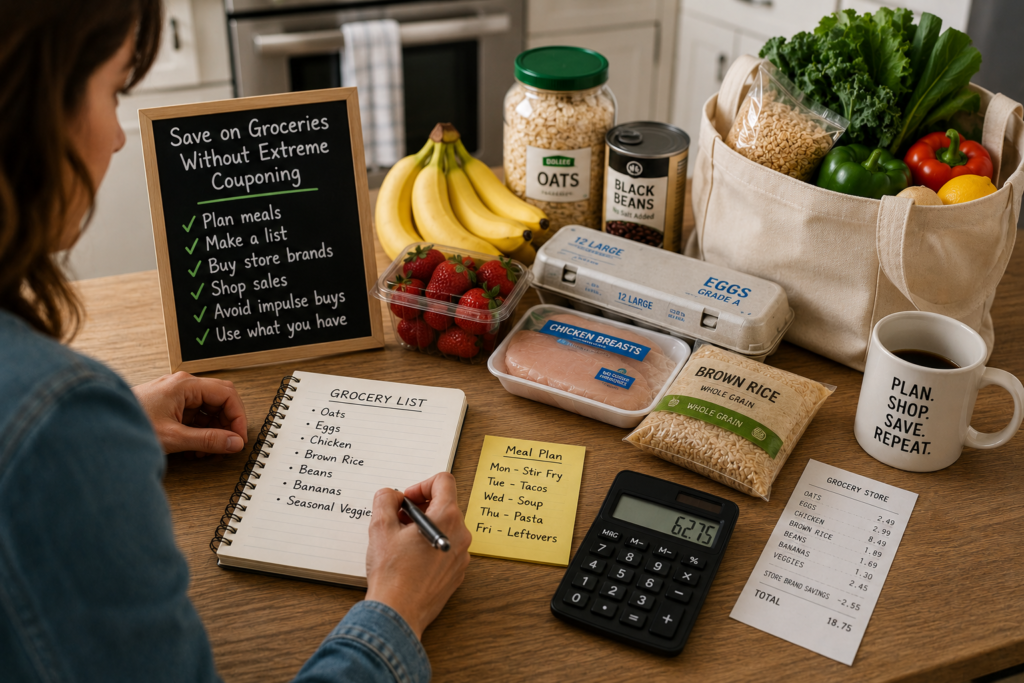
Open any article about saving money on food, and within three paragraphs someone will mention a coupon binder. They’ll show you a receipt where they “saved” $187 on 47 bottles of mustard, a cart full of processed food they didn’t need, purchased at a store 40 minutes from their house.
That’s extreme couponing. And for the vast majority of people, it’s impractical, time-consuming, and weirdly expensive in its own way.
Here’s what actually works: a set of straightforward shopping, planning, and cooking habits that bring your grocery bill down by 30 to 50% without requiring you to clip anything, stockpile anything, or turn grocery shopping into a part-time job.
The average American household spends roughly $475 per month on groceries, according to the Bureau of Labor Statistics. Most of those households are leaving $150 to $250 on the table every single month through habits they’ve never questioned.
This guide covers every angle, from how you plan before the store to how you cook after it, with specific strategies that work at any grocery store in any budget bracket.
Why Extreme Couponing Doesn’t Work for Most People
Before getting into what works, it’s worth understanding why the coupon-heavy approach falls short.
It rewards buying things you don’t need. Coupons exist to move product. Manufacturers issue them for items with high margins, usually processed, branded, and packaged foods. Getting 75 cents off a $4.50 box of cereal doesn’t save you money if the store-brand version costs $2.50 and you would have been fine with oatmeal for $0.30 per serving.
It trades time for marginal savings. Serious couponers spend 5 to 10 hours per week organizing, planning, matching deals, and driving between stores. That’s a part-time job. If your time is worth anything at all, the per-hour return on extreme couponing is often below minimum wage.
It creates waste. Buying six jars of pasta sauce because they’re on sale means nothing if three of them expire before you use them. Stockpiling perishables or even shelf-stable items beyond what you’ll realistically consume converts “savings” into trash.
It doesn’t address the real cost drivers. The biggest factors in your grocery bill aren’t the price of individual items. They’re how often you shop, how much you throw away, what you eat versus what you buy, and whether your meals are planned or improvised. Coupons don’t touch any of those.
The strategies below do.
Part 1: Before You Leave the House
The grocery store is designed to make you spend more than you planned. Wide aisles, strategic product placement, end-cap displays, the smell of fresh bread near the entrance. Every detail is engineered to increase your cart size.
Your best defense happens before you walk through the door.
Build a Meal Plan (Even a Loose One)
Meal planning is the single highest-impact grocery savings strategy. Full stop. It addresses the three biggest budget killers simultaneously: impulse buying, food waste, and expensive last-minute takeout when you “have nothing to eat.”
You don’t need a rigid, color-coded weekly plan. A loose framework works fine:
- Pick 4 to 5 dinners for the week. Just the main meals. Breakfast and lunch can be flexible (more on that later).
- Check what you already have. Open the fridge, freezer, and pantry. Build at least one or two meals around ingredients that are already on hand.
- Write down only what you need to buy. Your shopping list comes directly from your meal plan plus staple replenishments. Nothing else makes the list unless it’s a true household need.
A 2023 study by the International Food Information Council found that households that planned meals before shopping spent an average of 23% less on groceries per month compared to households that shopped without a plan. On a $475 monthly grocery budget, that’s $109 saved monthly, over $1,300 annually, from 15 minutes of planning.
Shop Your Kitchen First
Before you write a single item on your shopping list, do a quick inventory of what’s already in your kitchen.
Check three places:
The fridge. What produce is getting close to its expiration? What leftovers can become tomorrow’s lunch? What condiments and sauces are still half-full? Many people buy duplicates of items they already own because they didn’t look before they left.
The freezer. The average American freezer contains $50 to $100 worth of forgotten food. Meat bought on sale three months ago, frozen vegetables pushed to the back, half a loaf of bread, containers of soup or chili from a big batch cook. Pull everything out, see what you have, and build a meal or two around it.
The pantry. Canned goods, pasta, rice, dried beans, spices, baking supplies. These items have long shelf lives but tend to accumulate and get forgotten. A quick scan prevents buying a third can of diced tomatoes when you already have two.
This five-minute habit eliminates duplicate purchases, reduces waste, and often removes two or three items from your shopping list before you even start writing it.
Make a List and Stick to It
This sounds obvious. It isn’t. According to a 2022 Slickdeals survey, the average American spends $314 per month on impulse purchases, and grocery stores are one of the top three locations where impulse buying happens.
The rule is simple: if it’s not on the list, it doesn’t go in the cart.
Write your list organized by store section (produce, dairy, meat, pantry, frozen) so you can move through the store efficiently without backtracking through temptation zones. Use a list app like AnyList, Todoist, or a shared Google Keep note if you want it on your phone.
One exception to the “list only” rule: if a staple ingredient you regularly use is on a genuinely good sale (not just a yellow tag, but 30%+ off), grab it. Stocking up on things you’ll actually use at a meaningful discount is smart shopping. Grabbing chips because they’re at the end of the aisle is not.
Eat Before You Shop
It sounds like folk wisdom, but research backs it up. A 2013 study published in JAMA Internal Medicine found that hungry shoppers purchased 31% more high-calorie, impulsive food items compared to shoppers who had eaten recently. The total spending difference was measurable and consistent across income levels.
You don’t need a full meal. A snack, a piece of fruit, or a handful of nuts 30 minutes before shopping is enough to take the edge off and let your rational brain make purchasing decisions instead of your stomach.
Part 2: At the Store
Shop the Perimeter Strategically
You’ve probably heard the advice to “shop the perimeter” where fresh foods live. That’s partially useful, but the perimeter includes some of the most expensive sections in the store: the deli counter, the bakery, the prepared foods section, and the premium meat case.
A smarter approach: shop the perimeter for produce, proteins, dairy, and eggs, but skip the sub-sections designed to sell convenience at a premium.
- Deli counter vs. block cheese. Pre-sliced deli cheese costs $8 to $12 per pound. A block of the same cheese costs $4 to $6 per pound. You own a knife. Same logic applies to pre-sliced deli meats versus buying a whole rotisserie chicken and slicing it yourself.
- Bakery section vs. bread aisle. Artisan bakery bread at $5 to $7 per loaf is lovely, but a high-quality bread aisle option at $3 to $4 delivers 90% of the taste at half the price.
- Prepared foods vs. 20 minutes of cooking. A pre-made grocery store salad costs $8 to $12. The same salad from bulk ingredients costs $2 to $3. The store is charging you $6 or more for five minutes of chopping.
Buy Store Brands (Almost) Everything
This is the closest thing to a guaranteed savings hack in grocery shopping. Store-brand and generic products are, in many cases, manufactured in the same facilities, using the same ingredients, as their name-brand equivalents. The packaging is different. The price is 20 to 40% lower.
According to a 2023 report from the Private Label Manufacturers Association, store-brand products cost an average of 25% less than national brands across all categories. On a $475 monthly grocery bill, switching just half your purchases to store brand saves roughly $60 per month.
Categories where store brands are virtually identical to name brands:
- Canned goods (tomatoes, beans, vegetables, broth)
- Baking supplies (flour, sugar, baking soda, vanilla extract)
- Dairy (milk, butter, eggs, sour cream, cream cheese)
- Frozen vegetables and fruits
- Pasta and rice
- Cooking oils and vinegar
- Cleaning supplies and paper products
- Over-the-counter medications (same active ingredients, FDA-regulated)
- Spices and seasonings
- Condiments
Categories where brand might matter to you (taste is more subjective):
- Coffee and tea
- Snack foods and chips
- Cereal
- Ice cream
- Specialty sauces
Try the store brand once. If you can’t tell the difference, that’s your new default. If you genuinely prefer the name brand in a specific category, keep buying it. The goal isn’t to sacrifice every preference. It’s to stop paying a branding premium on items where you don’t notice or care about the difference.
Learn to Read the Unit Price
The sticker price tells you how much an item costs. The unit price tells you how much it actually costs, and those are often very different things.
The unit price is printed on the shelf tag, usually in small text, showing cost per ounce, per pound, per count, or per 100 sheets. It’s the only honest way to compare two products.
Examples where the sticker price is misleading:
- A 12-oz jar of peanut butter for $3.49 ($0.29/oz) vs. a 28-oz jar for $5.99 ($0.21/oz). The bigger jar costs more at the register but 28% less per ounce.
- A 6-pack of paper towels for $5.99 ($1.00/roll, 60 sheets each) vs. a 4-pack of “double rolls” for $6.49 ($1.62/roll, but 120 sheets each, so $0.014/sheet vs. $0.017/sheet). The 4-pack is actually cheaper despite the higher sticker price.
- A 16-oz bag of frozen chicken for $4.99 ($0.31/oz) vs. a 3-lb bag for $8.99 ($0.19/oz). The bulk bag saves 39% per ounce.
One caution: bigger isn’t always cheaper. Occasionally, the smaller size has a lower unit price, especially during sales. Always check the tag instead of assuming.
Shop Seasonal Produce
Fruits and vegetables cost dramatically less when they’re in season and grown locally (or at least domestically). Out-of-season produce is shipped from the other hemisphere, stored in controlled atmospheres, and marked up accordingly.
A rough guide to peak seasons and lowest prices in the U.S.:
Spring (March to May): Asparagus, artichokes, peas, strawberries, spinach, radishes, green onions
Summer (June to August): Tomatoes, corn, zucchini, peppers, berries, peaches, watermelon, cucumbers, green beans
Fall (September to November): Apples, pears, sweet potatoes, winter squash, Brussels sprouts, cranberries, cauliflower, pumpkin
Winter (December to February): Citrus fruits (oranges, grapefruits, lemons), cabbage, root vegetables (carrots, turnips, beets), kale, broccoli
Buying strawberries in June costs $2 to $3 per pound. Buying them in January costs $4 to $6 for a smaller package, and they taste like they were picked three weeks ago (because they were).
Build your meals around what’s cheap and abundant right now, and your produce spending drops by 30 to 40% while the quality goes up.
Know the Cheap Protein Sources
Protein is typically the most expensive component of any meal. But the price range within the protein category is enormous, and most people default to the expensive end without considering alternatives.
Budget protein power rankings (cost per gram of protein):
| Protein Source | Approximate Cost per Pound | Grams of Protein per Pound | Cost per 30g of Protein |
|---|---|---|---|
| Dried lentils/beans | $1.50 – $2.00 | 100 – 115g | $0.40 – $0.60 |
| Eggs (dozen) | $2.50 – $4.00 | ~72g (dozen) | $1.00 – $1.70 |
| Chicken thighs (bone-in) | $1.50 – $3.00 | ~80g | $0.56 – $1.13 |
| Canned tuna | $1.50 – $2.50 (5 oz can) | ~30g per can | $1.50 – $2.50 |
| Whole chicken | $1.50 – $2.50 | ~90g | $0.50 – $0.83 |
| Ground turkey | $3.50 – $5.00 | ~95g | $1.10 – $1.58 |
| Peanut butter | $2.50 – $4.00 (16 oz) | ~100g | $0.75 – $1.20 |
| Ground beef (80/20) | $4.00 – $6.00 | ~77g | $1.56 – $2.34 |
| Chicken breast (boneless) | $3.50 – $6.00 | ~140g | $0.75 – $1.29 |
| Salmon fillet | $8.00 – $14.00 | ~90g | $2.67 – $4.67 |
You don’t need to eat lentils at every meal. But swapping boneless chicken breast for bone-in thighs twice a week, adding one bean-based dinner per week, and using eggs for two to three breakfasts or dinners saves $40 to $80 per month on protein alone.
The Frozen Aisle Is Your Friend
Fresh produce has a reputation advantage over frozen, but nutritionally, frozen fruits and vegetables are equal or superior to fresh in most cases. A 2017 study from the University of Georgia found that frozen produce retained more vitamins over time because it’s flash-frozen at peak ripeness, while “fresh” produce degrades during days or weeks of shipping and shelf sitting.
Frozen produce is cheaper, lasts months instead of days, and eliminates the waste problem that plagues fresh produce purchases.
Best frozen buys:
- Frozen berries for smoothies and baking ($2 to $3/lb frozen vs. $4 to $6/lb fresh)
- Frozen broccoli, spinach, peas, and green beans ($1 to $2/lb frozen vs. $2.50 to $4/lb fresh)
- Frozen stir-fry vegetable blends (pre-cut, pre-mixed, ready to cook)
- Frozen fruit for smoothies (bananas, mango, mixed berries)
Where fresh still wins: Salad greens, herbs, avocados, tomatoes for raw eating, and anything where texture matters (frozen lettuce is not a thing for good reason).
A smart strategy: buy fresh for what you’ll eat within three to four days, and frozen for everything else. Your vegetable variety goes up, your waste goes down, and your spending drops.
Don’t Ignore the “Ugly” Produce
Many grocery stores now offer imperfect or “ugly” produce at 30 to 50% discounts. These are fruits and vegetables that are oddly shaped, slightly blemished, or cosmetically imperfect but nutritionally and flavor-wise identical to their prettier counterparts.
Subscription services like Misfits Market and Imperfect Foods deliver ugly produce to your door at discounted prices. If your local store has an imperfect produce bin, check it every visit. A dented apple makes the same applesauce as a round one.
Time Your Shopping Trip
When you shop affects how much you spend.
Best times to find markdowns: Early morning (bakery and deli markdowns from the previous day), late evening (meat and produce marked down before closing), and mid-week (Monday through Wednesday, when stores clear weekend overstock).
Worst time to shop: Saturday and Sunday afternoons. Stores are crowded, shelves are picked over, you spend more time in the store (which correlates with more spending), and the psychological pressure of a packed store increases impulse buying.
Shopping frequency matters too. Every trip to the grocery store costs you an average of $20 to $40 in unplanned purchases, according to a study by the Food Marketing Institute. If you shop three times a week instead of once, you’re adding $40 to $80 in impulse spending per week.
The fix: shop once per week for your main haul. If you need a mid-week top-up (milk, bread, a missing ingredient), go with a specific list of three items or fewer. Get in, get out.
Part 3: In the Kitchen
Saving money on groceries doesn’t stop at the register. What happens in your kitchen determines whether the food you bought becomes meals or garbage.
Cook in Batches
Batch cooking is the intersection of saving money and saving time. The concept: cook a large quantity of one or two dishes on a single day, then portion them for meals throughout the week.
Why it saves money:
- Buying in bulk for one big cook is cheaper per serving than buying small quantities for individual meals
- Fewer “I’m too tired to cook” moments means fewer $25 to $40 takeout orders
- Leftovers become lunch instead of spending $10 to $15 on a midday meal out
High-yield batch cooking ideas:
- A big pot of chili or soup (serves 8 to 12, costs $10 to $15 total, freezes well)
- A sheet pan of roasted chicken thighs with vegetables (serves 4 to 6, costs $8 to $12)
- A large batch of rice, beans, and seasoned ground meat (serves 8 to 10, costs $8 to $10)
- A pot of pasta sauce from canned tomatoes and ground turkey (makes 6 to 8 servings, costs $6 to $10)
- Overnight oats prepped in five jars (5 breakfasts, costs $4 to $6 total)
One to two hours of cooking on Sunday can cover half or more of your meals for the entire week. The per-serving cost of batch-cooked meals typically falls between $1.50 and $3.00, compared to $8 to $15 for the average restaurant or takeout meal.
Master Five Cheap, Filling Meals
You don’t need a hundred recipes. You need five reliable, inexpensive meals that you enjoy eating and can make without a recipe. These become your rotation, your default when you’re tired, busy, or uninspired.
Here are five templates that cost $2 to $4 per serving:
1. Rice bowls. Cooked rice + a protein (egg, chicken, beans, ground meat) + a vegetable (roasted broccoli, sautéed peppers, frozen stir-fry blend) + a sauce (soy sauce, salsa, hot sauce, peanut sauce). Infinite variations, always filling.
2. Pasta with simple sauce. Pasta + canned tomatoes + garlic + olive oil + whatever vegetables need using up. Add ground meat or white beans for protein. A pound of pasta feeds four to six people for $1 to $2.
3. Bean-based soups and stews. Dried beans or canned beans + onion + garlic + broth + spices + any vegetables you have. A pot of black bean soup costs $3 to $5 and feeds a family for two days.
4. Sheet pan dinners. One protein + two or three vegetables, seasoned and roasted on a single pan at 400°F for 25 to 35 minutes. Minimal cleanup, maximum flavor, and you can use whatever’s on sale that week.
5. Eggs any way. Scrambled with vegetables, fried on toast, baked in a frittata with leftovers, or hard-boiled for portable meals. Eggs cost $0.25 to $0.40 each and deliver 6 grams of protein per egg. A three-egg dinner with toast and sautéed vegetables costs about $1.50.
These five templates cover breakfast, lunch, and dinner. Learn them once, rotate weekly, and you’ll always have a cheap answer to “what’s for dinner” that doesn’t involve a delivery app.
Stop Wasting Food
Food waste is the silent budget killer. The USDA estimates that 30 to 40% of the U.S. food supply goes to waste, and the average American household throws away approximately $1,500 worth of food per year. That’s $125 per month going directly into the trash.
Reducing food waste by even half saves $60 per month without buying anything differently.
Practical waste reduction strategies:
Use the “first in, first out” method. When you unpack groceries, move older items to the front of the fridge and pantry. Put new purchases behind them. This simple reorganization ensures you use what’s closest to expiring before reaching for the new stuff.
Repurpose wilting vegetables. Soft carrots, limp celery, and slightly wrinkled peppers are perfect for soups, stir-fries, and sauces where texture doesn’t matter. Overripe bananas become banana bread. Stale bread becomes croutons, breadcrumbs, or French toast. Almost nothing needs to be thrown away if you catch it at the right stage.
Freeze what you won’t use in time. Bread, meat, shredded cheese, cooked rice, fresh herbs (in olive oil in ice cube trays), ripe bananas, and most cooked meals freeze well for 2 to 3 months. If you know you won’t eat something before it goes bad, freeze it the day you realize, not the day it spoils.
Understand expiration dates. “Best by” and “sell by” dates are quality suggestions from the manufacturer, not safety deadlines (with the exception of infant formula, which is FDA-regulated). Milk that says “sell by June 15” is typically fine for 5 to 7 days after that date if it smells and tastes normal. Eggs last 3 to 5 weeks past their carton date when refrigerated. Canned goods remain safe for years past their “best by” date.
Learning the difference between “this is expired” and “this is past the manufacturer’s conservative quality suggestion” prevents hundreds of dollars of perfectly good food from hitting the trash each year.
Make Breakfast and Lunch Boring (In a Good Way)
This is a controversial opinion in food culture, but most people who successfully manage a grocery budget eat similar breakfasts and lunches most days and save their variety and creativity for dinner.
The logic: breakfast and lunch are functional meals. You’re eating them at work, on the go, or between tasks. You don’t need Instagram-worthy variety at 7 a.m. and noon. You need fuel that’s quick, cheap, and filling.
Cheap, repeatable breakfasts (cost per serving):
- Oatmeal with banana and peanut butter: $0.50 to $0.75
- Two eggs and toast: $0.75 to $1.00
- Yogurt with granola and frozen berries: $1.00 to $1.50
- Overnight oats (prep Sunday, eat all week): $0.60 to $0.90
Cheap, repeatable lunches:
- Leftovers from last night’s dinner: $0 (already paid for)
- Rice and beans with salsa: $0.75 to $1.25
- PB&J with an apple: $0.80 to $1.20
- Large batch soup, portioned into containers: $1.00 to $2.00
If you spend $1.00 on breakfast and $1.50 on lunch versus $5 at a coffee shop and $12 at a fast-casual restaurant, you save $14.50 per day. Over 20 workdays, that’s $290 per month.
This single shift, simple weekday breakfast and lunch, is worth more than every coupon in existence combined.
Part 4: Store Selection and Shopping Strategy
Compare Stores by Category, Not Overall
No single grocery store is cheapest for everything. The store with the best produce prices might have expensive dairy. The warehouse club with cheap bulk goods charges premium prices on small-quantity items.
A practical approach: identify two or three stores and know what each one does well.
Discount grocers (Aldi, Lidl, WinCo, Grocery Outlet): Best for staples, produce, dairy, bread, and store-brand packaged goods. Prices are typically 20 to 40% below conventional supermarkets.
Warehouse clubs (Costco, Sam’s Club, BJ’s): Best for bulk proteins (chicken, ground beef, pork), cheese, eggs, cooking oils, nuts, toilet paper, and cleaning supplies. The per-unit price is hard to beat, but only buy quantities you’ll actually use.
Conventional supermarkets (Kroger, Safeway, Publix, H-E-B): Best for sales, loss leaders, and loyalty program rewards. These stores use strategic pricing, selling some items at or below cost to get you in the door, so cherry-picking their weekly sales can be worthwhile.
Ethnic and specialty grocery stores (Asian, Latin, Middle Eastern, Indian markets): Dramatically cheaper for spices, rice, dried beans, fresh produce, sauces, noodles, and specialty ingredients. Spices that cost $6 at a conventional store often cost $1 to $2 at an ethnic market for a larger quantity.
You don’t need to visit four stores every week. Shop your primary store for the main haul and visit a secondary store once or twice a month for specific bulk or specialty items.
Aldi Deserves Its Own Section
If you have an Aldi nearby and you’re not shopping there, you’re almost certainly overpaying for groceries.
Aldi’s business model is built on efficiency: smaller stores, limited selection (1,400 SKUs vs. 30,000+ at a typical supermarket), minimal staff, and almost entirely private-label products. The result is prices that are consistently 30 to 50% below conventional grocery stores.
A 2023 price comparison by Cheapism found that a basket of 40 common grocery items cost $91.56 at Aldi versus $143.35 at a national chain. That’s a 36% savings on the same items.
Aldi’s trade-off: limited brands, limited selection, and you bag your own groceries. For most people, those trade-offs are barely noticeable, and the savings are instantly life-changing for households on tight budgets.
Skip the Grocery Store Entirely (Sometimes)
For certain staple items, non-grocery retailers beat grocery store prices consistently:
- Dollar Tree / Dollar stores: Spices, canned goods, condiments, snacks, and some frozen items at $1.25 per item. Quality varies, but staples like canned tomatoes, rice, and dried pasta are identical to grocery store versions.
- Amazon Subscribe & Save: Bulk pantry staples (coffee, protein bars, canned goods, snacks, baby food) at 5 to 15% discounts with scheduled delivery. Price-compare before assuming Amazon is cheapest, but for specific items, the subscription discount stacks with coupon clips on the product page.
- Restaurant supply stores (like Restaurant Depot or Smart & Final): Open to the public in many locations. Excellent prices on bulk cooking oils, canned goods, spices, and large-format proteins. Ideal if you batch cook regularly.
Part 5: Long-Term Habits That Compound
Grow Even a Little of Your Own Food
You don’t need a farm or even a backyard. A few pots on a windowsill or balcony can grow herbs that would cost $2 to $4 per package at the store.
Highest-return plants for beginners:
- Fresh herbs (basil, cilantro, parsley, chives, mint): A single basil plant produces more than you can eat and costs $2 to $3 to start. A single package of cut basil at the store costs $2 to $3 and lasts a week.
- Cherry tomatoes: One plant can produce 10 to 20 pounds of tomatoes over a season. Container-friendly, grows on a balcony.
- Lettuce and salad greens: Ready to harvest in 30 days, regrows after cutting, and thrives in shallow containers.
- Green onions: Buy a bunch, use the tops, and plant the root ends in a jar of water. They regrow repeatedly for months.
The savings per item are modest, but the quality improvement is dramatic. Fresh-picked herbs and tomatoes taste noticeably better than anything from a store, and the habit connects you to your food in a way that naturally reduces waste and impulsive buying.
Keep a Price Book (Low-Effort Version)
A price book is a record of what you typically pay for your most-purchased items. It sounds tedious, but the modern version takes almost no effort.
After three to four shopping trips, note the regular prices for your top 20 most-purchased items at your primary store. Keep the list in your phone. This takes about 10 minutes total.
Now you have a personal price database. When you see a “sale,” you know instantly whether it’s a real deal or a fake markdown. When comparing stores, you can identify exactly which items are cheaper where.
Most people who keep a casual price book find that they’ve been overpaying for at least three to five staple items, either because they assumed one store was cheapest for everything or because they fell for “sale” prices that were barely below regular price.
Build a Bare-Bones Meal Plan for Tight Weeks
Every budget has bad months. Car repairs, medical bills, irregular income dips. Having a pre-planned “emergency meal plan” that costs $30 to $50 for a full week of food prevents two expensive outcomes: panic buying (grabbing whatever’s convenient and overpriced) and falling back on takeout and delivery.
A sample emergency week for one person ($30 to $40):
- Breakfast daily: Oatmeal with peanut butter and banana ($3.50 for the week)
- Lunch daily: Rice and beans with salsa, or PB&J ($5 to $7 for the week)
- Dinners: Two nights of pasta with canned tomato sauce ($3), two nights of rice bowls with eggs and frozen vegetables ($4), one night of bean soup ($2.50), one night of baked potatoes with butter and broccoli ($3), one night of quesadillas with canned beans and cheese ($3)
- Snacks: Apples, carrots, peanut butter ($3 to $4)
It’s not fancy. But it’s nutritious, filling, and prevents a tight budget week from turning into $100 of stress spending on delivery apps.
Write this plan down, save it in your phone, and keep it ready. Knowing you can feed yourself well for $40 in a pinch removes a layer of financial anxiety that no coupon can touch.
The Real Numbers: What a 30% Grocery Savings Looks Like
If your household currently spends $475 per month on groceries (the national average), a 30% reduction brings you to $333 per month. That’s $142 saved every single month.
Over time:
- 1 year: $1,704 saved
- 3 years: $5,112 saved
- 5 years: $8,520 saved
- 10 years: $17,040 saved
If you invest that $142/month at an average 7% annual return:
- 10 years: $24,600
- 20 years: $74,000
- 30 years: $172,500
All from buying store-brand pasta, eating leftovers for lunch, and planning your meals on Sunday evening.
No coupons clipped. No binder required. No trunk full of mustard.
Start With Three Changes This Week
You don’t need to overhaul your grocery routine overnight. Pick three strategies from this guide and implement them on your next shopping trip:
- Plan five dinners and make a list before you leave the house. This alone eliminates most impulse purchases and prevents the “nothing to eat” takeout trap.
- Switch five staple items to store brand. Pick the ones where you care least about the brand: canned goods, pasta, flour, butter, frozen vegetables. Pocket the 25% difference.
- Check your fridge and freezer before you shop. Build at least one meal around what you already have, and skip buying anything you already own.
Three changes. One shopping trip. You’ll see the difference on the receipt immediately, and you’ll feel it in your bank account by month’s end.
The grocery store isn’t working against you if you walk in with a plan. And a good plan will always outperform a stack of coupons.