Organic traffic is the darling of affiliate marketing advice. Build a blog. Grow a YouTube channel. Post on social media. Wait. Be patient. The commissions will come.
And that advice is solid, for the most part. Organic content builds long-term assets that generate income without ongoing costs.
But here’s what nobody talks about enough: some affiliate marketers are spending $50 a day on ads and earning $200 back. Others are spending $50 a day and earning exactly $0.
The difference isn’t luck. It’s knowing when paid ads make sense for affiliate offers and when they’re a fast way to empty your bank account.
This guide covers both sides. You’ll learn the conditions that make paid affiliate campaigns profitable, the situations where you should keep your wallet closed, and the tactical details of running ads that generate commissions instead of losses.
The Fundamental Math Behind Paid Affiliate Ads
Before anything else, you need to understand one number: your break-even cost per acquisition (CPA).
Here’s the calculation:
Commission per sale ÷ Conversion rate = Break-even CPA
If an affiliate product pays you $50 per sale and 2% of the people who land on the sales page buy, your break-even CPA is $50 ÷ 0.02 = $2,500. That means you’d need to send 50 people to the sales page to generate one sale. If you’re paying $2 per click, that’s $100 in ad spend for a $50 commission. You lose $50 every time.
Now change the numbers. Same $50 commission, but the product converts at 10%. Break-even CPA is $50 ÷ 0.10 = $500. You need 10 clicks per sale. At $2 per click, that’s $20 in ad spend for a $50 commission. You profit $30 per sale.
Same product. Same commission. Wildly different outcomes based on conversion rate alone.
This is why the math comes first. If the numbers don’t work on paper, they won’t work with real money. No amount of ad optimization will save a campaign where the fundamental economics are broken.
The three variables you need to estimate before spending a dollar:
- Commission amount. What do you earn per sale, lead, or action?
- Conversion rate of the offer. What percentage of visitors to the affiliate sales page actually convert? (Your affiliate manager may share this, or you can estimate from your own organic traffic data.)
- Estimated cost per click. What will you pay per visitor? This varies wildly by platform, niche, and targeting.
If (commission × conversion rate) > cost per click, you have a potentially profitable campaign. If not, stop here and choose a different offer or a different strategy.
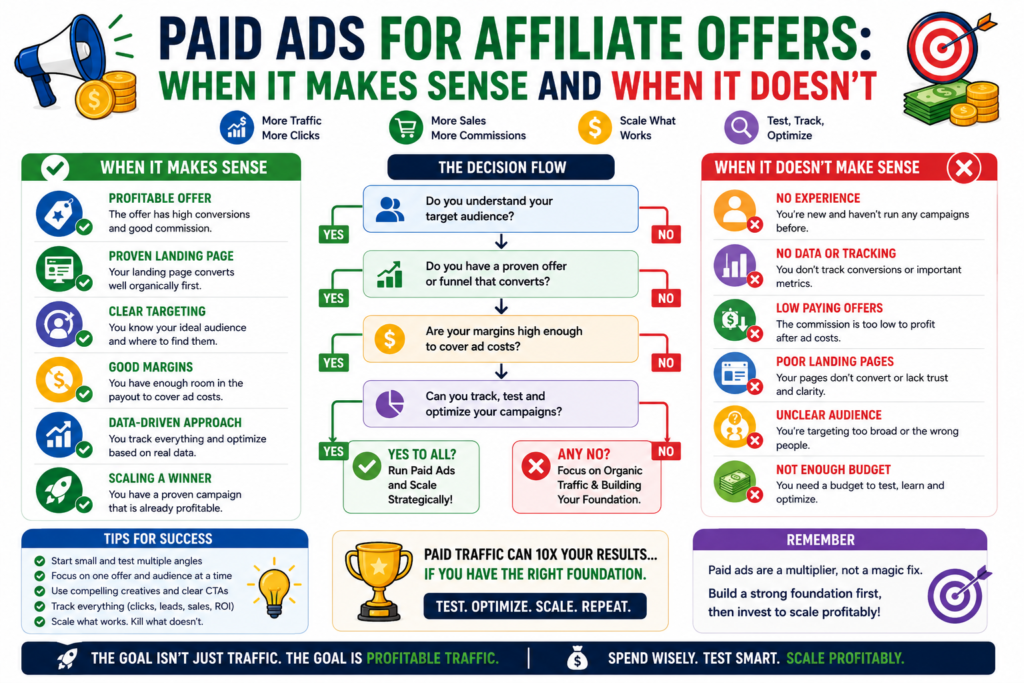
When Paid Ads Make Sense for Affiliate Offers
Paid ads aren’t universally good or bad. They’re a tool, and like any tool, they work brilliantly in certain conditions and terribly in others.
Condition 1: The Commission Is High Enough to Absorb Ad Costs
Low-ticket affiliate offers (commissions under $10) are almost impossible to profit from with paid ads. The cost per click on most advertising platforms sits between $0.50 and $5.00, and sometimes much higher in competitive niches. When your commission is $8, you need nearly every click to convert just to break even. That doesn’t happen.
Paid ads start making sense with commissions of $50 or higher for single purchases, or $20+ per month for recurring commission programs. Recurring commissions change the math dramatically. A product that pays $30 per month means a single customer acquired through ads could be worth $360 over a year, even if they cost $100 to acquire.
The sweet spots for paid affiliate ads:
- SaaS products with recurring commissions ($30 to $100/month per referral)
- High-ticket digital products ($200+ commissions per sale)
- Financial products (credit cards, investment platforms, insurance, often paying $50 to $200 per sign-up)
- Online education platforms ($50 to $500 per enrollment)
- Business services and tools ($100+ per sale or recurring)
Condition 2: The Offer Converts Well
You can drive thousands of clicks to an affiliate offer, but if the sales page is poorly designed, the product is overpriced relative to alternatives, or the checkout process is clunky, your money evaporates before it becomes commission.
Before running ads to any affiliate offer, evaluate the sales page:
- Does it load quickly on mobile?
- Is the value proposition clear within five seconds?
- Are there testimonials, case studies, or social proof?
- Is the pricing transparent?
- Does the checkout process feel smooth and trustworthy?
If you wouldn’t buy the product after reading the sales page, don’t spend money sending strangers to it.
Some affiliate programs share their average conversion rates. Ask your affiliate manager. If the offer converts at 3% or higher from cold traffic, it’s worth testing with ads. Below 1%, you’ll need extremely cheap clicks or a pre-sell strategy (more on that later) to make it work.
Condition 3: You Can Track and Attribute Sales
Paid advertising without tracking is gambling. You need to know which ads, which audiences, and which creatives are driving actual commissions, not just clicks.
This means:
- Using tracking links with UTM parameters or a dedicated affiliate tracking tool
- Having access to conversion data from your affiliate program (ideally with sub-ID tracking so you can tie conversions back to specific campaigns)
- Setting up proper pixel tracking if the affiliate program allows it (some do, many don’t)
If an affiliate program gives you a generic link with no sub-ID options and no way to track which of your campaigns generated a sale, running paid ads becomes a guessing game. You might be profitable, but you won’t know which campaigns to scale and which to cut.
Condition 4: You Have Budget to Test and Optimize
Paid ads rarely work on the first attempt. The first version of your ad, your targeting, and your landing page will almost certainly underperform. That’s normal. Profitability comes from testing, learning, and iterating.
A realistic testing budget:
- Minimum: $500 to $1,000 to test a single offer with a few ad variations
- Comfortable: $2,000 to $5,000 to test multiple offers, audiences, and creatives
- Scaling: $5,000+ per month once you’ve found winning campaigns
If you’re working with a budget of $100 and expecting to find a profitable campaign, the odds are against you. That budget doesn’t give you enough data to make informed optimization decisions. You’ll spend the money, see unclear results, and not know whether the offer is unprofitable or your ads just need refinement.
Condition 5: You Have a Pre-Sell Strategy
Sending paid traffic directly to an affiliate sales page is the most common approach, and it’s usually the least profitable one.
Why? Because cold traffic, people who have never heard of you, don’t trust you. And when they land on a sales page from an ad, their guard is up. They know they’re being sold to.
A pre-sell page (also called a bridge page) sits between your ad and the affiliate offer. It’s a page you control where you warm up the visitor before sending them to the sales page.
Effective pre-sell formats:
- A product review article. Write an honest review with pros, cons, and your personal experience. Include your affiliate link at the end.
- A comparison page. Compare the affiliate product with two or three alternatives. This positions you as a neutral advisor rather than a salesperson.
- A video review or demonstration. Embed a short video of you using the product, then link to the sales page below.
- A quiz or assessment. Ask visitors a few questions about their needs, then recommend the best product (your affiliate offer) based on their answers.
Pre-sell pages consistently outperform direct linking because they establish a layer of trust and context before the visitor sees the sales pitch. Conversion rates from pre-sell pages are often two to three times higher than direct linking.
When Paid Ads Don’t Make Sense for Affiliate Offers
Now the other side. There are clear situations where running paid ads for affiliate offers is a bad idea, regardless of how good your ad skills are.
Situation 1: The Commission Is Too Low
If an affiliate product pays $5 per sale, you’d need clicks at $0.10 or less with a conversion rate above 2% to break even. On most advertising platforms, that’s not realistic. Even on platforms with cheap traffic (like certain display networks), the quality of those clicks tends to be so low that conversion rates crater.
A general rule: if the commission is under $30 for a one-time payment with no recurring element, paid ads will struggle to be profitable unless you have an unusually high-converting funnel or access to very cheap, targeted traffic.
Situation 2: The Offer Page Is Weak
You have zero control over the affiliate product’s sales page. If the page is slow, confusing, ugly, or unconvincing, your ad spend is funding someone else’s conversion rate problem.
Signs of a weak offer page:
- Takes more than three seconds to load
- No clear headline or value proposition
- Missing social proof
- Complicated or multi-step checkout
- Looks outdated or untrustworthy
- Doesn’t work well on mobile devices
No amount of brilliant ad copy will compensate for a sales page that loses visitors the moment they land.
Situation 3: The Affiliate Program Restricts Paid Advertising
Many affiliate programs explicitly prohibit paid advertising, or they restrict specific types of paid traffic. Common restrictions include:
- No direct linking to the sales page from ads (you must use a landing page in between)
- No bidding on the brand’s name or product names in search ads
- No Facebook or social media advertising
- No pop-up or pop-under traffic
- No incentivized traffic (paying people to click)
Violating these terms gets your affiliate account terminated and your pending commissions forfeited. Read the terms of service for every affiliate program before spending money on ads. If the program prohibits your intended ad strategy, either comply with their rules (use a bridge page, avoid brand keywords) or choose a different offer.
Situation 4: You Can’t Track Performance
If the affiliate program doesn’t support sub-ID tracking or conversion postbacks, you’re flying blind. You won’t know which keywords, audiences, or ad creatives generate sales. Without this data, optimization is impossible. You’re just spending money and hoping.
Some affiliate networks (like ShareASale, Impact, or PartnerStack) offer robust tracking. Others give you a single link and nothing else. If tracking is limited, consider whether you can build your own tracking layer using a tool like Voluum, RedTrack, or ClickMagick.
If the answer is no, stick to organic traffic for that offer.
Situation 5: You’re in a Niche Where Paid Traffic Is Prohibitively Expensive
Some niches have cost-per-click rates so high that profitability is nearly impossible for affiliate offers.
Examples of expensive PPC niches:
- Legal services ($5 to $50+ per click)
- Insurance ($10 to $80+ per click)
- Finance and loans ($5 to $50+ per click)
- Enterprise software ($10 to $30+ per click)
In these niches, the companies selling the products can afford expensive clicks because their customer lifetime value is enormous. As an affiliate earning a fraction of that lifetime value, you can’t compete on the same terms.
If your niche has CPCs above $5, you’ll need either a very high commission rate or a creative traffic strategy (like targeting adjacent, cheaper keywords) to make paid ads work.
Situation 6: You Have No Testing Budget
Running one ad with one audience and one creative is not a test. It’s a coin flip. If you can’t afford to run at least five to ten ad variations, test two to three audiences, and let the campaigns run for seven to fourteen days, you don’t have enough budget to find a winner.
Spending your last $200 on affiliate ads hoping for a miracle is not a strategy. It’s desperation. Build organic traffic first, generate some baseline income, and then reinvest into paid ads with a proper testing budget.
Choosing the Right Ad Platform for Affiliate Offers
Each advertising platform has different strengths, costs, and rules regarding affiliate content. Here’s a breakdown.
Google Search Ads
Best for: High-intent buyer keywords with affiliate offers that allow search advertising.
How it works: You bid on keywords people search when they’re ready to buy. “Best CRM for small business,” “Bluehost vs SiteGround,” “QuickBooks pricing.” Your ad appears at the top of search results, they click, land on your pre-sell page, and ideally click through to the affiliate offer.
Pros:
- Extremely high buyer intent. People searching product comparisons and “best X” queries are often ready to purchase.
- Precise targeting by keyword.
- Measurable and optimizable.
Cons:
- Competitive keywords are expensive ($2 to $15+ per click in many niches).
- Google has strict policies about affiliate content and may disapprove ads that lead to “bridge pages” with thin content.
- You need a quality landing page that provides genuine value, not just a redirect to an affiliate link.
Tips for Google Ads affiliate campaigns:
- Build substantial, content-rich landing pages that would pass as legitimate resources even without the affiliate links.
- Target long-tail, comparison, and “alternative to” keywords where competition is lower.
- Never direct-link to affiliate offers. Always use your own landing page.
- Include genuine reviews, comparisons, or original analysis on your landing page.
Facebook and Instagram Ads
Best for: Visual products, digital products, and offers that benefit from story-driven or curiosity-based ad copy.
How it works: You create image or video ads targeting specific demographics, interests, and behaviors. Since Facebook users aren’t actively searching for products, your ad needs to interrupt their feed and create interest.
Pros:
- Detailed audience targeting (interests, behaviors, demographics, lookalike audiences).
- Relatively affordable clicks in many niches ($0.50 to $3.00).
- Strong visual ad formats (video, carousel, stories).
- Massive user base.
Cons:
- Facebook has tightened policies on affiliate marketing. Direct affiliate links are often flagged or disapproved.
- Cold audiences need more warming up. You can’t just show an ad and expect a purchase.
- Account bans are common for affiliates who don’t follow policies carefully.
- iOS privacy changes have reduced tracking accuracy significantly.
Tips for Facebook affiliate campaigns:
- Always use a pre-sell page or lead magnet. Never link directly to an affiliate sales page.
- Collect email addresses through a lead magnet, then recommend affiliate products via email. This approach is more reliable than trying to drive immediate sales from cold Facebook traffic.
- Use video ads whenever possible. They perform better and cost less per engagement.
- Create content-style ads that look like helpful posts, not traditional advertisements.
YouTube Ads
Best for: Product demonstrations, software walkthroughs, and offers where showing the product in action drives conversions.
How it works: You create video ads that play before or during YouTube videos. You can target by keywords (people searching product-related terms), by placement (showing your ad on specific channels or videos), or by audience (interests, demographics).
Pros:
- Video builds trust faster than text or images.
- You can target people watching competitor reviews or product-related content.
- Pay-per-view pricing means you only pay when someone watches a meaningful portion of your ad.
- Less saturated than Google Search or Facebook for many affiliate niches.
Cons:
- Requires video content (higher production barrier than text or image ads).
- Longer path to conversion. Someone watching a YouTube ad is less likely to buy immediately compared to someone clicking a Google search ad.
- Tracking affiliate conversions from YouTube ads can be tricky.
Tips for YouTube affiliate campaigns:
- Create video ads that look like helpful reviews, not ads. “Hey, I just spent 30 days testing [product], and here’s what happened” performs far better than polished, commercial-style spots.
- Target competitor and product-review keywords.
- Send traffic to a landing page with an embedded version of your full review and affiliate links below.
Native Advertising (Taboola, Outbrain)
Best for: Content-style affiliate promotions in niches like health, finance, and lifestyle.
How it works: Your ads appear as recommended articles on news sites and content platforms. They look like editorial content, blending in with the surrounding articles.
Pros:
- Very cheap clicks ($0.10 to $0.80 in many niches).
- Massive scale. These networks reach billions of pageviews.
- Content-style format works well for story-driven pre-sell pages.
Cons:
- Traffic quality is often low. Lots of accidental clicks and curiosity clicks from people who won’t buy.
- Strict content policies, especially for health and finance claims.
- Requires aggressive testing and optimization to find profitable campaigns.
- Conversion rates from native ads tend to be significantly lower than search or social.
Tips for native ad affiliate campaigns:
- Write advertorial-style landing pages that tell a story leading to the product recommendation.
- Test dozens of headlines and images. Native ads live and die by the click-through rate of your thumbnail and headline combination.
- Expect to lose money during the first testing phase. Profitability comes after significant optimization.
TikTok Ads
Best for: Products targeting younger demographics, visual/lifestyle products, and offers that can be demonstrated in short video format.
How it works: Short video ads appear in users’ For You feed. You can target by interests, demographics, and behaviors.
Pros:
- Relatively cheap CPMs and clicks compared to Facebook.
- Organic-feeling creative performs well (you don’t need polished production).
- Growing user base with increasing purchasing power.
Cons:
- Affiliate policies can be restrictive.
- The audience skews younger, which means lower average purchasing power for many niches.
- Short attention spans require fast, punchy creative.
- Attribution and tracking are still maturing compared to Google and Facebook.
Building Your First Paid Affiliate Ad Campaign: Step by Step
If you’ve evaluated the conditions above and determined that paid ads make sense for your offer, here’s how to set up your first campaign.
Step 1: Select One Offer to Test
Don’t spread your budget across five different affiliate products. Pick one offer that meets these criteria:
- Commission of $50+ (or $20+/month recurring)
- Proven conversion rate (ask your affiliate manager or check your organic data)
- Quality sales page
- Affiliate program allows paid advertising (or allows it with a bridge page)
- Tracking and sub-ID support available
Step 2: Build Your Pre-Sell Page
Create a page on your own website or landing page builder that:
- Provides genuine value related to the product (a review, comparison, tutorial, or resource)
- Includes your affiliate link naturally within the content
- Loads quickly on mobile
- Has a clear visual hierarchy leading the reader to your affiliate link
- Includes an affiliate disclosure
This page is your competitive advantage. It’s the element you control entirely. Make it excellent.
Step 3: Set Up Tracking
Before launching any ads:
- Create unique tracking links for each campaign and ad variation (most affiliate platforms support sub-IDs in the link)
- Install any available conversion pixels from the affiliate program
- Set up UTM parameters for your ad links
- Use a third-party tracker (Voluum, RedTrack, ClickMagick) if you need more detailed data
Step 4: Create Your Ads
Start with three to five ad variations. Change one element per variation to learn what works:
- Different headlines
- Different images or videos
- Different ad copy angles (pain point focused, benefit focused, curiosity driven, social proof driven)
Write ad copy that speaks to the problem the product solves, not the product itself. “Spending three hours a week on invoicing?” is more compelling than “Try [software name] today!”
Step 5: Define Your Audience
Start with your best guess at who buys this product:
- For Google: target buyer-intent keywords related to the product category
- For Facebook/Instagram: target interests, job titles, or behaviors aligned with the product’s user base
- For YouTube: target keywords and placements related to product reviews in your niche
Begin with a moderately sized audience (100,000 to 1,000,000 on Facebook, for example). Too narrow and you’ll exhaust the audience quickly. Too broad and your relevance drops.
Step 6: Set Your Budget and Timeline
Allocate enough budget to generate meaningful data:
- Plan for at least 100 clicks per ad variation before making decisions
- Set daily budgets low enough to stretch your test over seven to fourteen days ($10 to $30/day per ad set is reasonable for testing)
- Don’t kill an ad after 24 hours because it hasn’t converted. Give it time to gather data.
Step 7: Analyze and Optimize
After your initial testing period, look at the data:
- Which ad creative has the best click-through rate?
- Which audience segment has the lowest cost per click?
- Which pre-sell page version has the highest click-through rate to the affiliate offer?
- Are any campaigns generating actual commissions?
Kill underperformers. Scale winners gradually (increase budget by 20 to 30% every few days, not 300% overnight). Test new variations based on what you learned.
The Bridge Page Strategy in Detail
Since bridge pages are the single most effective tactic for paid affiliate advertising, let’s go deeper.
A bridge page serves three purposes:
- It warms up cold traffic. People who click an ad are skeptical. Your bridge page earns a minimum level of trust before asking them to consider a purchase.
- It pre-qualifies visitors. Not everyone who clicks your ad is a good fit for the product. Your bridge page helps the right people self-select and move forward while the wrong people leave without wasting the advertiser’s time (and reducing your conversion rate).
- It gives you a tracking and retargeting layer. With the affiliate sales page, you can’t install your own pixels or collect emails. On your bridge page, you can.
Bridge page format: The “honest review” approach
This is the highest-converting bridge page format for most affiliate offers:
- Headline: A question or statement that resonates with the visitor’s problem. “Looking for a CRM that doesn’t require a PhD to set up?”
- Personal context: One to two paragraphs about why you tried this product. What problem were you facing? What had you already tried?
- Product overview: What the product does, who it’s for, and how it works (in your own words, not copied from the sales page).
- Your experience: Specific things you liked, with concrete details. “The email automation builder saved me about four hours per week compared to my old tool.”
- Honest downsides: What isn’t great about the product. “The reporting dashboard feels basic if you’re used to advanced analytics. If deep data visualization matters to you, this might frustrate you.”
- Verdict: Who should buy this and who should look elsewhere.
- Call to action: A clear, honest CTA. “If this sounds like a fit, you can try it free for 14 days through my link below.”
- Affiliate link button or text link.
- Disclosure: Clear statement that you earn a commission.
This format outperforms generic landing pages because it mirrors the way a trusted friend would recommend a product, specific, honest, and unpushy.
Advanced Strategies: Combining Paid Ads With Email Collection
The most sophisticated affiliate advertisers don’t try to earn commissions directly from ad clicks. Instead, they use ads to build an email list and then recommend affiliate products through automated email sequences.
Why this approach is more profitable:
- Multiple touches. Instead of one shot at converting a visitor, you get dozens of opportunities through email over weeks and months.
- Lower immediate CPA requirement. You don’t need to make a sale on the first visit. You just need an email opt-in, which converts at a much higher rate.
- Lifetime value compounds. A subscriber who cost $3 to acquire might generate $50+ in affiliate commissions over the next year across multiple product recommendations.
- Retargeting costs drop. Once someone is on your email list, reaching them again costs essentially nothing (just your email platform fee).
How to set it up:
- Run ads to a lead magnet landing page (free guide, checklist, template, or mini-course related to your niche).
- Collect email addresses through the opt-in form.
- Deliver the lead magnet and begin an automated email sequence.
- Within the email sequence, recommend affiliate products at strategic points (after providing value and building trust).
- Continue sending weekly broadcasts that mix value content with occasional affiliate recommendations.
This approach takes longer to see returns, but the returns are larger and more sustainable. An email list is an asset you own. Ad campaigns can be paused, banned, or priced out at any time. Your list stays.
How to Calculate Whether Your Paid Ads Are Actually Profitable
Many affiliates fool themselves into thinking a campaign is profitable because they see commissions coming in. But commissions aren’t profit. You have to subtract all costs.
The real profitability formula:
Profit = Total affiliate commissions − Ad spend − Tool costs − Time value
Let’s break that down:
- Total affiliate commissions: Everything you earned from the campaign (including recurring commissions projected over a reasonable time period, typically three to six months).
- Ad spend: The total amount spent on advertising.
- Tool costs: Tracking software, landing page builders, email platform fees, and any other tools used exclusively for this campaign.
- Time value: An often-ignored cost. If you spent 20 hours setting up and optimizing a campaign, that time has value. If the profit after ad spend and tools is $200 and you spent 20 hours, you effectively earned $10/hour. That might not beat your alternatives.
Key metrics to calculate weekly:
- Return on ad spend (ROAS): Total commissions ÷ total ad spend. A ROAS of 2.0 means you earned $2 for every $1 spent. Anything above 1.0 is technically profitable, but you want at least 2.0 to account for tools and time.
- Cost per acquisition (CPA): Total ad spend ÷ number of sales. Compare this to your commission per sale.
- Cost per lead (if using email strategy): Total ad spend ÷ number of email subscribers collected.
- Earnings per click (EPC): Total commissions ÷ total clicks. Compare this to your average cost per click. If EPC > CPC, you’re making money.
Track these numbers weekly at minimum. Daily if you’re spending significant amounts. A campaign that was profitable last week might not be profitable this week if competition shifts or ad costs rise.
Scaling Profitable Campaigns Without Breaking Them
You found a winning campaign. Commissions are coming in. ROAS is healthy. The temptation is to pour money in and scale fast.
Resist that temptation. Scaling too aggressively is the most common way affiliates destroy profitable campaigns.
Why campaigns break when you scale too fast:
- Ad platforms need time to optimize delivery. Doubling your budget overnight forces the algorithm to find new audience segments it hasn’t tested, often at higher costs.
- Audience saturation. Your best-performing audience is finite. As you spend more, you reach less-ideal people within that audience, and performance drops.
- Creative fatigue. The same ad shown too many times to the same people stops working. Click-through rates drop, costs rise.
How to scale sustainably:
- Increase budget by 20 to 30% every three to five days. This gives the algorithm time to adjust without disrupting what’s working.
- Expand to new audiences before maxing out your current one. Test lookalike audiences, new interest groups, or new keywords.
- Refresh creative regularly. Create new ad variations every two to three weeks. Keep the messaging angles that work but change the visuals, headlines, and hooks.
- Test new ad platforms. If Facebook is working, try YouTube or native ads with the same offer. Different platforms reach different segments of your audience.
- Expand to new offers. Once your system works for one affiliate product, replicate it with complementary products. The infrastructure (landing pages, email sequences, tracking) is already built.
A Decision Framework: Should You Use Paid Ads for This Affiliate Offer?
Run through this checklist before spending any money:
| Question | Green Light | Red Light |
|---|---|---|
| Commission per sale | $50+ (or $20+/month recurring) | Under $20 one-time |
| Offer conversion rate | 3%+ from cold traffic | Under 1% or unknown |
| Sales page quality | Professional, fast, mobile-friendly | Slow, outdated, confusing |
| Affiliate program allows ads | Yes, or yes with bridge page | Prohibits paid traffic |
| Tracking capabilities | Sub-IDs, conversion data available | No tracking, generic links only |
| Your testing budget | $500+ available to test | Under $200 total |
| Niche CPC range | Under $3 average | Over $5 average |
| You have a pre-sell strategy | Bridge page or email funnel built | Planning to direct-link only |
Six or more green lights: Strong candidate for paid ads. Start testing.
Four to five green lights: Proceed with caution. Address the red-light areas before spending significant budget.
Three or fewer green lights: Stick with organic traffic for this offer. The conditions aren’t right for paid ads to work profitably.
Real-World Scenarios: Putting It All Together
Scenario 1: SaaS Product With Recurring Commissions
- Product: Project management tool
- Commission: $30/month recurring (average customer stays 14 months = $420 lifetime value to you)
- Offer conversion rate: 5% on free trial sign-up
- Platform: Google Search Ads
- Target keywords: “best project management tool for agencies,” “[competitor] alternatives”
- CPC: $3.50 average
- Strategy: Pre-sell comparison page → affiliate link to free trial
At $3.50/click and 5% conversion, you spend $70 per free trial sign-up. Your first month’s commission is $30, so you’re negative $40 on day one. But by month three, you’ve earned $90 and are profitable. By month 14, that one customer generated $420 in commissions on $70 of ad spend. ROAS of 6.0.
This is a clear “yes” for paid ads, as long as you have the cash flow to absorb the initial loss before recurring commissions catch up.
Scenario 2: Low-Commission Physical Product
- Product: Kitchen gadget on Amazon
- Commission: $4 per sale (Amazon’s rate for kitchen products)
- Offer conversion rate: 8% (Amazon converts well)
- Platform: Facebook Ads
- CPC: $1.20 average
At $1.20/click and 8% conversion, you spend $15 per sale. Commission is $4. You lose $11 on every sale.
This is a clear “no” for paid ads. Promote this product through organic content (blog posts, YouTube videos, Pinterest) where your traffic cost is zero.
Scenario 3: High-Ticket Online Course
- Product: Business coaching program
- Commission: $200 per sale
- Offer conversion rate: 1.5% from cold traffic
- Platform: YouTube Ads
- Cost per view: $0.05, estimated CPC to landing page: $2.00
- Strategy: Video review ad → bridge page with detailed review → affiliate link
At $2.00/click and 1.5% conversion, you spend roughly $133 per sale. Commission is $200. Profit of $67 per sale before tool costs.
This works, but the margin is thin. Success depends on optimizing the bridge page to push that conversion rate higher. If you can get conversion to 2.5%, your cost per sale drops to $80, and profit jumps to $120 per sale.
The Hybrid Approach: Organic Foundation With Paid Amplification
The smartest affiliate marketers don’t choose between organic and paid. They use organic content as the foundation and paid ads as an accelerator.
How the hybrid approach works:
- Build organic content first. Create blog posts, YouTube videos, or social media content around your affiliate products. This validates which products your audience responds to and which messaging resonates.
- Identify your winners. Which organic content generates the most affiliate clicks and commissions? Which products convert best? Which content angles drive the most engagement?
- Amplify winners with paid ads. Take your best-performing content and put ad budget behind it. A blog post that converts well from organic search will likely convert from paid traffic too. A YouTube video that generates affiliate sales organically can be promoted to reach a larger audience.
- Use paid ads to accelerate list building. Run ads to your best lead magnet, build your email list faster, and let your automated sequences do the selling.
- Reinvest organic income into paid testing. Use the commissions from organic traffic to fund paid ad experiments. This way, you’re never risking money you can’t afford to lose.
This approach removes most of the risk from paid advertising while maximizing its upside. You’re not guessing what works. You’re scaling what’s already proven.
Protecting Your Affiliate Account When Running Paid Ads
A word of caution: affiliate programs terminate accounts for policy violations, and running paid ads is one of the most common ways to trigger those violations.
How to protect yourself:
- Read the affiliate program’s terms of service thoroughly. Look for sections on “promotional methods,” “paid advertising,” or “PPC policies.”
- Never bid on the brand’s trademarked terms (the product name, company name) in search ads unless the program explicitly allows it. This is the single most common reason affiliates get banned.
- Always use a bridge page. Even if direct linking is technically allowed, using your own landing page protects you from policy changes and gives you a better chance of staying compliant.
- Keep records. Screenshot your ads, save your landing pages, and document your compliance. If a dispute arises, you want evidence that you followed the rules.
- Communicate with your affiliate manager. Tell them you plan to run paid ads. Ask about any restrictions. A good affiliate manager will help you stay within guidelines and might even share tips on what works.
What to Do If Your Campaigns Aren’t Profitable
Not every campaign works. If you’ve tested and optimized and the numbers still don’t add up, don’t keep spending out of hope.
Diagnostic checklist for underperforming campaigns:
- High CPC, low CTR: Your ad creative isn’t compelling enough. Test new headlines, images, and copy angles.
- Good CTR, low conversion on your bridge page: Your bridge page isn’t persuasive or relevant enough. Rewrite it, add social proof, or test a different format.
- Good bridge page CTR, low conversion on the affiliate offer: The offer itself might be the problem. The sales page isn’t converting your traffic. Consider switching to a different affiliate product with a better sales funnel.
- Everything looks okay but no profit: The math might simply not work for this offer at these traffic costs. Move to a higher-commission product or a lower-cost traffic source.
Sometimes the answer is to stop running ads for a particular offer and redirect that budget elsewhere. Walking away from a losing campaign isn’t failure. It’s the smart financial decision.
Final Thoughts
Paid ads can accelerate affiliate income dramatically, but only under the right conditions. High commissions, converting offers, proper tracking, a pre-sell strategy, and enough budget to test and optimize.
When those conditions align, paid traffic becomes a lever you can pull to scale income on demand. When they don’t, it becomes an expensive lesson.
Start by auditing your current affiliate offers against the decision framework above. If you find an offer that checks most of the boxes, allocate a testing budget, build your bridge page, and launch a small campaign. Let the data guide every decision from there.
The affiliates who profit from paid ads aren’t the ones who spend the most. They’re the ones who measure the most, test the most, and cut their losses the fastest when something isn’t working.
If you’re currently earning affiliate commissions from organic traffic, which of your top-performing offers has the highest commission and best conversion rate? That offer is likely your best candidate for a paid traffic test.