Every professional pilot spends hundreds of hours in a flight simulator before taking the controls of a real aircraft. Surgeons practice on cadavers and simulation models before operating on patients. Yet most people jump into the stock market with real money and zero practice.
That’s where paper trading comes in.
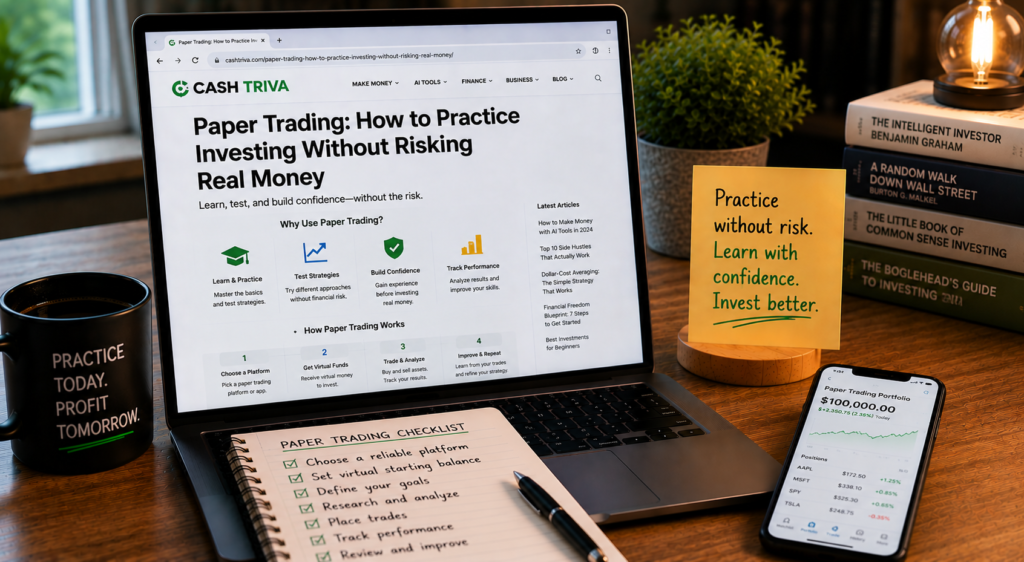
Paper trading gives you a simulated environment where you can buy and sell stocks, options, ETFs, and other securities using virtual money. The prices are real. The market conditions are real. The only thing that isn’t real is the money at stake. You get to make mistakes, test strategies, and build confidence without the financial consequences.
Whether you’re a complete beginner trying to understand how markets work or an experienced investor testing a new strategy, paper trading is one of the smartest moves you can make. This guide covers everything you need to know: how it works, where to do it, what to practice, common pitfalls, and how to know when you’re ready for real money.
What Is Paper Trading, Exactly?
The name comes from an era before computers, when aspiring traders would write down hypothetical buy and sell orders on paper. They’d track prices in the newspaper, calculate what their positions would be worth, and measure whether their instincts were right, all without placing a single real trade.
Today, paper trading is fully digital. Modern platforms provide you with a virtual account funded with fake money (typically $100,000 or more), access to real-time or slightly delayed market data, and the same order types, charting tools, and interfaces you’d use with a live account. You place trades just like you would with real money, and the platform tracks your gains, losses, and overall portfolio performance.
The key distinction: paper trading mirrors real market behavior without any financial risk. Your virtual profits won’t make you rich, and your virtual losses won’t cost you a dime. But the lessons you learn carry directly into live trading.
Why Paper Trading Matters More Than Most People Think
You Learn the Mechanics Without Pressure
The stock market has its own language, its own rhythms, and its own rules. Market orders, limit orders, stop-losses, bid-ask spreads, margin requirements, settlement periods. For someone new, these concepts are abstract until you experience them firsthand.
Paper trading turns theory into practice. When you place a limit order at $52.30 and watch it sit unfilled because the stock never drops below $52.45, you understand price dynamics in a way no textbook can teach. When you see how a stop-loss triggers during a volatile morning and sells your position at a price lower than you expected, you learn about slippage in real time.
You Develop Emotional Awareness
One of the biggest surprises for new traders is how much emotion affects decision-making. Watching a stock you bought drop 8% in two days creates a physical reaction, a tightness in your chest, an urge to sell immediately and stop the bleeding. Watching a winning position climb creates the opposite problem: greed that convinces you to hold past your original target.
Paper trading won’t replicate these emotions perfectly (we’ll address that limitation later), but it does introduce you to the psychological patterns of trading. You start to notice your impulses. You see how often your gut reaction would have been the wrong move. That self-awareness is invaluable.
You Test Strategies Without Consequences
Maybe you’ve read about momentum trading and want to try buying stocks breaking out to new highs. Maybe you’re curious about value investing and want to practice identifying underpriced companies using fundamental analysis. Maybe you want to experiment with options spreads or sector rotation.
Paper trading lets you run these experiments in real market conditions. You’ll find out quickly whether a strategy works the way you expected, and more importantly, whether it works for you, your schedule, your risk tolerance, and your temperament.
You Build a Track Record
Before risking real money, you should have evidence that your approach works. Paper trading lets you build a performance history over weeks or months. You can track your win rate, average gain, average loss, maximum drawdown, and risk-adjusted returns. If your simulated results are consistently negative, that’s information that could save you thousands of dollars.
How Paper Trading Works: A Practical Walkthrough
Setting Up Your Account
Most paper trading platforms let you start in under five minutes. You’ll create an account, choose your starting balance (many default to $100,000), and get dropped into a trading interface.
Take a few minutes to explore before placing any trades. Familiarize yourself with:
- The order entry panel where you’ll type in ticker symbols and specify trade details
- The portfolio view that shows your current holdings, cost basis, and profit/loss
- Charting tools for analyzing price movements and technical indicators
- The watchlist where you can track stocks you’re interested in
- Order history that logs every trade you’ve made
Placing Your First Trade
Start simple. Pick a company you know well, maybe one whose products you use every day. Look up its current stock price. Decide how many shares you want to “buy.” Place the order.
Here’s what a basic trade looks like:
You want to buy 50 shares of a stock trading at $150. You open the order entry, type in the ticker symbol, set the quantity to 50, choose “market order” (which fills at the current price), and click buy. Your portfolio now shows 50 shares with a total value of $7,500. Your available cash drops by that amount.
Over the following days, you’ll watch the position fluctuate. If the stock rises to $155, your position is worth $7,750, a paper profit of $250. If it falls to $145, you’re sitting on a $250 paper loss.
Understanding Order Types
Paper trading is the perfect time to get comfortable with different order types, since mistakes here cost nothing.
Market orders execute immediately at the best available price. They’re simple but give you less control over the exact price you pay.
Limit orders let you set a specific price. A buy limit order at $148 means you’ll only purchase the stock if it drops to $148 or lower. This gives you price control but carries the risk that the order never fills if the stock doesn’t reach your target.
Stop-loss orders automatically sell your position if the price drops to a specified level. If you buy at $150 and set a stop-loss at $140, your shares sell automatically if the stock hits $140, limiting your downside to roughly $10 per share.
Stop-limit orders combine features of stop and limit orders. They trigger at one price but only execute at another, giving you more control in exchange for the possibility that the order won’t fill during fast-moving markets.
Practice all of them. Place limit orders and watch which ones fill and which expire unfilled. Set stop-losses and observe how they behave during volatile trading sessions. The intuition you build here directly applies to live trading.
The Best Paper Trading Platforms
Not all simulators are created equal. The best platforms provide real-time data, realistic order execution, a professional-grade interface, and comprehensive tools. Here are the most respected options.
Thinkorswim by Charles Schwab
Thinkorswim is widely considered the gold standard for paper trading. The platform offers a full-featured simulated trading environment called “paperMoney” that includes:
- Real-time streaming data
- Every order type available in live trading
- Advanced charting with hundreds of technical indicators
- Options trading with full Greeks and strategy analysis
- A simulated balance of $100,000 (stocks) and $100,000 (options/futures)
- The exact same interface you’d use with a funded account
It’s free to use with a Schwab account, and you don’t need to deposit any money to access the paper trading features.
Webull Paper Trading
Webull offers a clean, modern paper trading experience that works well on both desktop and mobile. You get $1,000,000 in virtual buying power, access to stocks, ETFs, and options, and a straightforward interface that’s approachable for beginners. Real-time data and extended-hours trading are included.
TradingView Paper Trading
If you’re focused on technical analysis and charting, TradingView’s built-in paper trading feature lets you execute trades directly from charts. The platform is browser-based, visually polished, and connects to real market data. The free tier has limitations, but the paper trading functionality works without a paid subscription.
Interactive Brokers (IBKR) Paper Trading
Interactive Brokers provides a paper trading account that mirrors their professional-grade Trader Workstation platform. It’s more complex than other options, which makes it ideal if you plan to eventually trade with IBKR. You get access to global markets, advanced order types, and a wide range of asset classes including stocks, options, futures, forex, and bonds.
MarketWatch Virtual Stock Exchange
For a simpler, more casual experience, MarketWatch’s Virtual Stock Exchange lets you create or join trading games with virtual portfolios. It’s less feature-rich than dedicated trading platforms but works well for beginners who want a low-pressure entry point.
What to Practice During Paper Trading
Simply buying random stocks and checking back a week later won’t teach you much. Treat paper trading as a structured learning experience with specific goals.
Start with Position Sizing
Before worrying about which stocks to buy, learn how to manage how much you put into each trade. Position sizing is one of the most overlooked skills in investing, and poor position sizing destroys more portfolios than bad stock picks.
A common guideline: never risk more than 1-2% of your total portfolio on a single trade. With a $100,000 paper account, that means your maximum loss on any one position should be $1,000 to $2,000.
Practice calculating position sizes based on your entry price, stop-loss level, and risk percentage. This discipline, more than anything else, determines long-term survival in the markets.
Practice Reading Charts
Spend time analyzing price charts before placing trades. Learn to identify basic patterns like support and resistance levels, trendlines, moving averages, and volume spikes. You don’t need to become a technical analysis expert, but understanding what a chart is telling you gives you an edge over trading blind.
Place trades based on chart setups and track the results. Over time, you’ll develop a sense for which patterns work reliably and which ones give false signals.
Experiment with Different Strategies
Use your paper trading period to try multiple approaches and see what fits your personality and schedule.
Swing trading: Holding positions for several days to a few weeks, aiming to capture medium-term price moves. This works well for people with full-time jobs who can check markets once or twice a day.
Day trading: Opening and closing positions within the same trading day. This requires constant attention during market hours and isn’t practical for everyone, but paper trading lets you test it without risk.
Long-term investing: Buying stocks or ETFs and holding them for months or years. Paper trading can help you practice the discipline of staying in positions through short-term volatility.
Options strategies: If you’re interested in options, paper trading is the safest way to learn. Start with basic covered calls and cash-secured puts before moving to more complex strategies like spreads, straddles, or iron condors.
Keep a Trading Journal
This single habit separates serious learners from casual experimenters. After every trade, write down:
- Why you entered the position (your thesis or setup)
- Your entry price, target price, and stop-loss level
- What happened after you entered
- Why you exited (hit target, hit stop-loss, changed your mind)
- What you learned from the trade
After a month of journaling, you’ll have a detailed map of your decision-making patterns. You’ll see recurring mistakes, identify your strengths, and spot tendencies you weren’t aware of.
Simulate Realistic Conditions
Treat your paper account like real money. That means:
- Don’t trade with an unrealistic balance. If you plan to start live trading with $5,000, adjust your paper account to $5,000 (or mentally allocate only $5,000 of your virtual balance). Trading with $100,000 in fake money creates habits that won’t translate to a smaller real account.
- Follow your rules. If you set a stop-loss, honor it. Don’t move it lower because “it’s just paper money.”
- Track commissions and fees. Most brokers now offer commission-free stock trading, but options still carry per-contract fees. Factor these into your results.
- Trade during actual market hours. Placing orders on a weekend to be filled Monday morning is fine, but make sure you’re experiencing real-time price action during live sessions.
The Honest Limitations of Paper Trading
Paper trading is a powerful learning tool, but it has real limitations you should understand.
The Emotion Gap
This is the biggest one. When your paper portfolio drops 15%, you might feel a twinge of disappointment. When your real portfolio drops 15%, you feel fear. Real money creates real stress, and that stress changes behavior.
Many traders who perform brilliantly in simulation crumble when they switch to live accounts. They second-guess entries, close winning positions too early, hold losers too long, or abandon their strategy entirely after two bad trades.
You can’t fully bridge this gap during paper trading, but you can prepare for it. Acknowledge that your emotional response will intensify with real money, and build strict rules that you commit to following regardless of how you feel.
Execution Differences
Paper trading platforms typically fill your orders at the exact price you see on the screen. In real markets, especially with less liquid stocks or larger positions, you’ll experience slippage. Your market order might fill a few cents higher than expected. Your limit order might get partially filled. A fast-moving stock might gap through your stop-loss.
These differences are small on any single trade but add up over hundreds of trades. Your real-world results will rarely match your paper trading results exactly.
The Lack of Accountability
With paper money, there’s no consequence for breaking your own rules. You might set a stop-loss at $45 and then, when the stock drops to $45, decide to “give it more room” because there’s nothing actually at stake. In live trading, that habit could wipe out your account.
Combat this by treating every paper trade as if the money were real. If you wouldn’t do it with your savings, don’t do it in simulation.
Time Compression Temptation
Some traders rush through the paper trading phase because they’re eager to start making real money. They trade for a week, see some green numbers, and decide they’re ready. This is a mistake.
A week of simulated trading doesn’t prove anything. Markets go through different phases: trending up, trending down, trading sideways, low volatility, high volatility. You need to experience your strategy across multiple market conditions, which takes months, not days.
How Long Should You Paper Trade?
There’s no universal answer, but here are some benchmarks that indicate readiness.
Minimum time: At least two to three months of consistent paper trading. This gives you exposure to different market conditions and enough data to evaluate your strategy.
Minimum number of trades: At least 50 to 100 trades following a defined strategy. Smaller sample sizes don’t reveal reliable patterns. You might win 8 out of 10 trades by luck, a streak that tells you nothing about your actual edge.
Consistent profitability: You should see positive results over a sustained period, not just a few good days. Look at your performance across full weeks and months. Can you show a positive equity curve that doesn’t rely on one or two big winners?
Emotional control: You follow your rules consistently. You don’t chase trades out of boredom. You don’t revenge-trade after a loss. You don’t abandon your strategy when it hits a rough patch.
Mechanical confidence: Placing orders, adjusting stop-losses, reading charts, and managing positions feel natural. You don’t have to think about where to click or what buttons to press.
If you can check all five boxes, you’re in a reasonable position to transition to real money.
Transitioning from Paper Trading to Live Trading
The jump from simulation to real markets is the most psychologically challenging step for any new trader or investor. Here’s how to manage it.
Start Smaller Than You Think You Should
Whatever position size you were comfortable with in paper trading, cut it in half for your first real trades. If you were buying 100 shares in simulation, start with 50 or even 25 in your live account. This reduces the emotional intensity while you adjust to having real money on the line.
You can always scale up after you’ve proven to yourself that you can follow your rules with actual dollars at risk.
Keep the Same Strategy
Don’t switch strategies when you go live. The entire point of paper trading was to test and refine a specific approach. Carry that approach directly into your live account. Same entry criteria, same exit criteria, same position sizing rules (adjusted for your real account size), same risk management.
Accept That the First Month Will Be Uncomfortable
Your heart will beat faster. You’ll check your portfolio too often. You’ll feel the urge to do something, anything, when a position moves against you. This is normal. It doesn’t mean you’re not ready. It means you’re experiencing the emotional reality of markets for the first time.
Stick to your rules. Trust the process you developed during simulation. The discomfort fades as you accumulate experience.
Continue Journaling
Your trading journal becomes even more valuable with real money. Document not just the trade details but your emotional state. Were you anxious entering the position? Did you feel pressure to close early? Did fear or excitement override your plan? These notes reveal patterns that you can address over time.
Use Paper Trading Alongside Live Trading
Going live doesn’t mean abandoning simulation. Many experienced traders maintain a paper account for testing new strategies, practicing unfamiliar instruments, or experimenting with different time frames. Your paper account becomes a permanent laboratory running alongside your real portfolio.
Common Mistakes to Avoid
Treating paper trading as a game. The moment you start making wild, reckless trades because “it doesn’t matter,” you’ve eliminated the learning value. Approach simulation with the same seriousness you’d bring to real money.
Ignoring losses. Paper losses don’t hurt, which makes them easy to dismiss. Don’t. Every loss contains information. Analyze what went wrong, whether the setup was flawed, whether you entered too early or too late, and whether external factors moved against you.
Over-optimizing based on past results. Some traders look at their paper trading history and adjust their strategy to be perfect in hindsight. This creates a system that works brilliantly on historical data but fails in real time. Your strategy should be based on principles, not curve-fitted to past performance.
Paper trading forever. Simulation is preparation, not a destination. At some point, you need to accept the risk and start trading with real money. Waiting for absolute certainty means waiting forever, because markets never provide certainty.
Comparing your paper results to professional traders. Social media is full of traders showing massive gains. Most of these are cherry-picked, exaggerated, or outright fabricated. Focus on your own progress and your own plan.
Paper Trading for Different Types of Investors
For Complete Beginners
Start with the basics. Learn how to read a stock quote. Understand what happens when you place a buy order. Watch how your portfolio value changes throughout the day. Buy a mix of well-known stocks and an index ETF like SPY or VTI and observe how individual stocks behave compared to the broader market.
Don’t worry about fancy strategies yet. Your goal for the first month is mechanical comfort: knowing where things are, how orders work, and what the numbers on your screen mean.
For Intermediate Investors
You already understand the basics. Use paper trading to refine your strategy. Test specific setups with defined entry and exit criteria. Experiment with sector ETFs, options, or international markets. Challenge yourself by tracking a concentrated portfolio (5-10 positions) versus a diversified one (20+) and comparing the results.
For Experienced Traders Learning a New Strategy
If you’re profitable with one approach but want to add another, paper trading is the responsible way to do it. Run the new strategy in simulation while continuing to trade your proven strategy with real money. This protects your capital while giving the new approach time to prove itself.
The Bigger Picture
Paper trading won’t make you a perfect investor. Nothing will. Markets are unpredictable, and even the best strategies go through losing periods. What paper trading does is compress your learning curve, reduce costly beginner mistakes, and give you a structured environment to develop the skills and discipline that real-money trading demands.
Think of it as tuition-free education. Every mistake you make in simulation is a mistake you won’t have to pay for with your savings. Every lesson you learn about your own psychology, risk tolerance, and decision-making patterns translates directly into better performance when the stakes are real.
Open a paper trading account today. Set it to a realistic balance. Pick a strategy to test. Start journaling. Give yourself two to three months of disciplined practice before putting real dollars on the line. That patience, the willingness to prepare before you act, is already a sign that you have the temperament for successful investing.