Introduction
In today’s highly competitive digital marketplace, businesses need fast and measurable ways to reach potential customers. While search engine optimization (SEO) provides long-term organic growth, Pay-Per-Click (PPC) advertising delivers immediate visibility and targeted traffic. Behind successful PPC campaigns is the PPC Specialist.
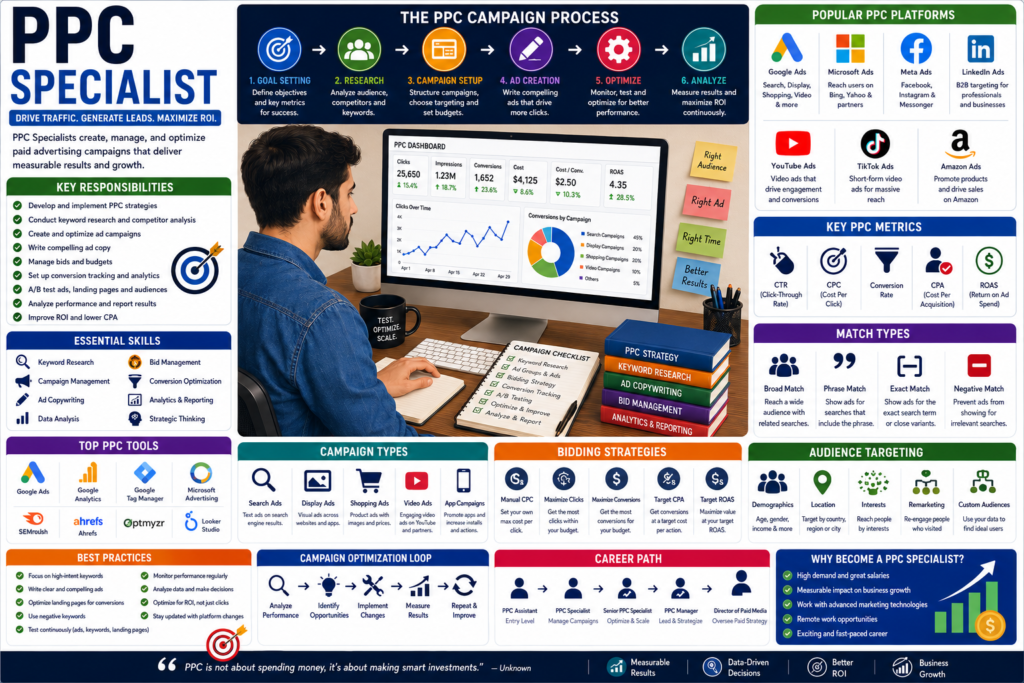
A PPC Specialist is responsible for creating, managing, optimizing, and analyzing paid advertising campaigns across search engines, social media platforms, and digital networks. Their goal is to maximize return on investment (ROI), increase conversions, and help businesses achieve measurable growth.
As companies continue investing heavily in digital advertising, PPC Specialists remain among the most sought-after professionals in the marketing industry.
What Is a PPC Specialist?
A PPC Specialist is a digital marketing professional who manages paid advertising campaigns where advertisers pay only when users click on their ads.
Their responsibilities include:
- Campaign creation
- Keyword research
- Bid management
- Audience targeting
- Ad copywriting
- Conversion tracking
- Budget management
- Performance analysis
- Landing page optimization
- Campaign reporting
PPC Specialists focus on generating qualified traffic that converts into leads, sales, or other business objectives.
Why PPC Advertising Matters
Immediate Visibility
Unlike SEO, PPC campaigns can generate traffic almost instantly.
Precise Targeting
Advertisers can target specific audiences based on:
- Keywords
- Demographics
- Interests
- Location
- Device type
Measurable Performance
Every click, conversion, and dollar spent can be tracked.
Scalable Growth
Successful campaigns can be expanded as budgets increase.
High ROI Potential
Well-optimized campaigns often generate significant returns.
Core Responsibilities of a PPC Specialist
Campaign Strategy
Developing advertising strategies aligned with business goals.
Keyword Research
Identifying valuable search terms that attract qualified traffic.
Ad Creation
Writing compelling advertisements that drive clicks.
Bid Management
Optimizing bids to maximize campaign performance.
Audience Targeting
Reaching the most relevant users.
Conversion Optimization
Improving campaign profitability and results.
Analytics and Reporting
Measuring campaign performance and identifying improvements.
Popular PPC Platforms
Google Ads
The largest PPC advertising platform in the world.
Campaign types include:
- Search Ads
- Display Ads
- Shopping Ads
- Video Ads
- Performance Max Campaigns
- App Campaigns
Microsoft Advertising
Provides access to Bing and Microsoft partner networks.
Meta Ads
Advertising across:
- Messenger
LinkedIn Ads
Ideal for B2B marketing and professional audiences.
TikTok Ads
Popular for short-form video advertising.
YouTube Ads
Video-based advertising through Google Ads.
The PPC Campaign Process
1. Goal Definition
Identify objectives such as:
- Lead generation
- Online sales
- Brand awareness
- App downloads
- Website traffic
2. Audience Research
Understand customer needs, behaviors, and interests.
3. Keyword Research
Find search terms with strong commercial intent.
4. Campaign Setup
Create campaign structures and targeting settings.
5. Ad Creation
Develop persuasive headlines and descriptions.
6. Landing Page Optimization
Ensure users have a seamless experience after clicking ads.
7. Performance Monitoring
Track key metrics and adjust strategies.
8. Continuous Optimization
Improve campaign performance over time.
Keyword Research for PPC
Effective keyword research is the foundation of successful campaigns.
Broad Match Keywords
Reach wider audiences.
Phrase Match Keywords
Target more specific searches.
Exact Match Keywords
Focus on highly relevant search queries.
Negative Keywords
Prevent ads from appearing for irrelevant searches.
Proper keyword selection helps maximize budget efficiency.
Ad Copywriting
PPC Specialists must create advertisements that stand out.
Effective ads often include:
Strong Headlines
Capture attention quickly.
Clear Benefits
Explain why users should click.
Calls-to-Action (CTAs)
Examples include:
- Get Started Today
- Request a Free Quote
- Shop Now
- Learn More
Relevant Keywords
Improve ad relevance and quality scores.
Quality Score
Google uses Quality Score to evaluate ad quality.
Factors include:
Expected Click-Through Rate
Likelihood users will click.
Ad Relevance
Alignment between keywords and ads.
Landing Page Experience
User experience after clicking the ad.
Higher Quality Scores often result in lower advertising costs.
Conversion Tracking
PPC Specialists rely heavily on conversion tracking.
Conversions may include:
- Purchases
- Form submissions
- Phone calls
- App installs
- Newsletter signups
Accurate tracking is essential for campaign optimization.
PPC Metrics and KPIs
Click-Through Rate (CTR)
Measures how often users click ads.
Cost Per Click (CPC)
Amount paid for each click.
Conversion Rate
Percentage of visitors completing desired actions.
Cost Per Acquisition (CPA)
Cost required to acquire a customer.
Return on Ad Spend (ROAS)
Revenue generated from advertising investment.
Impression Share
Percentage of available impressions received.
Monitoring these metrics helps improve campaign performance.
Landing Page Optimization
A successful PPC campaign depends on effective landing pages.
Best practices include:
- Fast loading speeds
- Mobile responsiveness
- Clear headlines
- Strong calls-to-action
- Simple forms
- Trust signals and testimonials
Better landing pages improve conversion rates and ROI.
PPC Automation and AI
Modern PPC platforms increasingly use artificial intelligence.
Examples include:
Smart Bidding
Automatically adjusts bids for optimal performance.
Performance Max
Uses machine learning across Google inventory.
Automated Rules
Simplifies campaign management.
Predictive Audiences
Identifies likely converters.
AI helps PPC Specialists improve efficiency and scalability.
Popular PPC Tools
Google Ads
Campaign management platform.
Google Analytics
Website and conversion tracking.
Google Tag Manager
Simplifies tracking implementation.
Microsoft Advertising
Bing and Microsoft network campaigns.
SEMrush
Keyword research and competitor analysis.
Ahrefs
Competitive intelligence and keyword insights.
Optmyzr
Advanced PPC optimization platform.
Looker Studio
Campaign reporting and dashboards.
Career Path for PPC Specialists
PPC Assistant
Supports campaign management activities.
PPC Specialist
Manages campaigns independently.
Senior PPC Specialist
Leads larger advertising accounts.
PPC Manager
Oversees teams and budgets.
Performance Marketing Manager
Manages multiple paid acquisition channels.
Head of Paid Media
Leads advertising strategy across organizations.
Marketing Director
Oversees broader marketing operations.
Industries Hiring PPC Specialists
E-Commerce
Driving online sales and customer acquisition.
SaaS Companies
Generating qualified leads and trial signups.
Healthcare
Promoting services and appointments.
Finance
Attracting customers through targeted campaigns.
Education
Marketing courses and educational programs.
Real Estate
Generating property inquiries and leads.
Best Practices for PPC Success
Continuously Test Ads
Experiment with headlines, descriptions, and offers.
Monitor Performance Daily
Identify opportunities and issues quickly.
Use Negative Keywords
Reduce wasted advertising spend.
Optimize Landing Pages
Improve conversion rates and user experience.
Focus on ROI
Prioritize profitable campaigns over vanity metrics.
Stay Updated
Advertising platforms evolve frequently.
Future Trends in PPC Advertising
Artificial Intelligence
AI continues automating optimization and targeting.
Audience-Based Advertising
Behavioral targeting becomes increasingly sophisticated.
Privacy Changes
Marketers adapt to evolving data regulations.
First-Party Data
Businesses rely more heavily on owned customer data.
Video Advertising Growth
Video continues gaining advertising market share.
Automation and Machine Learning
Campaign management becomes increasingly intelligent.
Benefits of Becoming a PPC Specialist
- High industry demand
- Strong earning potential
- Remote work opportunities
- Data-driven decision making
- Continuous learning
- Clear career progression
- Direct impact on business growth
Conclusion
PPC Specialists play a vital role in helping businesses achieve immediate visibility, attract qualified customers, and generate measurable results through paid advertising. By combining analytical thinking, strategic planning, creative copywriting, and performance optimization, they drive growth across industries.
As digital advertising continues expanding, skilled PPC Specialists will remain highly valuable. Professionals who master campaign management, conversion optimization, analytics, and emerging advertising technologies can build rewarding careers in one of the fastest-growing areas of digital marketing.