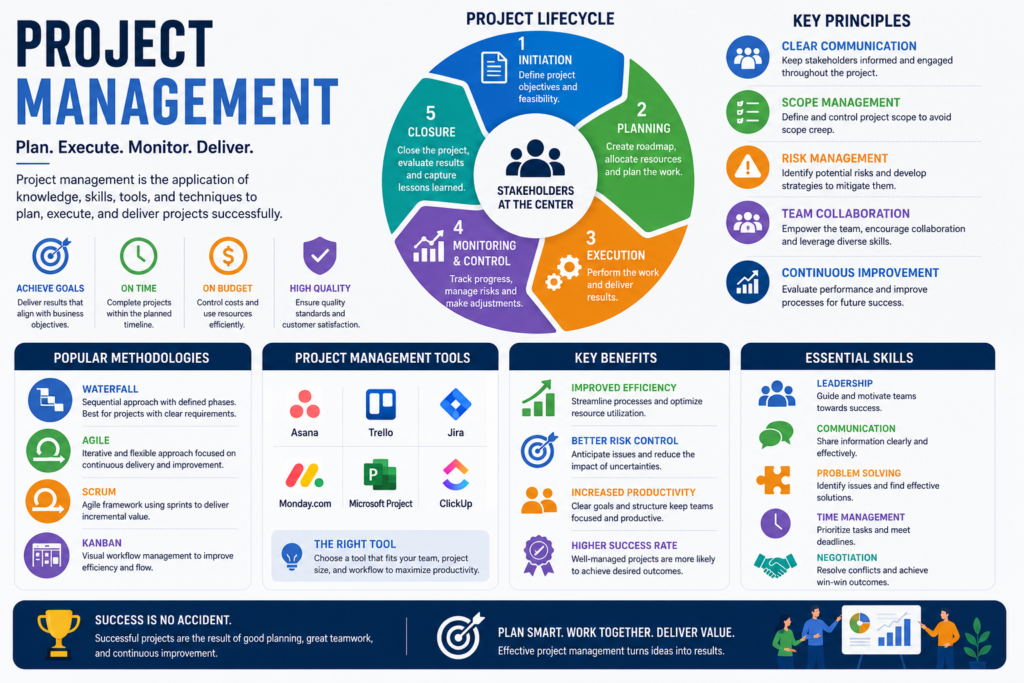
Introduction
Project management is a critical discipline that helps organizations achieve strategic goals through the successful planning, execution, and completion of projects. Whether developing software, launching a marketing campaign, constructing a building, or implementing a new business process, effective project management ensures that objectives are met on time, within budget, and according to quality standards.
In today’s fast-paced business environment, organizations rely on skilled project managers and structured methodologies to coordinate teams, manage resources, reduce risks, and deliver measurable results.
This guide explores the fundamentals of project management, methodologies, processes, tools, and best practices that contribute to project success.
What Is Project Management?
Project management is the process of planning, organizing, executing, monitoring, and closing projects to achieve specific goals and objectives.
A project is a temporary effort designed to create a unique product, service, or result. Unlike ongoing operations, projects have defined start and end dates, budgets, resources, and deliverables.
The primary objectives of project management include:
- Delivering projects on time
- Staying within budget
- Meeting quality requirements
- Managing risks effectively
- Satisfying stakeholders
- Achieving business goals
The Project Management Lifecycle
Every project typically follows a structured lifecycle consisting of several phases.
1. Project Initiation
The initiation phase defines the project’s purpose, objectives, scope, and feasibility.
Key activities include:
- Business case development
- Stakeholder identification
- Project charter creation
- Goal definition
2. Project Planning
Planning establishes the roadmap for successful execution.
Activities include:
- Scope definition
- Schedule development
- Resource allocation
- Budget planning
- Risk assessment
- Communication planning
3. Project Execution
During execution, teams perform the work required to achieve project objectives.
Responsibilities include:
- Task management
- Team coordination
- Resource utilization
- Quality assurance
- Stakeholder communication
4. Monitoring and Control
Project managers continuously track performance and address issues.
This phase focuses on:
- Schedule tracking
- Budget monitoring
- Risk management
- Performance reporting
- Change management
5. Project Closure
The final phase ensures all deliverables are completed and accepted.
Activities include:
- Final reviews
- Documentation
- Lessons learned
- Resource release
- Project evaluation
Key Roles in Project Management
Project Manager
The project manager oversees planning, execution, communication, and project delivery.
Project Sponsor
The sponsor provides strategic direction, funding, and executive support.
Project Team
Team members perform project tasks and contribute specialized expertise.
Stakeholders
Stakeholders are individuals or groups affected by project outcomes.
Product Owner
In Agile environments, the product owner represents customer needs and prioritizes work.
Popular Project Management Methodologies
Waterfall
Waterfall follows a sequential approach where each phase must be completed before the next begins.
Advantages:
- Clear structure
- Detailed documentation
- Predictable timelines
Agile
Agile emphasizes flexibility, collaboration, and continuous improvement.
Benefits include:
- Faster delivery
- Better adaptability
- Increased customer involvement
Scrum
Scrum is a popular Agile framework that organizes work into short development cycles called sprints.
Key Scrum roles:
- Product Owner
- Scrum Master
- Development Team
Kanban
Kanban focuses on visual workflow management and continuous delivery.
Benefits:
- Improved transparency
- Better workflow control
- Increased productivity
Hybrid Project Management
Many organizations combine traditional and Agile approaches to fit specific project requirements.
Project Planning Essentials
Defining Project Scope
A clear scope helps prevent misunderstandings and scope creep.
Scope documentation should include:
- Objectives
- Deliverables
- Requirements
- Constraints
- Assumptions
Creating a Project Schedule
Scheduling helps teams manage deadlines and dependencies.
Common scheduling tools include:
- Gantt charts
- Milestone tracking
- Work breakdown structures (WBS)
Budget Management
Effective budgeting ensures financial resources are allocated appropriately.
Project budgets typically include:
- Labor costs
- Equipment expenses
- Software licenses
- Vendor services
- Contingency reserves
Risk Management
Every project faces uncertainties that can impact success.
Identifying Risks
Potential risks may include:
- Budget overruns
- Resource shortages
- Technical challenges
- Schedule delays
- Regulatory changes
Risk Assessment
Project managers evaluate:
- Risk probability
- Potential impact
- Response strategies
Risk Mitigation
Mitigation plans help reduce the likelihood and consequences of project risks.
Team Leadership and Collaboration
Successful projects depend heavily on effective teamwork.
Communication
Clear communication improves coordination and reduces misunderstandings.
Motivation
Project leaders should encourage engagement, recognition, and accountability.
Conflict Resolution
Addressing conflicts quickly helps maintain productivity and team morale.
Collaboration
Modern collaboration tools improve efficiency and support remote teams.
Project Management Tools
Technology plays a vital role in project success.
Popular project management platforms include:
- Asana
- Trello
- Jira
- Monday.com
- Microsoft Project
- ClickUp
- Notion
Common features include:
- Task tracking
- Resource management
- Team collaboration
- Reporting dashboards
- Workflow automation
Project Performance Metrics
Monitoring performance helps ensure projects stay on track.
Schedule Performance
Measures progress against planned timelines.
Budget Performance
Tracks spending against approved budgets.
Resource Utilization
Evaluates how efficiently resources are used.
Quality Metrics
Measures compliance with project requirements and standards.
Stakeholder Satisfaction
Assesses how well project outcomes meet stakeholder expectations.
Benefits of Effective Project Management
Organizations that implement strong project management practices experience numerous advantages.
Improved Efficiency
Structured processes reduce wasted time and resources.
Better Risk Control
Potential issues can be identified and addressed earlier.
Increased Productivity
Teams work more effectively with clear objectives and responsibilities.
Higher Success Rates
Projects are more likely to achieve intended outcomes.
Enhanced Customer Satisfaction
Successful delivery improves customer trust and loyalty.
Future Trends in Project Management
Artificial Intelligence
AI-powered tools assist with forecasting, scheduling, and risk analysis.
Remote Project Management
Virtual teams and remote collaboration continue to grow globally.
Data-Driven Decision Making
Analytics provide deeper insights into project performance.
Agile Expansion
Agile practices are increasingly adopted across industries beyond software development.
Automation
Automated workflows reduce administrative tasks and improve efficiency.
Conclusion
Project management is essential for turning ideas into successful outcomes. Through careful planning, effective leadership, risk management, and continuous monitoring, organizations can deliver projects that meet objectives and create value.
As businesses become increasingly complex and technology-driven, project management skills remain among the most valuable competencies in the modern workplace. Organizations that invest in effective project management practices gain a significant advantage in achieving strategic goals, improving efficiency, and driving long-term success.