There’s a pattern hiding inside almost every online income success story.
Look past the flashy screenshots, the “I made $10K this month” thumbnails, and the origin myths that make it sound like money just appeared. What you’ll find underneath is almost always the same structure: not one income stream, but several, layered on top of each other, each one feeding the others.
The people who build stable, lasting online income don’t bet everything on a single revenue source. They stack. And the ones who stack smartly, choosing income streams that compound and support each other, pull ahead faster than the ones who chase every shiny opportunity in isolation.
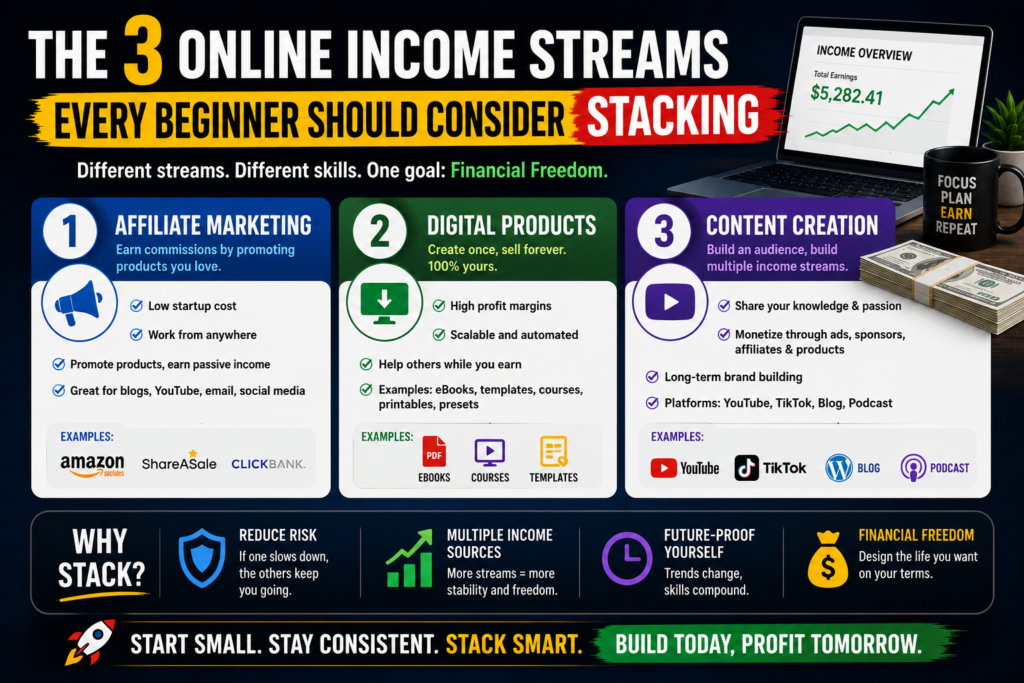
This article lays out the three specific income streams that work best together for someone starting from scratch. Not three random ideas. Three streams that share overlapping skills, reinforce each other’s growth, and create a system where the work you do for one directly benefits the other two.
By the end, you’ll understand exactly how each one works, how much you can realistically earn, and how to layer them into a single strategy that builds real financial stability over 12 to 24 months.
Why Stacking Beats Picking One
Before we get into the three streams, let’s talk about why stacking multiple income sources matters so much, especially for beginners.
Single Income Streams Are Fragile
If 100% of your online income comes from freelance writing and your biggest client cancels their contract, you lose 40% of your revenue overnight. If your entire income depends on affiliate commissions from one program and that company changes its commission structure (Amazon has done this repeatedly), your monthly income can drop by half with a single policy update.
Every individual income stream carries risk. Algorithms change. Clients leave. Platforms adjust their payouts. Markets shift. When you depend on a single source, you’re one bad decision (from someone else) away from financial trouble.
Stacked Income Streams Create Stability
When you have three income streams and one of them dips, the other two keep the lights on while you recover. A bad month for freelancing might coincide with a great month for digital product sales. A seasonal drop in affiliate commissions might overlap with a surge in client work. The streams balance each other naturally.
Beyond stability, stacking creates compounding effects that are impossible to achieve with a single stream. The skills you build freelancing help you create better digital products. The audience you build through content (for affiliate marketing) becomes a customer base for your own products. The products you sell establish authority that lets you charge higher freelancing rates.
Each stream doesn’t just add income. It multiplies the value of the other two.
The Wrong Way to Stack
A quick warning before we continue. Stacking doesn’t mean doing everything at once on day one. That’s a recipe for burnout and mediocrity. The right approach is sequential:
- Start with the income stream that generates revenue fastest
- Use that revenue and the skills you develop to build the second stream
- Layer in the third stream once the first two are producing consistent results
Think of it like building a house. You pour the foundation first, then frame the walls, then add the roof. Trying to do all three at once means nothing gets built properly.
The Three Streams: An Overview
Here are the three income streams, and why this specific combination works better than any other for beginners.
Stream 1: Freelancing (Service-Based Income)
You trade your skills for money. Fastest path to revenue. Builds real-world expertise. Generates cash flow to fund the other two streams.
Stream 2: Affiliate Marketing (Commission-Based Income)
You recommend products and earn commissions when people buy through your links. Builds an audience and content library. Creates semi-passive income that grows over time.
Stream 3: Digital Products (Product-Based Income)
You create something once and sell it repeatedly. Highest profit margins. Most scalable. The eventual engine that generates income without trading hours for dollars.
Here’s why these three work together so well:
- Freelancing gives you cash flow and skills immediately
- Those skills and client experiences become the content you create for affiliate marketing
- That content builds an audience that buys your digital products
- Your digital products establish authority that lets you raise your freelancing rates
- Higher rates mean fewer client hours, which frees up more time for content and products
It’s a flywheel. Each piece accelerates the others. And it all starts with the same foundation: developing a marketable skill and applying it in different ways across all three streams.
Stream 1: Freelancing (Your Cash Flow Engine)
Freelancing is where most people should start, and it’s the stream most people overlook when they’re dreaming about passive income and automated businesses.
Here’s the uncomfortable truth: passive income takes months (sometimes years) to build. You need cash flow now to pay bills, invest in tools, and buy yourself the time to build the other two streams. Freelancing delivers that cash flow faster than anything else.
What Freelancing Actually Looks Like in 2026
Freelancing means selling a skill as a service to clients who need it. You find clients, do the work, get paid. The transaction is simple and direct.
The most in-demand freelance skills right now:
Writing and content creation
- Blog posts and articles ($50 to $500+ per post)
- Website copywriting ($500 to $5,000+ per project)
- Email sequences ($200 to $2,000+ per sequence)
- Social media content management ($500 to $3,000/month per client)
- SEO content strategy ($1,000 to $5,000/month per client)
Design and visual work
- Graphic design ($30 to $150/hour)
- Brand identity packages ($500 to $5,000+ per project)
- Social media graphics and templates ($200 to $1,500/month per client)
- Presentation design ($200 to $2,000 per deck)
- UI/UX design ($50 to $200/hour)
Technical skills
- Web development ($50 to $200/hour)
- WordPress setup and customization ($500 to $5,000 per project)
- Automation and workflow setup ($500 to $3,000 per project)
- Data analysis and reporting ($40 to $150/hour)
Marketing services
- SEO audits and implementation ($500 to $5,000/month per client)
- Paid advertising management ($500 to $3,000/month per client)
- Email marketing setup and management ($500 to $2,500/month per client)
- YouTube video editing ($50 to $500 per video)
- Podcast editing and production ($50 to $300 per episode)
AI-adjacent skills
- AI prompt engineering and workflow design ($50 to $200/hour)
- AI tool implementation for businesses ($1,000 to $10,000 per project)
- AI-assisted content creation and editing ($40 to $100/hour)
How to Get Your First Freelance Client (Within 30 Days)
Week 1: Pick your skill and package it.
Choose one skill you can deliver at a professional level right now. Not five skills. One. Package it as a clear, specific service with a defined deliverable and price.
Bad: “I can help with your marketing.”
Good: “I write SEO-optimized blog posts for SaaS companies. $200 per 1,500-word post. Two revisions included. 5-day turnaround.”
Specificity attracts clients. Vagueness repels them.
Week 2: Build a minimal portfolio.
You need 2 to 3 samples of your work. If you don’t have client work to show yet, create samples. Write a blog post for an imaginary client. Design a brand identity for a made-up company. Build a landing page for a fictional product. The samples prove you can do the work. Nobody needs to know they weren’t paid projects.
Week 3: Start outreach.
Two primary channels for landing your first clients:
Freelance platforms: Upwork, Fiverr, and Contra are the biggest. Create a profile that focuses on one specific service. Apply to 5 to 10 relevant job postings per day. Your early proposals should be short, specific, and demonstrate that you actually read the job description. Personalized proposals that reference the client’s specific needs convert at 5x to 10x the rate of generic templates.
Direct outreach: Identify 20 to 30 businesses in your target market (small companies, startups, agencies). Find the decision-maker on LinkedIn. Send a brief, personalized message that identifies a specific problem you can solve for them. Include a relevant sample. Follow up once after 5 to 7 days if they don’t respond.
Week 4: Close and deliver.
Your first client will probably pay less than you’re worth. That’s fine. The goal of your first project isn’t maximum revenue. It’s proof of concept: prove you can find a client, deliver quality work, and get paid. That proof becomes the foundation for everything that follows.
Realistic Freelancing Income Timeline
- Month 1: $0 to $500 (landing first client, building samples)
- Month 2–3: $500 to $2,000/month (2 to 4 active clients)
- Month 4–6: $2,000 to $5,000/month (raising rates, getting referrals)
- Month 7–12: $3,000 to $8,000+/month (established reputation, repeat clients, higher rates)
The ceiling on freelancing is higher than most people think. Experienced freelancers charging premium rates in specialized niches earn $10,000 to $25,000+/month working 25 to 30 hours per week. But reaching that level takes 1 to 3 years of consistent skill development and client relationship building.
The Critical Role of Freelancing in the Stack
Freelancing does four things that the other two streams can’t:
- Immediate cash flow. You can earn your first dollar within weeks, not months.
- Skill development through paid practice. Clients pay you to get better at your craft. Every project sharpens your abilities.
- Market research. Working with real clients teaches you what businesses need, what they struggle with, and what they’re willing to pay for. This intelligence directly informs the digital products you’ll create later.
- Credibility. “I’ve written content for 30+ SaaS companies” is a powerful credibility statement when you’re selling digital products or building an affiliate marketing audience.
Don’t skip freelancing because it doesn’t sound as exciting as passive income. It’s the engine that funds and informs everything else.
Stream 2: Affiliate Marketing (Your Audience-Building Engine)
Once you have freelancing generating consistent cash flow (typically 2 to 4 months in), it’s time to start building Stream 2.
Affiliate marketing is the bridge between trading time for money (freelancing) and earning money while you sleep (digital products). It teaches you how to build an audience, create content, and generate revenue from that audience, all skills you’ll need for Stream 3.
How Affiliate Marketing Works
The concept is straightforward. You recommend a product or service. Someone clicks your special tracking link and makes a purchase. The company pays you a commission on that sale. You never handle inventory, customer service, shipping, or refunds. Your only job is connecting the right audience with the right product.
Where the money comes from:
- Physical product affiliates (Amazon Associates, ShareASale, individual brand programs): Commissions range from 1% to 15% per sale. Lower per-transaction earnings, but high conversion rates because customers are buying tangible products they already want.
- Software and SaaS affiliates (hosting companies, email platforms, design tools, project management apps): Commissions range from 20% to 50%, and many pay recurring commissions (you earn monthly for as long as the customer stays subscribed). A single referral to a $50/month tool with a 30% recurring commission earns you $15/month. Refer 100 people over a year, and that’s $1,500/month in recurring passive income.
- Course and info-product affiliates (online courses, coaching programs, membership sites): Commissions range from 20% to 50% per sale. Higher price points mean larger per-sale commissions ($50 to $500+ per referral).
- Financial product affiliates (credit cards, investment platforms, insurance, banking): Commissions range from $25 to $200+ per approved application. Extremely lucrative but competitive.
The Content Vehicle: Where Your Affiliate Links Live
Affiliate links don’t generate income sitting in a vacuum. They need content that attracts an audience, builds trust, and creates a natural reason for someone to click. That content lives on one or more of these platforms:
A blog or website (highest long-term ROI)
Blog posts optimized for search engines attract free, targeted traffic from Google for months or years after you publish them. A product review, comparison post, or “best of” list that ranks on page one of Google can generate affiliate commissions every day with zero ongoing effort.
This is where your freelancing skills become an unfair advantage. If you freelance as a writer, you already know how to create compelling content. If you freelance in SEO, you already know how to rank that content. If you freelance in web design, you can build a site that converts visitors into clicks.
YouTube (second-highest long-term ROI)
Video reviews and tutorials generate affiliate income through links in the description. YouTube content has a long shelf life (similar to blog posts) and builds stronger trust than text because viewers see and hear you (or at least hear your voice on faceless channels).
Social media (TikTok, Instagram, Pinterest)
Shorter shelf life than blogs or YouTube, but can drive bursts of traffic and commissions, especially around trending products or seasonal buying periods. Pinterest is particularly strong for affiliate marketing because users are often in a discovery and purchasing mindset.
Email newsletters
An email list is the most valuable asset in affiliate marketing. Your subscribers have opted in to hear from you. They trust your recommendations. Conversion rates from email are 3x to 5x higher than from social media or search traffic. Building your email list should start from the moment you publish your first piece of content.
Choosing What to Promote
This is where most beginners go wrong. They sign up for every affiliate program they can find and scatter links across unrelated content. That approach earns almost nothing.
The right approach: Promote products you’ve actually used, in a niche where you have genuine experience, to an audience that trusts your opinion.
How to choose your niche for affiliate marketing:
Start with the intersection of three things:
- Your freelancing skill. Whatever you do for clients, you already have deep knowledge of the tools, resources, and products in that space.
- Products with strong affiliate programs. Research what commissions are available in your area of expertise. Search “[your niche] + affiliate program” to find options.
- Topics people are actively searching for. Use Google’s autocomplete, AnswerThePublic, or keyword research tools to confirm that people are looking for information about these products.
Example combinations:
- Freelance writer → Affiliate content about writing tools (Grammarly, Jasper, Surfer SEO), hosting platforms (SiteGround, Bluehost), and email marketing software (ConvertKit, Beehiiv)
- Freelance designer → Affiliate content about design tools (Canva Pro, Adobe Creative Cloud, Figma), stock photo services (Shutterstock, Envato Elements), and website builders (Squarespace, Webflow)
- Freelance marketer → Affiliate content about marketing platforms (HubSpot, Semrush, Ahrefs), social media tools (Buffer, Later, Hootsuite), and course platforms (Teachable, Kajabi)
- Freelance developer → Affiliate content about hosting providers (Cloudways, DigitalOcean, Vercel), development tools (GitHub Copilot, JetBrains), and project management platforms (Linear, Notion, ClickUp)
See the pattern? Your freelancing experience gives you authentic expertise that makes your affiliate recommendations credible. You’re not faking knowledge. You’re sharing tools you actually use every day in your professional work.
Building Your Affiliate Marketing System
Step 1: Start a blog or YouTube channel in your niche. (Month 3 to 4 of your overall plan, once freelancing is generating steady income.)
Step 2: Create 2 to 3 pieces of content per week. Focus on search-intent content that people are actively looking for:
- Product reviews: “Surfer SEO Review: Is It Worth $89/Month?”
- Comparisons: “ConvertKit vs. Beehiiv: Which Email Platform Is Better for Creators?”
- Best-of lists: “The 7 Best Graphic Design Tools for Freelancers”
- Tutorials: “How to Set Up Your First Email Automation in ConvertKit (Step-by-Step)”
- Problem-solution posts: “How I Cut My Design Time in Half Using These 3 Tools”
Step 3: Build an email list from day one. Offer a free resource related to your niche (a template, checklist, or guide) in exchange for email signups. Include affiliate recommendations in your welcome sequence and regular newsletters.
Step 4: Scale what works. After 20 to 30 pieces of content, you’ll see patterns. Some posts attract significantly more traffic than others. Some affiliate products convert much better than others. Double down on your winners.
Realistic Affiliate Marketing Income Timeline
- Month 1–3 (of affiliate marketing, not overall): $0 to $100. Your content is new and hasn’t gained traction in search engines or algorithms yet.
- Month 4–6: $100 to $500/month. Early posts start ranking or gaining views. First consistent commissions come in.
- Month 7–12: $500 to $2,000/month. Your content library grows. Compounding effects kick in as older posts continue generating traffic.
- Year 2: $1,000 to $5,000+/month. With 100+ pieces of content and a growing email list, affiliate income becomes a meaningful part of your total earnings.
- Year 3+: $3,000 to $15,000+/month for creators who consistently publish quality content in profitable niches.
The Critical Role of Affiliate Marketing in the Stack
Affiliate marketing does three things the other streams can’t:
- Builds an audience. Freelancing is a one-to-one relationship (you and the client). Affiliate marketing is one-to-many. Every piece of content you create reaches dozens, hundreds, or thousands of people.
- Creates semi-passive income. A blog post that ranks in Google or a YouTube video that performs in search earns commissions for months or years without additional work from you.
- Validates product ideas for Stream 3. The products your audience buys through affiliate links tell you exactly what they need and what they’re willing to pay for. That data is gold when it’s time to create your own digital products.
Stream 3: Digital Products (Your Wealth-Building Engine)
This is the stream that changes everything. Freelancing trades time for money. Affiliate marketing earns commissions on other people’s products. Digital products let you create something once and sell it an unlimited number of times with near-zero marginal cost.
This is where the real wealth-building happens.
What Counts as a Digital Product?
A digital product is anything you create once in digital form and sell repeatedly without producing a new copy for each sale.
Templates and tools
- Canva template packs ($15 to $97)
- Notion workspace templates ($19 to $149)
- Spreadsheet templates for budgeting, project management, or business planning ($10 to $79)
- Website themes or landing page templates ($29 to $199)
- Social media content calendars and planning templates ($19 to $79)
- Email swipe files and copywriting templates ($27 to $97)
Educational content
- Mini-courses ($47 to $197)
- Full online courses ($197 to $2,000+)
- Ebooks and comprehensive guides ($9 to $49)
- Workshop recordings ($27 to $97)
- Paid newsletter or membership community ($10 to $99/month)
Creative assets
- Stock photography packs ($19 to $99)
- Lightroom or video editing presets ($15 to $79)
- Font and icon collections ($10 to $49)
- Audio and music packs ($15 to $99)
- Printable planners, wall art, or worksheets ($5 to $39)
Software and tools
- Simple SaaS applications ($10 to $99/month)
- Chrome extensions or browser tools ($5 to $49 one-time or subscription)
- API integrations and automation workflows ($29 to $199)
- WordPress plugins ($19 to $99)
Why Digital Products Are the Ultimate Income Stream
Near-infinite margins. Once you create a digital product, the cost of selling one more copy is essentially zero. No manufacturing. No shipping. No inventory. A $97 template pack costs you nothing to deliver to your 500th customer.
No income ceiling. A freelancer has a ceiling (there are only so many hours in a day). An affiliate marketer’s income is capped by the commission structure someone else sets. A digital product creator’s income is limited only by the number of people who discover and buy the product. Sell 10 copies of a $97 product and you’ve earned $970. Sell 1,000 copies and you’ve earned $97,000. The work to create the product is the same.
Compounding returns. Every piece of content you create (for affiliate marketing or audience building) can point to your digital product. Every new audience member is a potential customer. As your audience grows, your product sales grow without additional product creation effort.
True passive income potential. A well-positioned digital product with strong sales pages and automated email sequences can generate sales daily with minimal intervention. This is the closest thing to genuine passive income that exists online.
How Freelancing and Affiliate Marketing Feed Your Digital Product Business
This is where the stacking strategy comes together.
From freelancing, you get:
- Deep expertise. After working with 20 to 50 clients, you know the common problems, frequent questions, and repeated mistakes in your field better than almost anyone. That knowledge becomes your product.
- Proven frameworks. The processes and systems you develop for client work can be packaged and sold. If you’ve built a content strategy template that you use for every freelance client, that template (or a version of it) can become a digital product.
- Credibility. “Created by a freelancer who’s worked with 40+ companies” carries real weight on a sales page. Your freelancing track record is social proof for your products.
- Client testimonials and case studies. With client permission, their results become marketing material for your products.
From affiliate marketing, you get:
- An audience. You’ve already built a following of people interested in your niche through your blog, YouTube channel, or social media. When you launch a product, you’re not starting from zero. You have people who already know, like, and trust you.
- Market validation data. Your affiliate content reveals exactly what your audience wants. If your review of a $200 course generates significant commissions, that tells you your audience is willing to spend $200 on education in that topic. You can create a competing or complementary product at a similar price point.
- Content infrastructure. The blog, email list, and social media presence you built for affiliate marketing becomes the distribution system for your digital product.
- Revenue to invest. The affiliate income you’ve been earning funds the creation of your digital product (design, platform fees, and potentially hiring help for production).
Creating Your First Digital Product: A Step-by-Step Process
Step 1: Identify the product idea (Week 1)
Answer these questions:
- What’s the most common problem your freelance clients have?
- What question does your audience ask you most often?
- What affiliate product do your readers/viewers buy most, and what gap does it leave?
- What tool, template, or framework do you use repeatedly in your own work that others would benefit from?
The best first digital product is usually a template, toolkit, or mini-course that solves a specific problem you’ve seen repeatedly in your freelancing and content creation work.
Good first product ideas:
- A freelance writer creates a “Blog Post Template Pack” with 10 proven article structures and headline formulas ($37)
- A freelance designer creates a “Brand Identity Starter Kit” with logo templates, color palette guides, and typography pairings ($49)
- A freelance marketer creates a “Content Strategy Playbook” with planning templates, editorial calendars, and distribution checklists ($67)
- A freelance developer creates a “Website Launch Checklist” with technical SEO templates, performance testing guides, and security configuration files ($29)
Step 2: Validate before building (Week 2)
Don’t spend 3 months creating a product nobody wants. Validate first.
- Ask your email list. Send a survey or simply ask: “I’m thinking about creating [product description]. Would this be useful to you? Reply and tell me what you’d want it to include.”
- Pre-sell it. Offer the product at a discount before it’s finished. If 10 to 20 people pay for something that doesn’t exist yet, you have validation. If nobody buys, you just saved yourself months of wasted effort.
- Check existing demand. Search for similar products on Gumroad, Etsy, Creative Market, and Udemy. If competing products exist and have sales, that’s a good sign. It means there’s demand. Your version needs to be different or better, not the only option in the market.
Step 3: Create the product (Weeks 3–6)
Keep the scope manageable for your first product. A common mistake is trying to create a comprehensive, all-encompassing product on your first attempt. Start smaller than you think you should.
- Templates and toolkits: 1 to 2 weeks to create
- Ebooks and guides: 2 to 4 weeks to write, design, and format
- Mini-courses (under 2 hours of content): 3 to 6 weeks to script, record, and edit
- Full courses (5+ hours of content): 2 to 4 months (save this for your second or third product)
Tools for creating digital products:
- Templates: Canva (free), Google Docs/Sheets, Notion
- Ebooks: Google Docs + Canva for design, or a tool like Designrr
- Courses: Loom (for screen recordings), CapCut or DaVinci Resolve (for editing), Teachable or Gumroad (for hosting and delivery)
- Membership content: Skool, Circle, or Patreon
Step 4: Set up your sales system (Week 5–6)
You need three things:
- A sales page. A single page that explains what the product is, who it’s for, what problem it solves, what’s included, and why it’s worth the price. Include testimonials if you have them (even from beta testers or early reviewers).
- A delivery platform. Gumroad, Payhip, Teachable, or Podia handle payment processing and product delivery. You don’t need a complex setup. Gumroad charges a small transaction fee and has zero monthly costs, making it ideal for your first product.
- An email launch sequence. 3 to 5 emails that introduce the problem, build anticipation, and announce the product. Send these to your existing email list (which you’ve been building through Stream 2).
Step 5: Launch and iterate (Week 6+)
Launch to your email list first. Announce on your blog, YouTube channel, and social media. Ask early buyers for feedback and testimonials. Use that feedback to improve the product.
Your first launch won’t be perfect. It might generate $200. It might generate $2,000. The exact number matters less than the proof of concept: someone you’ve never met paid money for something you created. That’s the moment everything shifts psychologically. You realize this is real, repeatable, and scalable.
Realistic Digital Product Income Timeline
- First launch: $200 to $2,000 (depending on audience size and product price)
- Month 1–3 (post-launch): $300 to $1,500/month from ongoing sales and content promotion
- Month 4–6: $500 to $3,000/month as you create additional products and optimize sales funnels
- Month 7–12: $1,000 to $5,000+/month with a growing product catalog and larger audience
- Year 2+: $3,000 to $20,000+/month for creators who consistently launch new products and grow their audience
The power of digital products reveals itself over time. A creator with 5 products, each earning $500/month passively, generates $2,500/month without trading any hours. Scale that to 10 products earning $1,000/month each, and you have a six-figure annual income from products you created months or years ago.
The Critical Role of Digital Products in the Stack
Digital products do three things the other streams can’t:
- Decouple income from time. Freelancing requires your time for every dollar earned. Digital products earn money whether you’re working, sleeping, or on vacation.
- Build an asset. Every product you create is a business asset that has value and generates revenue. A product catalog is worth something. Hours of freelancing, once completed, are gone.
- Establish authority. Being the creator of a recognized product in your niche positions you as an authority. That authority raises your freelancing rates, increases your affiliate conversion rates, and makes future product launches more successful.
The Complete Stacking Timeline: Month by Month
Here’s how to build all three income streams over 18 months, starting from zero.
Phase 1: Foundation (Months 1–3)
Primary focus: Freelancing
- Month 1: Choose your skill, create a portfolio, set up profiles on freelance platforms, begin outreach
- Month 2: Land your first 2 to 3 clients, deliver great work, collect testimonials
- Month 3: Build to $1,000 to $3,000/month in freelance income, start raising rates
Secondary focus: Planting seeds for Stream 2
- Register a domain name and set up a simple blog or YouTube channel
- Publish 1 to 2 pieces of content per week about topics related to your freelancing niche
- Set up your email list with a simple lead magnet (a free checklist, template, or guide)
- Sign up for 3 to 5 affiliate programs for tools and products you actually use in your freelance work
Income at end of Phase 1: $1,000 to $3,000/month (almost entirely from freelancing)
Phase 2: Growth (Months 4–8)
Primary focus: Scaling freelancing + building affiliate marketing
- Months 4–5: Increase freelance rates by 20% to 30%. Begin declining low-value projects. Focus on fewer, higher-paying clients.
- Months 4–8: Ramp up content production to 2 to 4 pieces per week. Prioritize search-optimized content (product reviews, comparisons, tutorials). Grow your email list to 500+ subscribers. Begin seeing first affiliate commissions.
Secondary focus: Planning your first digital product
- Month 6–7: Start documenting common problems, questions, and patterns from your freelance work. Brainstorm product ideas. Survey your email list about what they need.
- Month 8: Begin creating your first digital product based on validated demand.
Income at end of Phase 2:
- Freelancing: $3,000 to $6,000/month
- Affiliate marketing: $200 to $800/month
- Digital products: $0 (still in creation phase)
- Total: $3,200 to $6,800/month
Phase 3: Stacking (Months 9–12)
Primary focus: Launching digital products + scaling affiliate income
- Month 9: Launch your first digital product to your email list and audience. Promote it through your blog and social channels.
- Month 10–12: Iterate on your first product based on feedback. Begin planning your second product. Continue publishing affiliate content consistently. Your content library is now large enough to generate meaningful passive traffic.
Freelancing adjustment: Start being selective about client work. You may choose to reduce your client load to 15 to 20 hours per week, freeing up time for content and product creation. Or you may raise rates significantly so you can serve fewer clients at higher revenue.
Income at end of Phase 3:
- Freelancing: $3,000 to $5,000/month (fewer hours, higher rates)
- Affiliate marketing: $800 to $2,500/month
- Digital products: $500 to $2,000/month
- Total: $4,300 to $9,500/month
Phase 4: Scaling (Months 13–18)
Primary focus: Scaling digital products and building the flywheel
- Months 13–15: Launch your second and third digital products. Build automated email sequences that sell products to new subscribers. Create content that serves both affiliate marketing and product promotion simultaneously.
- Months 16–18: The flywheel is spinning. New content drives traffic. Traffic builds your email list. Your email list buys your products and affiliate recommendations. Product sales fund better content creation (hiring editors, designers, or writers). Better content drives more traffic.
Freelancing evolution: At this point, you have options. Some creators phase out freelancing entirely to focus on products and content. Others keep a small number of premium clients at high rates because they enjoy the work and the income. Others pivot their freelancing into consulting or coaching at much higher hourly rates ($200 to $500/hour), leveraging their product and content authority to command premium pricing.
Income at end of Phase 4:
- Freelancing/consulting: $2,000 to $5,000/month (reduced hours or premium clients only)
- Affiliate marketing: $1,500 to $5,000/month
- Digital products: $2,000 to $8,000/month
- Total: $5,500 to $18,000/month
The Math Behind Stacking: Why Combined Income Grows Faster
Let’s look at why stacking produces significantly more total income than focusing on any single stream.
Scenario A: Freelancing Only (18 months of focused effort)
A freelancer who spends 18 months exclusively building their freelance business can realistically reach $5,000 to $10,000/month. Impressive, but:
- Income stops when you stop working
- Growth is limited by available hours
- No passive income component
- High burnout risk from constant client work
- If you get sick or take time off, income drops to zero
Scenario B: Affiliate Marketing Only (18 months of focused effort)
An affiliate marketer who spends 18 months building content might reach $1,000 to $4,000/month. Decent, but:
- Very slow ramp-up (6+ months before meaningful income)
- No cash flow during the building period (how do you pay bills?)
- Dependent on other companies’ affiliate programs and commission structures
- You’re always selling someone else’s products and keeping a small slice
Scenario C: Digital Products Only (18 months of focused effort)
A digital product creator who starts from scratch might reach $500 to $3,000/month. But:
- No audience to sell to at the beginning
- No credibility or expertise to draw from
- No cash flow while building products
- Launching to an empty room (no email list, no following, no traffic)
Scenario D: All Three, Stacked Strategically (18 months)
A creator who follows the stacking approach outlined above can realistically reach $5,500 to $18,000/month. And more importantly:
- Multiple income sources provide stability and resilience
- Passive income (affiliate + products) grows even when you’re not actively working
- Each stream makes the others stronger
- You have optionality (you can phase out any stream that stops serving you)
- You’re building business assets (content library, product catalog, email list) that have long-term compounding value
The total isn’t just additive. It’s multiplicative. Because the streams reinforce each other, the combined result is greater than the sum of the parts.
Common Mistakes to Avoid When Stacking
Starting All Three at Once
This is the most common mistake. You’ll spread yourself too thin, do everything poorly, and burn out within 2 months. Start with freelancing. Add affiliate marketing after 2 to 3 months. Add digital products after 6 to 9 months. Sequential beats simultaneous every time.
Choosing Unrelated Streams
If you freelance as a web designer, create affiliate content about cooking, and sell digital products about fitness, you get zero compounding benefits. The three streams should share a common niche so that expertise, audience, and credibility transfer between them.
Neglecting Your Email List
Your email list is the connective tissue between all three streams. It’s where you announce new affiliate content, launch digital products, and share your freelancing availability. Treating your email list as an afterthought means leaving money on the table across all three streams. Start building it from month one and nurture it consistently.
Underpricing Your Digital Products
New creators almost always price too low. A $7 ebook will take you almost as much effort to sell as a $47 one, but you need 7x the customers to earn the same revenue. Price based on the value the product delivers, not on your comfort level. If your template saves someone 10 hours of work and they bill at $50/hour, your template is saving them $500. Charging $47 for it is a bargain.
Spending Too Long Perfecting and Not Enough Time Shipping
Your first product doesn’t need to be perfect. Your first blog post won’t be your best. Your first freelance project will feel rough. Ship anyway. The feedback and data you get from real-world exposure is worth more than another week of polishing in isolation.
Done is better than perfect, and published is better than planned.
Comparing Your Month 3 to Someone Else’s Month 36
The creator earning $15,000/month from stacked income streams has been at this for years. They’ve published 300 articles, launched 8 products, worked with 100+ clients, and made countless mistakes you never saw. Comparing your early results to their current results is meaningless. Compare yourself to where you were last month. That’s the only benchmark that matters.
The Skills That Transfer Across All Three Streams
One of the strongest arguments for this specific combination of income streams is the skill overlap. Getting better at one stream automatically makes you better at the others.
Writing. You write freelance deliverables. You write blog content for affiliate marketing. You write product descriptions, sales pages, and email sequences for digital products. Every hour you spend improving your writing pays dividends across all three streams.
Marketing. Freelancing teaches you how to position and sell services. Affiliate marketing teaches you how to drive traffic and convert visitors. Digital products teach you how to launch and sell products. These are variations of the same core skill: understanding what people want and presenting your offer compellingly.
SEO. If you build SEO skills for affiliate marketing, those same skills help your freelancing portfolio site rank (bringing inbound client leads) and help your digital product sales pages get discovered through search.
Audience building. The audience you build for affiliate marketing is the same audience that buys your digital products, refers freelance clients to you, and amplifies your content through sharing and engagement.
Sales and negotiation. Negotiating freelance rates teaches you pricing psychology. That psychology directly informs how you price and sell digital products. Affiliate marketing teaches you conversion optimization. Those optimization skills improve your product sales pages.
Email marketing. Your email list supports all three streams simultaneously. The skills you develop writing engaging emails, segmenting audiences, and building automated sequences apply to freelance client communication, affiliate promotions, and product launches alike.
What This Looks Like After 3 Years
Let’s fast-forward and imagine what a well-executed stacking strategy produces after 36 months.
Your freelancing has evolved. You no longer take every client who comes along. You work with 3 to 5 premium clients at rates 3x to 5x higher than when you started. Or you’ve transitioned entirely to consulting, charging $200+ per hour and working 10 to 15 hours per week. Your reputation in your niche means clients come to you through referrals and your content. You haven’t sent a cold outreach email in over a year.
Your affiliate marketing generates $3,000 to $8,000/month passively from a content library of 200+ pieces. Your blog gets 50,000+ monthly visitors from Google. Your email list has 5,000 to 15,000 subscribers who receive weekly recommendations. The affiliate income requires maybe 5 to 10 hours per week to maintain (creating new content and updating existing pieces).
Your digital products catalog includes 5 to 10 products ranging from $27 to $497. Combined, they generate $3,000 to $12,000+/month. Your automated email sequences sell products to new subscribers 24/7 without your involvement. You launch a new product every 2 to 3 months, each launch bigger than the last because your audience is larger.
Your total income: $8,000 to $25,000+/month from diversified sources. No single client, platform, or product represents more than 30% of your total earnings. If any one stream had a terrible month, the others would cover your expenses without stress.
Your time: You work 25 to 35 hours per week. Some of that time is dedicated to client work you genuinely enjoy. Some goes to creating content. Some goes to product development. You have flexibility that a traditional job could never provide, and you’ve built assets (a content library, a product catalog, an email list, a professional reputation) that will continue generating income for years.
That’s not a fantasy. It’s a realistic outcome for someone who follows this stacking strategy consistently for 3 years. It won’t happen in 3 months. It won’t happen by accident. But it will happen for anyone who puts in the work, stays consistent, and resists the temptation to chase every new opportunity instead of building these three streams deliberately.
Getting Started This Week
If you’ve read this far, you don’t need more information. You need to take the first step.
Here’s what to do in the next 7 days:
Day 1–2: Choose your marketable skill and define your freelance service offering. One skill. One clear deliverable. One price.
Day 3–4: Create 2 to 3 portfolio samples that demonstrate your ability.
Day 5–6: Set up your freelance profile (Upwork, Fiverr, or Contra) and send your first 10 outreach messages or proposals.
Day 7: Register a domain name for your future blog. Set up a free email list on Beehiiv, ConvertKit, or Mailchimp. You won’t need these immediately, but having them ready means you can start capturing leads the moment you publish your first piece of content in Month 2 or 3.
That’s it. One week of focused action puts you on the path. Everything else builds from there.
The people who earn a living online in 2026 won’t be the ones who found a secret platform or a magic trick. They’ll be the ones who chose a proven strategy, stacked their income streams intelligently, and showed up consistently for 12 to 24 months while everyone else was still debating which single opportunity to pursue.
The strategy is in front of you. The timeline is clear. The only variable left is whether you start.
Which of the three streams feels most natural to you right now, and what skill are you planning to lead with? That first choice sets the direction for everything that follows.