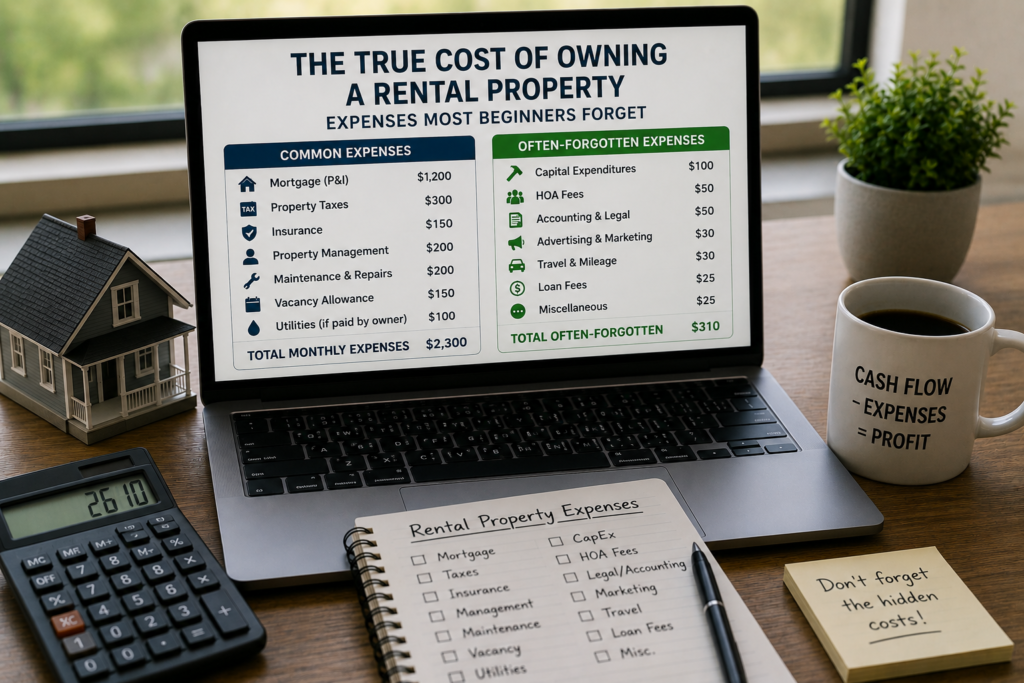
The spreadsheet looks perfect. You’ve found a rental property listed at $280,000. The mortgage payment will be $1,650/month. Comparable units in the neighborhood rent for $2,200/month. That’s $550/month in profit. Easy money.
Except it isn’t. Because that $550/month “profit” hasn’t accounted for property taxes, insurance, maintenance, vacancy, capital expenditures, property management, legal costs, accounting fees, landscaping, pest control, tenant turnover, or the dozen other expenses that quietly devour rental income month after month.
The gap between what beginners think a rental property costs and what it actually costs is where most first-time landlord disasters begin. The property was never a bad investment. The investor just didn’t know what they were buying into.
This guide catalogs every real expense of owning a rental property, including the ones that rarely show up in the optimistic projections you’ll find on investment forums. By the time you finish reading, you’ll be able to build a rental property budget that reflects reality, not fantasy.
The Expenses Everyone Knows About
Let’s start with the obvious costs. These are the line items that show up in every rental property analysis, and most beginners account for them. But even these “known” expenses have details that catch new investors off guard.
Mortgage Payment (Principal and Interest)
Your mortgage payment is usually the largest single expense. On a $280,000 property with 20% down ($56,000) and a 30-year fixed mortgage at 7%, the monthly principal and interest payment is approximately $1,490.
What beginners miss: The interest portion of your payment is front-loaded. In the first year of a 30-year mortgage, roughly 80-85% of each payment goes to interest and only 15-20% to principal. That means you’re barely building equity in the early years. On the $224,000 loan in this example, your first monthly payment puts about $1,307 toward interest and only $183 toward principal. It feels like you’re treading water, and financially, you mostly are for the first several years.
If you put less than 20% down, add mortgage insurance to this line item. FHA loans carry both an upfront mortgage insurance premium (1.75% of the loan, typically rolled into the balance) and annual mortgage insurance (0.55% of the loan, paid monthly). On a $270,000 FHA loan, that’s about $124/month added to your payment for the life of the loan. Conventional loans with less than 20% down require private mortgage insurance (PMI), typically 0.5-1.5% of the loan annually, though this drops off once you reach 20% equity.
Property Taxes
Property taxes vary wildly by location. In some states, you might pay 0.3% of the property’s assessed value annually. In others, you’ll pay over 2%. On a $280,000 property, that range translates to $840/year on the low end and $5,600/year on the high end.
What beginners miss: Property taxes aren’t static. They increase over time, sometimes significantly. Reassessments after a property sale often trigger a jump to the current market value, which can substantially increase your tax bill compared to what the previous owner paid. A property listed with “$200/month in property taxes” based on an old assessment might jump to $350/month after your purchase triggers a reassessment.
Check whether your target market has homestead exemptions that apply only to owner-occupied properties. If the seller lived in the property and claimed an exemption, the tax bill you see in listing data will be lower than what you’ll pay as a non-owner-occupant investor.
Some municipalities levy special assessments for infrastructure projects (new sidewalks, sewer upgrades, road improvements) that add hundreds or thousands of dollars to your annual tax bill with little warning. These assessments can last for years.
Homeowners Insurance
Landlord insurance (technically called a dwelling fire or DP-3 policy) costs more than standard homeowners insurance because rental properties carry higher risk. Expect to pay 15-25% more than the homeowner’s rate for the same property.
Annual premiums for a single-family rental typically range from $1,200 to $3,000, depending on the property’s location, age, construction type, and coverage limits. Properties in flood zones, hurricane-prone areas, or wildfire-risk zones will cost substantially more and may require separate policies.
What beginners miss: Standard landlord policies typically don’t cover floods, earthquakes, or certain types of water damage. If your property is in a flood zone, NFIP (National Flood Insurance Program) coverage adds $700 to $3,000+ per year. Earthquake coverage in seismic zones can add another $800 to $5,000 annually.
Insurance premiums have been increasing aggressively in many markets since 2022, with some areas seeing 20-40% annual premium increases. Your year-one insurance cost might be very different from your year-three cost. Budget for annual increases of at least 5-10%, and more in disaster-prone regions.
Loss-of-rent coverage (also called fair rental value coverage) is an add-on worth considering. If the property becomes uninhabitable due to a covered event (fire, storm damage), this coverage replaces your rental income during repairs. Without it, you’re paying the mortgage on a property that’s generating zero income.
The Expenses Most Beginners Underestimate
These costs appear in most rental analyses, but beginners almost always plug in numbers that are too low.
Maintenance and Repairs
This is the expense that separates realistic projections from fantasy projections. Every landlord forum has posts from beginners who budgeted $50/month for maintenance and discovered the hard way that $50 doesn’t cover much when a water heater dies.
The standard rule of thumb is to budget 1% of the property’s value per year for maintenance. On a $280,000 property, that’s $2,800/year or about $233/month. Some investors use a per-unit model: $100-$150/month per unit for single-family homes, slightly less for newer construction, more for older properties.
What these averages don’t capture is the timing. Maintenance expenses don’t arrive in neat, predictable monthly installments. You might spend $200 total in one quarter and then get hit with $3,500 in the next quarter when the garbage disposal dies, the fence blows over in a storm, and the bathroom faucet starts leaking simultaneously.
Real-world maintenance costs include:
Plumbing. A simple faucet repair runs $100-$250. A toilet replacement costs $200-$500 installed. A slab leak or main sewer line repair can reach $2,000-$10,000. Drain cleaning for a clogged main line costs $150-$500.
Electrical. Replacing outlets or switches: $100-$200 per unit. Fixing a tripped breaker or faulty wiring: $150-$400. Upgrading an outdated electrical panel: $1,500-$4,000.
Appliance repairs. Refrigerator repair: $200-$500. Dishwasher repair: $150-$400. Washer/dryer repair: $150-$500. At some point, repair costs exceed replacement value, and you’re buying a new appliance entirely.
General upkeep. Interior paint touch-ups, caulking, weatherstripping, filter replacements, smoke detector batteries, light fixtures, door hardware. None of these costs much individually, but collectively they add up to $500-$1,000 per year on a typical property.
The age and condition of the property dramatically affect maintenance costs. A property built in 2018 will cost significantly less to maintain in its first decade than a property built in 1975. If you’re buying an older property for the lower purchase price, factor in correspondingly higher maintenance expenses.
Vacancy
Vacancy is the silent killer of rental property returns. Every month the property sits empty, you’re paying the full mortgage, taxes, insurance, and maintenance with zero income to offset those costs.
The standard vacancy estimate is 5-8% of annual gross rent. On a property renting for $2,200/month ($26,400/year), that’s $1,320 to $2,112 per year set aside for vacancy, equivalent to roughly three to four weeks of lost rent annually.
What beginners miss: Vacancy isn’t just the period between tenants. It includes the time needed to prepare the unit after one tenant moves out and before the next moves in. That turnover period includes cleaning, repairs, repainting, re-listing, showing the unit, screening applicants, and executing a new lease. Even a smooth turnover takes two to four weeks. A turnover that requires significant repairs can take six to eight weeks.
Vacancy rates vary dramatically by market. College towns experience predictable summer vacancies. Seasonal resort areas might have high winter vacancy. Markets with strong job growth and tight housing supply might have near-zero vacancy. Markets losing population or employers might see vacancy rates of 10% or higher.
Advertising costs during vacancy add up too. While many landlords use free platforms like Zillow or Facebook Marketplace, some markets require paid listings, professional photography, or staging to attract quality tenants quickly. Budget $100-$300 per vacancy for marketing costs.
Property Management
If you hire a property management company (and many investors eventually do, especially those who own properties in different cities or who want a more hands-off experience), expect to pay:
Monthly management fee: 8-12% of collected rent. On $2,200/month rent, that’s $176-$264/month. Note the “collected rent” distinction. Most managers charge based on rent they actually collect, which means they don’t charge during vacancy (a small consolation).
Leasing fee: 50-100% of one month’s rent each time they place a new tenant. If annual turnover is common in your market, this fee alone can cost you $2,200/year.
Maintenance markup: Many managers add a 10-20% markup on maintenance and repair work coordinated through their preferred vendors. A $500 plumbing repair becomes $550-$600 when the manager takes their cut.
Lease renewal fee: Some managers charge $150-$300 to process a lease renewal, even though the tenant is already in place and the work involved is minimal. Not all managers charge this, so ask before signing a management agreement.
Additional fees to watch for: Setup fees ($200-$500 for onboarding a new property), inspection fees ($75-$150 per inspection), eviction management fees ($200-$500 plus legal costs), and early termination fees if you cancel the management contract before its term expires.
What beginners miss: Even if you self-manage, your time has a cost. If you spend 10 hours per month on management tasks and your time is worth $40/hour, you’re effectively paying $400/month, which might be more than a property manager would charge. Self-management saves cash but costs time. Decide which resource you have more of.
The Expenses Most Beginners Forget Entirely
These are the costs that don’t appear in most rental property calculators, YouTube analyses, or beginner investor guides. They’re real, they’re recurring, and they catch first-time landlords off guard.
Capital Expenditures (CapEx)
Capital expenditures are the big-ticket replacement costs that occur infrequently but hit hard when they arrive. These aren’t repairs (fixing what’s broken). These are replacements (swapping out entire systems or components that have reached the end of their useful life).
Every major system in a property has a lifespan, and you need to be saving for the replacement before it happens.
Roof: Lifespan of 20-30 years depending on material. Replacement cost: $8,000-$20,000 for a single-family home. If your property has a 15-year-old roof, you might be five to ten years from a five-figure expense.
HVAC system: Lifespan of 15-25 years. Replacement cost: $5,000-$15,000 depending on the system type and local labor rates. A furnace might last 20 years. A central AC compressor might last 15.
Water heater: Lifespan of 8-12 years for a tank unit, 15-20 years for tankless. Replacement cost: $1,000-$3,000 for standard tank replacement, $3,000-$5,000 for tankless.
Flooring: Carpet lasts 5-10 years in a rental (tenants are harder on carpet than homeowners). Replacement cost: $2,000-$5,000 for a full unit. Hardwood refinishing: $1,500-$3,000. LVP (luxury vinyl plank) installation: $2,500-$6,000.
Appliances: Refrigerators, stoves, dishwashers, and washers/dryers each last 10-15 years. Budget $500-$1,500 per appliance for replacement.
Exterior paint: Repainting the exterior of a single-family home costs $3,000-$8,000 and needs to happen every 7-10 years, depending on climate and material.
Driveway and parking surfaces: Asphalt resurfacing costs $1,500-$4,000. Concrete replacement for a driveway or walkway can run $3,000-$8,000.
Windows: Individual window replacement costs $300-$800 per window. Replacing all windows in a home: $5,000-$15,000.
Plumbing and sewer lines: Older homes with galvanized or cast iron pipes will eventually need repiping ($4,000-$15,000) or sewer line replacement ($3,000-$10,000).
The standard CapEx reserve is 1-2% of property value per year, set aside in a dedicated account. On a $280,000 property, that’s $2,800-$5,600/year or $233-$467/month. This money sits in savings until the day your HVAC compressor dies in the middle of August. Then you’re very glad it’s there.
New investors often skip CapEx reserves because “the roof is only five years old” or “the HVAC was just replaced.” Both of those things are great. They mean you have a longer runway before those expenses hit. But every month you’re not setting aside CapEx reserves, you’re borrowing from your future self.
Tenant Turnover Costs
When a tenant moves out and a new one moves in, the costs extend far beyond the vacancy period itself.
Cleaning: Professional deep cleaning between tenants costs $200-$500 depending on the size of the unit and its condition.
Paint: Even careful tenants leave scuff marks, nail holes, and general wear after a year or two. Repainting a unit costs $1,000-$2,500 if you hire a professional, or $200-$500 in materials if you do it yourself (plus a weekend or more of labor).
Carpet cleaning or replacement: Professional carpet cleaning: $150-$300. If the carpet is worn beyond cleaning, replacement for a unit runs $1,500-$4,000.
Minor repairs: Patching drywall, replacing damaged blinds, fixing cabinet doors, repairing screen doors, touching up trim. A typical turnover requires $200-$800 in minor repairs, even with a responsible tenant.
Lock rekeying: For security, you should rekey locks between every tenant. Cost: $75-$200 for a locksmith to rekey all exterior locks.
Marketing and showing time: Listing the unit, responding to inquiries, scheduling showings, and meeting prospective tenants costs time and sometimes money (paid listings, professional photos). Budget 5-15 hours of your time per turnover.
Tenant screening costs: Background checks, credit checks, and application processing cost $30-$75 per applicant. If you screen five applicants before finding the right tenant, that’s $150-$375.
Add it all up, and a single tenant turnover easily costs $2,000-$5,000 in direct expenses, plus the vacancy period. If you experience one turnover per year, that’s a significant bite out of your annual cash flow.
What beginners miss: The best way to reduce turnover costs is to retain good tenants. A small rent discount or a proactive repair response that keeps a reliable tenant in place for three years instead of one saves you two turnover cycles ($4,000-$10,000) and two vacancy periods. Tenant retention is one of the most profitable “investments” a landlord can make.
Landscaping and Exterior Maintenance
If your rental property has a yard, someone has to maintain it. And in many lease structures (especially single-family homes), that someone is you.
Lawn mowing: Professional mowing service costs $30-$75 per visit. Weekly mowing for a 30-week season runs $900-$2,250/year.
Tree trimming: Overgrown trees near the house or power lines need professional trimming every 2-3 years. Cost: $300-$1,500 per session, depending on tree size and number.
Tree removal: A dead or dangerous tree costs $500-$3,000+ to remove, depending on size and location.
Leaf removal: Fall cleanup costs $200-$500 per season in areas with deciduous trees.
Snow removal: In northern climates, snow plowing or shoveling for a driveway and walkways costs $30-$75 per event. A season with 20 plow-worthy snowfalls could run $600-$1,500.
Sprinkler system maintenance: Winterization, spring startup, and repairs cost $200-$500/year. A broken sprinkler head or valve can damage landscaping or cause water waste if not addressed promptly.
Gutter cleaning: Professional gutter cleaning costs $100-$250 twice a year. Clogged gutters cause water damage that costs thousands to repair, so this is cheap insurance.
Some landlords shift landscaping responsibility to tenants through lease terms. This works with single-family homes but rarely with multi-family properties where common areas need consistent maintenance. Even when tenants are responsible, some will neglect the yard, forcing you to intervene (and potentially pay) to maintain curb appeal and avoid HOA or municipal code violations.
Pest Control
Depending on your market, pest control is either an occasional expense or a recurring line item.
Routine preventive treatment: $30-$60/month for a quarterly pest control service. Annual cost: $360-$720.
Termite treatment: If termites are present, treatment costs $500-$2,500. Termite damage repair can cost thousands more. In termite-prone regions (much of the South and Southwest), annual termite inspections ($75-$150) and preventive bonds ($200-$400/year) are standard operating expenses.
Rodent removal: Professional mouse or rat removal costs $200-$600 per treatment. Sealing entry points to prevent recurrence adds another $200-$500.
Bed bug treatment: One of the most expensive pest problems. Treating a single unit for bed bugs costs $1,000-$5,000 depending on the severity and treatment method (heat treatment is more expensive but more effective than chemical treatment). In multi-unit buildings, bed bugs can spread between units, multiplying the cost.
What beginners miss: Pest problems that aren’t addressed quickly become pest emergencies that cost five to ten times more. A $300 proactive termite treatment prevents $15,000 in structural damage. A $200 rodent exclusion prevents $2,000 in damage to insulation, wiring, and stored items.
Legal Expenses
Most landlord-tenant relationships proceed smoothly. But when they don’t, legal costs arrive fast.
Lease drafting or review: Having a real estate attorney draft or review your lease costs $300-$800. A good lease is your primary protection against tenant disputes, so this is money well spent. Generic leases downloaded from the internet often lack state-specific provisions that protect you in a dispute.
Eviction costs: If a tenant stops paying rent and refuses to leave, formal eviction proceedings typically cost:
- Filing fees: $50-$500 depending on jurisdiction
- Attorney fees: $500-$2,500 for a straightforward eviction
- Process server fees: $50-$150
- Lost rent during the eviction process: 1-4 months (or longer in jurisdictions with extended tenant protections)
- Property damage: Non-paying tenants often leave properties in poor condition, adding $1,000-$10,000+ in repair costs
Total cost of a single eviction: $3,000-$15,000 or more when you combine legal fees, lost rent, and property damage.
Fair housing compliance: Violating fair housing laws (even unintentionally) can result in complaints, investigations, and settlements that cost thousands. Fair housing training and compliance review ($100-$500) is a worthwhile preventive expense.
LLC formation and maintenance: Many investors hold rental properties in an LLC for liability protection. Formation costs $50-$500 depending on the state. Annual filing fees and registered agent services add $100-$300/year. Attorney consultation for proper LLC structuring: $500-$1,500.
What beginners miss: The legal costs of being a landlord aren’t just about evictions. Lease disputes, security deposit disagreements, habitability complaints, insurance claims, and contractor disputes all carry potential legal costs. Budget $500-$1,000/year as a baseline legal reserve, even in years when nothing goes wrong.
Accounting and Tax Preparation
Rental property taxes are more complex than personal income taxes. Tracking income, categorizing expenses, calculating depreciation, and filing the appropriate schedules takes time and expertise.
CPA or tax preparer fees: Having a professional prepare your tax return with rental property income adds $200-$600 to your annual tax preparation costs, on top of what you’d pay for personal-only filing. Complex situations (multiple properties, 1031 exchanges, cost segregation studies) can push accounting fees higher.
Bookkeeping software: Tools like QuickBooks, Stessa, or Buildium range from free to $50/month. Even if you use free software, maintaining accurate books requires 1-3 hours per month of your time.
Cost segregation study: An advanced tax strategy that accelerates depreciation deductions. A professional cost segregation study costs $3,000-$10,000, but can generate tens of thousands in tax savings for the right property. This is typically only worth the cost for properties valued above $300,000 to $400,000.
What beginners miss: Poor bookkeeping costs money in two ways. First, you miss legitimate tax deductions because you didn’t track the expense. Second, you can’t produce accurate financial reports, which means you can’t tell whether a property is actually profitable or you’re just fooling yourself with incomplete numbers.
Keep every receipt. Log every expense. Categorize everything correctly. The 30 minutes per week you spend on bookkeeping saves hours of scrambling at tax time and ensures you capture every deductible dollar.
HOA Fees
If your rental property is a condo, townhouse, or located in a community with a homeowners association, monthly HOA fees are a fixed, non-negotiable expense.
HOA fees for condos typically range from $200-$600/month, though luxury buildings and older communities with deferred maintenance can charge $800 or more. Single-family homes in HOA communities usually pay less, often $50-$200/month.
What beginners miss: HOA fees increase over time, sometimes dramatically. A well-managed HOA raises dues gradually to fund reserves. A poorly managed HOA hits owners with special assessments, which are one-time charges for major repairs the HOA didn’t adequately save for. A special assessment of $5,000-$20,000 for a new roof, elevator repair, or parking structure maintenance can land in your mailbox with 30-60 days’ notice.
Before buying in an HOA community, review the HOA’s financial statements, reserve study, and meeting minutes from the past two years. Look for signs of underfunded reserves, pending special assessments, or contentious management decisions. A low monthly HOA fee paired with depleted reserves is a red flag, not a bargain.
Check the HOA’s rental restrictions too. Some HOAs limit the percentage of units that can be rented, cap the number of leases per year, or prohibit rentals altogether. Buying a condo you can’t legally rent out is an expensive discovery to make after closing.
Utilities
Who pays utilities varies by property type and lease structure.
Single-family homes: Tenants typically pay all utilities (electricity, gas, water, sewer, trash, internet). Your expense is usually zero during occupancy but 100% during vacancy. A vacant property in winter still needs heat to prevent frozen pipes. Budget $100-$300/month for vacancy utility costs.
Multi-family properties: Water, sewer, and trash are commonly landlord-paid because these services are often billed to the property (not individual units) and can’t be easily separated. Monthly cost: $100-$300+ per unit depending on local rates and tenant usage.
Common area utilities: If the property has shared hallways, exterior lighting, laundry rooms, or parking lot lights, you pay those electricity costs. Monthly cost: $50-$200 depending on the property.
What beginners miss: Water bills in landlord-paid situations can spike without warning. A running toilet can waste 200 gallons per day, adding $50-$100/month to your water bill. A tenant who waters the lawn excessively, fills a pool, or simply uses water carelessly can push costs well above budget. Consider installing low-flow fixtures, and include lease language about excessive utility usage.
Permits, Licenses, and Inspections
Many municipalities require landlords to obtain rental permits or business licenses before renting a property. These aren’t optional, and the penalties for non-compliance include fines, revoked rental permission, and liability exposure.
Rental permits/licenses: $50-$300/year depending on jurisdiction. Some cities require permits for each individual unit.
Rental inspections: Many permit programs include mandatory property inspections (every 1-3 years) to verify compliance with housing codes. Inspection fees: $50-$200 per inspection. If the property fails inspection, you pay for the required repairs plus a re-inspection fee.
Business license or registration: Some states or municipalities require landlords to register as a business. Cost: $25-$200/year.
Lead paint disclosure requirements: For properties built before 1978, federal law requires lead paint disclosure and, in some jurisdictions, lead paint testing and certification. Testing costs $300-$600 per property. If lead paint is found, remediation can cost $5,000-$30,000 depending on scope.
Certificate of occupancy: Some jurisdictions require a new CO at each tenant change, involving an inspection and fee. Cost: $50-$200 per occurrence.
What beginners miss: These costs are small individually, but they’re mandatory and recurring. Ignoring permit requirements doesn’t save money. It creates legal exposure that can cost far more when a code enforcement officer shows up or a tenant uses your non-compliance as leverage in a dispute.
Lawn, Snow, and Seasonal Service Contracts
Beyond basic landscaping, seasonal maintenance requirements add recurring costs that vary by climate:
Winterization: In cold climates, preparing the property for winter includes insulating exposed pipes, servicing the heating system, and ensuring storm windows are in place. If the property is vacant during winter, you may need to arrange regular check-ins to prevent frozen pipes. Professional winterization: $150-$400.
Spring readiness: Post-winter inspection for ice damage, gutter cleaning, and AC system servicing. Professional HVAC tune-up: $80-$150.
Fire safety compliance: Smoke detectors, carbon monoxide detectors, and fire extinguishers need regular testing and replacement. Annual cost: $50-$150 for replacement batteries and units.
The Expense That Nobody Tracks: Opportunity Cost
Here’s a cost that never appears on a spreadsheet but profoundly affects your actual returns: the opportunity cost of your down payment and time.
Down Payment Opportunity Cost
When you put $56,000 into a rental property down payment, that money is no longer available for other investments. If you had instead invested that $56,000 in an S&P 500 index fund earning an average 9% annually, it would grow to approximately $132,000 in 10 years.
Your rental property might return more than that through the combination of cash flow, appreciation, loan paydown, and tax benefits. But it might not. The opportunity cost of your down payment is a real expense that should be factored into your return calculations.
This doesn’t mean stocks are better than real estate (the leverage advantage of real estate often compensates for this). It means that comparing your rental returns against “what that money would have earned elsewhere” gives you a more honest picture of performance.
Time Opportunity Cost
If you self-manage a rental property and spend 10 hours per month on landlord duties, that’s 120 hours per year. At a $50/hour opportunity cost, that’s $6,000/year in time value that doesn’t show up in your cash flow calculations.
Some investors genuinely enjoy property management and consider the time well spent. Others find it draining and would rather spend those hours on higher-earning activities, hobbies, or family time. Be honest with yourself about which category you fall into before deciding to self-manage.
Building a Realistic Rental Property Budget
Now that you know what the expenses actually are, let’s build a complete budget for a typical single-family rental property.
Property details:
- Purchase price: $280,000
- Down payment: $56,000 (20%)
- Loan amount: $224,000 at 7% for 30 years
- Monthly rent: $2,200
Monthly expenses:
| Expense | Monthly Cost |
|---|---|
| Mortgage (P&I) | $1,490 |
| Property taxes | $310 |
| Insurance | $175 |
| Maintenance reserves (1% rule) | $233 |
| CapEx reserves (1% rule) | $233 |
| Vacancy reserve (7% of rent) | $154 |
| Turnover costs (amortized) | $100 |
| Landscaping/exterior | $100 |
| Pest control | $40 |
| Legal/accounting reserves | $75 |
| Permits and licenses | $20 |
| Miscellaneous | $50 |
| Total monthly expenses | $2,980 |
Monthly income: $2,200
Monthly cash flow: -$780
Wait. That’s negative. And that’s the uncomfortable truth that most beginner analyses miss. When you account for all actual expenses, many properties that look profitable on a simplified spreadsheet are actually cash flow negative, at least on paper.
Now, this analysis deserves context. The $233/month each for maintenance and CapEx reserves isn’t money you’re spending every month. It’s money you’re setting aside for future expenses. In months where nothing breaks, that cash accumulates in your reserve fund. Over time, you’ll spend it on repairs and replacements, but in the short term it’s sitting in savings.
If you remove the reserve contributions and look at actual out-of-pocket costs in a month where nothing breaks, the picture changes:
Actual cash expenses in a quiet month:
| Expense | Monthly Cost |
|---|---|
| Mortgage (P&I) | $1,490 |
| Property taxes | $310 |
| Insurance | $175 |
| Landscaping | $100 |
| Pest control | $40 |
| Permits | $20 |
| Total actual monthly cost | $2,135 |
Monthly cash flow (quiet month): $2,200 – $2,135 = $65
That’s barely breakeven. And the moment something breaks, you’re in the red.
This doesn’t mean the property is a bad investment. You’re still building equity through loan paydown (approximately $183/month in year one, increasing each year). You’re still capturing appreciation (at 3% annually on a $280,000 property, that’s $8,400/year). You’re still getting tax benefits from depreciation and expense deductions.
But if you bought this property expecting $550/month in cash flow, reality is going to be a cold shower.
How to Protect Your Cash Flow
Knowing the true expenses is step one. Step two is structuring your investment to produce real cash flow after accounting for all of them.
Buy at the Right Price
The most powerful cash flow lever is your purchase price. A property that’s overpriced by 10% costs you in higher mortgage payments every single month for 30 years. Negotiate aggressively. Walk away from deals where the numbers only work at full asking price. The market will always present another opportunity.
Target Higher Rent-to-Price Ratios
Properties where monthly rent equals at least 0.8-1% of the purchase price are more likely to cash flow after all expenses. A $280,000 property needs to rent for at least $2,240-$2,800/month to have a reasonable shot at positive cash flow. If market rents for comparable properties are $2,200, the purchase price might simply be too high for the rental market to support.
Reduce Turnover
Every tenant turnover costs $2,000-$5,000 in direct expenses plus vacancy. Keeping a good tenant for three years instead of one saves you two turnover cycles. Respond to maintenance requests promptly. Keep the property in good condition. Consider modest rent increases that keep your income growing without pushing reliable tenants out. A $50/month below-market rent on a tenant who stays for five years is far cheaper than market-rate rent with annual turnover.
Self-Manage (If Your Time Allows)
Property management fees of 8-12% of rent are one of the largest controllable expenses. On $2,200/month rent, self-management saves $176-$264/month ($2,112-$3,168/year). If you have the time, temperament, and proximity to handle management duties, self-managing in the early years of property ownership can make the difference between positive and negative cash flow.
Minimize Holding Costs During Vacancy
When a unit is vacant, every day costs money. Prepare the unit for the next tenant before the current tenant moves out (schedule painters, order materials, line up cleaners). List the property for rent 30-60 days before the current lease ends. Pre-screen applicants so you can sign a new lease within days of the previous tenant’s departure.
The goal is a turnover period of one to two weeks, not four to six weeks. That time difference can represent $1,000-$2,500 in saved vacancy costs per turnover.
Build Reserves Before You Need Them
Start contributing to maintenance and CapEx reserves from month one, even when the property is new and nothing needs attention. The point of reserves isn’t to cover today’s expenses. It’s to cover the $12,000 roof replacement three years from now or the $6,000 HVAC failure five years from now. If those reserves aren’t built up when the emergency arrives, the money comes from your personal savings or, worse, a credit card.
Get Multiple Quotes for Major Work
For any repair or replacement costing more than $500, get at least three quotes from different contractors. Prices for the same work can vary by 50-100% depending on the contractor. A $7,000 roof repair from one company might be $4,500 from another doing the same scope of work with comparable materials and warranty.
Build relationships with reliable, reasonably priced contractors before you need them urgently. A landlord who calls a plumber for the first time at midnight during a pipe burst is going to pay emergency rates. A landlord who has a trusted plumber on speed dial might get a faster response and a fair price.
Review Insurance Annually
Insurance premiums creep up, and coverage gaps can develop as property values change. Review your policy annually and shop competing quotes every two to three years. A 30-minute call to an insurance broker can save $200-$500/year. Verify that your coverage limits still match the property’s replacement cost, and make sure you haven’t overlooked riders for flood, earthquake, or other location-specific risks.
The True Cost in Year One vs. Year Five vs. Year Ten
Rental property economics change over time, and understanding this trajectory helps you stay committed through the lean early years.
Year One
Year one is almost always the most expensive year. You have closing costs to absorb, move-in repairs to fund, the learning curve of being a new landlord, and possibly a few months of vacancy while you find your first tenant. Cash flow is thin or negative. Reserve accounts are empty. Every unexpected expense feels like a crisis.
This is normal. Year one is an investment in the infrastructure that will produce returns later.
Year Five
By year five, your rent has likely increased 10-15% through annual adjustments (assuming 2-3% annual increases). Your fixed-rate mortgage payment hasn’t changed. The gap between income and fixed costs has widened in your favor. Your reserve accounts have built up. You’ve replaced the most failure-prone components (old water heater, aging appliances). You know your contractors, your market, and your tenant profile. Cash flow has improved meaningfully.
Year Ten
By year ten, rent increases have compounded significantly. If rent started at $2,200 and grew 3% annually, it’s now approximately $2,955/month. Your mortgage payment is still $1,490. The spread between income and your largest fixed expense has grown by $755/month. Maintenance costs on components you replaced in years three through seven are low. CapEx reserves are healthy. The property is generating real, consistent cash flow.
This is the payoff for surviving years one through three. The landlords who quit in year two because “rental properties don’t cash flow” never reach the years where the compounding economics transform a thin-margin investment into a genuine wealth builder.
The Bottom Line: What Owning a Rental Property Really Costs
Here’s the honest summary:
A rental property costs significantly more to own than the mortgage payment, taxes, and insurance that most beginners calculate. When you account for maintenance, CapEx reserves, vacancy, turnover, landscaping, pest control, legal reserves, accounting, permits, and miscellaneous expenses, the true operating cost of a rental property is typically 40-50% of gross rental income.
That means on a property renting for $2,200/month, expect $880-$1,100/month in non-mortgage operating expenses over time. Add your mortgage payment on top, and the true cost of ownership often consumes 90-100% of rental income in the early years.
This doesn’t mean rental properties are bad investments. It means they’re frequently misunderstood investments. The returns come from four sources, not one: cash flow (often thin), appreciation (requires time), loan paydown (automatic but slow), and tax benefits (real but complex). Beginners who expect large monthly cash flow checks from day one are setting themselves up for disappointment.
The investors who build wealth through rental property are the ones who understand the true cost structure from the beginning, budget conservatively, maintain healthy reserves, and stay invested long enough for rent increases and loan paydown to transform the economics in their favor.
Run your numbers with every expense on this list included. If the deal still works, even modestly, you’ve found a property worth owning. If the deal only works when you ignore half the expenses on this page, keep looking. The right property is out there. It just costs more than you think.