Introduction
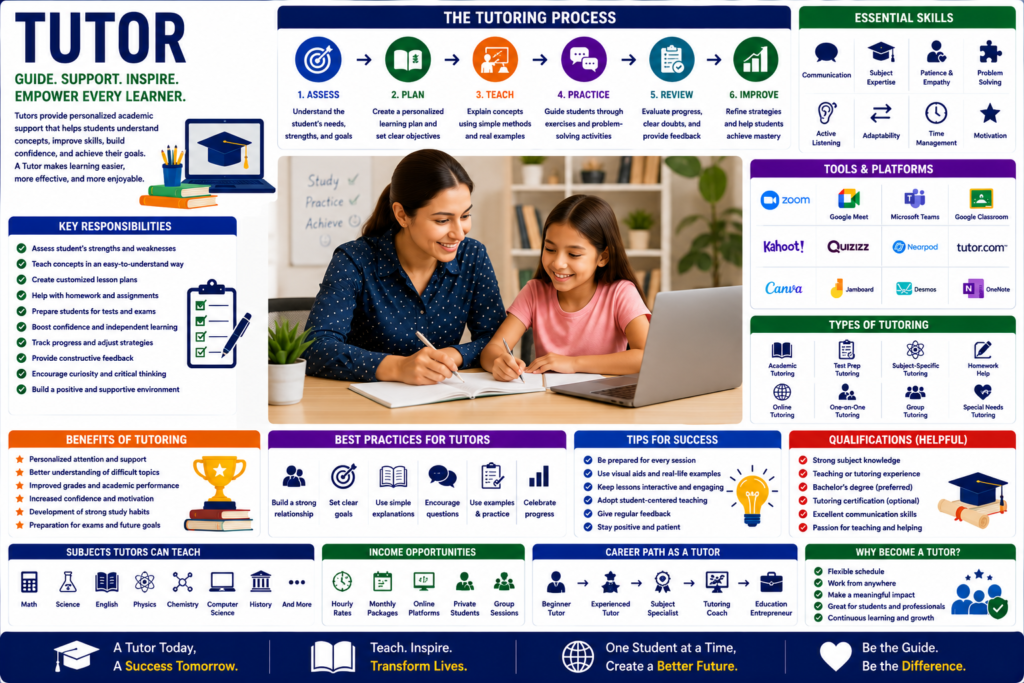
Education is one of the most powerful tools for personal and professional growth. However, every student learns differently, and many require additional support beyond the traditional classroom environment. This is where Tutors play a critical role.
Tutors provide personalized instruction designed to help students understand concepts, improve academic performance, build confidence, and achieve educational goals. Whether working with children, high school students, university learners, or adult professionals, Tutors offer customized guidance that addresses individual learning needs.
As education continues evolving through technology, remote learning, and specialized instruction, tutoring has become an increasingly valuable and growing profession worldwide.
This guide explores the role of a Tutor, responsibilities, essential skills, teaching methods, tools, certifications, career opportunities, and future trends shaping the tutoring industry.
What Is a Tutor?
A Tutor is an educational professional who provides individualized or small-group instruction to help learners improve their understanding of specific subjects or skills.
Unlike traditional classroom teachers who work with larger groups, Tutors focus on personalized learning experiences tailored to each student’s strengths, weaknesses, and goals.
Tutors may assist with:
- Academic subjects
- Homework support
- Test preparation
- Language learning
- Professional skills development
- Study strategies
- Exam coaching
- College preparation
- Career-related education
Their primary objective is to help students achieve measurable learning outcomes.
Why Tutors Are Important
Personalized Learning
Tutors adapt lessons to individual student needs.
Academic Improvement
Students often achieve higher grades and better performance.
Increased Confidence
One-on-one support helps learners overcome academic challenges.
Flexible Learning
Tutoring can occur online or in person at convenient times.
Goal Achievement
Tutors help students prepare for exams, certifications, and educational milestones.
Key Responsibilities of a Tutor
Assessing Student Needs
Understanding learning gaps and academic goals.
Lesson Planning
Creating customized learning plans.
Teaching Concepts
Explaining subject matter clearly and effectively.
Homework Assistance
Supporting students with assignments and projects.
Progress Monitoring
Tracking performance improvements.
Exam Preparation
Helping students prepare for tests and assessments.
Providing Feedback
Offering constructive guidance and encouragement.
Types of Tutors
Academic Tutor
Supports school and university subjects.
Online Tutor
Provides instruction through virtual platforms.
Test Preparation Tutor
Helps students prepare for standardized exams.
Language Tutor
Teaches speaking, reading, and writing skills.
Special Education Tutor
Supports learners with specialized educational needs.
STEM Tutor
Focuses on science, technology, engineering, and mathematics.
Professional Skills Tutor
Teaches workplace and career-related competencies.
Subjects Commonly Taught by Tutors
Mathematics
- Algebra
- Geometry
- Calculus
- Statistics
Science
- Biology
- Chemistry
- Physics
- Environmental Science
Languages
- English
- Spanish
- French
- German
- Mandarin
Humanities
- History
- Geography
- Literature
- Social Studies
Technology
- Programming
- Data Analysis
- Web Development
- Computer Science
The Tutoring Process
1. Initial Assessment
Evaluate student abilities and goals.
2. Learning Plan Development
Create customized educational strategies.
3. Instruction
Deliver lessons and learning activities.
4. Practice and Reinforcement
Provide exercises and assignments.
5. Progress Evaluation
Measure improvements and adjust instruction.
6. Goal Achievement
Help students reach academic objectives.
Essential Skills for Tutors
Communication Skills
Explaining complex topics in simple ways.
Patience
Supporting students through learning challenges.
Subject Expertise
Strong knowledge in the subject area being taught.
Adaptability
Adjusting teaching methods for different learners.
Organization
Managing lesson plans and schedules effectively.
Motivation
Encouraging students to stay engaged and confident.
Critical Thinking
Helping students develop problem-solving abilities.
Effective Tutoring Techniques
Active Learning
Encouraging students to participate actively.
Question-Based Learning
Using questions to develop understanding.
Demonstrations
Showing practical examples and applications.
Visual Learning
Incorporating charts, diagrams, and illustrations.
Practice Exercises
Reinforcing concepts through repetition.
Personalized Feedback
Providing targeted guidance and recommendations.
Online Tutoring
Technology has transformed the tutoring profession.
Benefits include:
- Global student access
- Flexible scheduling
- Remote work opportunities
- Digital learning tools
- Increased convenience
Popular online tutoring platforms include:
- Zoom
- Google Meet
- Microsoft Teams
- Skype
- Learning Management Systems (LMS)
Educational Technology Tools
Presentation Tools
- PowerPoint
- Canva
- Google Slides
Interactive Learning Platforms
- Kahoot!
- Quizizz
- Nearpod
Collaboration Tools
- Google Docs
- Miro
- Padlet
Assessment Tools
- Google Forms
- Socrative
- ClassMarker
Technology helps Tutors create engaging and interactive learning experiences.
Benefits of Tutoring for Students
Improved Academic Performance
Students often achieve better grades and test scores.
Better Study Habits
Tutors teach effective learning strategies.
Increased Motivation
Personal support boosts engagement.
Enhanced Confidence
Students gain confidence through mastery of concepts.
Individual Attention
Lessons focus entirely on the student’s needs.
Tutor vs Teacher
Tutor
Provides individualized instruction and personalized support.
Teacher
Educates larger groups within structured curricula.
Both roles are valuable, but tutoring offers more personalized learning experiences.
Tutor vs Academic Coach
Tutor
Focuses on subject-specific instruction.
Academic Coach
Focuses on study habits, organization, and educational planning.
Some professionals combine both roles.
Certifications for Tutors
Teaching Certification
Useful for academic tutoring.
TESOL Certification
Beneficial for language instruction.
TEFL Certification
Supports English language teaching.
Subject-Specific Certifications
Demonstrate expertise in specialized fields.
Online Teaching Certifications
Enhance virtual instruction capabilities.
Industries Hiring Tutors
Educational Institutions
Schools, colleges, and universities.
Tutoring Centers
Dedicated learning support organizations.
Online Education Platforms
Virtual tutoring services.
Corporate Training Programs
Professional development and skills training.
Nonprofit Organizations
Community education initiatives.
Private Clients
Independent tutoring services.
Career Path for Tutors
Junior Tutor
Entry-level educational support role.
Tutor
Provides independent instruction.
Senior Tutor
Works with advanced learners and specialized subjects.
Academic Coordinator
Manages educational programs and tutoring teams.
Curriculum Developer
Designs educational content and learning materials.
Educational Consultant
Provides expertise to schools and organizations.
Tutoring Business Owner
Builds and manages tutoring services or agencies.
Best Practices for Tutors
Understand Student Needs
Develop individualized learning plans.
Build Strong Relationships
Create trust and positive learning environments.
Set Clear Goals
Define measurable educational outcomes.
Use Multiple Teaching Methods
Accommodate different learning styles.
Encourage Independence
Help students become self-directed learners.
Continuously Improve
Stay updated on educational research and technology.
Future Trends in Tutoring
Artificial Intelligence
AI supports personalized learning experiences.
Online Tutoring Growth
Remote education continues expanding globally.
Microlearning
Short, focused lessons become increasingly popular.
Adaptive Learning Systems
Technology customizes instruction automatically.
Global Tutoring Markets
Tutors gain access to international students.
Educational Analytics
Data helps measure learning effectiveness.
Benefits of Becoming a Tutor
- Flexible work schedules
- Remote and in-person opportunities
- High demand for educational support
- Ability to make a meaningful impact
- Opportunities for specialization
- Potential for entrepreneurship
- Continuous professional growth
Conclusion
Tutors play a vital role in helping students achieve academic success through personalized instruction, encouragement, and expert guidance. By adapting lessons to individual learning needs, Tutors help learners build confidence, improve performance, and reach their educational goals.
As education continues embracing technology and personalized learning approaches, skilled Tutors will remain highly valuable. Professionals who combine subject expertise, communication skills, patience, and innovative teaching strategies can build rewarding careers while making a lasting difference in students’ lives.