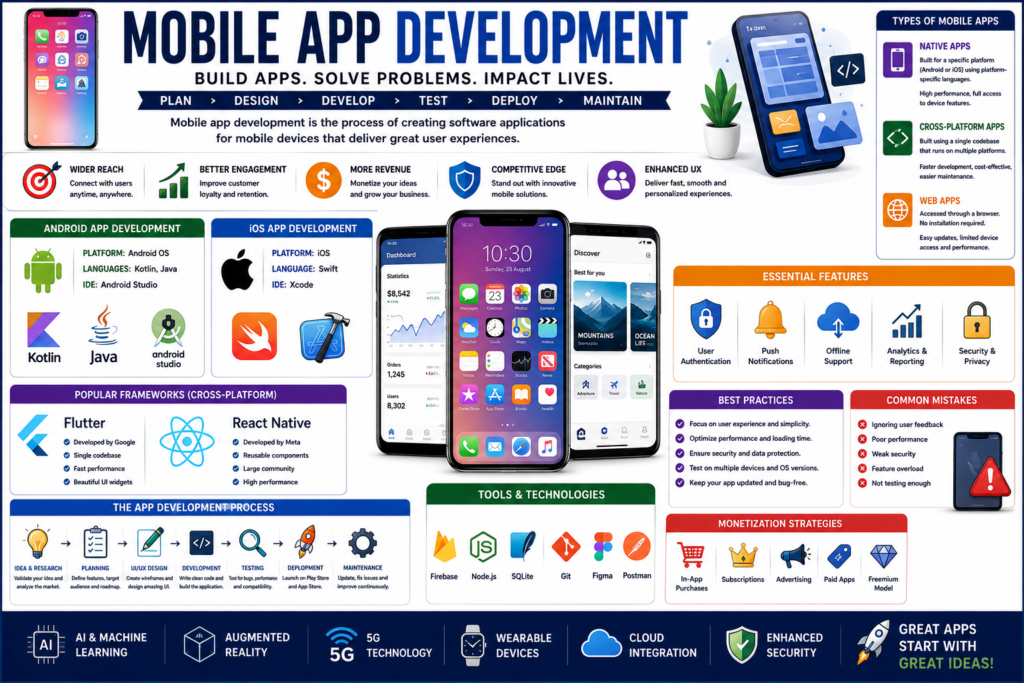
Introduction
Mobile app development has transformed the way people communicate, shop, learn, work, and entertain themselves. With billions of smartphone users worldwide, mobile applications have become a critical part of everyday life and a major opportunity for businesses, entrepreneurs, and developers.
From social media platforms and banking apps to fitness trackers and e-commerce solutions, mobile applications drive digital innovation across nearly every industry.
Whether you’re an aspiring developer, startup founder, business owner, or technology enthusiast, understanding mobile app development can help you create powerful digital experiences and capitalize on one of the fastest-growing sectors in technology.
This comprehensive guide explores mobile app development fundamentals, technologies, frameworks, design principles, and best practices for building successful applications.
What Is Mobile App Development?
Mobile app development is the process of designing, building, testing, and maintaining software applications that run on mobile devices such as smartphones and tablets.
Mobile apps typically operate on:
- Android devices
- iPhones (iOS)
- Tablets
- Wearable devices
The development process involves:
- User interface design
- Programming
- Database integration
- Testing
- Deployment
- Ongoing maintenance
Why Mobile App Development Matters
Mobile applications provide significant benefits for businesses and users alike.
Improved Customer Engagement
Apps offer direct communication channels with customers.
Increased Accessibility
Users can access services anytime and anywhere.
Enhanced User Experience
Apps provide faster and more personalized experiences than traditional websites.
Business Growth
Mobile applications can generate revenue, improve brand loyalty, and expand market reach.
Competitive Advantage
Companies with well-designed apps often gain an edge over competitors.
Types of Mobile Applications
Native Apps
Native apps are built specifically for a particular operating system.
Examples:
- Android apps
- iOS apps
Advantages:
- High performance
- Better user experience
- Full device functionality
Disadvantages:
- Higher development costs
- Separate codebases
Cross-Platform Apps
Cross-platform apps work on multiple operating systems using a shared codebase.
Advantages:
- Faster development
- Lower costs
- Easier maintenance
Popular frameworks include:
- Flutter
- React Native
Web Apps
Web applications run through mobile browsers.
Advantages:
- No installation required
- Easier updates
Disadvantages:
- Limited device access
- Lower performance compared to native apps
Android App Development
Android is one of the world’s most widely used mobile operating systems.
Common Android Technologies
Kotlin
Kotlin is Google’s preferred language for Android development.
Benefits:
- Modern syntax
- Improved safety
- High productivity
Java
Java remains widely used for Android applications.
Benefits:
- Large ecosystem
- Extensive documentation
Android Studio
Android Studio is the official development environment for Android applications.
Features include:
- Code editing
- Testing tools
- Performance monitoring
- Emulator support
iOS App Development
iOS development focuses on creating applications for Apple devices.
Swift
Swift is Apple’s primary programming language.
Benefits:
- Fast performance
- Modern syntax
- Enhanced safety
Xcode
Xcode is Apple’s official development platform.
Features include:
- Interface design tools
- Code editor
- Testing environment
- App deployment tools
Cross-Platform Development Frameworks
Flutter
Flutter, developed by Google, is one of the most popular frameworks.
Benefits:
- Single codebase
- Excellent performance
- Rich user interface components
React Native
React Native, developed by Meta, allows developers to build mobile apps using JavaScript.
Benefits:
- Code reusability
- Large community
- Fast development
Mobile App Development Process
Step 1: Idea Validation
Before development begins:
- Research the market
- Analyze competitors
- Identify user needs
- Validate demand
Step 2: Planning
Define:
- Features
- Business goals
- User requirements
- Development timeline
Step 3: UI/UX Design
Design focuses on:
- User experience
- Navigation
- Visual appeal
- Accessibility
Step 4: Development
Developers create:
- Front-end functionality
- Back-end systems
- APIs
- Database integrations
Step 5: Testing
Testing ensures:
- Functionality
- Performance
- Security
- Compatibility
Step 6: Deployment
Apps are published through:
- Google Play Store
- Apple App Store
Step 7: Maintenance
Continuous updates help improve:
- Security
- Features
- Performance
- User satisfaction
Essential Mobile App Features
Successful apps often include:
User Authentication
Examples:
- Email login
- Social login
- Multi-factor authentication
Push Notifications
Benefits:
- User engagement
- Marketing opportunities
- Important updates
Offline Functionality
Allows users to access content without an internet connection.
Analytics
Helps track:
- User behavior
- Engagement
- Retention
Security
Protect user data through:
- Encryption
- Secure authentication
- Data protection policies
Mobile UI/UX Design Principles
Simplicity
Users should complete tasks easily and efficiently.
Consistency
Consistent design improves usability.
Accessibility
Apps should accommodate users with different needs and abilities.
Performance
Fast-loading apps improve satisfaction and retention.
Intuitive Navigation
Users should easily understand how to use the application.
Backend Development for Mobile Apps
Many mobile apps require backend services.
Backend systems handle:
- User accounts
- Databases
- Payments
- Notifications
- Business logic
Popular backend technologies include:
- Node.js
- Python
- Java
- Firebase
Mobile App Monetization Strategies
In-App Purchases
Users purchase digital products or premium features.
Subscriptions
Recurring payments provide predictable revenue.
Advertising
Display ads generate income from app usage.
Paid Apps
Users pay before downloading.
Freemium Model
Basic functionality is free while premium features require payment.
Common Mobile App Development Mistakes
Avoid these common issues:
Ignoring User Feedback
User insights are essential for improvement.
Poor Performance
Slow apps often experience higher uninstall rates.
Weak Security
Security vulnerabilities can damage trust and reputation.
Feature Overload
Too many features can create confusion.
Inadequate Testing
Poor testing often leads to bugs and negative reviews.
Mobile App Development Best Practices
Focus on User Experience
User satisfaction should remain a top priority.
Optimize Performance
Reduce load times and improve responsiveness.
Ensure Security
Protect user information and transactions.
Keep Updating
Regular updates improve reliability and engagement.
Monitor Analytics
Use data to guide improvements and future development.
Career Opportunities in Mobile App Development
Popular roles include:
- Android Developer
- iOS Developer
- Flutter Developer
- React Native Developer
- Mobile UI/UX Designer
- Mobile Software Engineer
- App Product Manager
Demand for mobile development professionals continues to grow globally.
Future Trends in Mobile App Development
Emerging trends include:
- Artificial Intelligence integration
- Augmented Reality (AR)
- Virtual Reality (VR)
- Internet of Things (IoT)
- Wearable applications
- 5G-powered experiences
- Low-code development platforms
Developers who stay current with new technologies gain a competitive advantage.
Essential Skills for Mobile Developers
Successful developers often possess:
- Programming skills
- Problem-solving abilities
- UI/UX understanding
- Database knowledge
- API integration expertise
- Testing and debugging skills
- Continuous learning mindset
Technology evolves rapidly, making ongoing education essential.
Conclusion
Mobile app development is one of the most exciting and rewarding areas of modern technology. As smartphones continue to dominate digital interactions, the demand for innovative mobile applications and skilled developers remains strong.
By learning mobile technologies, mastering development frameworks, focusing on user experience, and following industry best practices, developers can create applications that provide real value and achieve long-term success.
Whether you’re building apps for personal projects, startups, or enterprise organizations, mobile app development offers endless opportunities to innovate, solve problems, and shape the future of digital experiences.