Introduction
In today’s interconnected world, businesses and individuals regularly communicate across borders, cultures, and languages. As globalization continues to expand, effective communication has become more important than ever. This is where professional translation services play a crucial role.
Translation services help bridge language barriers by converting written content from one language into another while preserving meaning, tone, and cultural relevance. Whether it’s legal documents, websites, marketing materials, technical manuals, or business communications, accurate translation ensures messages are understood clearly by diverse audiences.
This comprehensive guide explores translation services, their benefits, types, applications, and best practices for achieving successful multilingual communication.
What Are Translation Services?
Translation services involve converting text or content from one language into another while maintaining the original meaning, context, and intent.
Professional translation goes beyond simple word-for-word conversion. It considers:
- Cultural nuances
- Industry terminology
- Grammar and syntax
- Audience expectations
- Local language preferences
The goal is to create content that feels natural and accurate to native speakers.
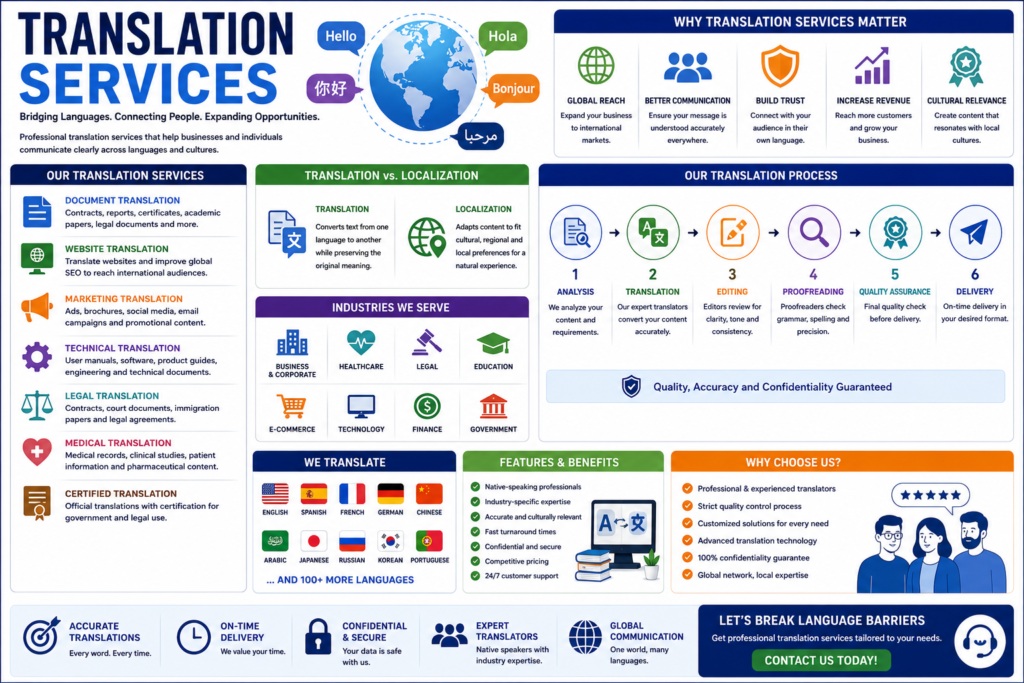
Why Translation Services Matter
Global Market Expansion
Translation enables businesses to reach international customers and enter new markets.
Improved Customer Experience
Customers prefer information presented in their native language.
Stronger Brand Credibility
Professionally translated content enhances trust and professionalism.
Better Communication
Translation reduces misunderstandings and improves clarity.
Increased Revenue Opportunities
Multilingual content can significantly expand potential customer bases.
Types of Translation Services
Document Translation
One of the most common translation services.
Examples include:
- Contracts
- Reports
- Certificates
- Academic documents
- Business correspondence
Website Translation
Website translation helps businesses reach international audiences.
Benefits include:
- Improved user experience
- Increased global traffic
- Better search engine visibility
Marketing Translation
Marketing content requires cultural adaptation and localization.
Examples include:
- Advertisements
- Product descriptions
- Email campaigns
- Social media content
Technical Translation
Technical translation involves specialized industry terminology.
Examples include:
- User manuals
- Software documentation
- Engineering specifications
- Technical guides
Legal Translation
Legal documents require exceptional accuracy.
Examples include:
- Contracts
- Court documents
- Immigration paperwork
- Legal agreements
Medical Translation
Medical translations often involve:
- Patient records
- Clinical studies
- Pharmaceutical information
- Medical device documentation
Accuracy is critical due to potential health implications.
Certified Translation Services
Certified translations are often required for official purposes.
Examples include:
- Immigration applications
- Birth certificates
- Marriage certificates
- Academic transcripts
- Legal proceedings
Certified translations provide assurance regarding accuracy and authenticity.
Translation vs. Localization
Although often used interchangeably, translation and localization differ.
Translation
Focuses on converting content between languages.
Localization
Adapts content to fit:
- Culture
- Regional preferences
- Currency
- Date formats
- Local customs
Localization creates a more natural experience for target audiences.
Industries That Use Translation Services
Business and Corporate
Companies use translation for:
- International communication
- Contracts
- Marketing materials
- Training resources
Healthcare
Healthcare organizations require multilingual communication for patients and professionals.
Legal Sector
Law firms and courts frequently use translation services.
Education
Educational institutions translate:
- Course materials
- Diplomas
- Research papers
E-commerce
Online stores benefit from multilingual product listings and customer support.
Technology
Software companies often translate:
- Applications
- User interfaces
- Documentation
Benefits of Professional Translation Services
Accuracy
Professional translators understand language complexities and industry terminology.
Cultural Relevance
Translations reflect local customs and communication styles.
Consistency
Professional services maintain consistent terminology across projects.
Time Savings
Experienced translators complete projects efficiently.
Quality Assurance
Many translation providers use editing and proofreading processes.
Website Translation and SEO
Website translation can improve international search visibility.
Multilingual SEO Benefits
- Increased organic traffic
- Better user engagement
- Expanded audience reach
- Improved search rankings in target markets
SEO translation often includes:
- Keyword research
- Localized content
- Optimized metadata
- Region-specific search terms
Common Translation Challenges
Cultural Differences
Certain phrases may not translate directly between languages.
Technical Terminology
Specialized industries require expert knowledge.
Context Preservation
Maintaining original intent can be challenging.
Language Variations
Different regions may use distinct vocabulary and expressions.
Professional translators address these challenges through expertise and research.
Human Translation vs. Machine Translation
Human Translation
Advantages:
- Context awareness
- Cultural understanding
- Higher accuracy
- Better tone adaptation
Machine Translation
Advantages:
- Speed
- Cost efficiency
- Basic communication support
While machine translation can assist with simple tasks, professional human translation remains essential for high-quality results.
Choosing a Translation Service Provider
When selecting a translation partner, consider:
Industry Expertise
Choose translators familiar with your industry.
Language Specialization
Ensure expertise in both source and target languages.
Quality Control Processes
Look for editing and proofreading procedures.
Confidentiality
Protect sensitive information through secure processes.
Client Reviews
Evaluate reputation and customer satisfaction.
Translation Workflow
Step 1: Content Analysis
Review source material and project requirements.
Step 2: Translation
Convert content into the target language.
Step 3: Editing
Refine language and improve clarity.
Step 4: Proofreading
Check grammar, consistency, and accuracy.
Step 5: Quality Assurance
Final review before delivery.
This process helps ensure professional results.
Best Practices for Successful Translation Projects
Provide Clear Source Content
Well-written source material improves translation quality.
Define Target Audience
Audience information helps translators adapt tone and style.
Maintain Consistent Terminology
Use glossaries and style guides when possible.
Consider Localization Needs
Adapt content for regional preferences.
Work with Qualified Professionals
Experienced translators deliver more accurate results.
Common Translation Mistakes to Avoid
Using Only Automated Tools
Machine translation may miss context and cultural nuances.
Ignoring Localization
Direct translation may not resonate with local audiences.
Overlooking Industry Expertise
Specialized content requires subject-matter knowledge.
Failing to Review Translations
Quality assurance is essential for professional results.
Inconsistent Terminology
Consistency improves clarity and brand professionalism.
Future Trends in Translation Services
Emerging trends include:
- AI-assisted translation
- Real-time language solutions
- Voice translation technology
- Multilingual content marketing
- Advanced localization platforms
- Machine learning enhancements
Technology continues to improve efficiency while human expertise remains vital for quality.
Career Opportunities in Translation
Popular roles include:
- Translator
- Interpreter
- Localization Specialist
- Language Consultant
- Technical Translator
- Medical Translator
- Legal Translator
- Multilingual Content Specialist
Demand for language professionals continues to grow in global markets.
Conclusion
Translation services play a vital role in connecting people, businesses, and organizations across linguistic and cultural boundaries. Whether supporting international business expansion, legal compliance, healthcare communication, or digital marketing, professional translation helps ensure messages are understood accurately and effectively.
By choosing qualified translation professionals, prioritizing localization, and maintaining quality standards, organizations can strengthen global communication, enhance customer experiences, and unlock new opportunities in international markets.
As the world becomes increasingly connected, translation services will continue to be essential tools for successful global communication and business growth.