Introduction
Animation is one of the most powerful forms of visual storytelling. From blockbuster movies and television shows to video games, advertisements, educational content, and social media videos, animation brings ideas, characters, and stories to life through movement and creativity.
Behind every animated scene is an Animator—a creative professional who transforms static images, models, and concepts into engaging visual experiences. Animators combine artistic talent, technical expertise, storytelling skills, and an understanding of motion to create content that entertains, educates, and inspires audiences worldwide.
As digital media continues to expand, animation remains one of the fastest-growing creative industries, offering exciting career opportunities across entertainment, technology, marketing, and education.
What Is an Animator?
An Animator is a creative professional who creates the illusion of movement by manipulating images, illustrations, characters, objects, or digital models.
Animators work in various mediums including:
- Film and television
- Video games
- Advertising
- Mobile applications
- Web content
- Social media
- Educational media
- Virtual reality experiences
Their goal is to create believable movement, emotional expression, and engaging visual narratives.
Why Animation Matters
Enhances Storytelling
Animation makes stories more engaging and memorable.
Captures Attention
Moving visuals attract and retain audience interest.
Simplifies Complex Concepts
Animation helps explain difficult ideas in an easy-to-understand format.
Builds Emotional Connections
Character animation creates empathy and audience engagement.
Supports Modern Marketing
Animated content often performs better across digital platforms.
Types of Animation
2D Animation
2D animation uses flat artwork and illustrations.
Examples include:
- Cartoons
- Explainer videos
- Motion graphics
- Educational videos
3D Animation
3D animation creates characters and environments with depth and realism.
Common applications include:
- Animated films
- Video games
- Product visualizations
- Architectural walkthroughs
Character Animation
Focuses on bringing characters to life through movement, emotions, and expressions.
Motion Graphics Animation
Combines graphic design and animation for marketing and communication purposes.
Stop Motion Animation
Uses physical objects photographed frame-by-frame.
Popular examples include:
- Clay animation
- Puppet animation
- Product animation
Visual Effects Animation (VFX)
Creates digital effects used in movies, television, and gaming.
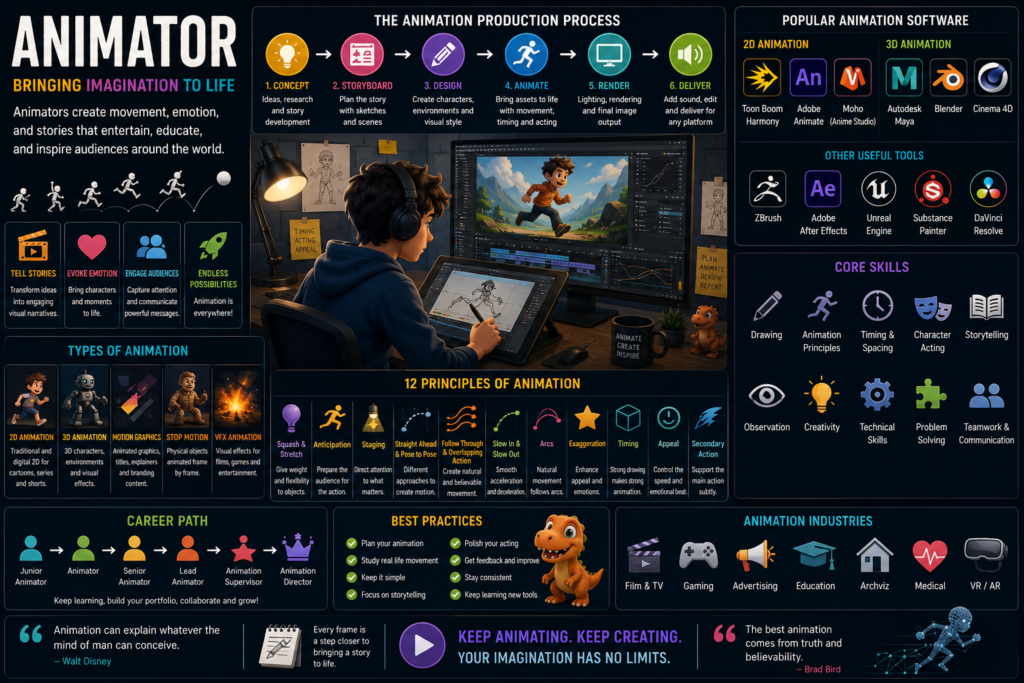
The Animation Production Process
1. Concept Development
Creating ideas, storylines, and project objectives.
2. Storyboarding
Planning scenes visually before animation begins.
3. Character and Asset Design
Creating characters, environments, and visual elements.
4. Animatics
Developing rough animated sequences to establish timing and pacing.
5. Animation Production
Animating characters, objects, and environments.
6. Lighting and Rendering
Enhancing visual quality and generating final output.
7. Post-Production
Adding sound effects, music, editing, and visual enhancements.
8. Final Delivery
Preparing content for distribution across platforms.
Essential Skills for Animators
Drawing Fundamentals
Understanding anatomy, perspective, and composition.
Storytelling
Creating narratives that connect with audiences.
Animation Principles
Mastering movement and timing techniques.
Creativity
Generating original ideas and visual solutions.
Observation Skills
Studying real-life movement and behavior.
Attention to Detail
Ensuring smooth and believable animations.
Communication
Collaborating effectively with production teams and clients.
The 12 Principles of Animation
Developed by Disney animators, these principles remain foundational today.
Squash and Stretch
Adds flexibility and realism to movement.
Anticipation
Prepares audiences for actions.
Staging
Directs viewer attention to important actions.
Straight Ahead and Pose-to-Pose
Different approaches to creating movement.
Follow Through and Overlapping Action
Creates natural and believable motion.
Timing
Determines speed and emotional impact.
Exaggeration
Enhances appeal and entertainment value.
Appeal
Makes characters visually engaging.
These principles continue to guide modern animation practices.
Popular Animation Software
Autodesk Maya
Industry-standard software for 3D animation and visual effects.
Blender
A powerful open-source platform for:
- Modeling
- Animation
- Rendering
- Visual effects
Toon Boom Harmony
Widely used for professional 2D animation.
Adobe Animate
Popular for web and interactive animation projects.
Cinema 4D
Known for motion graphics and 3D animation.
Unreal Engine
Increasingly used for real-time animation production.
Animation in Different Industries
Film and Television
Creating animated movies, shows, and visual effects.
Video Games
Developing character animations and interactive experiences.
Advertising
Producing engaging commercials and promotional content.
Education
Creating learning materials and instructional videos.
Healthcare
Visualizing medical procedures and scientific concepts.
Technology
Supporting user experiences with animated interfaces and demonstrations.
Character Animation
Character animation is one of the most specialized areas of animation.
Animators focus on:
- Facial expressions
- Body language
- Emotions
- Acting performance
- Personality development
Strong character animation helps audiences connect emotionally with stories.
2D vs 3D Animation
2D Animation
Benefits include:
- Faster production
- Lower costs
- Distinct artistic styles
3D Animation
Benefits include:
- Greater realism
- Advanced visual effects
- Immersive environments
Many studios combine both approaches to achieve unique creative results.
Career Path for Animators
Junior Animator
Learns production workflows and animation fundamentals.
Animator
Creates animation sequences independently.
Senior Animator
Leads projects and mentors team members.
Lead Animator
Guides animation quality and direction.
Animation Director
Oversees animation production and creative vision.
Creative Director
Manages overall artistic strategy and storytelling.
Best Practices for Animators
- Study real-world movement
- Practice consistently
- Focus on storytelling
- Master animation principles
- Build a strong portfolio
- Learn multiple software tools
- Accept constructive feedback
- Stay updated with industry trends
Future Trends in Animation
Artificial Intelligence
AI tools are accelerating production workflows and content generation.
Virtual Production
Real-time rendering technologies are transforming animation pipelines.
Augmented Reality (AR)
Animation increasingly supports immersive digital experiences.
Virtual Reality (VR)
Interactive storytelling continues to expand.
Real-Time Animation
Technologies such as Unreal Engine enable faster production.
Cross-Platform Content
Animators create content optimized for multiple digital channels.
Benefits of Becoming an Animator
- High creative freedom
- Diverse industry opportunities
- Growing global demand
- Remote work possibilities
- Freelance flexibility
- Continuous learning
- Strong career progression
Conclusion
Animators are essential creators in today’s digital entertainment and media landscape. Through movement, storytelling, and artistic vision, they transform ideas into memorable experiences that captivate audiences worldwide.
As animation continues expanding into gaming, virtual reality, marketing, education, and emerging technologies, skilled Animators will remain highly valuable. By mastering animation principles, creative storytelling, and modern production tools, aspiring Animators can build rewarding careers in one of the world’s most exciting creative industries.