Introduction
Every successful piece of written content—whether it’s a book, website, article, report, marketing campaign, academic paper, or business document—requires a final layer of quality control before publication. This critical responsibility belongs to the Proofreader.
Proofreaders play a vital role in ensuring content is polished, accurate, professional, and free from errors. They serve as the final checkpoint before content reaches readers, helping organizations maintain credibility, professionalism, and clear communication.
As digital content continues to grow across industries, professional proofreading remains an essential service for businesses, publishers, writers, students, and marketing teams worldwide.
This guide explores the role of a Proofreader, essential skills, proofreading processes, tools, career opportunities, and best practices for achieving editorial excellence.
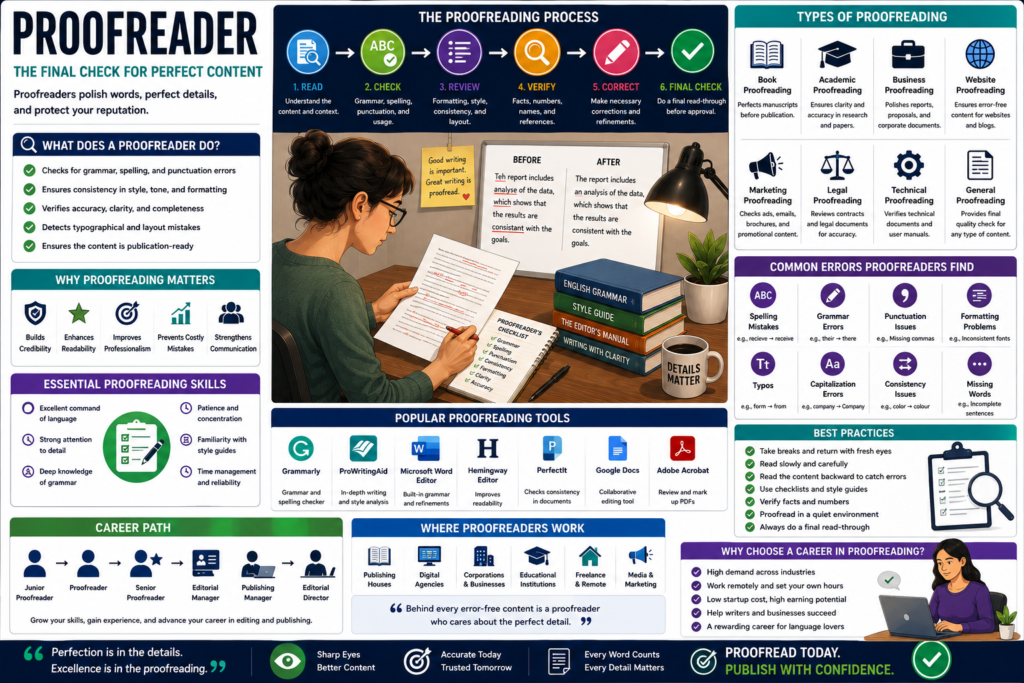
What Is a Proofreader?
A Proofreader is a language and quality assurance specialist responsible for reviewing written content to identify and correct errors before publication or distribution.
Proofreaders focus on:
- Grammar
- Spelling
- Punctuation
- Formatting
- Consistency
- Typography
- Minor language issues
Unlike editors who often restructure and improve content, proofreaders perform the final review stage to ensure the material is publication-ready.
Why Proofreading Matters
Improves Professionalism
Error-free content creates a strong and trustworthy impression.
Enhances Readability
Correct grammar and punctuation improve reading flow and comprehension.
Protects Brand Reputation
Mistakes can damage credibility and audience trust.
Prevents Costly Errors
Proofreading helps avoid publishing mistakes that may require expensive corrections.
Supports Clear Communication
Well-proofread content communicates ideas more effectively.
Responsibilities of a Proofreader
A professional proofreader typically:
- Reviews written documents
- Corrects spelling mistakes
- Identifies grammar issues
- Checks punctuation usage
- Verifies formatting consistency
- Reviews typography and layout
- Ensures style guide compliance
- Detects duplicate words and omissions
- Flags factual inconsistencies when necessary
- Performs final quality assurance checks
Types of Proofreading
Book Proofreading
Reviews manuscripts before publication.
Website Proofreading
Ensures web content is accurate and professional.
Academic Proofreading
Supports students, researchers, and educational institutions.
Business Proofreading
Reviews:
- Reports
- Presentations
- Proposals
- Internal communications
Marketing Proofreading
Checks advertising and promotional materials.
Legal Proofreading
Reviews contracts and legal documents for accuracy.
Technical Proofreading
Verifies technical documentation and product materials.
Proofreading vs Editing
Many people confuse proofreading with editing.
Editing
Focuses on:
- Structure
- Clarity
- Style
- Content improvement
- Readability
Proofreading
Focuses on:
- Grammar
- Spelling
- Punctuation
- Formatting
- Final corrections
Editing occurs before proofreading within the content production process.
The Proofreading Process
1. Initial Review
Reading the document carefully to understand context and purpose.
2. Grammar Check
Identifying grammatical errors and inconsistencies.
3. Spelling Verification
Correcting spelling mistakes and typos.
4. Punctuation Review
Ensuring proper punctuation usage.
5. Formatting Inspection
Checking:
- Fonts
- Headings
- Alignment
- Numbering
- Spacing
6. Consistency Check
Verifying uniform terminology and style.
7. Final Read-Through
Performing a complete final review before approval.
Essential Skills for Proofreaders
Exceptional Grammar Knowledge
Understanding language rules and conventions.
Attention to Detail
The ability to identify even the smallest errors.
Concentration
Maintaining focus while reviewing lengthy documents.
Time Management
Meeting deadlines without sacrificing quality.
Critical Thinking
Recognizing inconsistencies and potential issues.
Communication Skills
Providing clear feedback when necessary.
Patience
Careful review often requires multiple passes.
Common Errors Proofreaders Identify
Spelling Mistakes
Examples include:
- Typographical errors
- Misspelled words
- Incorrect word usage
Grammar Errors
Such as:
- Subject-verb agreement
- Tense inconsistencies
- Sentence fragments
Punctuation Issues
Including:
- Missing commas
- Incorrect apostrophes
- Quotation mark errors
Formatting Problems
Such as:
- Inconsistent headings
- Spacing errors
- Misaligned text
Consistency Issues
Examples include:
- Mixed terminology
- Inconsistent capitalization
- Style guide violations
Popular Proofreading Tools
Grammarly
Helps identify grammar, spelling, and clarity issues.
Microsoft Word Editor
Provides built-in proofreading assistance.
Google Docs
Supports collaborative review and editing.
ProWritingAid
Offers advanced writing and proofreading suggestions.
Hemingway Editor
Improves readability and sentence structure.
PerfectIt
Checks consistency and style guide compliance.
Adobe Acrobat
Useful for reviewing PDF documents.
Style Guides Used by Proofreaders
Many proofreaders follow established style guides.
AP Style
Common in journalism and media.
Chicago Manual of Style
Widely used in publishing.
APA Style
Frequently used in academic and scientific writing.
MLA Style
Common in education and humanities.
Company Style Guides
Many organizations maintain custom editorial standards.
Proofreading Best Practices
Take Breaks
Fresh eyes identify errors more effectively.
Read Slowly
Careful reading improves accuracy.
Review Multiple Times
Different review passes help identify different types of issues.
Read Aloud
Hearing content can reveal hidden mistakes.
Use Checklists
Systematic reviews improve consistency.
Eliminate Distractions
Focused environments improve proofreading quality.
Industries Hiring Proofreaders
Publishing
Books, magazines, and journals.
Marketing Agencies
Advertising and promotional content.
Education
Academic papers and learning materials.
Technology
Product documentation and knowledge bases.
Legal Services
Contracts and legal communications.
Corporate Communications
Internal and external business documents.
Career Path for Proofreaders
Junior Proofreader
Learns quality assurance standards and editorial processes.
Proofreader
Handles content reviews independently.
Senior Proofreader
Leads quality assurance efforts and mentors team members.
Copy Editor
Expands responsibilities beyond proofreading.
Editorial Manager
Oversees content review teams and workflows.
Publishing Manager
Leads publication quality and editorial standards.
Freelance Proofreading Opportunities
Many proofreaders choose freelance careers.
Benefits include:
- Remote work flexibility
- Global client opportunities
- Flexible schedules
- Multiple income streams
- Diverse project types
Freelancers often work with:
- Authors
- Businesses
- Agencies
- Publishers
- Students
- Online content creators
Future Trends in Proofreading
AI-Assisted Proofreading
Artificial intelligence tools increasingly support proofreading workflows.
Digital Publishing Growth
The demand for online content review continues expanding.
Multilingual Content Review
Global businesses require proofreading across multiple languages.
Remote Collaboration
Cloud-based workflows enable worldwide proofreading services.
Content Quality Assurance Expansion
Organizations place greater emphasis on content accuracy and trustworthiness.
Benefits of Becoming a Proofreader
- Flexible work opportunities
- Remote career options
- Strong demand for quality assurance
- Freelance potential
- Continuous learning
- Diverse industries
- Low startup costs
Proofreader vs Copy Editor
Proofreader
Performs final reviews and corrections before publication.
Copy Editor
Makes broader improvements related to style, clarity, consistency, and content quality.
Both roles are essential in producing professional and polished content.
Conclusion
Proofreaders are the final guardians of content quality. Through careful review, attention to detail, and strong language skills, they ensure written materials are accurate, consistent, and ready for publication.
As organizations continue producing large volumes of digital and print content, the demand for skilled Proofreaders remains strong. Professionals who master proofreading techniques, style guides, quality assurance processes, and modern editing tools can build rewarding careers while helping businesses and creators communicate with confidence and professionalism.