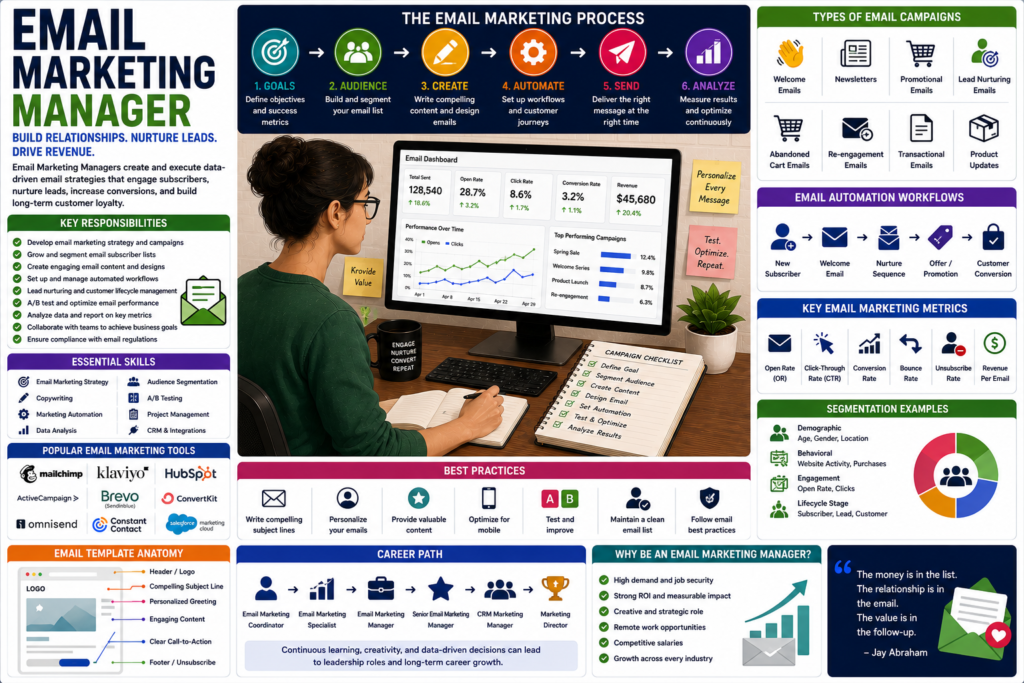
Introduction
Email marketing remains one of the most effective and profitable digital marketing channels available to businesses today. Despite the growth of social media, video marketing, and emerging technologies, email consistently delivers exceptional return on investment (ROI), making it a cornerstone of modern marketing strategies.
Behind successful email campaigns is the Email Marketing Manager—a professional responsible for planning, creating, executing, and optimizing email communications that engage audiences, generate leads, increase sales, and strengthen customer relationships.
As organizations continue investing in personalized marketing and customer retention strategies, Email Marketing Managers play an increasingly important role in driving business growth.
What Is an Email Marketing Manager?
An Email Marketing Manager is a digital marketing professional responsible for managing email marketing strategies and campaigns.
Their primary objectives include:
- Growing subscriber lists
- Nurturing leads
- Increasing conversions
- Improving customer retention
- Building customer loyalty
- Generating revenue
Email Marketing Managers combine strategy, content creation, automation, analytics, and customer insights to deliver effective email experiences.
Why Email Marketing Matters
High Return on Investment
Email marketing consistently ranks among the highest-performing marketing channels.
Direct Customer Communication
Brands can communicate directly with customers without relying on third-party platforms.
Personalized Experiences
Emails can be tailored to individual preferences and behaviors.
Customer Retention
Regular communication strengthens customer relationships.
Scalable Marketing
Automation allows businesses to communicate with thousands of subscribers efficiently.
Key Responsibilities of an Email Marketing Manager
Typical responsibilities include:
- Campaign planning
- Email copy creation
- Audience segmentation
- Marketing automation
- A/B testing
- Performance analysis
- CRM integration
- Lead nurturing
- Newsletter management
- Compliance monitoring
The Email Marketing Process
1. Goal Definition
Determine campaign objectives such as:
- Lead generation
- Product promotion
- Customer onboarding
- Retention
- Upselling
- Brand awareness
2. Audience Segmentation
Divide subscribers into relevant groups based on:
- Demographics
- Purchase history
- Engagement levels
- Customer behavior
- Interests
3. Content Creation
Develop compelling email content that provides value.
4. Design and Development
Create responsive and visually appealing email templates.
5. Automation Setup
Configure automated workflows and triggers.
6. Testing
Perform quality assurance and A/B testing.
7. Launch
Send campaigns to targeted audiences.
8. Performance Analysis
Measure results and optimize future campaigns.
Essential Skills for Email Marketing Managers
Marketing Strategy
Understanding customer journeys and campaign objectives.
Copywriting
Writing persuasive subject lines and email content.
Data Analysis
Interpreting performance metrics and campaign results.
Automation Expertise
Building scalable marketing workflows.
Customer Psychology
Understanding audience motivations and behaviors.
Project Management
Managing multiple campaigns simultaneously.
Communication
Collaborating with marketing, sales, and design teams.
Types of Email Marketing Campaigns
Welcome Emails
Introduce new subscribers to the brand.
Newsletter Campaigns
Provide updates, news, and valuable content.
Promotional Emails
Highlight offers, discounts, and product launches.
Lead Nurturing Campaigns
Guide prospects through the sales funnel.
Abandoned Cart Emails
Encourage customers to complete purchases.
Re-Engagement Campaigns
Reconnect with inactive subscribers.
Transactional Emails
Deliver order confirmations, receipts, and account updates.
Audience Segmentation
Segmentation is critical for email marketing success.
Common segmentation methods include:
Demographic Segmentation
Based on age, location, gender, and occupation.
Behavioral Segmentation
Based on website activity and purchase behavior.
Engagement Segmentation
Based on email opens and clicks.
Customer Lifecycle Segmentation
Based on where users are in the buying journey.
Targeted campaigns typically outperform generic email blasts.
Marketing Automation
Automation allows businesses to deliver timely and relevant communications.
Popular automated workflows include:
- Welcome series
- Lead nurturing sequences
- Cart abandonment emails
- Customer onboarding
- Product recommendations
- Re-engagement campaigns
Automation improves efficiency and customer experience.
Email Personalization
Modern consumers expect personalized communication.
Personalization techniques include:
- First-name usage
- Product recommendations
- Dynamic content
- Behavioral triggers
- Personalized offers
Personalized emails often achieve higher engagement rates.
Key Email Marketing Metrics
Open Rate
Percentage of recipients who open emails.
Click-Through Rate (CTR)
Percentage of recipients who click links.
Conversion Rate
Percentage of recipients who complete desired actions.
Bounce Rate
Percentage of undelivered emails.
Unsubscribe Rate
Percentage of users leaving the mailing list.
Revenue Per Email
Measures campaign profitability.
Tracking these metrics helps improve future performance.
A/B Testing in Email Marketing
Email Marketing Managers frequently test:
Subject Lines
Determine which headlines generate more opens.
Call-to-Action Buttons
Optimize clicks and conversions.
Email Layouts
Improve readability and engagement.
Send Times
Identify the most effective delivery schedules.
Personalization Elements
Measure audience response to tailored content.
Testing helps maximize campaign effectiveness.
Popular Email Marketing Tools
Mailchimp
Widely used email marketing platform.
Klaviyo
Popular for e-commerce email automation.
HubSpot
Combines CRM and marketing automation capabilities.
ActiveCampaign
Advanced automation and customer journey management.
ConvertKit
Popular among creators and online businesses.
Brevo (formerly Sendinblue)
Provides email and SMS marketing solutions.
Salesforce Marketing Cloud
Enterprise-level marketing automation platform.
Career Path for Email Marketing Managers
Marketing Assistant
Supports campaign execution and reporting.
Email Marketing Specialist
Manages campaigns and automation workflows.
Email Marketing Manager
Leads email strategy and performance optimization.
Senior Email Marketing Manager
Oversees larger programs and teams.
CRM Marketing Manager
Manages customer lifecycle marketing initiatives.
Digital Marketing Manager
Oversees multiple marketing channels.
Marketing Director
Leads organizational marketing strategy.
Industries Hiring Email Marketing Managers
E-Commerce
Driving sales and customer retention.
SaaS Companies
Supporting lead generation and onboarding.
Financial Services
Communicating products and customer updates.
Healthcare
Providing educational and appointment-related communications.
Education
Promoting courses and student engagement.
Technology
Supporting product adoption and customer success.
Best Practices for Email Marketing
Focus on Value
Provide useful and relevant content.
Segment Audiences
Deliver targeted messages.
Optimize for Mobile
Most emails are opened on mobile devices.
Test Continuously
Use A/B testing to improve results.
Maintain Clean Lists
Remove inactive or invalid subscribers.
Respect Privacy Regulations
Follow GDPR, CAN-SPAM, and other compliance requirements.
Future Trends in Email Marketing
Artificial Intelligence
AI assists with personalization, content creation, and optimization.
Predictive Analytics
Marketers increasingly use data to anticipate customer behavior.
Interactive Emails
Interactive experiences improve engagement.
Hyper-Personalization
Advanced segmentation creates highly relevant experiences.
Omnichannel Integration
Email increasingly works alongside SMS, social media, and CRM platforms.
Privacy-First Marketing
Compliance and data protection continue gaining importance.
Benefits of Becoming an Email Marketing Manager
- High demand across industries
- Strong earning potential
- Remote work opportunities
- Data-driven decision making
- Creative and strategic work
- Career advancement opportunities
- Direct impact on business growth
Conclusion
Email Marketing Managers are essential professionals in modern digital marketing. By combining strategy, automation, personalization, and analytics, they help businesses build stronger customer relationships and drive measurable results.
As organizations continue focusing on customer retention and personalized experiences, skilled Email Marketing Managers will remain highly valuable. Professionals who master automation platforms, audience segmentation, analytics, and customer engagement strategies can build successful and rewarding careers in this growing field.