Introduction
Technology plays a central role in modern businesses, and when systems, software, or hardware fail, organizations rely on Technical Support Specialists to resolve issues quickly and efficiently. These professionals serve as the first line of defense against technical problems, helping users maintain productivity and ensuring business operations continue smoothly.
Technical Support Specialists combine technical knowledge, problem-solving skills, and customer service expertise to assist users with software, hardware, networking, and system-related issues. They are essential members of IT departments, software companies, managed service providers, and technology organizations worldwide.
As businesses continue adopting cloud computing, remote work solutions, cybersecurity tools, and advanced software systems, the demand for skilled Technical Support Specialists continues to grow.
What Is a Technical Support Specialist?
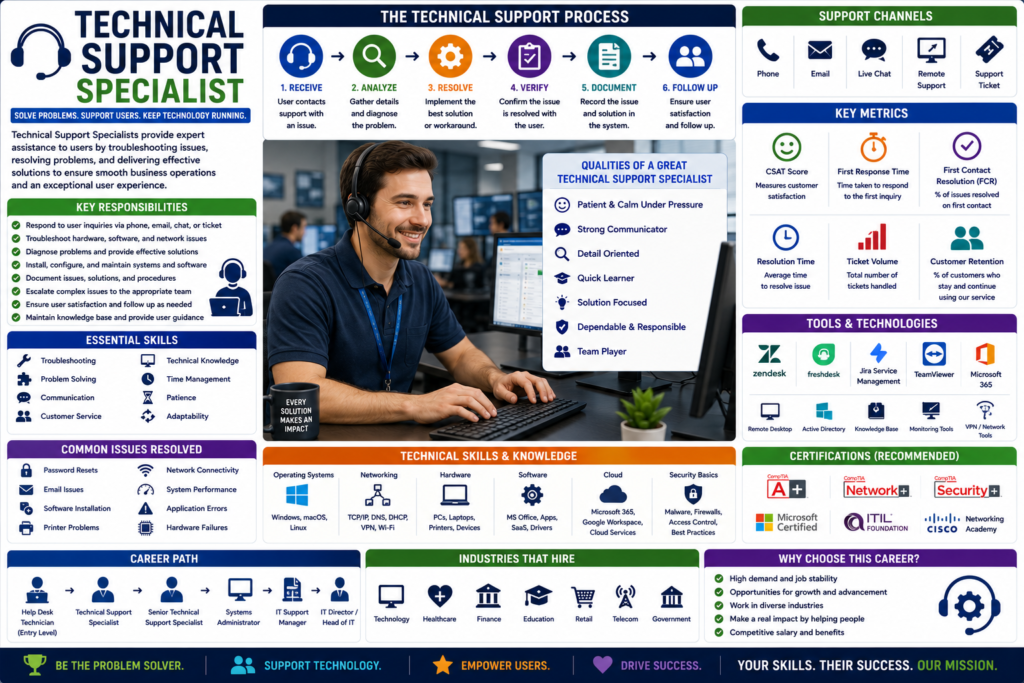
A Technical Support Specialist is an IT professional responsible for diagnosing, troubleshooting, and resolving technical issues for users, customers, or employees.
Their primary responsibilities include:
- Troubleshooting hardware issues
- Resolving software problems
- Assisting users with technical questions
- Managing support tickets
- Configuring systems and devices
- Supporting networks and connectivity
- Documenting solutions
- Escalating complex issues
- Maintaining IT systems
- Providing remote support
Technical Support Specialists help ensure technology operates effectively and efficiently.
Why Technical Support Specialists Are Important
Minimize Downtime
Quick issue resolution keeps employees productive.
Improve Customer Satisfaction
Fast and effective support enhances user experiences.
Protect Business Operations
Reliable technical support prevents disruptions.
Reduce Technology Costs
Proper maintenance helps avoid expensive repairs and downtime.
Support Digital Transformation
Technical support teams help organizations adopt new technologies successfully.
Key Responsibilities
Troubleshooting Technical Issues
Diagnosing and resolving software, hardware, and network problems.
Help Desk Support
Responding to support requests through:
- Phone
- Live chat
- Ticketing systems
System Configuration
Setting up devices, software, and user accounts.
User Assistance
Guiding users through technical solutions and best practices.
Documentation
Recording issues, solutions, and support procedures.
Escalation Management
Forwarding complex issues to advanced support teams when necessary.
Types of Technical Support
Help Desk Support
Provides first-level assistance for common technical issues.
Desktop Support
Supports computers, laptops, printers, and workplace technology.
Network Support
Maintains connectivity and network performance.
Software Support
Assists users with applications and software systems.
Hardware Support
Troubleshoots physical device issues.
Remote Technical Support
Provides assistance through remote access tools.
Customer Technical Support
Supports external customers using products or services.
The Technical Support Process
1. Receive the Request
Users submit issues through a ticketing system, phone call, or email.
2. Gather Information
Understand symptoms, environment, and error messages.
3. Diagnose the Problem
Identify the root cause of the issue.
4. Implement a Solution
Apply fixes or provide guidance.
5. Verify Resolution
Confirm the issue has been resolved.
6. Document the Case
Record actions taken and outcomes.
7. Follow Up
Ensure user satisfaction and prevent recurring issues.
Essential Skills for Technical Support Specialists
Technical Troubleshooting
The ability to identify and solve technical issues efficiently.
Communication Skills
Explaining technical concepts in simple terms.
Customer Service
Providing professional and helpful support experiences.
Problem Solving
Analyzing issues and finding practical solutions.
Patience
Working with users who may have varying levels of technical knowledge.
Time Management
Managing multiple support requests simultaneously.
Adaptability
Learning new technologies and systems quickly.
Technical Knowledge Areas
Successful Technical Support Specialists often understand:
Operating Systems
- Windows
- macOS
- Linux
Networking
- TCP/IP
- DNS
- DHCP
- VPNs
- Wi-Fi troubleshooting
Hardware
- Computers
- Printers
- Mobile devices
- Servers
Software Applications
- Productivity tools
- Business applications
- SaaS platforms
Cloud Technologies
- Microsoft 365
- Google Workspace
- Cloud storage systems
Common Technical Issues
Technical Support Specialists frequently resolve:
Password Resets
Helping users regain account access.
Software Installation Problems
Resolving compatibility and setup issues.
Network Connectivity Issues
Diagnosing internet and network failures.
Printer Problems
Addressing hardware and driver-related issues.
Email Issues
Resolving configuration and delivery problems.
Performance Problems
Improving slow systems and applications.
Support Tools and Technologies
Ticketing Systems
Popular platforms include:
- Zendesk
- Freshdesk
- Jira Service Management
- ServiceNow
Remote Access Tools
- TeamViewer
- AnyDesk
- Remote Desktop
- LogMeIn
Monitoring Tools
Track system performance and availability.
Knowledge Bases
Provide documentation and self-service resources.
CRM Systems
Manage customer support interactions.
Technical Support Certifications
Professional certifications can improve career opportunities.
CompTIA A+
Foundational IT support certification.
CompTIA Network+
Networking fundamentals certification.
CompTIA Security+
Cybersecurity knowledge certification.
Microsoft Certifications
Focus on Microsoft technologies and cloud platforms.
ITIL Foundation
Service management and support best practices.
Cisco Certifications
Networking and infrastructure expertise.
Key Performance Metrics
First Response Time
Measures how quickly support responds.
Resolution Time
Tracks issue resolution speed.
First Contact Resolution (FCR)
Percentage of issues resolved during the first interaction.
Customer Satisfaction (CSAT)
Measures user satisfaction with support.
Ticket Volume
Number of support requests handled.
Service Level Agreement (SLA) Compliance
Measures adherence to support commitments.
Career Path for Technical Support Specialists
Help Desk Technician
Entry-level technical support role.
Technical Support Specialist
Handles technical issues independently.
Senior Technical Support Specialist
Supports complex environments and mentors colleagues.
Systems Administrator
Manages servers and IT infrastructure.
Network Administrator
Focuses on networking technologies.
IT Manager
Leads IT operations and support teams.
IT Director
Oversees organizational technology strategy.
Industries Hiring Technical Support Specialists
Technology Companies
Supporting software and cloud platforms.
Healthcare
Maintaining healthcare technology systems.
Financial Services
Supporting banking and financial technology.
Education
Managing educational technology environments.
Telecommunications
Supporting communication infrastructure.
Government
Maintaining public-sector technology systems.
Best Practices for Technical Support
Listen Carefully
Understand the problem before troubleshooting.
Document Everything
Maintain accurate records and procedures.
Prioritize Customer Experience
Technical solutions should also provide positive user experiences.
Continue Learning
Technology evolves constantly.
Communicate Clearly
Avoid unnecessary technical jargon.
Follow Established Processes
Consistent procedures improve support quality.
Future Trends in Technical Support
Artificial Intelligence
AI-powered support assistants automate routine tasks.
Remote Support Expansion
Remote work increases demand for virtual assistance.
Cloud-Based Support
Cloud technologies continue transforming IT operations.
Self-Service Portals
Knowledge bases reduce repetitive support requests.
Cybersecurity Integration
Support teams increasingly assist with security-related issues.
Automation
Routine troubleshooting becomes more automated.
Benefits of Becoming a Technical Support Specialist
- High global demand
- Remote work opportunities
- Strong career growth potential
- Entry point into IT careers
- Valuable technical skills
- Diverse industry opportunities
- Competitive salaries
Conclusion
Technical Support Specialists play a crucial role in maintaining technology systems, assisting users, and ensuring business continuity. Through troubleshooting expertise, communication skills, and customer-focused service, they help organizations maximize the value of their technology investments.
As businesses become increasingly dependent on digital systems, skilled Technical Support Specialists will remain highly valuable. Professionals who combine technical knowledge, certifications, problem-solving abilities, and excellent customer service can build rewarding careers in the growing field of information technology.