Introduction
Technology is the backbone of modern businesses, and when systems fail, productivity can come to a halt. Whether it’s a forgotten password, a network outage, a software error, or a hardware malfunction, organizations rely on Help Desk Technicians to keep operations running smoothly.
Help Desk Technicians are often the first point of contact for employees, customers, and users experiencing technical problems. They play a critical role in diagnosing issues, providing solutions, maintaining IT systems, and ensuring users receive the support they need.
As businesses continue to expand their reliance on technology, cloud services, remote work environments, and cybersecurity tools, the demand for skilled Help Desk Technicians continues to grow. This role provides an excellent entry point into the information technology industry while offering numerous opportunities for career advancement.
What Is a Help Desk Technician?
A Help Desk Technician is an IT professional responsible for providing technical support and assistance to users experiencing hardware, software, network, or system-related issues.
Their primary objective is to resolve technical problems quickly and efficiently while maintaining a positive user experience.
Typical responsibilities include:
- Troubleshooting technical issues
- Responding to support tickets
- Installing software and hardware
- Managing user accounts
- Resetting passwords
- Diagnosing network problems
- Assisting with device setup
- Escalating complex issues
- Maintaining documentation
- Supporting business operations
Help Desk Technicians serve as the frontline support team within an organization’s IT department.
Why Help Desk Technicians Are Important
Ensure Business Continuity
Technical issues can disrupt workflows and reduce productivity. Help Desk Technicians help minimize downtime.
Improve User Experience
Fast and effective support increases employee and customer satisfaction.
Maintain Technology Systems
Regular support and maintenance help prevent larger technical issues.
Enhance Security
Technicians assist with account management, software updates, and security best practices.
Support Digital Transformation
Organizations depend on technical support teams when implementing new technologies.
Key Responsibilities of a Help Desk Technician
Technical Support
Providing assistance through:
- Phone support
- Email support
- Live chat
- Ticketing systems
- Remote access tools
Troubleshooting
Diagnosing and resolving:
- Software errors
- Hardware failures
- Connectivity issues
- Application problems
- Operating system errors
User Account Management
Managing:
- Password resets
- User permissions
- Account creation
- Access control
Device Setup
Configuring:
- Computers
- Laptops
- Mobile devices
- Printers
- Peripheral equipment
Documentation
Recording issues and solutions for future reference.
Escalation
Forwarding advanced issues to specialized IT teams when necessary.
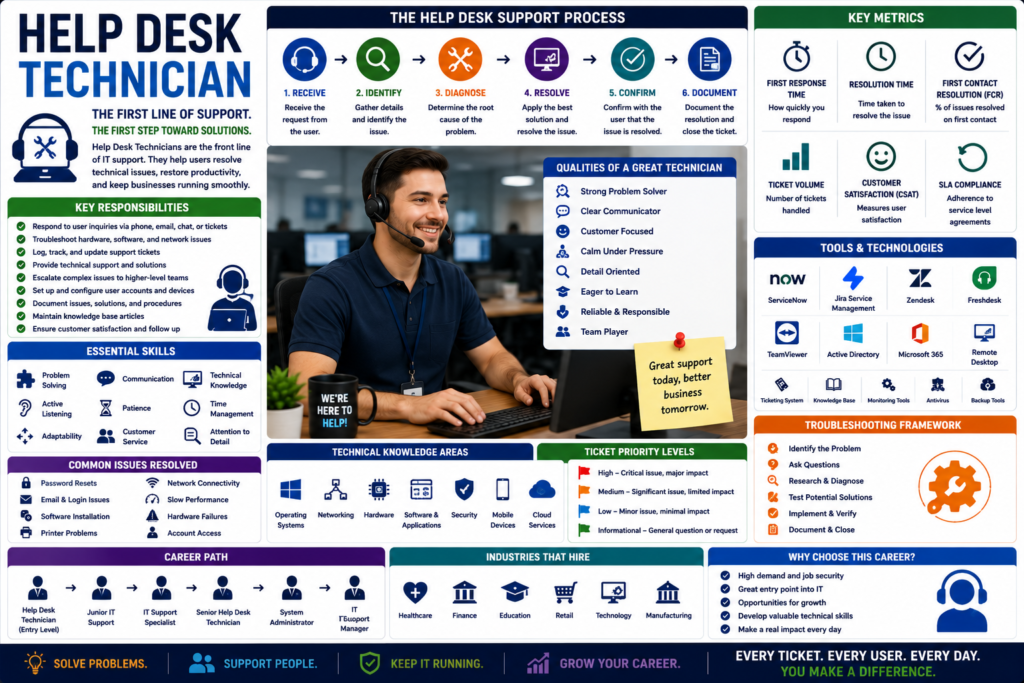
The Help Desk Support Process
1. Receive the Request
Users report technical problems through support channels.
2. Gather Information
The technician collects details about the issue.
3. Diagnose the Problem
Determine the root cause of the issue.
4. Implement a Solution
Apply corrective actions or provide guidance.
5. Verify Resolution
Confirm the issue has been resolved successfully.
6. Document the Outcome
Update records and close the support ticket.
Essential Skills for Help Desk Technicians
Technical Troubleshooting
The ability to identify and resolve IT issues efficiently.
Communication Skills
Explaining technical concepts in simple terms.
Customer Service
Delivering professional and helpful support experiences.
Problem Solving
Analyzing situations and finding practical solutions.
Time Management
Handling multiple support requests effectively.
Adaptability
Learning and supporting new technologies.
Attention to Detail
Accurately documenting issues and solutions.
Technical Knowledge Areas
Successful Help Desk Technicians typically understand:
Operating Systems
- Microsoft Windows
- macOS
- Linux
Networking
- TCP/IP
- DNS
- DHCP
- VPNs
- Wi-Fi troubleshooting
Hardware
- Desktops
- Laptops
- Printers
- Mobile devices
- Peripheral equipment
Software Applications
- Microsoft Office
- Google Workspace
- Business applications
- Cloud-based software
Security Fundamentals
- User authentication
- Access control
- Malware prevention
- Security updates
Common Issues Handled by Help Desk Technicians
Password Resets
One of the most common support requests.
Software Installation Problems
Resolving compatibility and configuration issues.
Printer Issues
Diagnosing connectivity and driver-related problems.
Email Problems
Fixing login, configuration, and delivery issues.
Network Connectivity Issues
Troubleshooting internet and network access.
System Performance Problems
Improving slow devices and applications.
Hardware Failures
Identifying defective components and equipment.
Help Desk Tools and Technologies
Ticketing Systems
Popular platforms include:
- ServiceNow
- Zendesk
- Freshdesk
- Jira Service Management
Remote Support Software
- TeamViewer
- AnyDesk
- Remote Desktop
- LogMeIn
Monitoring Tools
Used to monitor system health and performance.
Knowledge Bases
Store troubleshooting procedures and support documentation.
CRM Platforms
Manage customer interactions and support histories.
Certifications for Help Desk Technicians
Professional certifications can improve employment opportunities and earning potential.
CompTIA A+
The most recognized entry-level IT certification.
CompTIA Network+
Focuses on networking fundamentals.
CompTIA Security+
Introduces cybersecurity concepts and best practices.
Microsoft Certifications
Demonstrate expertise with Microsoft technologies.
Google IT Support Professional Certificate
Provides foundational IT support knowledge.
ITIL Foundation
Focuses on IT service management processes.
Help Desk Technician vs Technical Support Specialist
Help Desk Technician
Typically provides first-line support and resolves common issues.
Technical Support Specialist
Handles more advanced technical problems and specialized systems.
Help Desk positions often serve as stepping stones toward advanced IT careers.
Key Performance Metrics
First Response Time
Measures how quickly support responds to requests.
Resolution Time
Tracks the speed of issue resolution.
First Contact Resolution (FCR)
Percentage of issues resolved during the initial interaction.
Customer Satisfaction (CSAT)
Measures user satisfaction with support services.
Ticket Volume
Tracks the number of support requests handled.
SLA Compliance
Measures adherence to service-level agreements.
Career Path for Help Desk Technicians
Help Desk Technician
Entry-level support role.
Senior Help Desk Technician
Handles more complex technical issues.
IT Support Specialist
Provides broader infrastructure and systems support.
Systems Administrator
Manages servers and enterprise systems.
Network Administrator
Focuses on networking infrastructure.
Cybersecurity Analyst
Protects organizational systems and data.
IT Manager
Leads technology teams and operations.
IT Director
Oversees organizational IT strategy.
Industries Hiring Help Desk Technicians
Technology Companies
Supporting software products and services.
Healthcare
Maintaining healthcare information systems.
Education
Supporting students, faculty, and administrative staff.
Financial Services
Managing secure technology environments.
Government Agencies
Maintaining public-sector technology infrastructure.
Manufacturing
Supporting operational technology and business systems.
Retail
Managing point-of-sale and business applications.
Best Practices for Help Desk Success
Listen Carefully
Understanding the issue is the first step toward solving it.
Stay Patient
Users often experience stress during technical problems.
Document Everything
Good documentation improves future support efforts.
Continue Learning
Technology evolves constantly.
Follow Processes
Consistent procedures improve service quality.
Focus on User Satisfaction
Technical support should always prioritize the user experience.
Future Trends in Help Desk Support
Artificial Intelligence
AI-powered chatbots and virtual assistants automate routine requests.
Remote Support Expansion
Remote work increases demand for virtual IT assistance.
Cloud-Based Infrastructure
Organizations continue migrating to cloud technologies.
Automation
Routine support tasks become increasingly automated.
Cybersecurity Integration
Help Desk teams play larger roles in security awareness and incident response.
Self-Service Portals
Knowledge bases and automated solutions reduce ticket volume.
Benefits of Becoming a Help Desk Technician
- Excellent entry point into IT
- High demand worldwide
- Opportunities for remote work
- Strong career growth potential
- Valuable technical experience
- Diverse industry opportunities
- Competitive salaries and benefits
Conclusion
Help Desk Technicians are essential to modern organizations, providing the technical support that keeps systems running and users productive. Through troubleshooting expertise, communication skills, and customer-focused service, they ensure technology remains a valuable business asset rather than an obstacle.
As businesses continue expanding their digital operations, skilled Help Desk Technicians will remain in high demand. Professionals who develop strong technical knowledge, earn industry certifications, and continuously improve their skills can build rewarding and successful careers in information technology.