Introduction
In today’s data-driven business environment, organizations constantly seek ways to improve efficiency, reduce costs, increase profitability, and deliver better customer experiences. Bridging the gap between business objectives and technological solutions is the Business Analyst.
Business Analysts play a critical role in helping organizations understand challenges, identify opportunities, gather requirements, analyze data, and recommend solutions that support strategic goals. They work closely with stakeholders, management teams, developers, project managers, and end-users to ensure that business needs are translated into actionable solutions.
As companies continue investing in digital transformation, process optimization, and data-driven strategies, Business Analysts remain among the most valuable professionals across multiple industries.
This guide explores the responsibilities, skills, methodologies, tools, certifications, and career opportunities associated with the Business Analyst profession.
What Is a Business Analyst?
A Business Analyst (BA) is a professional who analyzes business processes, identifies needs, evaluates solutions, and helps organizations improve performance.
Their primary objective is to ensure that business challenges are clearly understood and that solutions deliver measurable value.
Business Analysts often act as a bridge between:
- Business stakeholders
- Executive leadership
- IT teams
- Product managers
- Developers
- Customers
- Project managers
By translating business requirements into actionable plans, Business Analysts help organizations achieve strategic objectives more efficiently.
Why Business Analysts Are Important
Improve Business Efficiency
Business Analysts identify inefficiencies and recommend process improvements.
Support Better Decision-Making
Data-driven insights help leaders make informed business decisions.
Reduce Project Risks
Clear requirements minimize misunderstandings and costly project failures.
Enhance Customer Satisfaction
Solutions are designed around customer and business needs.
Drive Digital Transformation
Business Analysts help organizations successfully adopt new technologies.
Key Responsibilities of a Business Analyst
Requirements Gathering
Collecting and documenting business needs from stakeholders.
Process Analysis
Evaluating existing workflows and identifying improvement opportunities.
Data Analysis
Using data to uncover trends, opportunities, and business insights.
Stakeholder Management
Facilitating communication between technical and business teams.
Solution Evaluation
Assessing whether proposed solutions meet business requirements.
Documentation
Creating business requirements documents and process maps.
Change Management Support
Helping organizations adapt to new processes and systems.
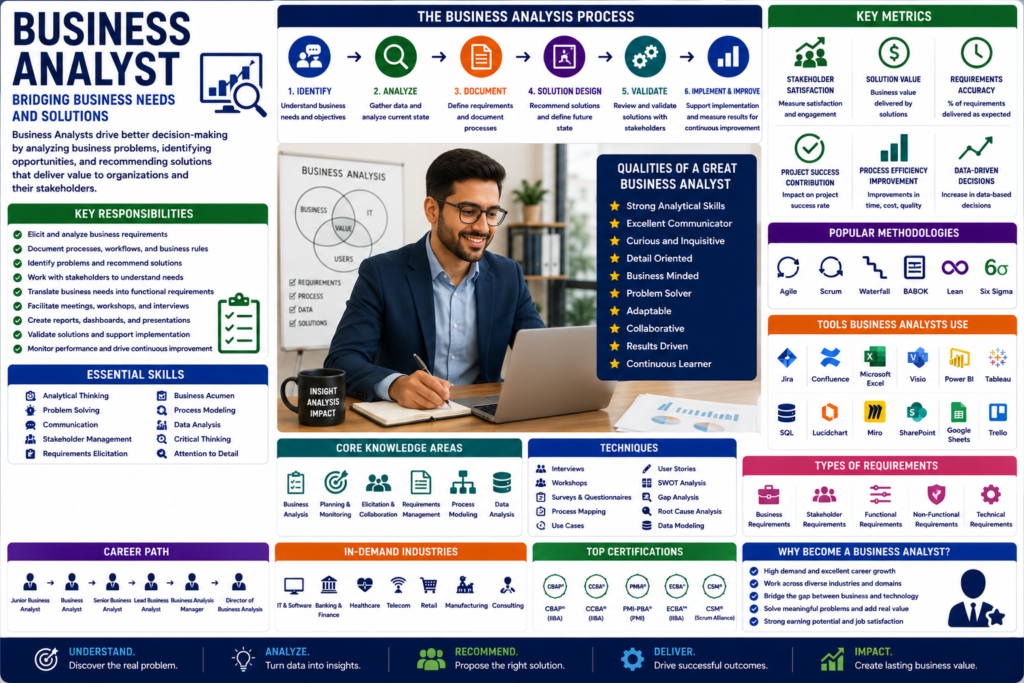
The Business Analysis Process
1. Identify Business Needs
Understand organizational goals and challenges.
2. Gather Requirements
Conduct interviews, workshops, and stakeholder meetings.
3. Analyze Current Processes
Evaluate existing workflows and systems.
4. Define Future State
Recommend improved business processes and solutions.
5. Validate Requirements
Ensure stakeholder alignment and approval.
6. Support Implementation
Collaborate with project teams during development and deployment.
7. Measure Results
Evaluate whether business objectives have been achieved.
Essential Skills for Business Analysts
Analytical Thinking
The ability to evaluate information and identify patterns.
Communication Skills
Clearly communicating ideas to technical and non-technical audiences.
Problem Solving
Identifying root causes and recommending effective solutions.
Critical Thinking
Assessing options and making logical recommendations.
Stakeholder Management
Building relationships and facilitating collaboration.
Documentation Skills
Creating detailed and accurate requirements.
Adaptability
Working effectively in changing business environments.
Requirements Gathering Techniques
Requirements gathering is one of the most important BA responsibilities.
Common techniques include:
Stakeholder Interviews
One-on-one discussions to understand needs and objectives.
Workshops
Collaborative sessions involving multiple stakeholders.
Surveys and Questionnaires
Collecting information from larger groups.
Observation
Analyzing real-world business operations.
Document Analysis
Reviewing existing policies, procedures, and systems.
Prototyping
Creating visual representations of proposed solutions.
Business Process Analysis
Business Analysts frequently evaluate processes to improve efficiency.
Areas of focus include:
- Workflow optimization
- Cost reduction
- Productivity improvements
- Risk mitigation
- Automation opportunities
- Customer experience enhancements
Process analysis helps organizations operate more effectively and competitively.
Business Analysis Methodologies
Agile Business Analysis
Supports iterative development and continuous feedback.
Waterfall Analysis
Follows a structured and sequential approach.
Lean Methodology
Focuses on eliminating waste and improving efficiency.
Six Sigma
Uses data-driven techniques to improve quality and performance.
Business Process Management (BPM)
Focuses on designing and optimizing workflows.
Data Analysis in Business Analysis
Modern Business Analysts rely heavily on data.
Key responsibilities include:
Data Collection
Gathering relevant business information.
Data Interpretation
Identifying patterns and trends.
Performance Analysis
Measuring operational effectiveness.
Reporting
Presenting findings to stakeholders.
Forecasting
Predicting future business outcomes.
Data analysis enables evidence-based decision-making.
Business Analyst Deliverables
Typical outputs created by Business Analysts include:
Business Requirements Document (BRD)
Defines business needs and objectives.
Functional Requirements Document (FRD)
Details system functionality requirements.
User Stories
Common in Agile projects.
Process Maps
Visual representations of workflows.
Gap Analysis Reports
Identify differences between current and desired states.
Use Cases
Describe user interactions with systems.
Business Analysis Tools
Microsoft Excel
Widely used for analysis and reporting.
Microsoft Power BI
Business intelligence and data visualization platform.
Tableau
Advanced analytics and reporting tool.
Jira
Requirements and Agile project management.
Confluence
Documentation and collaboration.
Lucidchart
Process mapping and workflow diagrams.
Visio
Business process and system diagrams.
SQL
Database querying and data analysis.
Stakeholder Management
Business Analysts interact with many stakeholders, including:
- Executives
- Department managers
- Customers
- Developers
- Product owners
- Project managers
Successful stakeholder management requires:
- Clear communication
- Active listening
- Negotiation
- Conflict resolution
- Relationship building
Business Analyst vs Project Manager
Business Analyst
Focuses on understanding requirements and defining solutions.
Project Manager
Focuses on project delivery, timelines, budgets, and execution.
While these roles often collaborate closely, their responsibilities differ significantly.
Business Analyst vs Product Manager
Business Analyst
Analyzes business needs and requirements.
Product Manager
Defines product vision, strategy, and market direction.
Business Analysts typically focus more on requirements and processes, while Product Managers focus on product outcomes.
Certifications for Business Analysts
Professional certifications can strengthen credibility and career opportunities.
CBAP (Certified Business Analysis Professional)
Highly respected certification from IIBA.
CCBA (Certification of Capability in Business Analysis)
Mid-level business analysis certification.
PMI-PBA
Business analysis certification from PMI.
Agile Analysis Certification
Supports Agile project environments.
Six Sigma Certifications
Useful for process improvement roles.
Scrum Certifications
Beneficial for Agile Business Analysts.
Industries Hiring Business Analysts
Technology
Supporting software and digital transformation projects.
Financial Services
Analyzing banking and financial processes.
Healthcare
Improving operational and patient-care systems.
Retail and E-Commerce
Optimizing customer experiences and operations.
Manufacturing
Improving production processes and efficiency.
Government
Supporting policy and technology initiatives.
Telecommunications
Enhancing service delivery and infrastructure projects.
Career Path for Business Analysts
Junior Business Analyst
Supports analysis and documentation activities.
Business Analyst
Manages requirements and process improvement initiatives.
Senior Business Analyst
Leads complex projects and stakeholder engagements.
Lead Business Analyst
Supervises analysis teams and large-scale initiatives.
Business Architect
Designs enterprise-level business frameworks.
Product Manager
Leverages business expertise to manage products.
Director of Business Analysis
Oversees organizational analysis practices.
Chief Operating Officer (COO)
Executive leadership role focused on operational excellence.
Best Practices for Business Analysts
Understand Business Goals
Align solutions with organizational objectives.
Ask the Right Questions
Thoroughly explore requirements and challenges.
Use Data Effectively
Support recommendations with evidence.
Communicate Clearly
Ensure stakeholder understanding and alignment.
Document Accurately
Create comprehensive and actionable requirements.
Focus on Value
Prioritize solutions that deliver measurable business outcomes.
Future Trends in Business Analysis
Artificial Intelligence
AI assists with data analysis and decision support.
Automation
Business Analysts increasingly identify automation opportunities.
Data-Driven Organizations
Analytics become central to business operations.
Digital Transformation
Organizations continue modernizing systems and processes.
Agile Business Analysis
Agile practices become increasingly common.
Business Intelligence Expansion
Demand for data insights continues growing.
Benefits of Becoming a Business Analyst
- High demand across industries
- Strong earning potential
- Diverse career opportunities
- Strategic business impact
- Opportunities for leadership growth
- Continuous learning and development
- Strong job stability
Conclusion
Business Analysts play a critical role in helping organizations solve problems, improve processes, and achieve strategic objectives. By combining analytical thinking, communication skills, business knowledge, and data-driven decision-making, they help organizations adapt and thrive in competitive markets.
As businesses continue embracing digital transformation and data-driven operations, skilled Business Analysts will remain highly valuable. Professionals who master requirements gathering, process improvement, stakeholder management, and analytics can build rewarding careers while making a significant impact on organizational success.