Introduction
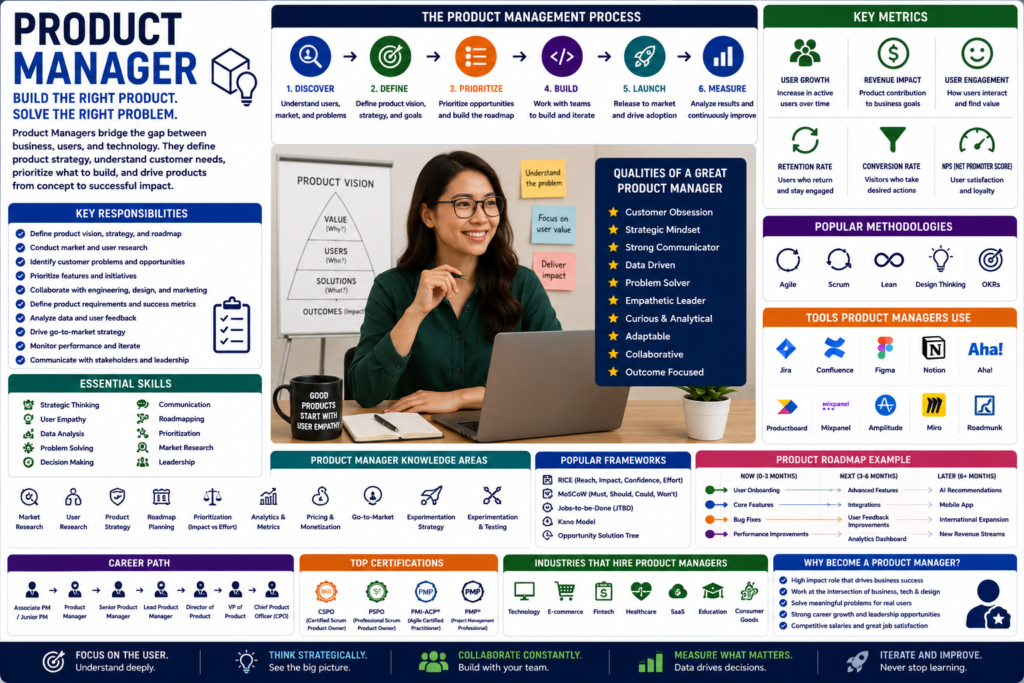
In today’s fast-paced digital economy, successful products do not happen by accident. Behind every popular software application, mobile app, online platform, or innovative consumer product is a Product Manager guiding its vision, strategy, and execution.
Product Managers play a critical role in connecting customer needs with business objectives. They work closely with designers, engineers, marketers, executives, and customers to ensure products solve real problems and deliver measurable value.
As organizations increasingly focus on innovation, customer experience, and digital transformation, Product Managers have become some of the most sought-after professionals in technology and business.
This guide explores the responsibilities, skills, tools, methodologies, certifications, and career opportunities associated with the Product Manager profession.
What Is a Product Manager?
A Product Manager (PM) is responsible for defining, developing, and managing products throughout their lifecycle.
Their primary goal is to ensure that products meet customer needs while supporting business objectives and generating value for stakeholders.
Product Managers often act as the bridge between:
- Customers
- Engineering teams
- Design teams
- Marketing departments
- Sales organizations
- Executive leadership
They are responsible for making strategic decisions that influence product direction and success.
Why Product Managers Are Important
Align Business and Customer Needs
Product Managers ensure products solve real customer problems while supporting company goals.
Drive Innovation
They identify opportunities for new features, products, and market expansion.
Improve Customer Experience
PMs focus on creating products that deliver meaningful value.
Coordinate Cross-Functional Teams
They bring together multiple departments to achieve shared objectives.
Maximize Business Growth
Successful products generate revenue, customer loyalty, and competitive advantages.
Key Responsibilities of a Product Manager
Product Strategy
Developing long-term plans and product vision.
Market Research
Understanding customer needs, industry trends, and competitor activities.
Product Roadmapping
Creating strategic plans that guide product development.
Stakeholder Management
Aligning business leaders, teams, and customers around priorities.
Feature Prioritization
Deciding which features deliver the most value.
Product Launches
Coordinating successful releases and go-to-market strategies.
Performance Analysis
Measuring product success through key metrics.
The Product Management Lifecycle
1. Discovery
Understanding market opportunities and customer needs.
Activities include:
- Customer interviews
- User research
- Competitor analysis
- Data analysis
2. Product Planning
Defining goals, features, and success metrics.
3. Product Development
Collaborating with engineering and design teams.
4. Product Launch
Introducing products or features to customers.
5. Growth and Optimization
Improving performance through ongoing iteration.
6. Product Retirement
Managing end-of-life strategies when necessary.
Essential Skills for Product Managers
Strategic Thinking
Understanding long-term business goals and opportunities.
Communication
Working effectively with stakeholders and teams.
Leadership
Influencing without direct authority.
Problem Solving
Identifying and solving customer challenges.
Analytical Skills
Using data to make informed decisions.
Customer Empathy
Understanding user needs and pain points.
Prioritization
Balancing competing demands and limited resources.
Product Strategy
Product strategy provides direction for the entire organization.
A strong strategy answers:
- Who are our customers?
- What problems are we solving?
- Why does our product matter?
- How will we compete?
- What outcomes are we pursuing?
Successful Product Managers continually refine product strategies based on changing market conditions.
Product Roadmaps
A product roadmap outlines future plans and priorities.
Roadmaps help:
- Align stakeholders
- Communicate strategy
- Prioritize development efforts
- Track progress toward goals
Roadmaps typically include:
- Features
- Milestones
- Timelines
- Strategic initiatives
Market Research
Understanding customers is essential for product success.
Research methods include:
Customer Interviews
Gathering direct feedback from users.
Surveys
Collecting large-scale customer insights.
Competitor Analysis
Evaluating competing products and strategies.
Analytics
Understanding user behavior through data.
Market Trends
Identifying emerging opportunities and risks.
Product Development Process
Product Managers collaborate with multiple teams.
Engineering
Builds product functionality.
UX/UI Design
Creates intuitive user experiences.
Marketing
Promotes products and supports launches.
Sales
Provides customer insights and market feedback.
Customer Success
Shares user challenges and opportunities.
Agile Product Management
Many Product Managers work within Agile environments.
Popular Agile frameworks include:
Scrum
Organizes work into short development cycles called sprints.
Kanban
Visualizes workflow and continuous delivery.
SAFe
Supports large-scale Agile organizations.
Agile methodologies allow teams to adapt quickly to customer feedback.
Product Metrics and KPIs
Successful Product Managers monitor:
User Growth
Measures product adoption.
Customer Retention
Tracks long-term engagement.
Customer Satisfaction
Measures user happiness and loyalty.
Revenue Growth
Evaluates business performance.
Feature Adoption
Tracks usage of new functionality.
Churn Rate
Measures customer loss.
Net Promoter Score (NPS)
Assesses customer advocacy and loyalty.
Product Management Tools
Jira
Popular for Agile planning and development tracking.
Confluence
Documentation and collaboration platform.
Productboard
Product management and roadmap software.
Aha!
Strategic roadmap planning tool.
Trello
Task management and project organization.
Notion
Documentation and collaboration workspace.
Figma
Design collaboration and prototyping platform.
Mixpanel
Product analytics and user behavior tracking.
Product Manager vs Product Owner
Product Manager
Focuses on product vision, strategy, and business outcomes.
Product Owner
Focuses on execution, backlog management, and development team priorities.
In many organizations, these roles work closely together.
Product Manager vs Project Manager
Product Manager
Owns the product’s success and long-term strategy.
Project Manager
Owns project execution, timelines, budgets, and delivery.
Product Managers decide what should be built, while Project Managers focus on how and when it gets delivered.
Industries Hiring Product Managers
Software and SaaS
Managing digital products and platforms.
E-Commerce
Improving online shopping experiences.
Financial Technology (FinTech)
Developing financial services products.
Healthcare Technology
Creating healthcare solutions and platforms.
Telecommunications
Managing communication products and services.
Consumer Products
Developing physical and digital offerings.
Product Manager Certifications
Professional certifications can enhance credibility.
Certified Scrum Product Owner (CSPO)
Popular Agile certification.
Professional Scrum Product Owner (PSPO)
Advanced Scrum certification.
PMI Product Management Certifications
Project and product management credentials.
Pragmatic Institute Certifications
Focused on market-driven product management.
Product School Certifications
Industry-recognized product management training.
Career Path for Product Managers
Associate Product Manager
Entry-level product management role.
Product Manager
Manages products and product initiatives.
Senior Product Manager
Leads larger products and strategic initiatives.
Group Product Manager
Oversees multiple product managers.
Director of Product Management
Leads product teams and strategy.
Vice President of Product
Oversees organizational product vision.
Chief Product Officer (CPO)
Executive leadership role responsible for company-wide product strategy.
Best Practices for Product Managers
Stay Customer Focused
Always prioritize customer needs and value.
Use Data Effectively
Support decisions with measurable insights.
Communicate Clearly
Keep stakeholders aligned and informed.
Prioritize Ruthlessly
Focus on the most impactful opportunities.
Embrace Continuous Learning
Markets and technologies evolve rapidly.
Build Strong Relationships
Success depends on collaboration and trust.
Future Trends in Product Management
Artificial Intelligence
AI is transforming product experiences and decision-making.
Data-Driven Product Strategy
Analytics increasingly influence product priorities.
Customer-Centric Innovation
Organizations focus more heavily on user outcomes.
Product-Led Growth (PLG)
Products themselves become primary growth engines.
Automation
Product teams use automation to improve efficiency.
Remote Collaboration
Distributed product teams continue expanding globally.
Benefits of Becoming a Product Manager
- High demand across industries
- Excellent earning potential
- Leadership opportunities
- Strategic business impact
- Diverse career paths
- Continuous learning and innovation
- Opportunities to shape products used by millions
Conclusion
Product Managers play a critical role in turning ideas into successful products that create value for customers and businesses alike. By combining strategic thinking, customer empathy, data analysis, leadership, and collaboration, they guide products from concept to market success.
As organizations continue investing in innovation and digital transformation, skilled Product Managers will remain among the most valuable professionals in the modern workforce. Those who master product strategy, customer research, Agile methodologies, and cross-functional leadership can build rewarding careers while shaping the future of products and technology.