Introduction
In today’s rapidly evolving educational and corporate training environments, effective learning experiences are more important than ever. Organizations, schools, universities, and businesses need engaging, efficient, and measurable learning solutions that help people acquire knowledge and develop skills. This responsibility often falls to the Instructional Designer.
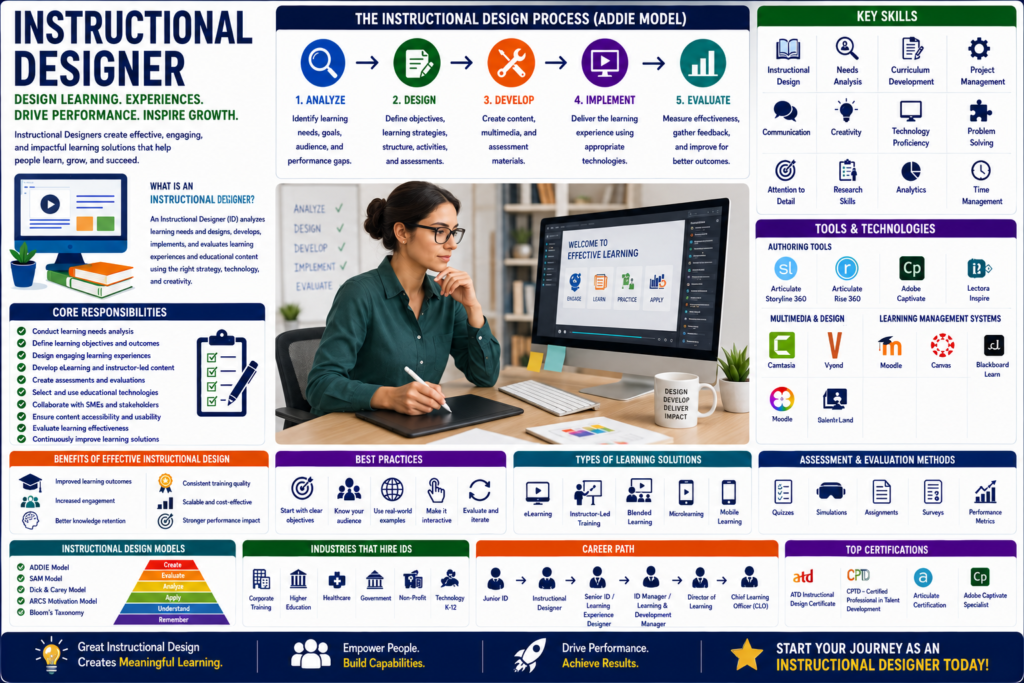
Instructional Designers are specialists who create educational programs, training materials, e-learning courses, and learning experiences that improve knowledge retention and performance. They combine educational theory, technology, psychology, and design principles to develop learning solutions that meet specific goals and learner needs.
As digital learning, remote education, and corporate training continue to grow worldwide, Instructional Designers have become essential professionals in modern education and workforce development.
This guide explores the role of an Instructional Designer, responsibilities, skills, tools, certifications, career opportunities, and future trends shaping the industry.
What Is an Instructional Designer?
An Instructional Designer is a professional who designs, develops, implements, and evaluates learning experiences and educational materials.
Their primary objective is to create learning solutions that help individuals achieve specific knowledge, skills, and performance outcomes.
Instructional Designers often work on:
- E-learning courses
- Employee training programs
- Educational curricula
- Online learning experiences
- Certification programs
- Professional development courses
- Learning management systems (LMS)
- Digital learning content
- Instructor-led training materials
They serve as the bridge between subject matter experts, educators, learners, and technology platforms.
Why Instructional Designers Are Important
Improve Learning Outcomes
Well-designed instruction increases knowledge retention and learner success.
Enhance Engagement
Interactive and learner-centered experiences improve participation.
Support Organizational Growth
Training programs help employees develop valuable skills.
Enable Scalable Learning
Digital courses can reach thousands of learners globally.
Increase Training Efficiency
Effective instructional design reduces learning time while improving results.
Key Responsibilities of an Instructional Designer
Learning Needs Analysis
Identifying educational goals and performance gaps.
Curriculum Development
Designing structured learning pathways.
E-Learning Development
Creating interactive online courses and modules.
Content Creation
Developing lessons, assessments, videos, and activities.
Learning Evaluation
Measuring learning effectiveness and outcomes.
Collaboration
Working with subject matter experts and stakeholders.
Technology Integration
Selecting and implementing educational technologies.
The Instructional Design Process
Most Instructional Designers follow structured methodologies.
1. Analyze
Identify learner needs, goals, and challenges.
2. Design
Develop learning objectives and instructional strategies.
3. Develop
Create learning materials and content.
4. Implement
Launch training programs or educational solutions.
5. Evaluate
Assess effectiveness and make improvements.
This framework is commonly known as the ADDIE Model.
The ADDIE Model
Analysis
Understanding learner requirements and performance goals.
Design
Planning content structure, learning activities, and assessments.
Development
Producing learning materials and digital content.
Implementation
Delivering training to learners.
Evaluation
Measuring outcomes and identifying improvements.
ADDIE remains one of the most widely used instructional design frameworks.
Essential Skills for Instructional Designers
Learning Theory Knowledge
Understanding how people learn effectively.
Communication Skills
Explaining concepts clearly and collaborating with stakeholders.
Creativity
Designing engaging and innovative learning experiences.
Project Management
Managing timelines, budgets, and deliverables.
Technology Proficiency
Using e-learning and educational software tools.
Analytical Thinking
Evaluating learner performance and instructional effectiveness.
Problem Solving
Creating solutions for complex learning challenges.
Learning Theories Used in Instructional Design
Behaviorism
Focuses on observable learning outcomes.
Cognitivism
Examines mental processes involved in learning.
Constructivism
Encourages learners to build knowledge through experiences.
Adult Learning Theory
Addresses the unique needs of adult learners.
Experiential Learning
Promotes learning through hands-on activities and reflection.
These theories guide instructional design decisions and strategies.
Types of Learning Solutions
E-Learning Courses
Self-paced online learning modules.
Instructor-Led Training (ILT)
Traditional classroom-based instruction.
Virtual Instructor-Led Training (VILT)
Live online learning sessions.
Microlearning
Short, focused learning experiences.
Mobile Learning
Educational content optimized for mobile devices.
Blended Learning
Combines online and in-person instruction.
Educational Technology Tools
Instructional Designers rely on a variety of technologies.
Authoring Tools
- Articulate Storyline
- Articulate Rise
- Adobe Captivate
- Lectora
Multimedia Tools
- Camtasia
- Vyond
- Canva
- Adobe Creative Cloud
Learning Management Systems (LMS)
- Moodle
- Canvas
- Blackboard
- TalentLMS
Collaboration Platforms
- Microsoft Teams
- Slack
- Zoom
- Google Workspace
Learning Management Systems (LMS)
LMS platforms help organizations manage training and education.
Key functions include:
- Course delivery
- Progress tracking
- Assessments
- Certifications
- Reporting
- Learner management
Instructional Designers often configure and optimize LMS environments.
Assessment and Evaluation
Effective learning requires measuring outcomes.
Common evaluation methods include:
Quizzes
Assess learner understanding.
Simulations
Evaluate practical skills.
Assignments
Measure application of knowledge.
Surveys
Gather learner feedback.
Performance Metrics
Track business or educational impact.
Evaluation helps improve future learning experiences.
Instructional Designer vs Teacher
Instructional Designer
Designs learning experiences and educational content.
Teacher
Delivers instruction directly to learners.
Instructional Designers often create the materials that teachers use.
Instructional Designer vs Curriculum Developer
Instructional Designer
Focuses on learning experiences and instructional methods.
Curriculum Developer
Focuses on broader educational programs and standards.
Many professionals perform both roles.
Industries Hiring Instructional Designers
Corporate Training
Employee development and compliance programs.
Higher Education
Online and traditional learning initiatives.
K-12 Education
Curriculum development and digital learning.
Healthcare
Clinical training and professional education.
Technology
Software training and customer education.
Government
Workforce development and public training programs.
Nonprofit Organizations
Educational outreach and community programs.
Certifications for Instructional Designers
ATD Instructional Design Certificate
Popular industry-recognized credential.
CPTD (Certified Professional in Talent Development)
Advanced learning and development certification.
Adobe Captivate Certification
Validates e-learning development expertise.
Articulate Certification Programs
Demonstrates proficiency in authoring tools.
Learning Experience Design Certifications
Focused on modern learner-centered design practices.
Career Path for Instructional Designers
Junior Instructional Designer
Supports content development and course creation.
Instructional Designer
Designs and develops learning experiences independently.
Senior Instructional Designer
Leads major learning projects.
Learning Experience Designer (LXD)
Focuses on learner-centered experience design.
Learning and Development Manager
Oversees organizational training initiatives.
Director of Learning and Development
Leads enterprise-wide learning strategies.
Chief Learning Officer (CLO)
Executive responsible for organizational learning and development.
Best Practices for Instructional Designers
Understand Learner Needs
Design with the audience in mind.
Focus on Outcomes
Align instruction with measurable objectives.
Use Interactive Learning
Increase engagement through active participation.
Apply Learning Science
Base decisions on proven educational research.
Evaluate Continuously
Improve programs through feedback and data.
Embrace Technology
Leverage digital tools to enhance learning experiences.
Future Trends in Instructional Design
Artificial Intelligence
AI-powered personalization and adaptive learning.
Learning Experience Design (LXD)
Greater focus on learner-centered experiences.
Microlearning
Short-form content continues gaining popularity.
Virtual Reality (VR)
Immersive learning environments expand.
Mobile Learning
Learners increasingly access content on mobile devices.
Data-Driven Learning
Analytics help improve educational effectiveness.
Benefits of Becoming an Instructional Designer
- High demand across industries
- Remote work opportunities
- Competitive salaries
- Creative and strategic work
- Opportunities for specialization
- Positive impact on learning and development
- Continuous professional growth
Conclusion
Instructional Designers play a vital role in creating effective, engaging, and impactful learning experiences. By combining educational theory, technology, creativity, and strategic thinking, they help learners acquire knowledge, develop skills, and achieve meaningful outcomes.
As organizations continue investing in digital learning, workforce development, and educational innovation, skilled Instructional Designers will remain highly valuable. Professionals who master instructional methodologies, learning technologies, and learner-centered design principles can build rewarding careers while shaping the future of education and training.