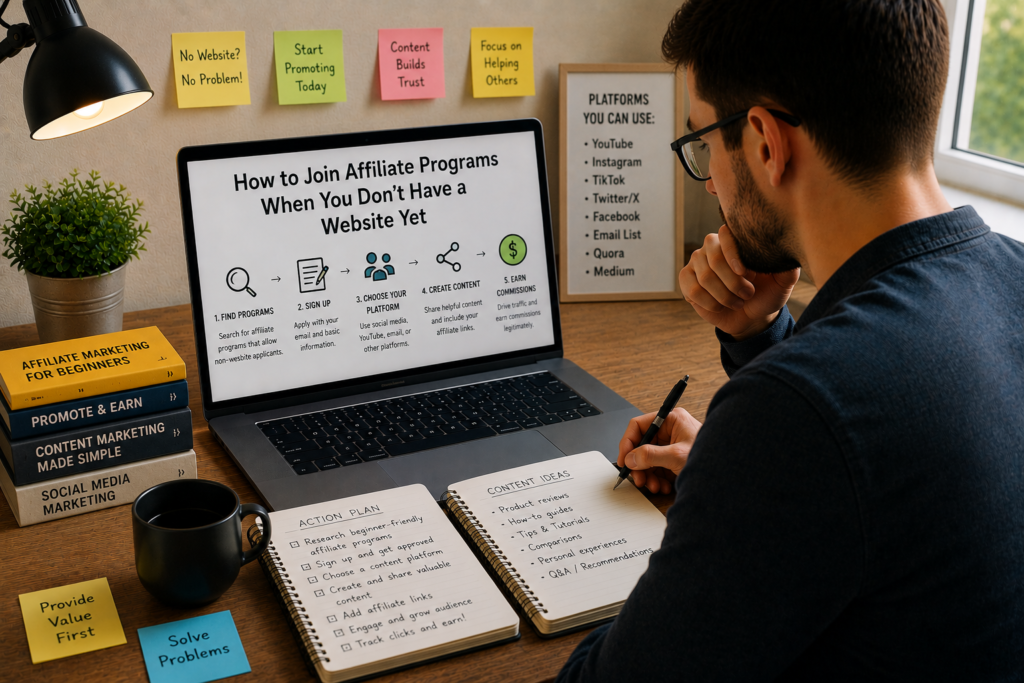
Most people assume they need a polished website before they can earn a single dollar from affiliate marketing. That assumption keeps thousands of would-be marketers stuck at the starting line, waiting for the “perfect” moment that never comes.
Here’s the reality: plenty of affiliate programs accept applicants who don’t own a website. And plenty of successful affiliate marketers built their income streams long before they ever registered a domain name.
This guide breaks down exactly how to get started, which programs accept you without a site, and what you can do right now to start earning commissions.
Why Most People Think You Need a Website
The misconception comes from how affiliate marketing worked ten or fifteen years ago. Back then, the standard path was straightforward: build a niche blog, write product reviews, insert affiliate links, and wait for Google traffic to roll in.
That model still works. But it’s far from the only model.
Today, content lives everywhere. People discover products through TikTok videos, Instagram stories, YouTube tutorials, Twitter threads, Pinterest pins, email newsletters, and podcast recommendations. Affiliate networks and brands have caught on. Many of them now accept applications from creators who operate on any platform where they can reach an audience.
The shift happened because brands care about one thing above all else: can you drive sales? If you can do that from a YouTube channel, a Facebook group, or an email list, the medium doesn’t matter.
Affiliate Programs That Accept Applicants Without a Website
Not every program will work for you if you don’t have a site. Some, like certain Amazon Associates regional programs, technically require a URL during sign-up. But many popular programs are flexible. Here are the ones worth knowing about.
Amazon Associates
Amazon’s affiliate program asks for a website or mobile app URL during registration, but it accepts YouTube channels, social media profiles, and mobile apps as qualifying platforms. If you have a YouTube channel or an active social media account with a following, you can list that URL instead of a traditional website.
A few things to keep in mind with Amazon:
- You need to generate at least three qualifying sales within your first 180 days, or your account gets closed.
- Cookie duration is only 24 hours, meaning someone needs to buy within a day of clicking your link.
- Commission rates vary by product category, and they’ve dropped significantly over the years.
Amazon works best as a starting point because the brand trust is already built in. People buy from Amazon constantly, so conversion rates tend to be decent even with short cookie windows.
ShareASale
ShareASale is one of the largest affiliate networks, connecting marketers with thousands of merchants across dozens of categories. During the application process, you can list a social media profile or YouTube channel as your primary promotional platform.
Some individual merchants within ShareASale may have stricter requirements, but the network itself won’t reject you for lacking a traditional website. You’ll find everything from fashion brands to software companies to home goods retailers.
ClickBank
ClickBank has long been one of the most beginner-friendly affiliate platforms. The marketplace is heavy on digital products (online courses, eBooks, software tools), and the sign-up process doesn’t require a website.
Commission rates on ClickBank tend to be high, often 50% or more on digital products, because there’s almost no cost of goods. The trade-off is that product quality varies widely. You’ll want to research and, ideally, test any product before promoting it. Your reputation is on the line with every recommendation you make.
CJ Affiliate (formerly Commission Junction)
CJ Affiliate is another major network that connects publishers with well-known brands. The application process does ask about your promotional methods, and listing social media channels or a YouTube presence is acceptable.
Getting approved by individual advertisers within CJ can be competitive. Brands on this network tend to be larger and more selective. Having some track record of content creation, even on social media, strengthens your application.
Rakuten Advertising
Rakuten partners with major retail brands and accepts applications from content creators across platforms. The approval process reviews your promotional methods and audience, not just whether you have a dot-com address.
Impact
Impact powers affiliate programs for brands like Uber, Airbnb, Canva, and dozens of SaaS companies. Many of these programs accept social media influencers and content creators directly, without requiring a website.
Individual Brand Programs
Many companies run their own affiliate or referral programs outside of the big networks. Software companies are especially open to this. Programs from tools like ConvertKit, Notion, Canva, NordVPN, and Skillshare frequently accept applicants who promote through content creation on any platform.
Check the footer of any brand’s website for an “Affiliates” or “Partners” link. You might be surprised how many accept social-only applicants.
Platforms You Can Use Instead of a Website
If you’re not building a website, you need to build a presence somewhere. The platform you choose should match both your strengths and the type of products you want to promote.
YouTube
YouTube is arguably the single best platform for affiliate marketing without a website. Video content builds trust faster than almost any other format, and product reviews, tutorials, and comparison videos convert at high rates.
Here’s what makes YouTube effective for affiliates:
- Evergreen content. A well-made product review can generate clicks and commissions for years after you publish it.
- Search intent. People come to YouTube actively looking for answers, recommendations, and product comparisons. They’re already in a buying mindset.
- Link placement. You can place affiliate links directly in video descriptions, making it easy for viewers to click through.
You don’t need expensive equipment to start. A smartphone, decent lighting, and a quiet room are enough. Focus on being genuinely helpful, and the production quality can improve over time.
TikTok
TikTok’s short-form video format works well for product demonstrations, quick reviews, and “things you didn’t know you needed” style content. The platform’s algorithm can push your content to large audiences even if you have zero followers.
The challenge with TikTok is link placement. You can’t add clickable links to individual video captions. Instead, you’ll need to direct viewers to a link in your bio (using a tool like Linktree or Stan Store) or leverage TikTok Shop if you’re promoting physical products.
TikTok works best for impulse-buy products, trending items, and visually appealing goods. It’s less effective for high-consideration purchases that require lengthy explanations.
Instagram gives you multiple content formats to work with: feed posts, Stories, Reels, and carousels. For affiliate marketing, Stories and Reels tend to perform best because they allow for direct product demonstrations.
The link sticker in Stories is now available to all accounts regardless of follower count, which removed one of the biggest barriers to affiliate marketing on Instagram.
Building an audience on Instagram takes consistency and a clear niche. Accounts that try to promote everything to everyone struggle to grow. Pick a lane, such as skincare, tech gadgets, home organization, or fitness gear, and build your content around that focus.
Pinterest functions more like a visual search engine than a traditional social platform. Users come to Pinterest looking for ideas, inspiration, and product recommendations, which makes it a natural fit for affiliate marketing.
You can add affiliate links directly to pins. When someone searches for “best running shoes for flat feet” or “budget home office setup” and finds your pin, they can click through your affiliate link and purchase.
Pinterest works especially well for:
- Home decor and DIY
- Fashion and beauty
- Food and recipes
- Health and fitness products
- Digital products and printables
Content on Pinterest has a much longer shelf life than content on Instagram or TikTok. A single pin can drive traffic for months or even years.
Email Lists
Building an email list without a website might sound contradictory, but it’s entirely doable. Tools like ConvertKit, Mailchimp, and Beehiiv let you create simple landing pages where people can subscribe. You can share these landing page links on social media, in YouTube descriptions, or in online communities.
Email is powerful for affiliate marketing because:
- You own the relationship. Algorithm changes on social platforms can’t take away your list.
- You can segment your audience and send targeted recommendations.
- Email converts at higher rates than most social media posts because subscribers have already shown interest by opting in.
Start by offering something valuable in exchange for an email address: a free guide, a checklist, a resource list, or a mini-course. Then nurture that list with genuinely helpful content, mixing in affiliate recommendations where they fit naturally.
Facebook Groups
Running a Facebook Group around a specific topic positions you as a trusted voice in that community. If you manage a group about budget travel, for example, recommending travel gear, booking platforms, or packing accessories through affiliate links feels natural and helpful rather than salesy.
The key with Facebook Groups is to lead with value. Groups that exist solely to push affiliate links die quickly. Groups that solve real problems and happen to include affiliate recommendations thrive.
Podcasts
If you’re comfortable speaking but camera-shy, podcasting is a strong alternative. You can mention affiliate products during episodes, include links in show notes, and build deep trust with listeners over time.
Podcasting has a longer ramp-up period than short-form video, but listeners tend to be highly engaged and loyal. A recommendation from a podcast host carries significant weight.
How to Strengthen Your Application Without a Website
Even when a program doesn’t require a website, you’re still competing with other applicants. Here’s how to make your application stand out.
Build a Content Portfolio First
Don’t apply to affiliate programs with an empty social media profile. Spend two to four weeks creating quality content in your niche before you submit applications. Affiliate managers review your content to assess whether you’re a good fit for their brand. Give them something to evaluate.
Aim for at least 10 to 15 pieces of content on your chosen platform. These don’t need to be perfect, but they should demonstrate your niche focus, your communication style, and your ability to create consistently.
Be Specific About Your Promotional Strategy
Most affiliate applications ask how you plan to promote products. “I’ll post on social media” is a weak answer. Instead, be specific:
- “I create product comparison videos on YouTube targeting buyers researching [product category]. My videos average [X] views, and I include affiliate links in every description.”
- “I run a Pinterest account focused on home organization with [X] monthly viewers. I create pins featuring product recommendations with direct affiliate links.”
- “I manage a Facebook Group of [X] members interested in [topic]. I share honest product reviews and recommendations within the group.”
Specificity shows that you’ve thought through your approach and have a real plan for generating sales.
Show Engagement, Not Just Followers
A small, engaged audience beats a large, passive one. If you have 500 YouTube subscribers who actively comment on your videos, that can be more convincing than 10,000 Instagram followers who never interact with your posts.
When possible, include engagement metrics in your application: average views, comments, click-through rates, or any data that shows your audience pays attention and takes action.
Start With Less Competitive Programs
If you’re brand new, avoid applying exclusively to high-profile programs with strict requirements. Start with programs that are known for accepting beginners, build a track record of generating sales, and then use that history to apply to more selective programs.
ClickBank, individual SaaS referral programs, and smaller merchants on ShareASale are good starting points. Once you can demonstrate that you’ve driven real revenue, doors open more easily.
Common Mistakes to Avoid
Applying Everywhere at Once
Shotgun-applying to dozens of programs before you have a clear strategy wastes time and can result in rejections that make future applications harder. Pick three to five programs that align with your niche and your audience, and focus your energy there.
Promoting Products You Haven’t Used
Audiences can tell when a recommendation is genuine and when it’s a cash grab. Whenever possible, use the products you promote. Share real experiences, including the downsides. Honest reviews build trust, and trust drives long-term commissions.
Ignoring Disclosure Requirements
In the United States, the FTC requires you to disclose affiliate relationships clearly and conspicuously. This applies regardless of the platform you’re using. On YouTube, include a disclosure in both the video and the description. On social media, use clear language like “This post contains affiliate links” or hashtags like #ad or #affiliate.
Skipping disclosures isn’t just unethical. It can result in legal consequences and program termination.
Spamming Links
Dropping affiliate links into random comment sections, forums, or DMs is the fastest way to get banned from both the platform and the affiliate program. Every link you share should be attached to genuinely useful content that serves the reader or viewer first.
A Realistic Timeline for Getting Started
Here’s what a practical launch plan looks like if you’re starting from scratch:
Weeks 1-2: Choose your niche and platform. Set up your profile. Research affiliate programs that fit your niche and accept applicants without websites.
Weeks 3-4: Create your first 10 to 15 pieces of content. Focus on topics that naturally connect to products you want to promote. Don’t include affiliate links yet, since you probably won’t be approved until you have content to show.
Weeks 5-6: Apply to two or three affiliate programs. Use your content portfolio and engagement data to strengthen your applications.
Weeks 7-8: Once approved, begin integrating affiliate links into new content. Track which content and which products generate the most clicks and conversions.
Months 3-6: Analyze your results. Double down on what works. Expand to additional programs. Consider building an email list to create a direct line to your audience.
Months 6-12: At this point, you might consider building a website to complement your existing efforts. A simple site can serve as a hub for your content, improve your credibility with affiliate programs, and give you another channel for organic search traffic.
Should You Eventually Build a Website?
Probably, yes. While you absolutely can earn affiliate commissions without one, a website gives you advantages that are hard to replicate on social platforms:
- You own the platform. Social media algorithms change. Accounts get suspended. A website is yours.
- SEO brings passive traffic. Well-optimized content on your own site can attract visitors from search engines for years with minimal ongoing effort.
- It strengthens future applications. Having a professional-looking website makes you more attractive to premium affiliate programs and brand partnerships.
- Monetization flexibility. A website opens up additional income streams: display ads, sponsored content, digital product sales, and more.
That said, don’t let “I need a website first” keep you from starting today. The best time to begin affiliate marketing is before everything is perfect. Build your audience, learn what resonates, start generating revenue, and then invest in a website when you’re ready.
Wrapping Up
You don’t need a website to start earning from affiliate marketing. You need an audience, even a small one, and a willingness to create content that genuinely helps people make purchasing decisions.
Pick a platform that plays to your strengths. Create content consistently in a focused niche. Apply to programs that accept social-only applicants. Disclose your affiliate relationships honestly. And treat every recommendation as a reflection of your personal brand, because it is.
The affiliate marketers who succeed long-term are the ones who start before conditions are perfect and improve as they go. Your website can come later. Your first commission doesn’t have to wait.