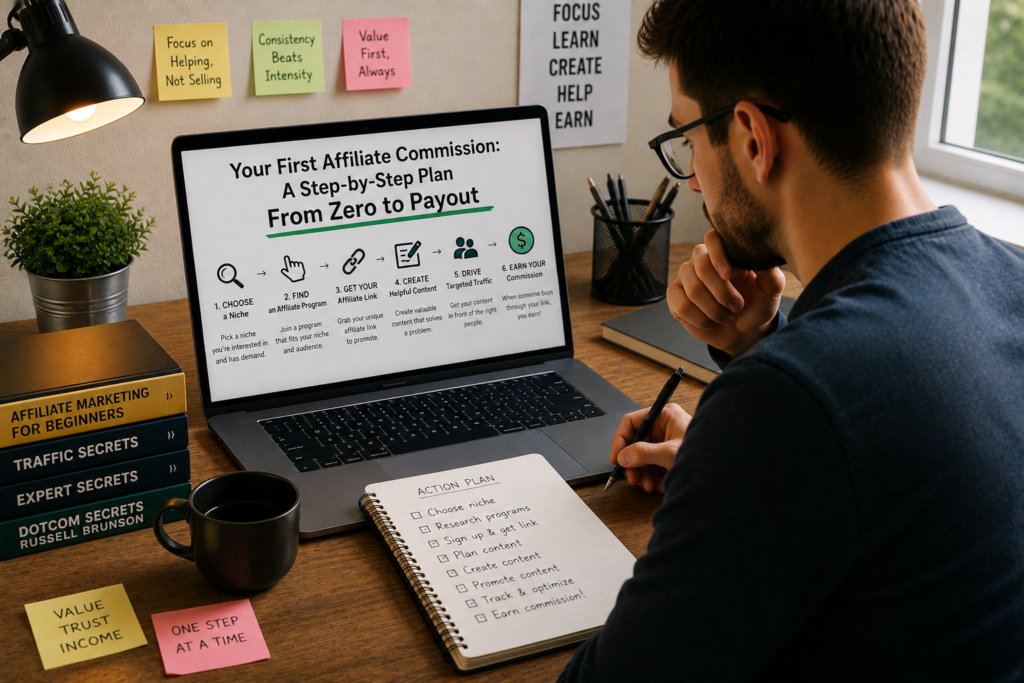
There’s a specific feeling that comes with earning your first affiliate commission. It might be $3.20 from an Amazon link or $47 from a software referral, but the number almost doesn’t matter. What matters is the proof: you built something online, someone clicked, someone bought, and you got paid for it.
That first commission changes your thinking. It stops being a theory and starts being a skill you can repeat, scale, and sharpen.
But getting there? That’s where most people stall. They sign up for a program, paste a link somewhere, hear crickets, and move on. The gap between “I signed up” and “I got paid” is filled with small, specific actions that most guides gloss over.
This one won’t. Below is the full plan, from absolute zero to your first deposit.
Why Most Beginners Never Earn a Single Commission
Before we get into what works, it helps to understand what doesn’t.
The most common reason people fail at affiliate marketing is not a lack of effort. It’s misplaced effort. They spend three weeks designing a logo, picking brand colors, and setting up social profiles before they’ve written a single piece of content that could actually generate a click.
Here are the patterns that keep people stuck at zero:
- Picking a niche they don’t care about because someone on YouTube said it pays well
- Promoting too many products at once instead of going deep on one or two
- Skipping the content and jumping straight to paid ads with no data
- Treating affiliate links like a lottery ticket, dropping them into random forums and hoping for the best
- Waiting for everything to be perfect before publishing anything
Every one of these problems has the same root cause: no clear plan with ordered steps. That’s what we’re fixing right now.
Step 1: Pick a Niche That Passes Three Tests
Your niche is the topic area you’ll create content around. Get this wrong and everything downstream gets harder. Get it right and content creation feels less like work and more like sharing what you already know.
A strong niche passes three tests:
Test 1: You can talk about it for 30 minutes without notes.
This doesn’t mean you need to be a certified expert. It means you have real experience, opinions, or genuine curiosity. If you’ve spent the last six months testing budget espresso machines, that counts. If you’ve been managing your own WordPress sites for two years, that counts.
Test 2: People are already spending money in this space.
Check Amazon bestseller lists, browse product review sites, or look at what’s trending in affiliate networks like ShareASale, CJ Affiliate, or Impact. If products exist and people are buying them, commissions are on the table.
Test 3: You can picture 20+ content ideas without straining.
Open a doc and brainstorm headlines. “Best budget espresso machine under $200.” “How I fixed the bitter taste from my Breville.” “Espresso machine vs. French press: which actually saves money?” If ideas flow easily, you’ve found your lane.
Some niches that consistently perform well for beginners:
- Personal finance tools and apps
- Home office and productivity gear
- Pet products and training resources
- Fitness equipment and supplements
- Software and SaaS tools (email marketing, design, project management)
- Online education and course platforms
You don’t need to dominate the niche. You just need to serve a specific slice of it well.
Step 2: Find One Affiliate Program Worth Your Time
Beginners often sign up for five or six programs on day one. That’s a distraction, not a strategy. Start with one. Here’s how to pick it.
Look at what you already use and recommend. If you tell friends about a specific product or service regularly, check whether it has an affiliate program. Most SaaS companies, online retailers, and course creators do.
Evaluate the program on four factors:
- Commission rate. Physical products typically pay 3-10%. Digital products and software often pay 20-50%. Recurring commissions (monthly payouts for subscription products) are especially valuable over time.
- Cookie duration. This is how long after someone clicks your link the company will still credit you for a sale. Amazon gives you 24 hours. Many software companies give 30-90 days. Longer is better, especially when you’re starting out and traffic is low.
- Product quality. Promote something you’d actually buy. If the product is mediocre, your audience will figure that out, and you’ll burn trust you can’t rebuild.
- Payout threshold and method. Some programs pay at $10, others at $100. Know the number so you can set a realistic goal for your first commission.
Good starting points for beginners:
| Program Type | Examples | Typical Commission |
|---|---|---|
| General retail | Amazon Associates | 1-4% per sale |
| Web hosting | Bluehost, SiteGround, Cloudways | $65-200 per sale |
| Email marketing | ConvertKit, AWeber, GetResponse | 30% recurring |
| Online courses | Teachable, Skillshare, Udemy | 15-50% per sale |
| Design tools | Canva, Adobe, Figma | Varies |
Pick one. Sign up. Get your affiliate link. Move on.
Step 3: Build a Simple Content Home Base
You need a place to publish content that attracts people who are already interested in what you’re promoting. This is your home base.
The fastest option: a simple blog or website.
A WordPress site with a clean theme, an About page, and a few solid articles is enough. You don’t need a podcast studio, a YouTube setup, or a TikTok strategy right now. You need written content that Google can index and readers can find.
If you’re short on budget, free platforms like Medium, Substack, or LinkedIn articles can work as a starting point, though you’ll have less control over SEO and monetization.
What your home base needs on day one:
- A clear topic focus (reflected in your site name or bio)
- One “About” or “Start Here” page explaining who you are and what this site covers
- A disclosure statement that you use affiliate links (this is legally required by the FTC in the US and good practice everywhere)
- Your first piece of content (we’ll cover this next)
Don’t spend more than a day or two on setup. The site doesn’t need to be beautiful. It needs to exist.
Step 4: Create Your First Piece of Commission-Ready Content
Not all content generates affiliate income equally. Some types are significantly better at converting readers into buyers. Start with one of these three formats:
Format 1: The Product Review
Write an honest, detailed review of the product you’re promoting. Cover who it’s for, what it does well, where it falls short, and who should look elsewhere. Include your affiliate link naturally within the content.
A strong product review answers the questions a buyer has right before they make a purchase decision:
- Is this worth the price?
- How does it compare to the main alternative?
- What surprised you (good or bad) after using it?
- Who will get the most value from this?
Format 2: The “Best Of” Comparison
“5 Best Email Marketing Tools for Small Businesses” or “Best Standing Desks Under $400.” These posts capture people who are ready to buy but haven’t decided which product yet. You compare three to seven options, give your honest pick, and include affiliate links for each.
Format 3: The Problem-Solution Tutorial
“How to Set Up an Email List in 15 Minutes” or “How to Start a Blog That Actually Gets Traffic.” These posts solve a specific problem and naturally weave in a tool recommendation with your affiliate link as part of the solution.
Writing tips that drive clicks:
- Lead with what the reader cares about, not with your backstory
- Use screenshots, photos, or specific numbers to add credibility
- Place your affiliate link where it feels natural (after you’ve explained the value, not before)
- Include a clear recommendation: “If you’re [type of person], I’d go with [product] because [reason]”
- Write at least 1,500 words for review-style content; search engines tend to favor depth on commercial topics
Step 5: Optimize for Search Engines (Without Overthinking It)
SEO is how you get free, consistent traffic from Google. You don’t need to become an expert, but you do need to cover the basics.
Keyword research in 15 minutes:
Open a free tool like Ubersuggest, Google’s Keyword Planner, or AnswerThePublic. Type in your product name or niche topic. Look for search terms with:
- Clear buying intent (“best,” “review,” “vs,” “alternative to,” “worth it”)
- Monthly search volume above 100
- Low to medium competition
Example: “ConvertKit review” might have 2,400 monthly searches with medium competition. That’s a solid target for a new site.
On-page SEO basics:
- Put your target keyword in the page title, the URL, and the first 100 words
- Use subheadings (H2, H3) that include related terms
- Write a compelling meta description (under 160 characters) that makes people want to click
- Add alt text to images describing what’s shown
- Link to other relevant content on your site (internal linking)
- Keep paragraphs short and scannable
That’s it for now. Don’t get lost in technical SEO rabbit holes before you’ve published your first five articles.
Step 6: Distribute Your Content Where Buyers Already Hang Out
Publishing is step one. Distribution is what actually gets eyes on your content while you wait for Google to index and rank your pages (which can take weeks or months).
Quick-win distribution channels:
- Reddit: Find subreddits related to your niche. Don’t spam links. Provide value in comments and discussions, and link to your content only when it genuinely answers someone’s question.
- Quora: Search for questions related to your topic. Write thorough answers and include a link to your full article for readers who want more detail.
- Pinterest: Especially effective for niches like home decor, recipes, fitness, personal finance, and fashion. Create pins that link back to your blog posts.
- Facebook Groups: Join groups where your target audience spends time. Share insights, answer questions, and occasionally share your content when it’s relevant.
- Email list (even a tiny one): If you can collect even 10-20 email subscribers, you have a direct line to people who’ve already shown interest. Send them your new content. Tools like MailerLite or ConvertKit offer free plans for small lists.
- X (Twitter) and LinkedIn: Share insights from your content. Pull out a single tip, statistic, or opinion and post it. Link to the full piece in a follow-up or in your bio.
The 80/20 rule of distribution: Spend 20% of your time creating content and 80% getting it in front of people. Most beginners do the opposite.
Step 7: Track Everything (So You Know What’s Working)
You can’t improve what you don’t measure. Set up tracking from day one so you’re making decisions based on data, not guesses.
What to track:
- Traffic sources: Where are your visitors coming from? (Google Analytics is free and takes 10 minutes to set up)
- Click-through rate on affiliate links: How many visitors are clicking your links? Most affiliate programs provide this in their dashboard. Tools like Pretty Links or ThirstyAffiliates can track clicks on your end.
- Conversion rate: Of the people who click your affiliate link, how many actually buy? This comes from your affiliate program’s reporting.
- Top-performing content: Which articles are driving the most traffic and clicks?
A simple weekly check-in:
Every Sunday, spend 15 minutes reviewing these numbers. Ask yourself:
- Which piece of content got the most traffic this week?
- Which affiliate link got the most clicks?
- What can I do next week to double down on what’s working?
This habit alone puts you ahead of 90% of affiliate beginners who publish and forget.
Step 8: Scale What Works, Cut What Doesn’t
After two to four weeks of publishing and promoting content, patterns will start to emerge. Some content will attract visitors. Some won’t. Some affiliate links will get clicks. Others will sit untouched.
Here’s what to do with that information:
Double down on winners. If your comparison post is getting traffic, write more comparison posts. If a specific subreddit is sending visitors, spend more time there. If one product converts well, create additional content around it (tutorials, use cases, FAQ posts).
Update underperforming content. Sometimes a post is close to ranking on Google’s first page but needs a boost. Add more depth, include fresh information, improve the headline, or build a few internal links to it from your other content.
Drop what’s not working. If a distribution channel is eating your time with zero results after three weeks, stop. Redirect that energy elsewhere.
Create content clusters. Once you find a winning topic, build around it. If “best email marketing tools” is your top performer, write supporting articles: “How to write welcome emails,” “Email list building strategies for new bloggers,” “ConvertKit vs. Mailchimp: which is better for beginners?” Each supporting article can link to your main piece, strengthening its authority in search engines.
Step 9: Avoid the Mistakes That Kill Momentum
The gap between first commission and consistent income is where most people quit. Here are the traps to watch for:
Trap 1: Shiny object syndrome. A new affiliate program launches with 50% commissions. A YouTube guru says TikTok affiliate marketing is the next big thing. Every week, there’s a new distraction. Stay focused on your plan for at least 90 days before changing course.
Trap 2: Treating your audience like ATMs. Every piece of content doesn’t need an affiliate link. Mix in genuinely helpful, non-monetized content. Build trust. The commissions follow.
Trap 3: Ignoring disclosure requirements. Always disclose your affiliate relationships. It’s the law in many countries, and readers respect honesty. A simple line at the top of your post works: “This post contains affiliate links. If you purchase through these links, I may earn a commission at no extra cost to you.”
Trap 4: Comparing your week 3 to someone else’s year 3. The people showing $10,000 monthly affiliate income screenshots started exactly where you are. They just didn’t stop.
Trap 5: Perfectionism. Your first article won’t be your best. Your tenth will be significantly better than your first. Publish, learn, improve. The cycle matters more than any single piece.
A Realistic Timeline for Your First Commission
Let’s set honest expectations:
| Timeframe | What to Expect |
|---|---|
| Week 1-2 | Niche selected, affiliate program joined, home base set up, first piece of content published |
| Week 3-4 | 3-5 pieces of content live, active distribution on 2-3 channels, first trickle of traffic |
| Month 2 | 8-12 content pieces, growing search visibility, first affiliate link clicks showing up in your dashboard |
| Month 2-3 | First commission earned (for most beginners in low-competition niches) |
| Month 4-6 | Consistent clicks and periodic commissions, enough data to optimize |
Some people earn their first commission in the first week by promoting to an audience they’ve already built elsewhere. Others take three months of steady work. Both timelines are normal.
The variable that matters most is consistency. Publishing one article per week and distributing it properly will outperform publishing ten articles in a burst and then going silent for a month.
What to Do After Your First Commission
Congratulations, you proved the model works. Now what?
- Screenshot your first commission. Seriously. Save it somewhere. On the hard days, it’s a reminder that this is real.
- Analyze what worked. Which piece of content drove the sale? Which traffic source? Which product? Reverse-engineer the path and replicate it.
- Set your next goal. If your first commission was $5, aim for $50 in the next 30 days. If it was $50, aim for $200. Small, incremental goals keep you moving.
- Consider reinvesting. Put your first earnings back into the business. Buy a premium WordPress theme, invest in a keyword research tool like Ahrefs or Semrush, or pay for a course that fills a gap in your knowledge.
- Start building an email list if you haven’t already. Affiliate marketing becomes dramatically more profitable when you can reach your audience directly, without depending on search engine algorithms or social media platforms.
- Expand to a second affiliate program. Now that you understand the mechanics, add a complementary product. If you’ve been promoting an email marketing tool, add a landing page builder. If you’ve reviewed fitness equipment, add a nutrition supplement brand.
The Affiliate Marketing Toolkit for Beginners
Here’s a quick reference of free and low-cost tools that make the process easier:
Content and SEO
- WordPress (free, self-hosted) or Ghost for your blog
- Ubersuggest or Google Keyword Planner for keyword research
- Grammarly for proofreading
- Canva for creating images and Pinterest pins
Tracking and Analytics
- Google Analytics for traffic data
- Google Search Console for monitoring search performance
- Pretty Links or ThirstyAffiliates for managing and tracking affiliate links
Email Marketing
- MailerLite (free up to 1,000 subscribers)
- ConvertKit (free up to 10,000 subscribers)
Affiliate Networks
- Amazon Associates (wide product selection, low commissions)
- ShareASale (thousands of merchant programs)
- CJ Affiliate (large brands, reliable payouts)
- Impact (strong tech and SaaS programs)
- PartnerStack (B2B software focus)
The Bottom Line
Earning your first affiliate commission isn’t about luck, special skills, or having a massive following. It’s about executing a series of small, specific steps in the right order:
- Pick a niche you know and care about
- Join one affiliate program with a product worth recommending
- Build a simple content home base
- Publish one piece of content designed to convert
- Optimize it for search
- Distribute it where your audience already spends time
- Track your results
- Do more of what works
The plan is simple. The execution takes patience. But the first time you log into your affiliate dashboard and see a real commission with your name on it, you’ll know exactly what to do next: do it again, and do it better.
Start today. Pick your niche. Write your first review. The commission is closer than you think.