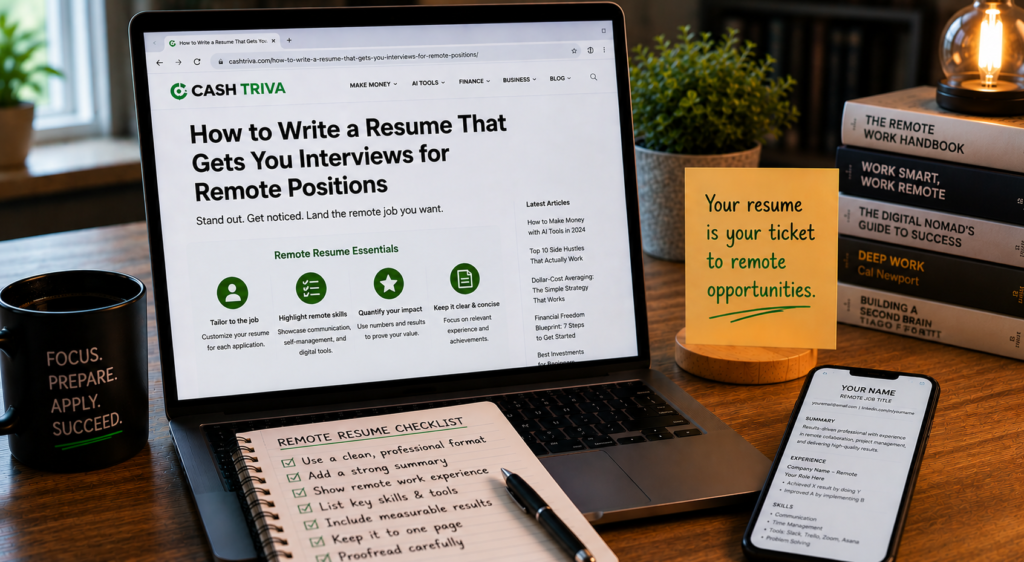
The competition for remote roles has changed dramatically over the past few years. What started as a pandemic-era necessity has become the default preference for millions of professionals, and companies now receive hundreds (sometimes thousands) of applications for a single remote opening.
Your resume has roughly six to seven seconds to make an impression. That’s not a guess. It’s backed by eye-tracking studies from career research firms. And when a recruiter is scanning for remote-specific qualifications, a generic resume won’t cut it.
This guide breaks down exactly how to build a resume that speaks directly to remote hiring managers, passes through applicant tracking systems (ATS), and positions you as someone who thrives outside of a traditional office.
Why Remote Resumes Need a Different Approach
A resume for an in-office role and a resume for a remote role are not the same document. Hiring managers evaluating remote candidates are looking for a specific set of signals that go beyond technical competence.
They want to see evidence that you can:
- Communicate clearly in writing (since most remote teams rely on async communication)
- Manage your own schedule and hit deadlines without supervision
- Use remote collaboration tools with confidence
- Deliver measurable results without someone checking over your shoulder
- Work across time zones, if applicable
If your resume doesn’t speak to these expectations, it gets filtered out, even if you have the perfect skill set for the role.
Start With a Remote-Optimized Professional Summary
The professional summary sits at the top of your resume. It’s the first thing both humans and ATS software read, so it needs to do heavy lifting.
A weak summary sounds like this:
“Experienced marketing professional looking for a challenging remote opportunity where I can leverage my skills.”
That says nothing. It tells the reader you want a remote job, but it doesn’t show you can actually do one.
A stronger version looks like this:
“Marketing manager with 6+ years of experience leading distributed teams across 4 time zones. Built and executed content strategies that increased organic traffic by 140% year-over-year. Proficient in Asana, Slack, Notion, and Google Workspace for cross-functional project management.”
Notice the difference. The second version includes remote-specific proof points: distributed teams, time zones, remote tools, and quantified outcomes. That’s what gets attention.
What your summary should include:
- Your years of experience and area of expertise
- A mention of remote, distributed, or hybrid work experience
- One or two measurable accomplishments
- Names of remote collaboration tools you use daily
Choose the Right Resume Format
For remote positions, the reverse-chronological format remains the strongest choice. Recruiters are familiar with it, ATS software reads it reliably, and it makes your career progression easy to follow.
Here’s the structure that works best:
- Contact information and location (city/state or “Open to Remote”)
- Professional summary
- Core skills and tools
- Work experience (reverse-chronological)
- Education and certifications
- Optional sections (volunteer work, publications, languages)
A note on functional resumes: Some career coaches recommend skill-based (functional) resumes for career changers. For remote roles, this format often backfires. Recruiters may assume you’re hiding gaps, and many ATS platforms struggle to parse functional layouts. Stick with reverse-chronological unless you have a compelling reason not to.
Handle Your Location Strategically
Location matters more than people realize for remote jobs. Some “remote” positions are restricted to certain states, countries, or time zones for tax and legal reasons.
Best practices for listing your location:
- If the job posting says “Remote (US only),” list your city and state
- If the role is fully global, write “Remote” or “Location-flexible” below your name
- If you’re willing to relocate or travel occasionally, say so: “Based in Austin, TX. Open to quarterly on-site meetings.”
- Never leave location blank. Recruiters will assume the worst, that you’re in a region they can’t hire from
Including your time zone can be a smart move for global roles. Something like “EST (UTC-5)” helps the hiring manager immediately understand your availability overlap.
Build a Skills Section That Matches ATS Keywords
Applicant tracking systems are the gatekeepers of modern hiring. These software platforms scan your resume for specific keywords before a human ever sees it. If your resume doesn’t match enough of the job description’s language, it gets ranked lower or filtered out entirely.
How to optimize for ATS without keyword-stuffing:
- Pull the job description into a document
- Highlight every skill, tool, and qualification mentioned
- Compare those terms against your own experience
- Mirror the exact language the employer uses (if they say “project management,” don’t write “managing projects”)
- Place high-priority keywords in your summary, skills section, and job descriptions
Remote-specific keywords to consider including (where truthful):
- Remote collaboration
- Asynchronous communication
- Self-directed / self-motivated
- Virtual team management
- Cross-functional coordination
- Time zone management
- Distributed workforce
- Digital-first communication
- Home office setup
- Video conferencing (Zoom, Google Meet, Microsoft Teams)
Tools that remote employers commonly look for:
| Category | Tools |
|---|---|
| Communication | Slack, Microsoft Teams, Zoom, Google Meet, Loom |
| Project Management | Asana, Trello, Jira, Monday.com, ClickUp, Linear |
| Documentation | Notion, Confluence, Google Docs, Coda |
| Design | Figma, Canva, Miro, FigJam |
| Development | GitHub, GitLab, VS Code, Docker |
| Time Tracking | Toggl, Clockify, Harvest, Time Doctor |
Only list tools you’ve genuinely used. Claiming proficiency in a tool you’ve never touched is a fast track to an awkward interview.
Write Work Experience That Proves You Can Work Remotely
This is where most remote resumes fall apart. Candidates list their responsibilities, but they don’t demonstrate remote competence. Every bullet point in your experience section is a chance to show that you operate effectively outside an office.
The formula for a strong bullet point:
Action verb + what you did + how you did it (remotely) + measurable result
Weak example:
“Managed a team and completed projects on time.”
Strong example:
“Led a 12-person engineering team across 3 time zones using Jira and daily async standups in Slack, delivering 95% of sprint commitments on schedule over 8 consecutive quarters.”
The second version tells a story. It shows scale, tools, remote methodology, and consistency.
More examples of remote-proof bullet points:
- “Onboarded 15 new hires remotely using Notion playbooks and Loom video walkthroughs, reducing ramp-up time by 30%.”
- “Coordinated a product launch across marketing, engineering, and customer success teams spread across 5 countries, hitting the release date with zero delays.”
- “Managed a $2.4M annual ad budget with full autonomy, reporting results weekly through automated dashboards in Google Data Studio.”
- “Wrote and maintained internal documentation in Confluence, reducing repeat support questions by 40% within the first quarter.”
Patterns to notice in these examples:
- They name specific tools
- They mention distributed or remote contexts
- They include numbers (team size, percentages, dollar amounts, time frames)
- They show independence and self-direction
Quantify Everything You Can
Numbers are the fastest way to separate your resume from the pile. Hiring managers for remote roles are especially drawn to quantified results because remote work demands accountability and output measurement.
Where to find numbers for your resume:
- Revenue generated or saved
- Team size managed
- Percentage improvements (traffic, conversion, retention, efficiency)
- Number of projects completed
- Customer satisfaction scores
- Deadlines met or cycle times reduced
- Content published (articles, campaigns, releases)
If you don’t have exact figures, estimate conservatively and use qualifiers: “approximately,” “over,” or “nearly.” A rough number beats no number every time.
Address Employment Gaps Honestly
Employment gaps are common and less stigmatized than they used to be, especially in remote work circles. But leaving them unexplained invites assumptions.
How to handle gaps on a remote resume:
- If you freelanced during the gap, list it as a role: “Freelance Content Writer | Jan 2024 – Aug 2024”
- If you took time for education, caregiving, or personal development, a brief one-line note works: “Career sabbatical for professional development and AWS certification (2024)”
- If you did volunteer or open-source work, include it. It shows initiative and continued skill use
- Don’t try to hide gaps with vague date formatting. Recruiters notice, and it creates distrust
Include a Dedicated “Remote Work” Section (When It Makes Sense)
If you have extensive remote experience, consider adding a short section that highlights your remote-specific setup and practices. This is especially effective for candidates applying to fully distributed companies like GitLab, Automattic, Zapier, or Buffer, where remote culture is deeply embedded.
Example:
Remote Work Setup
- Dedicated home office with high-speed internet (500 Mbps), dual monitors, and professional audio/video equipment
- Experienced with async-first workflows across EST, CET, and AEST time zones
- Comfortable with documentation-driven decision-making and written communication as the default
This section works best for mid-level and senior roles. For entry-level positions, it can feel unnecessary, so use your judgment.
Tailor Every Resume to the Specific Job Posting
Sending the same resume to every job posting is one of the biggest mistakes remote job seekers make. Each company has different remote expectations, different tools, and different language for describing what they need.
A practical tailoring process:
- Read the full job posting, including the “About Us” and “How We Work” sections
- Identify the top 5 skills or qualifications mentioned
- Adjust your summary to reflect those priorities
- Reorder your skills section so the most relevant ones appear first
- Swap in bullet points from your experience that align most closely
- Mirror the company’s tone. If they write casually, your resume can be slightly less formal. If they’re buttoned-up, keep it polished
This process takes 15 to 20 minutes per application. That investment pays off dramatically compared to blasting out a generic document.
Formatting Rules That Keep Your Resume ATS-Friendly and Readable
Fancy designs might look impressive on a screen, but they often break ATS parsing. Here’s what to follow:
Do:
- Use standard section headings (Work Experience, Education, Skills)
- Stick to clean fonts like Calibri, Arial, Helvetica, or Georgia
- Use 10.5 to 12pt font size for body text
- Save as PDF unless the application specifically asks for .docx
- Keep it to one page for under 10 years of experience, two pages for more
- Use consistent date formatting (e.g., “Jan 2023 – Present”)
Avoid:
- Headers and footers (ATS software often skips these)
- Tables for layout (many parsers can’t read them)
- Graphics, icons, or images embedded in the resume
- Columns, text boxes, or unusual formatting
- Creative file names. Use “FirstName_LastName_Resume.pdf”
Write a Cover Letter That Complements Your Resume
While this guide focuses on resumes, a quick note on cover letters: for remote roles, a well-written cover letter carries extra weight. It’s a live sample of your written communication skills, which is exactly what remote teams depend on.
Your cover letter should:
- Explain why you want this specific remote role (not just any remote job)
- Reference a detail from the company’s remote culture or values
- Share one story that demonstrates your ability to work independently
- Be concise. Three to four short paragraphs is the sweet spot
Common Mistakes That Kill Remote Resumes
Watch out for these patterns that cause immediate rejection:
1. Leading with “seeking remote work” as your primary motivation. Companies want to know you’re passionate about the role, not just the flexibility. Frame remote as your working style, not your end goal.
2. Listing every tool you’ve ever opened. A bloated tools section signals a lack of focus. Group tools by category and include only those relevant to the role.
3. Using passive language. “Was responsible for” and “assisted with” sound weak. Replace them with action verbs: built, launched, drove, reduced, created, scaled.
4. Ignoring the company’s remote model. “Remote-first,” “hybrid-remote,” and “remote-friendly” are different things. Tailor your resume to show you understand and fit their specific model.
5. Forgetting to proofread. Typos on a remote resume are especially damaging. If your written communication is sloppy on the document that’s supposed to represent your best work, hiring managers will question every Slack message and email you’ll send.
Before You Hit Submit: A Final Checklist
Run through this list before sending each application:
- [ ] Professional summary mentions remote experience or remote readiness
- [ ] Skills section includes tools and keywords from the job description
- [ ] At least 3 bullet points demonstrate remote-specific competencies
- [ ] Results are quantified with numbers, percentages, or time frames
- [ ] Location or remote availability is clearly stated
- [ ] Resume is ATS-friendly (clean format, standard headings, no graphics)
- [ ] File is saved as PDF with a professional file name
- [ ] You’ve proofread the entire document out loud (reading aloud catches errors your eyes skip)
- [ ] The resume is tailored to this specific job posting
Putting It All Together
Writing a resume for remote positions comes down to one principle: show, don’t tell. Anyone can write “self-motivated” or “strong communicator.” The candidates who get interviews are the ones who prove it through specific examples, named tools, quantified results, and clear evidence that they’ve done this before.
Remote hiring managers aren’t just evaluating whether you can do the job. They’re evaluating whether you can do the job without someone watching. Your resume is the first piece of evidence in that case. Make it count.