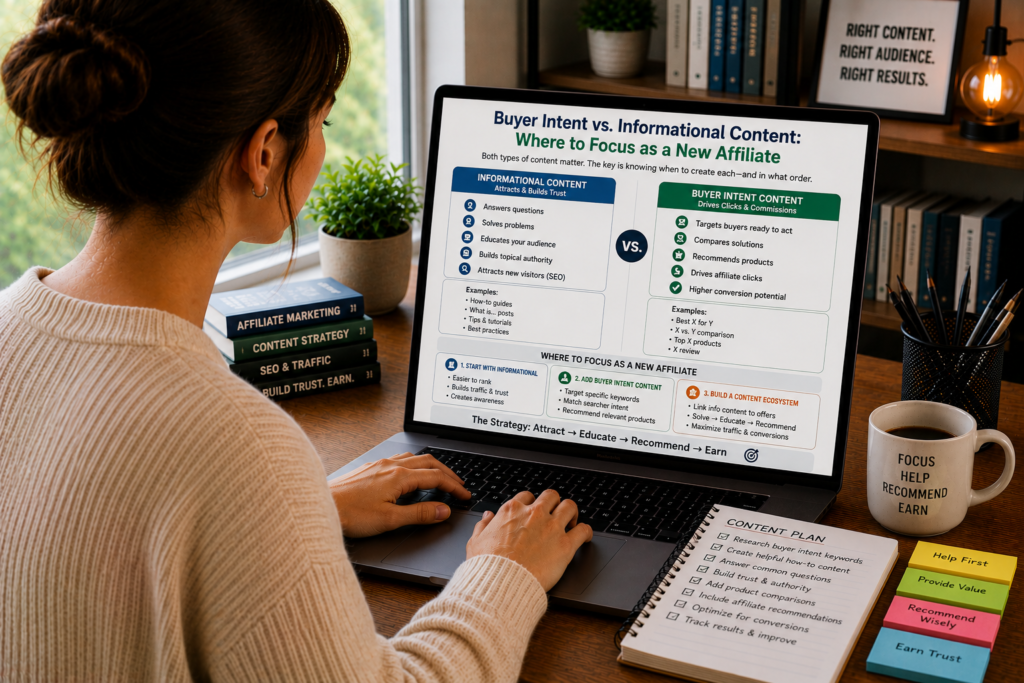
You just launched your affiliate site. The domain is live, your hosting is set up, and you’re staring at a blank content calendar. Now comes the question that trips up almost every new affiliate marketer:
Do you write content that helps people buy, or content that helps people learn?
On one side, you’ve got buyer intent content: product reviews, comparison posts, “best of” roundups. These are the pages that earn commissions. On the other side, you’ve got informational content: how-to guides, explainer articles, tutorials. These build traffic and authority but rarely put money in your pocket directly.
Both matter. But your time, budget, and energy are limited, especially in the early months. Getting this balance wrong means either waiting too long for your first commission or building a site that never earns Google’s trust.
This guide breaks down the real differences between these two content types, explains when and why each one matters, and gives you a practical framework for deciding where to put your focus at every stage of your affiliate site’s growth.
What Buyer Intent Content Actually Looks Like
Buyer intent content targets people who are already in a purchasing mindset. They’ve identified a problem, they know a product category can solve it, and they’re looking for guidance on which specific product to choose.
The defining characteristic: the reader is willing to spend money today (or very soon).
Here are the most common formats:
Product roundups (“Best X for Y”)
These are the workhorses of affiliate revenue. A well-structured roundup targeting “best noise-canceling headphones for studying” speaks directly to someone who has decided to buy headphones and needs a recommendation. Your job is to narrow their options and make the decision easier.
Head-to-head comparisons (“X vs Y”)
Comparison posts target people who’ve already shortlisted two or three products. They’ve done preliminary research and need a tiebreaker. “Sony WH-1000XM5 vs Bose QuietComfort Ultra” attracts someone who is one article away from clicking “Add to Cart.”
Single product reviews
Detailed reviews of specific products attract searchers who are almost done shopping. They’ve picked a product and want validation (or a reason to reconsider). A thorough, honest review with genuine hands-on experience converts at a high rate.
“Best alternative to” posts
These target people who’ve researched a popular product and decided it’s not right for them, whether because of price, features, or availability. They’re actively shopping for a replacement, which means strong purchase intent.
Price-qualified roundups (“Best X under $Y”)
When someone adds a price ceiling to their search, they’ve already allocated budget. They’re not browsing. They’re buying within a defined range.
The common thread across all of these: the reader arrived at your page with a purchase decision in progress. Your content is the last stop before the checkout page.
What Informational Content Actually Looks Like
Informational content targets people who want to learn, understand, or solve a problem. They may eventually buy something, but that’s not why they’re searching right now.
The defining characteristic: the reader wants knowledge, not a product recommendation.
Common formats include:
How-to guides
Step-by-step instructions for completing a task. “How to set up a home recording studio” teaches a process. The reader might buy equipment later, but right now they want the blueprint.
Explainer articles
“What is a condenser microphone” or “difference between dynamic and condenser microphones.” These answer factual questions and build the reader’s understanding of a topic.
Tutorials and walkthroughs
Hands-on educational content that teaches a skill. “How to record vocals at home with a budget setup” provides practical instruction rather than product recommendations.
Problem-solving content
“Why does my microphone have static noise” or “how to reduce echo in a small room.” The reader has a problem and wants a solution, not a purchase suggestion.
Concept and theory posts
“What is audio gain and why does it matter” or “understanding sample rates for beginners.” Pure education with no commercial angle.
Notice the pattern: none of these articles have a natural place for affiliate links. You could force product mentions into a how-to guide, but the reader didn’t come for product advice. Shoehorning affiliate links into informational content creates friction, and Google has gotten very good at recognizing (and penalizing) this mismatch.
Why This Distinction Matters More Than You Think
Here’s what happens when new affiliates ignore the difference between these content types:
Scenario 1: All buyer intent, no informational content.
You publish 30 “best of” roundups in your first three months. Each one targets a commercial keyword. The content is solid. But Google barely sends any traffic.
Why? Because your brand-new site has no topical authority. Google doesn’t trust a domain that only publishes product recommendations. It looks like a thin affiliate site, the exact type Google has explicitly said it wants to push down in search results.
Without informational content surrounding your money pages, Google has no evidence that you genuinely understand the topic you’re recommending products for. Your buyer intent pages float in isolation, disconnected from any demonstrated expertise.
Scenario 2: All informational content, no buyer intent.
You publish 50 how-to guides and explainer articles. Traffic starts rolling in after four to six months. You’re getting 500, then 1,000, then 5,000 monthly visitors. But your affiliate dashboard shows almost nothing.
Why? Because informational traffic doesn’t convert. Readers come, get their answer, and leave. There’s no natural path from “how to brew pour-over coffee” to clicking an affiliate link for a specific kettle. You’ve built an audience that consumes free information and moves on.
The reality: you need both. But the ratio matters, the timing matters, and understanding what each type does for your site matters even more.
What Each Content Type Does for Your Site
Let’s get specific about the role each type plays.
Buyer Intent Content: The Revenue Engine
Buyer intent pages serve one primary function: they convert visitors into affiliate clicks and, eventually, commissions. They are the pages where money changes hands.
What they do well:
- Generate affiliate income directly
- Attract visitors who are ready to act
- Create clear, measurable ROI for your time and effort
- Provide natural placement for affiliate links without feeling forced
What they struggle with:
- Earning rankings on new, low-authority sites
- Attracting backlinks naturally (few people link to product roundups)
- Building the kind of topical depth Google wants to see
- Standing out when competing against established review sites
Informational Content: The Authority Builder
Informational pages serve a different function. They build the infrastructure that makes your buyer intent content rank.
What they do well:
- Attract organic backlinks (how-to guides and educational content earn links naturally)
- Build topical authority in Google’s eyes
- Create internal linking opportunities that boost your money pages
- Bring in top-of-funnel traffic that can be directed to buyer intent pages
- Establish your site as a genuine resource, not just a product catalog
What they struggle with:
- Generating direct affiliate revenue
- Converting visitors into buyers
- Justifying the time investment in the short term
The Real Framework: How to Decide Where to Focus
Here’s the part most guides get wrong. They tell you to write both types and leave it at that. That’s like telling a new business owner to “do marketing and sales.” Technically true, completely unhelpful.
What you need is a phased approach that matches your content strategy to your site’s current stage.
Stage 1: Months 1 Through 3 (Foundation Phase)
Recommended split: 40% buyer intent, 60% informational
This feels counterintuitive. You started an affiliate site to make money, so shouldn’t you focus on the pages that earn commissions? Not yet.
During the first three months, your site has virtually no authority. Google doesn’t know who you are, doesn’t trust your domain, and isn’t going to rank your “best wireless earbuds” post against established competitors.
Here’s what to do instead:
On the informational side (60%):
- Write 10 to 15 in-depth informational articles covering the core concepts in your niche
- Target long-tail informational keywords with very low competition (KD under 10)
- Focus on questions your target audience asks before they start shopping
- Make these genuinely useful, the kind of content that someone might bookmark or share
For a coffee equipment affiliate site, this means articles like:
- How to grind coffee beans without a grinder (8 methods)
- What grind size should you use for different brew methods
- How to clean a burr grinder (step-by-step with photos)
- Why does my French press coffee taste bitter (and how to fix it)
These articles do three things: they show Google your site covers coffee topics with depth, they attract early organic traffic from low-competition queries, and they create internal linking hubs for your future buyer intent content.
On the buyer intent side (40%):
- Write 5 to 8 buyer intent articles targeting very specific, long-tail commercial keywords
- Avoid broad keywords like “best coffee grinder” entirely at this stage
- Target hyper-specific terms like “best manual coffee grinder for travel” or “best coffee grinder for Aeropress under 50”
- Write from personal experience whenever possible. Google’s helpful content guidelines reward first-hand testing
The goal for this phase isn’t revenue. It’s building a site that Google recognizes as a real resource. Your informational content does the heavy lifting here, while your initial buyer intent posts get indexed and start aging (a factor that helps with future rankings).
Stage 2: Months 4 Through 8 (Growth Phase)
Recommended split: 55% buyer intent, 45% informational
By now, some of your informational content should be picking up organic traffic. Your site has a few months of history, a handful of indexed pages, and (hopefully) a couple of natural backlinks from your informational content.
Time to shift the balance.
On the buyer intent side (55%):
- Increase your output of commercial content
- Start targeting slightly more competitive buyer keywords (KD 15 to 25)
- Build comparison posts and single product reviews
- Create content clusters: a pillar “best of” post surrounded by supporting comparison and review posts
- Interlink everything. Your informational posts should link to relevant buyer intent pages, and vice versa
On the informational side (45%):
- Continue publishing informational content, but make it more strategic
- Write articles that naturally lead readers toward a purchase decision
- Target “bridge” keywords that sit between informational and commercial intent
Bridge content is a powerful concept. Here’s an example:
“How to choose a coffee grinder” is informational, but the reader is actively moving toward a purchase. An article answering this question can genuinely help the reader while naturally transitioning to product recommendations. “Based on the factors we just covered, here are the grinders that check every box for [specific use case]” is a natural, non-forced bridge to your affiliate roundup.
Other bridge content examples:
- “What to look for in a standing desk” (leads naturally to your best standing desks post)
- “Drip coffee maker vs pour over: which is right for you” (leads to specific product recommendations for each method)
- “How much should you spend on a good pair of headphones” (leads to your budget-specific roundup posts)
This bridge content does double duty: it ranks for informational keywords and funnels readers toward your money pages.
Stage 3: Months 9 Through 18 (Scaling Phase)
Recommended split: 65% buyer intent, 35% informational
Your site now has authority, indexed pages, and (ideally) growing organic traffic. The foundation is set. Time to capitalize.
On the buyer intent side (65%):
- Target higher-competition buyer keywords that you couldn’t touch early on
- Expand into adjacent product categories within your niche
- Update and improve your existing buyer intent content (refresh product picks, update pricing, add new contenders)
- Build comprehensive comparison hubs covering all major products in your space
On the informational side (35%):
- Maintain consistent informational publishing, but be selective
- Focus on topics that generate backlinks or fill gaps in your topical coverage
- Write “definitive guide” style content that can serve as a topical authority signal for your entire niche
Stage 4: Month 18 and Beyond (Optimization Phase)
Recommended split: 70% buyer intent, 30% informational
At this point, your strategy shifts from building to optimizing. Most of your new content should target commercial keywords, because your site now has the authority to compete for them.
Your informational content at this stage serves a maintenance function: keeping your topical coverage current, filling any remaining gaps, and continuing to earn backlinks that benefit your entire domain.
The Internal Linking Strategy That Ties It All Together
Publishing both content types without connecting them is like building roads that don’t lead anywhere. Internal linking is what transforms a collection of articles into a revenue-generating system.
Here’s how to structure it:
Informational articles link to buyer intent pages.
Every how-to guide and explainer should include at least one natural link to a relevant buyer intent page. “Now that you understand grind sizes, check out our picks for the best burr grinder for home use” is a natural transition, not a forced plug.
Buyer intent pages link to informational articles.
Your product roundups should link to educational content that helps readers understand the criteria you’re using. “We evaluated each grinder on burr type, grind consistency, and noise level. (Not sure why these matter? Here’s our guide to what makes a great coffee grinder.)” This adds depth and keeps readers on your site longer.
Create topic clusters.
Group your content around pillar topics. A “coffee grinders” cluster might include:
- Pillar: Best coffee grinders for every budget (buyer intent)
- Supporting: How to choose a coffee grinder (bridge)
- Supporting: Burr vs blade grinders explained (informational)
- Supporting: Best coffee grinder for espresso (buyer intent)
- Supporting: Best manual coffee grinder for travel (buyer intent)
- Supporting: How to clean and maintain your coffee grinder (informational)
- Supporting: Baratza Encore vs Encore ESP (buyer intent)
Every page in the cluster links to related pages in the same cluster. This structure signals to Google that your site covers this topic comprehensively, boosting rankings across the entire group.
How to Measure What’s Working
Different content types need different metrics. Measuring your buyer intent content by traffic volume, or your informational content by affiliate clicks, leads to bad decisions.
For buyer intent content, track:
- Affiliate link click-through rate (CTR)
- Earnings per click (EPC)
- Revenue per page per month
- Conversion rate from click to sale
- Ranking position for target keywords
A buyer intent page that gets 200 visitors per month but generates $150 in commissions is outperforming an informational page that gets 5,000 visitors and earns nothing.
For informational content, track:
- Organic traffic growth
- Number of backlinks earned
- Internal link click-through to money pages
- Time on page and engagement metrics
- Ranking position for target keywords
- Number of “People Also Ask” features won
An informational page that gets 1,000 monthly visitors and sends 15% of them to your buyer intent content through internal links is doing its job perfectly.
For your overall site, track:
- Total organic traffic (trending up month over month)
- Total affiliate revenue (trending up)
- Revenue per visitor across the site
- Domain authority/rating growth
- Number of keywords ranking on page one
Mistakes That Sink New Affiliate Sites
Mistake 1: Publishing 50 “Best” Posts Before Having Any Authority
This is the most common error. New affiliates create dozens of buyer intent posts because they want to start earning immediately. But without informational content to build authority and internal linking structure, these commercial pages sit on page three or four of Google indefinitely.
The fix: earn Google’s trust before asking for commercial keyword rankings.
Mistake 2: Writing Informational Content with No Path to Revenue
The opposite mistake. Building a library of educational content is admirable, but if none of it connects to money pages, you’re running a free encyclopedia, not an affiliate business.
The fix: every informational article should link to at least one buyer intent page. If no relevant money page exists yet, make a note to create one.
Mistake 3: Copying the Content Mix of Established Sites
Big affiliate sites often have a 80/20 or 90/10 split favoring buyer intent content. New affiliates see this and assume they should do the same from day one. But those sites earned that ratio over years of building authority. They can rank for competitive commercial keywords because they’ve already established trust with Google.
The fix: follow the phased approach outlined above. Your content ratio should evolve as your site matures.
Mistake 4: Treating Informational and Buyer Intent Content as Separate Silos
Some affiliates mentally separate their content into “traffic content” and “money content” and never connect the two. They end up with two disconnected content libraries that don’t support each other.
The fix: plan your content in clusters from the start. Every informational post should be written with awareness of which buyer intent page it supports.
Mistake 5: Ignoring Content Updates
Your buyer intent posts from six months ago now have outdated prices, discontinued products, and old screenshots. Your informational posts reference tools or techniques that have been updated.
The fix: schedule quarterly content audits. Update product recommendations, refresh statistics, fix broken links, and add new internal links to recently published content.
A 90-Day Content Plan for a Brand-New Affiliate Site
Here’s a practical plan you can follow during the first three months.
Weeks 1 through 2: Planning
- Research and select 30 keywords (12 buyer intent, 18 informational)
- Map keywords to content types and organize them into topic clusters
- Outline your internal linking strategy
Weeks 3 through 4: Foundation informational content
- Publish 4 informational articles targeting your easiest keywords
- Focus on comprehensive, experience-driven content
- Include internal links to planned (not yet published) money pages using placeholder anchor text you’ll activate later
Weeks 5 through 6: First buyer intent content
- Publish 2 buyer intent articles targeting hyper-specific, low-competition commercial keywords
- Link back to your published informational posts
- Make sure product recommendations are genuine and based on real evaluation
Weeks 7 through 8: Expand informational coverage
- Publish 4 more informational articles
- Target “bridge” keywords that naturally lead to purchase decisions
- Strengthen internal linking between all published posts
Weeks 9 through 10: Scale buyer intent
- Publish 3 more buyer intent articles
- Start building comparison posts that link to your single reviews
- Update earlier informational posts with links to new money pages
Weeks 11 through 12: Review and optimize
- Publish 2 more informational articles and 1 more buyer intent article
- Audit all internal links and fix any gaps
- Check Google Search Console for early indexing signals and keyword impressions
- Plan the next quarter’s content based on what’s showing traction
End of 90 days: You have approximately 20 to 25 published articles, a solid internal linking structure, a mix of content types that signals topical authority, and a handful of buyer intent posts that are aging and ready to start climbing in rankings.
The Long View: Why Patience Pays
Here’s an uncomfortable truth: most new affiliate sites don’t earn meaningful income in their first six months. The ones that survive and thrive are built by people who understood this from the start and invested in the right content at the right time.
Informational content is a long-term investment. It doesn’t pay you today, but it builds the authority that makes your buyer intent content rank six months from now. Skipping it is like skipping the foundation when building a house. Everything looks fine until it isn’t.
Buyer intent content is your revenue mechanism. Without it, you have a blog, not a business. But publishing it before your site can rank for commercial keywords is like opening a store on a street with no foot traffic.
The affiliates who win are the ones who understand the relationship between these two content types and time their efforts accordingly.
Start with authority. Build with intent. Scale with both.
That’s not just a content strategy. That’s how affiliate businesses are built to last.