Zero visitors. Zero impressions. Zero clicks.
That’s what stares back at you from Google Search Console the first time you check your brand-new affiliate site. And the second time. And usually, the fifth or sixth time too.
The early months of an affiliate site are brutally quiet. You’ve published content, set up your tracking, picked your affiliate programs, and now… nothing. The silence makes you wonder whether the whole thing is worth the effort.
Here’s what nobody tells new affiliate site owners: getting from zero to your first 1,000 visitors is the hardest traffic milestone you’ll hit. Going from 1,000 to 5,000 is easier. Going from 5,000 to 20,000 is easier still. The difficulty curve slopes downward as your site gains authority, indexed pages, and Google’s trust.
But that first thousand? You earn every single visitor.
This guide lays out a concrete, step-by-step plan for reaching that first milestone. No paid ads. No existing audience. No social media following. Just a new domain, good content, and a systematic approach that works even if you’re starting from absolute zero.
Why the First 1,000 Visitors Matter More Than You Think
The number itself isn’t magical. One thousand visitors won’t generate life-changing affiliate revenue. Depending on your niche and conversion rates, it might produce $20 to $200 in commissions.
But the first 1,000 visitors represent something far more valuable than the revenue they produce:
Proof of concept. Real humans found your site through search, read your content, and (some of them) clicked your affiliate links. Your niche works. Your content resonates. Your keyword research has traction.
Data you can act on. With 1,000 visitors, Google Search Console starts showing you meaningful patterns. Which keywords are driving impressions? Which pages have the highest click-through rate? Where are you ranking on page two, just one content update away from page one traffic? This data shapes every decision you make going forward.
Momentum that compounds. Google’s trust builds incrementally. Each visitor, each minute of engagement, each return visit signals to Google that your site deserves more visibility. The first 1,000 visitors make the next 1,000 come faster.
Psychological fuel. Building an affiliate site is a lonely, unglamorous process. Watching real traffic arrive keeps you motivated during the months when growth feels painfully slow.
Let’s get into how to make it happen.
Before You Chase Traffic: The Foundation Checklist
Driving visitors to a site that isn’t ready for them is a waste of effort. Before you focus on traffic, make sure these fundamentals are in place.
Technical SEO Basics
Your site needs to be crawlable, indexable, and fast. If Google can’t find, read, and render your pages properly, no amount of content or promotion will help.
Site speed matters. Pages that load in under 2.5 seconds keep visitors. Pages that take 5+ seconds lose more than half of them before the content even appears. Use a lightweight theme, compress images, enable browser caching, and use a content delivery network (CDN). Run your site through Google PageSpeed Insights and fix anything flagged as critical.
Mobile responsiveness is mandatory. Google indexes the mobile version of your site first. If your content looks broken, cramped, or unreadable on a phone, your rankings will suffer regardless of how good the content is.
SSL certificate (HTTPS). This is table stakes. Google treats non-HTTPS sites as “not secure,” and browsers display warnings that scare visitors away. Most hosting providers include free SSL certificates.
XML sitemap submitted to Google Search Console. Your sitemap tells Google which pages exist on your site. Submit it through Search Console and make sure new pages are added automatically as you publish them.
Clean URL structure. Use descriptive, keyword-relevant URLs. yoursite.com/best-coffee-grinders-french-press is far better than yoursite.com/p=1247. Keep URLs short, lowercase, and hyphen-separated.
No index-blocking mistakes. Check that your robots.txt file isn’t accidentally blocking Google from crawling your content. Verify that no pages have “noindex” tags unless you intentionally want them hidden from search.
Content Readiness
Don’t start promoting a site with three published articles. You need enough content to look like a real, established resource.
Minimum viable content library: 15 to 20 published articles. This gives Google enough pages to understand your site’s topic, and it gives visitors a reason to explore beyond the page they landed on.
A mix of content types. Your initial library should include a blend of buyer intent content (roundups, comparisons, reviews) and informational content (how-to guides, explainers, educational posts). This signals to Google that your site is a genuine resource, not a thin affiliate play.
Proper internal linking. Every article should link to at least two or three other articles on your site. This helps Google discover and crawl all your pages, distributes authority across your site, and keeps visitors engaged longer.
Affiliate Setup
Make sure your affiliate accounts are active and your links are working before traffic arrives. There’s nothing more frustrating than getting visitors, having them click your links, and discovering your affiliate tracking was broken the entire time.
- Apply to relevant affiliate programs (Amazon Associates, ShareASale, individual brand programs, etc.)
- Test every affiliate link on every published page
- Set up link tracking so you know which pages and links generate clicks
- Verify that your affiliate disclosures are visible and compliant with FTC guidelines
Phase 1: Win the Keywords Nobody Else Wants (Months 1 Through 2)
Your brand-new site has zero domain authority. You cannot compete for keywords that established sites are targeting. Trying to rank for “best wireless earbuds” against Wirecutter and RTINGS is like entering a boxing ring with a heavyweight champion on your first day of training.
Instead, you’re going to find and dominate keywords that bigger sites have overlooked, ignored, or deemed too small to bother with.
Finding Ultra-Low-Competition Keywords
The keywords that drive your first 1,000 visitors share three characteristics:
- Low keyword difficulty (KD under 15). Most keyword tools rate difficulty on a scale of 0 to 100. For a brand-new site, you want the bottom end of that scale.
- Some measurable search volume. Anything from 50 to 500 monthly searches works. You’re not looking for volume; you’re looking for winnable terms. Ten articles each bringing in 30 to 50 visitors per month gets you to 300 to 500 monthly visitors from those pages alone.
- Clear intent you can serve. The keyword should match a specific question, comparison, or buying decision that you can answer better than whatever currently ranks.
Here’s where to find them:
Google Autocomplete mining. Type your niche’s core product terms into Google and watch the suggestions. Then append each letter of the alphabet to find deeper variations. “Coffee grinder for a…” reveals “coffee grinder for Aeropress,” “coffee grinder for apartment,” “coffee grinder for artisan bread.” These long-tail variations often have zero dedicated content targeting them.
“People Also Ask” expansion. Search your core terms and click through the “People Also Ask” boxes. Each click generates new questions. Go three or four levels deep. These questions represent real searches that real people are making, and many of them have no strong content competing for them.
Reddit and forum mining. Go to Reddit and search your niche. Read threads where people ask for recommendations or help. The exact phrasing they use often matches low-competition search queries. “What’s the quietest coffee grinder for early morning use” might be a Reddit post title and a Google search query at the same time.
Amazon search suggestions. Amazon’s autocomplete reflects buyer behavior. Type your product categories and capture every suggestion. Cross-reference these with Google keyword data to find terms with search volume but low competition.
Competitor gap analysis. Find smaller affiliate sites in your niche (look for sites that rank on page one for any of your target keywords). Plug their domain into Ahrefs or SEMrush and filter for keywords where they rank in positions 5 through 20 with KD under 15. These are proven winnable terms.
Writing Content That Ranks Fast
Once you’ve identified 15 to 20 ultra-low-competition keywords, write content that’s specifically designed to rank quickly.
Match search intent precisely. Before writing a single word, search your target keyword in Google. Look at what currently ranks. If the top results are listicles, write a listicle. If they’re detailed guides, write a detailed guide. If they’re comparison tables, include a comparison table. Google is telling you what format it prefers for that query. Match it.
Cover the topic completely for its scope. Don’t confuse low competition with low effort. A 1,400-word article targeting “best coffee grinder for Aeropress under 100” should thoroughly cover that specific topic, including grind consistency for Aeropress brewing, the three to five best options, pros and cons of each, and a clear recommendation. Thin content won’t rank even for low-competition terms.
Include the information readers can’t get elsewhere. Original testing data, personal experience, specific measurements, real photos of products you’ve actually used. Google’s helpful content system explicitly rewards first-hand experience. A new site that demonstrates genuine expertise can outrank established sites that publish generic, research-based roundups.
Optimize on-page SEO without overdoing it. Include your target keyword in the title tag, the H1 heading, the URL, the meta description, and naturally within the first 100 words. Use semantic variations throughout the body. But don’t stuff keywords. Write for the human reader first; the optimization should be invisible to them.
Publish at a consistent pace. Aim for two to three articles per week during this phase. Google rewards sites that publish consistently over sites that dump 20 articles at once and then go silent for a month.
Phase 2: Build Authority Signals Google Trusts (Months 2 Through 4)
Publishing great content for low-competition keywords is the foundation. But content alone won’t get you to 1,000 visitors if Google doesn’t trust your domain yet. You need external signals that tell Google your site is legitimate, authoritative, and worth recommending to searchers.
Earning Your First Backlinks
Backlinks remain one of the strongest ranking factors in Google’s algorithm. A new site with zero backlinks faces an uphill battle, even for low-competition keywords. Here’s how to earn your first 10 to 20 links without buying them or spamming anyone.
Create linkable informational content. Product roundups rarely attract backlinks. Nobody links to “best coffee grinders under 100” in their blog post. But people do link to useful educational resources. Write two to three genuinely valuable informational pieces designed to attract links:
- Original research or data (survey your niche audience, compile statistics from public sources, create comparison charts that don’t exist elsewhere)
- Comprehensive how-to guides that become the definitive resource on a specific topic
- Visual resources like infographics, comparison diagrams, or buying decision flowcharts
These “link magnet” articles serve double duty: they attract backlinks that boost your entire domain’s authority, and they build topical relevance that helps your buyer intent content rank.
Guest posting on niche-relevant blogs. Find blogs in your niche or adjacent niches that accept guest contributions. Write a genuinely useful article (not a thinly veiled promotion for your site) and include one natural link back to a relevant page on your site.
Focus on relevance over domain authority. A link from a small but topically relevant blog in your niche is worth more than a link from a high-DA site in an unrelated industry.
To find opportunities, search Google for:
- “[your niche] + write for us”
- “[your niche] + guest post”
- “[your niche] + contribute”
- “[your niche] + guest author”
Aim for one to two guest posts per month. Quality matters more than volume.
Resource page link building. Search for resource pages in your niche: pages that curate helpful links on a specific topic. If your content is genuinely useful, email the page owner and suggest adding your resource. Keep the outreach short, specific, and non-pushy.
Template: “Hi [name], I noticed your resource page on [topic]. I recently published a comprehensive guide on [specific subtopic] that covers [what makes it different]. If you think it would be useful for your readers, here’s the link: [URL]. Either way, great list. Thanks for your time.”
Most won’t respond. Some will. One quality backlink from a relevant resource page can meaningfully boost your domain authority.
Broken link building. Use tools like Ahrefs or Check My Links (a free Chrome extension) to find broken links on resource pages and blog posts in your niche. If you have content that covers the same topic as the broken link, reach out and suggest your page as a replacement. You’re solving a problem for the site owner while earning a link.
HARO and journalist requests. Help a Reporter Out (HARO) and similar platforms connect journalists with sources. Sign up and respond to relevant queries in your niche. When a journalist uses your quote or expertise in their article, they typically link back to your site. The links you earn here tend to be from high-authority news and media sites.
Building Topical Authority Through Content Clusters
Google doesn’t evaluate pages in isolation. It evaluates your site’s overall coverage of a topic. A site with 25 interconnected articles about coffee equipment sends a stronger topical signal than a site with 25 articles about 25 unrelated topics.
Structure your content into clusters:
Choose three to four core topic clusters for your site. For a coffee equipment site, these might be: coffee grinders, espresso machines, pour-over equipment, and coffee beans/roasting.
Build each cluster deliberately. Each cluster should include:
- One comprehensive pillar page (buyer intent, targeting your most promising keyword in that cluster)
- Three to five supporting buyer intent pages (comparisons, individual reviews, budget-specific roundups)
- Three to five supporting informational pages (how-to guides, explainers, troubleshooting posts)
Interlink aggressively within clusters. Every page in a cluster should link to the pillar page and to at least two other pages in the same cluster. This internal linking structure tells Google that your site covers this topic comprehensively and helps distribute ranking authority across all pages in the cluster.
Publish clusters sequentially, not randomly. Instead of publishing one article from each of five different clusters, finish building one cluster (8 to 12 articles) before starting the next. This concentrated approach builds topical authority faster.
Establishing E-E-A-T Signals
Google’s E-E-A-T framework (Experience, Expertise, Authoritativeness, Trustworthiness) directly impacts how it evaluates content quality. For a new affiliate site, demonstrating these signals early accelerates Google’s willingness to rank your content.
Experience. Show that you’ve actually used the products you recommend. Include original photos (not stock images or Amazon product shots). Mention specific details that only a real user would know. “The Baratza Encore’s hopper holds about 8 oz of beans, but it’s slightly annoying to remove for cleaning because the latch sticks” is the kind of detail that signals genuine hands-on experience.
Expertise. Demonstrate knowledge of your niche beyond surface-level product specs. Your informational content should show deep understanding. A coffee site owner who can explain extraction theory, water chemistry, and grind distribution is more credible than one who just lists product features copied from Amazon.
Authoritativeness. This builds over time through backlinks, brand mentions, and consistent high-quality publishing. In the early months, focus on what you can control: author bios with relevant credentials or experience, consistent publishing under a real name (not “admin” or “staff”), and building a small but genuine social media presence tied to your niche.
Trustworthiness. Clear affiliate disclosures on every page with affiliate links. An accessible About page explaining who runs the site and why. A Contact page with a real email address. A Privacy Policy and Terms of Service. These aren’t just legal requirements; they’re trust signals that Google and visitors both evaluate.
Phase 3: Squeeze Maximum Value from Every Published Page (Months 3 Through 5)
By month three, you should have 25 to 40 published articles and some early traction in Google Search Console. Now it’s time to optimize what you’ve already built before publishing more.
Google Search Console Optimization
Google Search Console is your most powerful free tool during this phase. Here’s exactly how to use it.
Find “striking distance” keywords. Filter Search Console data for queries where your average position is between 8 and 20. These are keywords where you’re close to page one (or already on page one but at the bottom). A small improvement in ranking can produce a significant jump in traffic.
For each striking distance keyword:
- Make sure it appears naturally in the article’s content, headings, and meta description
- Check whether the article fully answers the question implied by the keyword
- Add a dedicated section addressing that keyword if the article doesn’t currently cover it
- Strengthen the internal linking to that page from other relevant articles on your site
Identify click-through rate opportunities. Look for keywords where you have good rankings (positions 3 to 7) but low CTR. This means people see your result but aren’t clicking it. The problem is usually your title tag or meta description.
Rewrite the title to be more specific and compelling. Instead of “Best Coffee Grinders 2026,” try “7 Best Coffee Grinders We Tested in 2026 (Starting at $35).” The specific number, the “we tested” credibility signal, and the price point all encourage clicks.
Rewrite the meta description to preview the value. Instead of a generic summary, include a specific claim or result: “After grinding 50+ pounds of beans across 12 machines, these are the grinders that delivered the most consistent results for every brew method.”
Find content gaps. Look at which queries are generating impressions but your content doesn’t specifically address. If people are finding your coffee grinder article through the query “quietest coffee grinder for apartment” but your article doesn’t have a section about noise levels, add one. You’re already showing up for that search; a content update could push you from page two to page one.
Update and Expand Existing Content
Content updates are one of the highest-ROI activities for a new affiliate site. Improving an existing page that Google has already indexed and partially ranked is often faster than publishing a brand-new page from scratch.
Expand thin sections. If a product review in your roundup has only 80 words, expand it to 200 to 300 words with more specific details about who the product is best for, how it performed in your testing, and what its main weaknesses are.
Add missing content formats. If your article doesn’t have a comparison table, add one. If it doesn’t have a FAQ section, add frequently asked questions pulled from “People Also Ask” results. If it doesn’t have a quick-pick summary at the top, add one.
Refresh outdated information. Update prices, check whether any recommended products have been discontinued, and add new products that have launched since you published.
Strengthen introductions. Your opening paragraph determines whether a visitor stays or bounces. If your intro is generic, rewrite it to immediately address the reader’s specific need and preview what they’ll learn.
Internal Link Audits
As your site grows, internal linking gaps develop naturally. Every month, audit your internal linking structure:
- Does every page link to at least two other relevant pages?
- Do your high-priority buyer intent pages receive internal links from at least five other pages?
- Are your pillar pages well-connected to all supporting content in their cluster?
- Do you have orphan pages (pages with no internal links pointing to them)?
Fix gaps as you find them. Internal linking is free, takes minutes, and directly impacts rankings.
Phase 4: Diversify Your Traffic Sources (Months 3 Through 6)
Organic search should be your primary traffic channel long-term. But during the early months, while Google is still evaluating your site, supplementary traffic sources can bridge the gap and accelerate your path to 1,000 visitors.
Pinterest (For Visual and Lifestyle Niches)
If your niche has a visual component (home decor, food, fashion, fitness, DIY, gardening, travel gear), Pinterest can send meaningful traffic even to brand-new sites.
Pinterest functions as a visual search engine, not a social media platform. Content on Pinterest has a much longer lifespan than posts on Instagram or Twitter. A well-optimized pin can drive traffic for months or even years.
Create pins for every article. Design two to three different pin images for each piece of content. Use clear, readable text overlay on an attractive background. Pin dimensions should be 1000 x 1500 pixels (2:3 ratio).
Optimize pin descriptions with keywords. Pinterest has its own search algorithm. Include relevant keywords in your pin titles and descriptions the same way you’d optimize for Google.
Pin consistently. Aim for 5 to 15 pins per day (a mix of your own content and repins of relevant content from others). Use a scheduling tool like Tailwind to maintain consistency without spending hours daily on the platform.
Join group boards in your niche. Group boards expose your pins to a larger audience than your own followers provide. Search for active group boards in your niche and request to join.
Pinterest traffic won’t replace organic search, but it can contribute 100 to 300 monthly visitors within the first few months, meaningful progress toward your 1,000-visitor goal.
Quora and Reddit (For Any Niche)
Both platforms have massive audiences and allow you to share expertise in ways that drive traffic back to your site, if done correctly.
The critical rule: provide genuine value first. Both Quora and Reddit communities despise self-promotion. If you show up just to drop links, you’ll be downvoted, reported, and banned. Instead:
On Quora:
- Find questions related to your niche that you can answer with genuine expertise
- Write thorough, helpful answers (200 to 400 words)
- Include a link to your relevant article only when it adds genuine value and goes deeper than your answer can
- Build a Quora profile that establishes your credibility in the niche
On Reddit:
- Become an active community member before you ever share a link
- Comment helpfully on other people’s posts for two to four weeks first
- When you share your own content, frame it as a resource you’ve created, not a promotion
- Only post in subreddits where your content is genuinely relevant and allowed by the rules
- Never post the same link across multiple subreddits simultaneously
Done right, Quora and Reddit can each send 50 to 200 monthly visitors and generate backlinks when other content creators discover and reference your answers.
Niche Forums and Communities
Many niches have dedicated forums, Facebook groups, Discord servers, or Slack communities. These concentrated audiences are small but highly engaged.
- Identify three to five active communities in your niche
- Spend the first month contributing genuinely (answering questions, sharing opinions, helping people)
- Once you’ve established credibility, share your content when it’s directly relevant to a discussion
- Never cold-post links without context or contribution
Forum traffic is small but valuable: these visitors are deeply interested in your niche and are more likely to engage, share, and return.
Email List Building (Starting Early)
Most new affiliate marketers ignore email because their traffic is too small to make it seem worthwhile. That’s a mistake.
Even with 50 monthly visitors, start collecting email addresses. Offer something genuinely useful in exchange:
- A buying guide PDF specific to your niche
- A comparison chart or cheat sheet
- A short email course (3 to 5 emails covering a topic in depth)
- Early access to new product reviews
Why start this early? Because an email list is the only traffic source you fully own. Google can change its algorithm. Pinterest can change its feed. Reddit can ban your account. But your email list belongs to you, and every subscriber represents a visitor you can bring back to your site any time you publish new content.
Even a list of 50 to 100 subscribers accelerates your growth. Each new article you publish gets immediate traffic from your email blast, which generates engagement signals that help the article rank in Google.
Phase 5: The Compounding Effect (Months 4 Through 8)
If you’ve followed the phases above, somewhere around month four to six, something shifts. Traffic starts compounding.
Here’s what the compounding effect looks like:
Your older content starts ranking. Articles you published in month one have now aged for several months. Google has had time to evaluate them, and if the content is solid, they start climbing from page three to page two, then from page two to page one.
New content ranks faster. Because your domain now has some authority, fresh articles reach page one faster than your earliest posts did. What took eight weeks in month one might take three weeks in month five.
Internal links become more powerful. With 30+ published articles, your internal linking structure creates a web of authority distribution. A new article inherits some authority from every page that links to it, giving it a ranking head start.
Backlinks produce downstream benefits. Links you earned in month two continue to benefit your entire domain. When a new page is published, it inherits domain-level authority from every backlink your site has ever earned.
Keyword cannibalization becomes an opportunity. Search Console data reveals keywords you’re accidentally ranking for across multiple pages. Consolidating this by choosing one target page per keyword and redirecting or merging the others concentrates ranking power and eliminates internal competition.
This compounding is why the path from 1,000 to 5,000 visitors is faster than the path from 0 to 1,000. You’ve built an engine that generates momentum on its own.
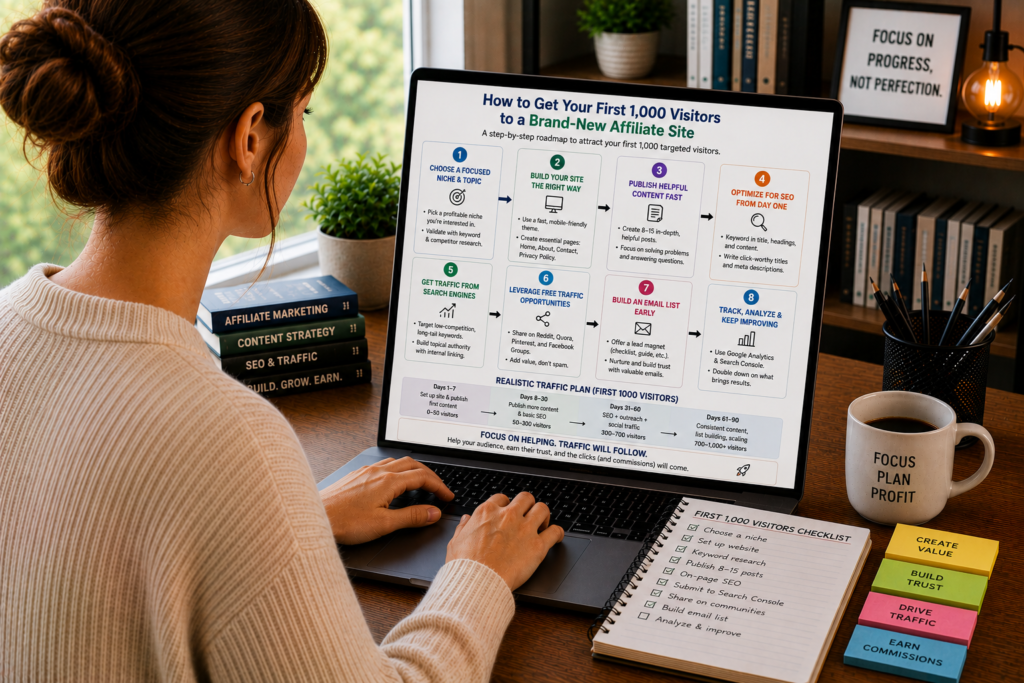
The Realistic Timeline: What to Expect Month by Month
Let’s calibrate your expectations with a realistic traffic timeline for a well-executed affiliate site starting from zero.
Month 1: 0 to 30 visitors.
Most traffic comes from Google indexing your pages and sending a trickle of impressions for very low-competition queries. Some direct traffic from testing your own site. Possibly a few visitors from initial Quora or Reddit activity. Don’t be discouraged. This is normal.
Month 2: 30 to 100 visitors.
Your earliest articles start appearing in Google Search Console data. You see impressions for long-tail keywords. A few pages start ranking on page two or at the bottom of page one for ultra-low-competition terms. Supplementary traffic from Pinterest or forums begins trickling in.
Month 3: 100 to 300 visitors.
The first meaningful organic traffic arrives. Several articles are now ranking on page one for their target keywords. Your content updates from Phase 3 start paying off. Your internal linking structure is helping newer pages get indexed and ranked faster.
Month 4: 300 to 500 visitors.
Compounding begins. Older articles climb to higher positions. New articles rank faster. Your domain authority is growing. Backlinks earned in earlier months are taking effect.
Month 5 to 6: 500 to 1,000 visitors.
You cross the 1,000-visitor threshold. Multiple articles are now ranking on page one. Your Search Console data is rich enough to drive strategic content decisions. Affiliate revenue starts becoming noticeable, if modest.
Important caveat: This timeline assumes consistent effort, 15 to 20 hours per week, publishing two to three quality articles weekly, active link building, and strategic content optimization. Less effort stretches the timeline. More effort compresses it. The trajectory also varies by niche competitiveness: a site in a low-competition niche like “best left-handed gardening tools” will reach 1,000 visitors faster than a site in a saturated niche like “best VPN.”
Tracking Your Progress: The Metrics That Matter
With limited traffic, you need to focus on the right metrics to gauge progress and make decisions.
Impressions (Google Search Console). Before you get clicks, you get impressions. Rising impressions mean Google is showing your content to searchers. If impressions are growing week over week, you’re on the right track even if clicks are still low.
Average position by keyword. Track your rankings for target keywords weekly. Movement from position 50 to position 20 is invisible in your traffic data but represents real progress. Movement from position 12 to position 8 is where traffic starts arriving.
Indexed pages. Monitor how many of your pages Google has indexed. If you’ve published 30 articles but only 18 are indexed, something is wrong with your site structure or crawlability.
Click-through rate. Once you start getting impressions, measure CTR. A low CTR with good rankings signals that your title tags and meta descriptions need improvement. This is one of the fastest fixes available.
Pages per session and time on page. These engagement metrics tell you whether visitors find your content valuable. If people are reading one page and leaving, your internal linking needs work. If time on page is under 30 seconds, your content isn’t matching search intent.
Referring domains. Track how many different websites link to yours. Growth in referring domains is one of the strongest predictors of future traffic growth.
Affiliate link clicks. Even with low traffic, tracking which affiliate links get clicked tells you which content resonates and which products your audience cares about. This data informs future content priorities.
The 10 Biggest Mistakes That Keep New Affiliate Sites Stuck at Zero
1. Publishing Content with No Keyword Strategy
Writing about whatever interests you, without checking whether anyone searches for it, produces content that nobody finds. Every article you publish should target a specific keyword with verified search volume and competition level you can realistically win.
2. Targeting Keywords Above Your Weight Class
A new site trying to rank for “best laptops” or “best credit cards” will fail. These keywords are owned by sites with thousands of backlinks and decades of authority. Target terms where smaller sites already rank on page one. That’s your playing field.
3. Neglecting Site Speed
A slow site kills your chances before content quality even enters the equation. If your pages take more than three seconds to load, fix this before doing anything else. Switch to faster hosting. Use a lightweight theme. Compress images. Install a caching plugin.
4. Waiting for Traffic Instead of Building It
Publishing articles and hoping Google sends visitors is not a strategy. Active effort, building backlinks, participating in communities, optimizing existing content, and strengthening internal linking, is what moves the needle during the early months.
5. Giving Up Too Early
The median timeline for a new site to gain meaningful organic traffic is four to eight months. Many new affiliates quit at month three because they expected faster results. If your content is good and your keyword targeting is sound, patience is the variable that separates success from failure.
6. Ignoring Google Search Console
Search Console tells you exactly what Google thinks about your site. Ignoring it means flying blind. Check it weekly from day one. The data becomes actionable faster than you expect.
7. Writing Thin Content for Low-Competition Keywords
Low competition doesn’t mean low effort. A 400-word article targeting an easy keyword won’t outrank even weak competitors. Every article should fully satisfy the search intent, regardless of how easy the keyword appears.
8. Publishing Without Proofreading
Spelling errors, grammatical mistakes, and awkward phrasing erode trust. If you can’t hire an editor, read every article out loud before publishing. Your ear catches mistakes your eyes skip over.
9. Skipping Affiliate Disclosures
Beyond the legal requirement, missing disclosures damage trust with both readers and Google. Every page with affiliate links should have a clear, visible disclosure statement near the top.
10. Not Tracking Anything
If you’re not measuring impressions, rankings, clicks, and affiliate performance, you can’t improve. Set up Google Search Console, Google Analytics, and your affiliate dashboard tracking from day one. Review the data weekly.
After 1,000: What Changes
Reaching 1,000 monthly visitors shifts your strategy in several meaningful ways.
You have enough data to make informed decisions. Search Console shows you clear patterns: which content types rank best, which keywords drive clicks, and where your opportunities are. Decision-making moves from guesswork to data analysis.
You can test conversion optimization. With 1,000 visitors per month, you can experiment with different affiliate link placements, CTA text, comparison table designs, and product recommendation formats. A/B testing becomes meaningful at this traffic level.
Content priorities become clearer. Your highest-traffic pages reveal what your audience cares about most. Double down on those topics. Expand the content clusters that are gaining traction. Deprioritize topics that aren’t resonating.
Revenue becomes predictable. With consistent traffic, your affiliate income becomes predictable enough to reinvest. Use early revenue to fund better product photos, professional editing, improved hosting, or a premium keyword research tool.
The next milestone comes faster. The effort that took six months to produce 1,000 visitors will take two to three months to produce the next 1,000. Your engine is running. Keep feeding it fuel.
The Condensed Action Plan
Here’s everything above distilled into a week-by-week action plan for your first six months.
Weeks 1 to 2: Set up technical SEO, submit sitemap, fix site speed, research 20 ultra-low-competition keywords.
Weeks 3 to 6: Publish 12 to 15 articles (mix of buyer intent and informational) targeting your easiest keywords. Build internal links between all published pages.
Weeks 7 to 10: Begin guest posting outreach (aim for two to three placements). Start participating in niche forums, Quora, and Reddit. Set up Pinterest if your niche is visual.
Weeks 11 to 14: Conduct first Search Console audit. Optimize title tags and meta descriptions for CTR. Update and expand your best-performing articles. Identify and target striking distance keywords.
Weeks 15 to 18: Publish 10 to 12 more articles, focusing on content clusters. Build second round of backlinks. Create a link magnet piece (original research, comprehensive guide, or visual resource).
Weeks 19 to 24: Intensify content optimization. Audit and strengthen all internal links. Expand content on topics showing traction. Begin email list building. Publish consistently at two to three articles per week.
By week 24, with consistent effort and sound execution, you should be at or approaching 1,000 monthly visitors with a clear upward trajectory.
The Honest Truth About Getting to 1,000
There’s no shortcut. No secret tactic. No single piece of content that will go viral and solve everything.
Getting your first 1,000 visitors is a grind. It’s a slow accumulation of small wins: a page that starts ranking for a 50-volume keyword, a backlink that gives your domain a tiny authority boost, a content update that moves a page from position 15 to position 7, a Quora answer that sends 20 visitors in a month.
None of these wins feel significant in isolation. Together, they build a traffic engine that runs indefinitely.
The affiliate marketers who reach 1,000 visitors, and then 10,000, and then 100,000, aren’t the ones who found a trick. They’re the ones who showed up week after week, published content that genuinely helped people, built links through real relationships, optimized based on real data, and refused to quit during the months when progress felt invisible.
Your first 1,000 visitors are out there, searching for answers in your niche right now. The question is whether you’ll build the site that Google trusts enough to send them to.
Start today. Be consistent. Trust the process. The traffic will come.