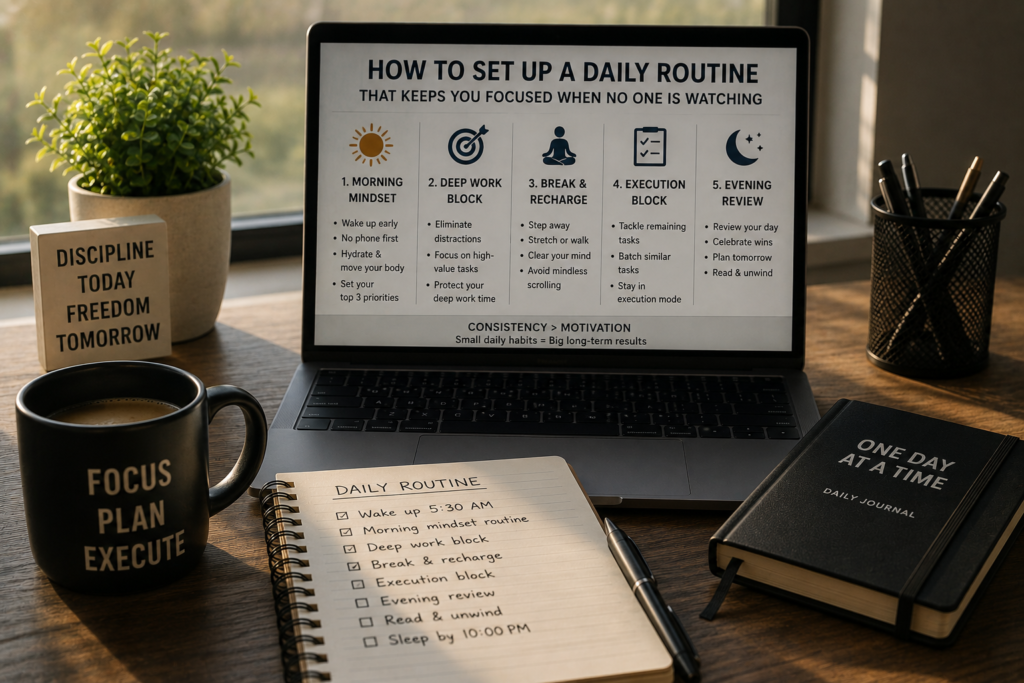
You sit down at your desk. Your laptop is open. You have a full day ahead and a list of things that need to get done. But nobody is checking in. Nobody is looking over your shoulder. Nobody will know if you spend the next 45 minutes scrolling through your phone.
And that’s the problem.
Staying focused when you’re accountable only to yourself is one of the hardest challenges of modern work. Whether you’re freelancing, running a business, working remotely, or building something on the side, the absence of external pressure can quietly erode your productivity day after day.
The good news? You can design a daily routine that acts as your own built-in accountability system. One that keeps you moving forward even when motivation fades, distractions pile up, and no one is watching.
This guide walks you through exactly how to build that routine, step by step.
Why Focus Falls Apart Without External Accountability
Before building the solution, it helps to understand the problem.
When someone is watching, whether it’s a boss, a teacher, or a client on a Zoom call, your brain activates what psychologists call “social facilitation.” The presence of others raises your alertness and sharpens your performance. Remove that pressure, and your brain defaults to its natural preference: conservation mode. It wants to save energy, avoid discomfort, and chase quick rewards.
This is why you can crush a deadline the night before a presentation but can’t seem to start the same project three weeks early. The urgency and visibility are missing.
A well-designed daily routine compensates for this gap. It replaces external accountability with internal structure, giving your brain clear signals about what to do, when to do it, and why it matters.
Step 1: Define What “Focused” Actually Means for You
“I want to be more focused” is too vague to act on. Focus looks different depending on your work, your goals, and your life situation.
Start by answering three questions:
- What are the 2-3 tasks that move my work forward the most? These are your high-leverage activities. For a writer, it might be drafting and editing. For a developer, it might be writing code and reviewing pull requests. For a business owner, it might be sales conversations and strategic planning.
- How many hours of deep, concentrated work do I realistically need each day? Most research suggests that 3-4 hours of genuine deep work is what high performers actually achieve. If you’re aiming for 8 hours of nonstop concentration, you’re setting yourself up to fail.
- What does a “good day” look like when I go to bed? Get specific. “I wrote 1,500 words and responded to client emails by 2 PM” is actionable. “I was productive” is not.
Write these answers down. They become the foundation of everything else.
Step 2: Anchor Your Day with a Morning Trigger
Every strong routine starts with a reliable trigger, a single action that tells your brain: “We’re starting now.”
This isn’t about waking up at 5 AM or doing cold plunges. It’s about consistency. Your morning trigger should be:
- Simple enough that you can do it on your worst day. Making coffee. Sitting at your desk. Opening a specific app.
- Consistent. Same action, same time, every working day.
- Disconnected from your phone. If the first thing you do is check notifications, you hand control of your attention to other people before your day has even begun.
Here’s an example of a morning trigger sequence:
- Wake up at 7:00 AM.
- Drink a glass of water.
- Sit at your desk by 7:30 AM.
- Open your task list and pick your top priority.
- Start working by 7:45 AM.
The goal isn’t perfection. It’s repetition. After a few weeks, this sequence becomes automatic, and starting your work shifts from a decision to a reflex.
Step 3: Use Time Blocking to Protect Your Best Hours
Your focus isn’t evenly distributed throughout the day. Most people have a 2-4 hour window where they do their best thinking. For many, it’s in the morning. For others, it’s late at night.
Identify your peak focus window and protect it aggressively.
Time blocking means assigning specific tasks to specific time slots on your calendar. Here’s why it works:
- It removes decision fatigue. Instead of asking “What should I work on?” every 30 minutes, you already have the answer.
- It creates artificial deadlines. When you know a block ends at 11:00 AM, your brain treats it like a mini-deadline and works faster.
- It makes distractions visible. If you scheduled 9-11 AM for writing and you’re browsing Reddit at 9:30, the gap between intention and behavior becomes obvious.
A sample time-blocked schedule might look like this:
| Time | Activity |
|---|---|
| 7:30 – 8:00 AM | Morning trigger + review task list |
| 8:00 – 10:30 AM | Deep work block (highest priority task) |
| 10:30 – 11:00 AM | Break + movement |
| 11:00 AM – 12:30 PM | Second deep work block |
| 12:30 – 1:30 PM | Lunch + full disconnection |
| 1:30 – 3:00 PM | Administrative tasks, emails, calls |
| 3:00 – 3:30 PM | Review + plan tomorrow |
Notice the structure: deep work happens first, admin fills the lower-energy afternoon, and there’s a clear endpoint. You’re not trying to focus for 8 straight hours. You’re concentrating your best effort into the hours that count.
Step 4: Create a Pre-Work Ritual That Shuts Out Distractions
The five minutes before you start focused work might be the most valuable five minutes of your day.
Use them to create what researchers call an “implementation intention,” a specific if-then plan that removes friction between you and your task.
Here’s a pre-work ritual that takes less than five minutes:
- Close every browser tab that isn’t related to your task. All of them.
- Put your phone in another room, or at minimum, face-down on silent. Studies show that simply having your phone visible on your desk reduces cognitive performance, even if you don’t touch it.
- Write down the single outcome you want from this work block. “Finish the first draft of sections 2 and 3” is better than “Work on the report.”
- Set a timer. 60-90 minutes works well for most people. The timer creates gentle pressure and gives you permission to stop when it rings.
- Put on the same background music or ambient sound every time. Over weeks, this becomes a Pavlovian cue that tells your brain it’s time to concentrate.
This ritual works because it shrinks the gap between “sitting at your desk” and “doing the work.” Most procrastination happens in that gap.
Step 5: Build in Accountability Checkpoints (Even If They’re Just for You)
Without a boss or a team, you need to create your own checkpoints. These are moments in the day where you pause, evaluate, and adjust.
Three checkpoints work well for most people:
Morning check-in (2 minutes): Before you start, write down your top 3 priorities. Keep it physical, a notebook or index card works better than an app because the act of writing forces clarity.
Midday review (5 minutes): Around lunchtime, look at what you’ve done so far. Are you on track? Did something unexpected eat your morning? Adjust your afternoon plan based on reality, not the ideal schedule you imagined at 7 AM.
End-of-day reflection (5 minutes): Before you close your laptop, answer two questions: “What did I accomplish today?” and “What’s the first thing I’ll work on tomorrow?” This reflection does two things. It gives you a sense of closure (which prevents work from bleeding into your evening), and it gives tomorrow’s version of you a head start.
These checkpoints take a combined 12 minutes. They’re worth hours of recovered focus.
Step 6: Design Your Environment to Make Focus the Default
Willpower is a limited resource. If your environment constantly tempts you to break focus, no routine will save you.
Instead of relying on discipline to resist distractions, redesign your space so distractions require effort and focus is the path of least resistance.
Physical environment:
- Work in the same spot every day. Your brain will start associating that location with focused effort.
- Keep your workspace clean. Visual clutter competes for your attention even when you’re not consciously looking at it.
- If you work from home, create a physical boundary between “work space” and “life space,” even if it’s just a different chair or a divider.
Digital environment:
- Use website blockers during deep work blocks. Tools like Cold Turkey, Freedom, or even the built-in Focus mode on your phone can make social media inaccessible during work hours.
- Turn off all non-critical notifications. Every notification is someone else’s priority interrupting yours.
- Use separate browser profiles or user accounts for work and personal browsing.
Social environment:
- Tell the people you live with your work hours and ask them to treat those hours the same way they’d treat an office job.
- If isolation is your problem (not distraction), schedule brief social check-ins with a friend, colleague, or accountability partner at set times.
The principle is straightforward: make it easy to do the right thing and hard to do the wrong thing.
Step 7: Handle the Energy Problem, Not Just the Time Problem
Most productivity advice focuses on time management. But when no one is watching, the real bottleneck is usually energy.
You might have a perfectly structured schedule, but if you’re exhausted, dehydrated, or running on three hours of sleep, that schedule is worthless.
Build these energy management practices into your routine:
Sleep: Protect 7-8 hours aggressively. No routine survives chronic sleep deprivation. Set a consistent bedtime, and treat it with the same seriousness as a morning alarm.
Movement: Schedule at least one movement break during your workday. A 15-minute walk between deep work blocks can restore more focus than a cup of coffee. Research from Stanford found that walking increases creative output by an average of 60%.
Nutrition: Eat meals at consistent times. Skipping lunch or replacing it with caffeine leads to an afternoon energy crash that destroys your second work block. Aim for meals that combine protein, fat, and complex carbohydrates for sustained energy.
Hydration: Keep water at your desk and drink throughout the day. Even mild dehydration (1-2%) impairs concentration and working memory.
These aren’t “wellness tips.” They’re performance infrastructure. Without them, your routine collapses under its own weight.
Step 8: Plan for Failure (Because It Will Happen)
Here’s what most productivity guides won’t tell you: you will break your routine. Probably within the first week. And that’s completely normal.
The difference between people who build lasting routines and those who abandon them isn’t perfection. It’s recovery speed. How quickly do you get back on track after a bad day?
Build these failure protocols into your routine:
The “minimum viable day” rule: On days when everything falls apart, whether you’re sick, stressed, distracted, or just not feeling it, define a minimum action that still counts. Maybe it’s 30 minutes of focused work. Maybe it’s just showing up at your desk and reviewing your task list. This keeps the habit chain intact even when the full routine breaks.
The “two-day rule”: Never skip your routine two days in a row. One bad day is a rest day. Two bad days starts a new pattern. This rule gives you flexibility without letting you slide into weeks of avoidance.
Weekly reset: Every Sunday evening (or whatever works for you), spend 15 minutes reviewing your week. What worked? What didn’t? What needs to change? Small weekly adjustments prevent the slow drift that turns a good routine into an abandoned one.
Step 9: Use the “Commitment Device” Strategy
A commitment device is any choice you make now that locks in your future behavior. It’s a way of removing the option to quit when things get hard.
Some practical commitment devices for focus:
- Tell someone your daily goal each morning. A simple text to a friend (“Today I’m finishing the proposal by noon”) creates social pressure that mimics having a boss. You don’t want to send a follow-up saying you watched YouTube instead.
- Use an accountability app. Tools like Focusmate pair you with a stranger for a 50-minute virtual co-working session. You show up, state your goal, work in silence together, and report back. The presence of another person, even virtually, activates that social facilitation effect.
- Pre-commit to consequences. Some people use apps like Beeminder, where you set a goal and get charged money if you don’t follow through. Having real stakes changes behavior fast.
- Batch your rewards. Instead of checking social media whenever you feel like it, make it a reward you earn after completing a deep work block. The key is sequencing: work first, reward second.
Commitment devices work because they shift the cost of procrastination from “future you” to “present you.” And present you is much more responsive to immediate consequences.
Step 10: Evolve Your Routine Every 30 Days
A routine that never changes becomes stale. Your work changes, your energy patterns shift with seasons, and what motivated you three months ago might bore you today.
Every 30 days, audit your routine:
- What’s working? Keep it. Double down on the parts that consistently produce results.
- What’s not working? Drop it or modify it. If your 5 AM wake-up is making you miserable and less productive, maybe 7 AM is your real start time.
- What’s missing? Are there new challenges, a bigger project, a shift in priorities, that your current routine doesn’t address?
- What can be simplified? Over time, routines tend to bloat. Cut anything that adds complexity without adding value.
The best routine is one you’ll actually follow six months from now. That requires ongoing adjustments, not rigid adherence to a plan you made on day one.
What a Complete Daily Routine Looks Like in Practice
Pulling everything together, here’s an example of a full daily routine built for focus without supervision:
6:30 AM — Wake up, drink water, no phone for the first 30 minutes.
7:00 AM — Light breakfast, movement (a short walk or stretching).
7:30 AM — Sit at desk. Morning check-in: write down top 3 priorities on a notecard.
7:45 AM — Pre-work ritual: close tabs, phone in another room, set 90-minute timer.
7:45 – 9:15 AM — Deep work block #1 (highest priority task).
9:15 – 9:30 AM — Break. Stand up, stretch, refill water.
9:30 – 11:00 AM — Deep work block #2.
11:00 AM — Midday review: check progress against morning priorities, adjust afternoon plan.
11:15 AM – 12:30 PM — Collaborative or administrative work (emails, calls, meetings).
12:30 – 1:30 PM — Lunch. Full disconnect from work.
1:30 – 3:00 PM — Light creative work or learning (tasks that need attention but not peak brainpower).
3:00 – 3:15 PM — End-of-day reflection: what got done, what’s first tomorrow.
3:15 PM onward — Personal time. Work is done.
This schedule gives you about 4 hours of deep focus, 2 hours of lighter work, and wraps up early in the afternoon. Adjust the times to fit your life, but keep the architecture: deep work first, admin second, clear start, clear end.
Common Mistakes That Sabotage Self-Directed Routines
Even with a solid plan, certain habits can quietly undermine your focus:
Checking email first thing in the morning. Email is a list of other people’s priorities. Opening it before you’ve done your own deep work means you spend your best mental hours reacting instead of creating.
Scheduling too many tasks. If your daily list has 15 items, you’ll feel overwhelmed before you start. Three priorities is enough. If you finish early, you can always add more.
Ignoring transitions. Jumping straight from one task to another without a brief pause leads to “attention residue,” where part of your brain is still processing the last task while you’re trying to focus on the new one. Even a 2-minute pause between tasks helps.
Working without a stop time. When you work for yourself, work can expand to fill every waking hour. A clear “done” time protects your rest, your relationships, and your long-term sustainability. Burnout doesn’t make you more productive. It makes you less.
Comparing your routine to someone else’s. The internet is full of “my 4 AM routine” videos. Ignore them. The right routine is the one that matches your biology, your responsibilities, and your goals, not someone else’s highlight reel.
The Deeper Truth About Focus Without Supervision
At the core of this challenge is a question that goes beyond productivity: Can you trust yourself to follow through when no one is holding you to it?
Building a daily routine is really about building self-trust. Every time you say you’ll do something and then do it, whether it’s starting work at 8 AM or finishing a project by Friday, you deposit a small amount of trust in your own account. Over time, that trust compounds. You stop needing external motivation because you’ve proven to yourself that you show up.
And every time you break a promise to yourself without getting back on track, you withdraw from that account. The deficit shows up as self-doubt, procrastination, and the nagging feeling that you can’t rely on yourself.
Your routine is a daily practice of keeping promises to yourself. That’s what makes it powerful, and that’s why it’s worth getting right.
Start Small, Start Today
You don’t need to implement all of these steps at once. Pick one or two that feel most relevant to where you are right now:
- If you have no routine at all, start with Step 2 (morning trigger) and Step 3 (time blocking your peak hours).
- If you have a routine but keep breaking it, focus on Step 8 (failure protocols) and Step 6 (environment design).
- If your routine feels stale, jump to Step 10 (the 30-day audit).
The best routine isn’t the most complex or the most Instagram-worthy. It’s the one you actually follow, day after day, especially when no one is watching. Start building yours today.