You’ve got a product idea. Maybe you’ve already sourced inventory, built a prototype, or started making something by hand. Now you’re staring at the big question every new seller faces: where do I actually sell this thing?
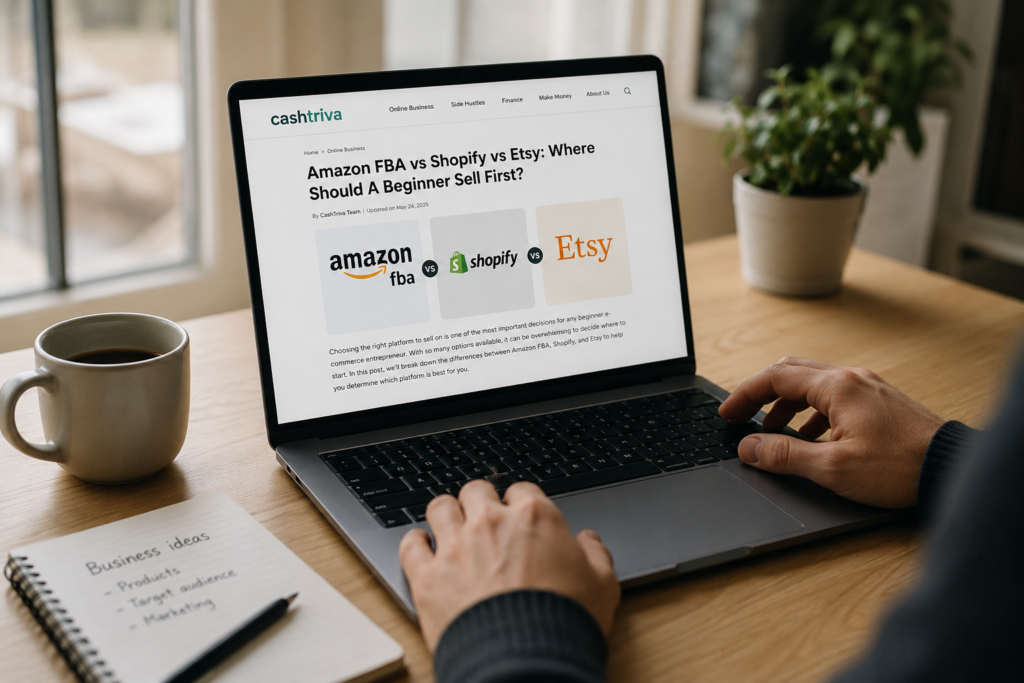
Three names keep coming up in every forum post, every YouTube video, and every “how to start an online business” guide: Amazon FBA, Shopify, and Etsy.
Each one works. Each one has made people real money. But they are built for very different sellers, and picking the wrong platform early on can cost you months of wasted effort, hundreds (or thousands) of dollars, and a whole lot of frustration.
This guide breaks down all three platforms side by side, with honest numbers, real trade-offs, and a clear recommendation based on what you’re actually selling, how much money you have to start, and what kind of business you want to build.
A Quick Overview of Each Platform
Before we get into the details, here’s what each platform actually is (and isn’t).
Amazon FBA (Fulfillment by Amazon) is a marketplace where you send your products to Amazon’s warehouses, and they handle storage, shipping, and customer service. You’re selling alongside millions of other sellers, and Amazon’s algorithm decides how visible your product is. Think of it like renting a shelf in the world’s biggest store.
Shopify is a website builder that lets you create your own standalone online store. You control everything, from design to pricing to marketing. But nobody shows up unless you bring them there yourself. Think of it like opening your own shop on a street with no foot traffic (until you do the marketing work).
Etsy is a marketplace focused on handmade, vintage, and craft supply items. It has a built-in audience of buyers already looking for those kinds of products. Think of it like setting up a booth at a craft fair that runs 24/7 and attracts millions of visitors.
Cost Comparison: What You’ll Actually Pay
Let’s talk money, because this is where most beginner guides get vague. Here’s what each platform will realistically cost you.
Amazon FBA Costs
- Monthly subscription: $39.99/month for a Professional seller account (or $0.99 per item sold on the Individual plan)
- Referral fees: Typically 8% to 15% of the sale price, depending on the category
- FBA fulfillment fees: Starting around $3.22 per unit for small, lightweight items, and going up from there based on size and weight
- Storage fees: $0.87 per cubic foot (January through September) and $2.40 per cubic foot (October through December)
- Inventory prep and shipping to warehouse: You’ll spend money getting products to Amazon’s fulfillment centers
- Realistic startup budget: $2,000 to $5,000 minimum (including inventory)
Shopify Costs
- Monthly subscription: $39/month for the Basic plan (there’s a $5/month Starter plan, but it’s very limited)
- Transaction fees: 2.9% + $0.30 per transaction on Basic (lower on higher-tier plans)
- Apps and themes: Free themes exist, but most sellers end up spending $20 to $100/month on apps for reviews, email marketing, upsells, etc.
- Marketing budget: This is the big one. You’ll need to spend on ads (Facebook, Google, TikTok) or invest serious time in content marketing and SEO. Plan for at least $300 to $1,000/month in ad spend when starting out.
- Realistic startup budget: $500 to $2,000 (plus ongoing ad spend)
Etsy Costs
- Listing fee: $0.20 per listing (lasts 4 months or until it sells)
- Transaction fee: 6.5% of the sale price (including shipping)
- Payment processing: 3% + $0.25 per transaction
- Offsite ads fee: 15% of the sale price if Etsy’s offsite ads generate the sale (12% for sellers making over $10,000/year). You can opt out if you make under $10,000/year.
- No monthly subscription required (though Etsy Plus is available for $10/month with some extra features)
- Realistic startup budget: $100 to $500
The bottom line on cost: Etsy is the cheapest way to start. Shopify sits in the middle but can get expensive fast once you factor in marketing. Amazon FBA requires the most upfront capital, but it gives you access to the biggest customer base.
Traffic and Visibility: Who Brings the Customers?
This is one of the most misunderstood differences between these three platforms.
Amazon: Built-in Demand, Fierce Competition
Amazon gets roughly 2.4 billion monthly visits. People go to Amazon with their credit cards ready. They search for a product, compare options, and buy. If your listing shows up on page one for a relevant search, you will make sales.
The problem? Getting to page one is a battle. Amazon’s search algorithm (A10) rewards products with strong sales velocity, good reviews, competitive pricing, and optimized listings. As a brand new seller with zero reviews, you’re starting at a disadvantage. You’ll likely need to run Amazon PPC (pay-per-click) ads at a loss for the first few weeks or months just to generate enough sales and reviews to gain traction.
The upside is real, though. Once you get momentum on Amazon, it can snowball. A product that ranks well can generate consistent daily sales with relatively little ongoing effort.
Shopify: You Are the Marketing Department
Shopify gives you zero traffic. None. Your store is invisible until you drive people to it.
This means you need a traffic strategy from day one. The most common options:
- Paid ads (Facebook/Instagram, Google Shopping, TikTok Ads)
- Social media content (building a following on Instagram, TikTok, Pinterest, or YouTube)
- SEO and content marketing (blogging, long-tail keyword targeting)
- Influencer partnerships
- Email marketing (once you build a list)
For most beginners, paid ads are the fastest route. But running profitable ads takes skill, testing, and budget. Expect to lose money on ads for the first few weeks while you figure out what works.
The advantage of Shopify is that every customer who visits your store is your customer. You own the relationship, you collect their email, and you can market to them again and again. On Amazon and Etsy, the platform owns the customer relationship.
Etsy: A Warm Audience, Looking for What You Make
Etsy gets around 450 million monthly visits. That’s far less than Amazon, but the audience is highly targeted. People come to Etsy looking for handmade goods, personalized items, vintage products, and supplies for crafting and DIY.
Etsy’s search algorithm (called Etsy Search) ranks listings based on relevance, listing quality, recency, customer experience, and shipping price. New listings get a temporary visibility boost, which means you can start getting views and sales relatively quickly if your product fits what Etsy buyers want.
The catch: Etsy’s algorithm changes frequently, and you’re always at the mercy of the platform. A policy update or algorithm shift can tank your visibility overnight.
The bottom line on traffic: Amazon brings the most buyers but makes you fight for visibility. Etsy brings a smaller but highly motivated audience. Shopify brings nobody, but lets you build a direct relationship with every customer you attract.
Control and Branding: How Much Is Yours?
Amazon: Their House, Their Rules
On Amazon, your “store” is really just a product listing page. You can create an Amazon Storefront (if you’re Brand Registered), but most customers never visit it. They find your product through search, compare it against competitors on the same page, and make a decision based on price, reviews, and images.
You have limited control over branding. Amazon dictates the layout, the checkout process, and even how your product images can look (white background, specific dimensions). You can’t collect customer email addresses. If Amazon suspends your account or changes a policy, you could lose your entire business overnight.
Shopify: Full Control, Full Responsibility
With Shopify, you own everything. Your domain name, your store design, your customer data, your email list. You can build the brand exactly the way you want it.
That freedom comes with responsibility. You’re in charge of design, copywriting, checkout optimization, shipping logistics, customer service, returns, and every other operational detail. There’s no safety net and no built-in support system.
For beginners who want to build a real, long-term brand that isn’t dependent on a third-party marketplace, Shopify is the strongest option. But it demands more work and more skill across more disciplines.
Etsy: Somewhere in Between
Etsy gives you a “shop” with your own name, banner, and product listings. You can customize it to some extent, and buyers do browse individual shops. There’s a sense of personality and craft that Amazon completely lacks.
But you’re still operating inside Etsy’s ecosystem. They control the search algorithm, the fee structure, and the policies. You can communicate with buyers through Etsy’s messaging system, but you don’t own their email addresses (unless they opt in to your marketing separately).
The bottom line on control: Shopify gives you full ownership. Etsy gives you a branded booth inside someone else’s marketplace. Amazon gives you a shelf slot next to your competitors.
What Types of Products Work Best on Each Platform?
This might be the most practical section of this entire article, so pay attention.
Best Products for Amazon FBA
- Mass-market consumer goods (kitchen gadgets, phone accessories, pet supplies, fitness equipment)
- Private label products (generic items you brand with your own label)
- Products with high search demand and consistent year-round sales
- Items that are small, lightweight, and easy to ship (to keep FBA fees manageable)
- Products where you can compete on price and volume
Not a great fit for Amazon: One-of-a-kind handmade items, highly personalized products, niche items with tiny audiences, or products where storytelling and brand identity matter more than price.
Best Products for Shopify
- Products with a strong brand story or visual identity (fashion, beauty, wellness, lifestyle)
- Higher-priced or premium items where margins can absorb ad costs
- Subscription products or consumables that encourage repeat purchases
- Products tied to a personal brand, community, or content platform
- Digital products, courses, or memberships
Not a great fit for Shopify: Commodity products where you’re competing purely on price, low-margin items that can’t absorb the cost of paid advertising, or products without a clear target audience you can reach through ads or content.
Best Products for Etsy
- Handmade jewelry, clothing, art, candles, soap, pottery, and home decor
- Personalized and custom items (engraved gifts, custom portraits, monogrammed products)
- Digital downloads (printables, planners, SVG files, wedding invitations)
- Vintage items (at least 20 years old, per Etsy’s policy)
- Craft supplies and tools
Not a great fit for Etsy: Mass-produced goods, electronics, generic consumer products, or anything that doesn’t fit Etsy’s handmade/vintage/craft identity. Etsy has been cracking down on resellers, so if your products look like they belong on AliExpress, you’ll run into problems.
Scalability: Where Can You Grow?
Amazon FBA: High Ceiling, Thin Margins
Amazon can scale massively. Top Amazon sellers do millions in annual revenue. FBA handles the logistics, so you don’t need a warehouse or shipping team. You can add new products relatively quickly.
The downside: margins tend to be thin. Between referral fees, FBA fees, PPC costs, and inventory investment, many Amazon sellers operate on 15% to 25% net margins. Scaling means more inventory investment, more capital tied up, and more risk.
Shopify: Unlimited Potential, But You Build Every Piece
There’s technically no ceiling on a Shopify store. Some of the biggest DTC (direct-to-consumer) brands in the world run on Shopify (Gymshark, Allbirds, Kylie Cosmetics). You can scale to millions.
But scaling a Shopify store means scaling your marketing. More revenue requires more ad spend, more content, more email campaigns, and a bigger team. Growth is directly tied to your ability to acquire customers profitably.
Etsy: Great Start, Limited Ceiling
Etsy is fantastic for getting started and making your first sales. But most Etsy sellers hit a ceiling somewhere between $50,000 and $200,000 in annual revenue. The platform just isn’t designed for massive scale.
Many successful Etsy sellers eventually expand to their own Shopify store (or both), using Etsy as a customer acquisition channel and their own store as the long-term growth engine.
The bottom line on scalability: Amazon and Shopify both support very large businesses. Etsy is best as a starting point or supplement, not a long-term-only strategy.
Ease of Getting Started
Amazon FBA: Steep Learning Curve
Setting up an Amazon seller account is straightforward, but actually launching a successful product involves product research, supplier sourcing, listing optimization, keyword research, PPC campaign setup, and inventory management. Most beginners spend 2 to 4 months (and significant money) before their first product is live and generating sales.
Shopify: Moderate Learning Curve
Building a Shopify store takes a few days to a few weeks. The platform is intuitive, and there are thousands of tutorials available. The hard part isn’t the store itself. It’s everything that comes after: writing compelling product pages, setting up email flows, running profitable ads, and driving traffic.
Etsy: Easiest Entry Point
You can open an Etsy shop and list your first product in under an hour. The interface is simple, the listing process is guided, and you can start getting views the same day. For someone who has never sold anything online before, Etsy is the lowest-friction starting point.
The Risk Factor
Every platform carries risk. Here’s what you should watch out for.
Amazon risks:
- Account suspension (Amazon is aggressive about policy enforcement)
- Competitors hijacking your listings or copying your product
- Rising FBA fees eating into your margins
- Heavy dependence on a single platform you don’t control
Shopify risks:
- Burning through ad budget before finding a profitable strategy
- Building a beautiful store that nobody visits
- Operational overwhelm (you handle everything)
- Slow, discouraging start while you build traction
Etsy risks:
- Algorithm changes tanking your visibility
- Etsy increasing fees (which has happened repeatedly in recent years)
- Your shop getting lost in a sea of similar products
- Policy changes that affect what you’re allowed to sell
So, Where Should YOU Start?
Here’s the straightforward answer, broken down by situation.
Start with Etsy if:
- You make handmade, vintage, or craft-related products
- You have a small budget (under $500)
- You’ve never sold online before and want to test the waters
- You want to validate a product idea before investing heavily
- You sell digital downloads
Start with Amazon FBA if:
- You’re selling (or want to sell) private label or mass-market products
- You have $2,000 to $5,000+ to invest upfront
- You want to tap into the largest pool of online buyers
- You’re comfortable with a steeper learning curve and more complex operations
- You’re willing to play the long game with product ranking and reviews
Start with Shopify if:
- You have a strong brand identity or personal brand
- You’re comfortable with digital marketing (or willing to learn fast)
- You sell higher-priced products with healthy margins
- You want full control over your customer relationships and data
- You’re thinking long-term and want to build a brand that isn’t tied to any marketplace
The Multi-Platform Strategy (The Smart Move)
Here’s what the most successful sellers eventually do: they don’t pick just one. They use a combination.
A common progression looks like this:
- Start on Etsy (or Amazon) to validate your product and generate initial sales
- Build a Shopify store once you have a proven product and some revenue coming in
- Expand to Amazon (if you started on Etsy) or Etsy (if you started on Amazon) to capture more market share
- Drive traffic to your Shopify store using content, ads, and the email list you’ve been building
- Gradually shift more revenue to your own store where margins are better and you own the customer relationship
This approach reduces risk, diversifies your income, and gives you the best of all three platforms.
Final Thoughts
There’s no single “best” platform. There’s only the best platform for you, right now, based on what you’re selling, how much you can invest, and what kind of business you want to build.
If you’re overwhelmed, here’s the simplest advice: pick one, start selling, and learn by doing. You can always expand later. The biggest mistake isn’t choosing the wrong platform. It’s spending so long comparing platforms that you never start at all.
The sellers who win are the ones who take action, make mistakes, adjust, and keep going. Your first platform is a starting point, not a permanent decision. Get your products in front of real buyers, learn what works, and grow from there.
What are you planning to sell, and which platform are you leaning toward? Your product type and budget will point you in the right direction faster than any amount of research.