You’re 20 minutes into a focused writing session. The words are coming. Your brain is locked in. Then your partner opens the door to ask where the packing tape is.
Or your roommate starts a loud phone call in the next room. Or your mother-in-law stops by unannounced. Or your six-year-old appears at your elbow holding a juice box she can’t open.
The task you were absorbed in? Gone. The mental thread you were pulling? Snapped. And the frustration that follows isn’t really about packing tape or juice boxes. It’s about the invisible line between “I’m working” and “I’m available” that nobody in your household seems to see.
This is one of the most common and least discussed struggles of remote work. Not the technology. Not the productivity systems. Not the Slack notifications. The people you live with.
And the hard truth is: it’s not their fault. If you haven’t built clear, specific, compassionate boundaries, then every interruption is just someone treating your home like… a home. Because that’s what it is. You’re the one who turned part of it into an office. The responsibility for making that work falls on you.
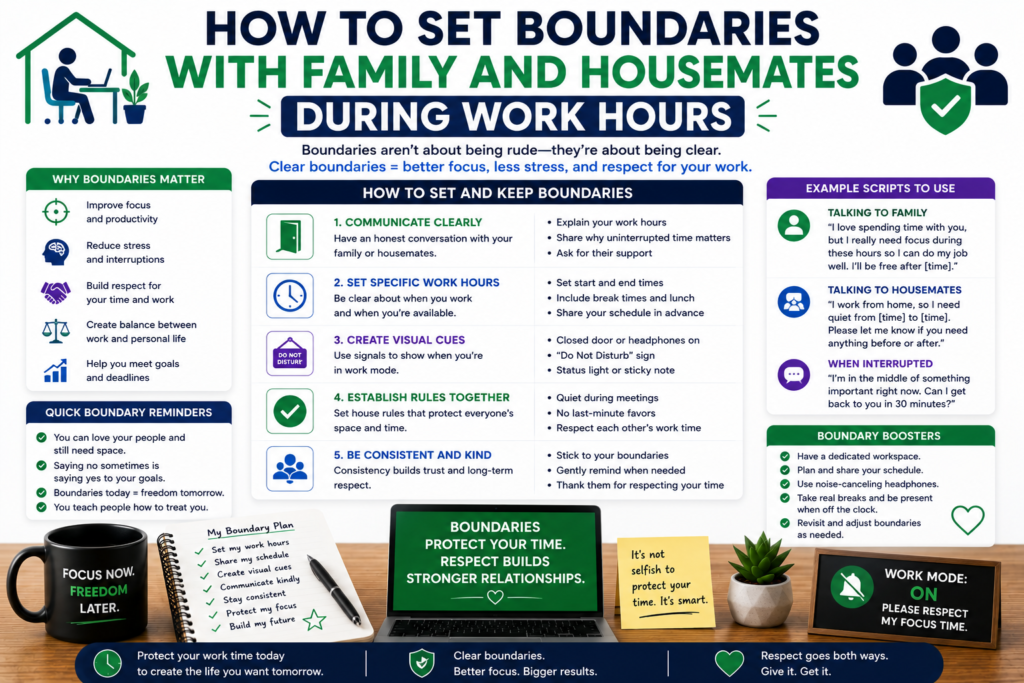
This guide walks through how to set boundaries that actually hold, without creating resentment, guilt, or the feeling that you’re building walls inside your own house.
Why Boundary Setting Feels So Uncomfortable
Before getting into tactics, it helps to understand why most remote workers avoid this conversation entirely.
Guilt. If you’re working from home, there’s an unspoken expectation (sometimes from yourself, sometimes from others) that you should be more available. You’re right there. How can you say “don’t talk to me” when you’re ten feet from the kitchen?
Fear of conflict. Telling a partner, parent, or roommate “I need you to stop doing that during these hours” feels confrontational. Most people would rather silently stew than have that conversation.
Unclear work identity. In an office, your work persona is defined by the environment. At home, you’re simultaneously an employee, a partner, a parent, a roommate, and a household member. Switching between those roles without clear signals is exhausting, and confusing for everyone around you.
Cultural expectations. In many families and cultures, being behind a closed door during the day reads as antisocial or selfish. The idea that you’re “at work” but physically present creates a cognitive dissonance that’s hard for some family members to reconcile.
None of these feelings are irrational. They’re real, and they make boundary setting harder than any productivity article usually acknowledges. But avoiding the conversation doesn’t make the problem smaller. It makes it grow.
The Foundation: A Boundary Is a Statement About You, Not a Rule for Them
This distinction changes everything.
A rule sounds like: “Don’t bother me between 9 and 12.”
A boundary sounds like: “Between 9 and 12, I need to be fully focused on work. I won’t be able to respond to non-urgent things during that window. After 12, I’m all yours.”
The first version tells someone what they can’t do. The second version tells them what you need and what they can expect. Same outcome, completely different emotional impact.
Boundaries work when the people around you understand three things:
- What the boundary is. Specific times, specific behaviors, specific spaces.
- Why it matters. Not “because I said so,” but because this is how you protect your job, your income, your mental health, or your ability to be present later.
- What’s in it for them. When you work with fewer interruptions, you finish faster. You’re less stressed in the evening. You’re more present on weekends. The boundary benefits everyone.
If you skip any of those three pieces, the boundary feels arbitrary, and arbitrary rules get ignored.
Step 1: Define Your Non-Negotiable Work Windows
Before you talk to anyone, get clear on what you actually need. Not a vague “I need quiet during the day,” but a specific schedule with defined focus windows.
Sit down and map out your typical work week. Identify:
- Hard focus blocks: The hours where interruptions cost you the most. For many people, this is a two to three-hour window in the morning. These blocks are for deep, concentrated work, and they need protection.
- Flexible blocks: Times when you’re doing lighter work (email, admin, scheduling) and can handle a quick question without losing your train of thought.
- Available blocks: Lunch, breaks, and the periods before and after your core hours when you’re fully accessible.
Write this down. A rough example:
| Time | Status | What it means for the household |
|---|---|---|
| 8:00–8:30 a.m. | Available | Morning routine, happy to chat |
| 8:30–11:00 a.m. | Hard focus | Please don’t interrupt unless it’s urgent |
| 11:00–11:30 a.m. | Flexible | Quick questions are fine |
| 11:30 a.m.–12:30 p.m. | Available | Lunch, fully offline |
| 12:30–2:30 p.m. | Hard focus | Same as morning, no interruptions |
| 2:30–3:00 p.m. | Flexible | Can handle quick things |
| 3:00–3:30 p.m. | Available | Break, open for conversation |
| 3:30–5:00 p.m. | Flexible | Working but interruptible for short requests |
| 5:00 p.m. onward | Available | Done for the day |
This schedule gives your household clarity. They don’t have to guess whether “now” is a good time. They can look at the schedule and know.
Step 2: Have the Conversation (Not the Lecture)
This is where most people go wrong. They either avoid the conversation entirely or deliver it as a monologue: “Here’s what I need, here are the rules, please follow them.”
Neither approach works. The conversation needs to be collaborative, and it needs to happen when everyone is calm and unhurried, not in the heat of a frustration moment after the third interruption of the morning.
Here’s a framework for the conversation:
Open with acknowledgment. Start by recognizing that your work-from-home arrangement affects everyone in the household, not just you.
“I know it’s weird that I’m here all day but not really ‘here.’ I want to figure out a way to make this work better for all of us.”
Explain the problem in concrete terms. Don’t say “I need fewer distractions.” Say what actually happens when you’re interrupted.
“When I get pulled out of focused work, it takes me about 20 minutes to get back to where I was. On a bad day, that means I end up working an extra hour or two in the evening, which cuts into our time together.”
Present your proposed schedule. Share the focus/flexible/available breakdown. Invite feedback.
“I mapped out my day. Here’s what I’m thinking. Does this work with your schedule? Is there anything that conflicts?”
Ask what they need. Boundaries go both ways. Your partner might need you to handle school pickup at 3:15. Your roommate might need quiet for their own calls at certain hours. Your kids might need to know when they can come to you.
“What do you need from me during the day? Let’s make sure this works for both of us.”
Agree on the urgent exception. Every boundary needs an emergency clause. Define what counts as “urgent enough to interrupt a focus block.”
Good candidates for the urgent list: someone is hurt, something is on fire, a delivery requires a signature right now, a child is sick, an alarm is going off.
Not urgent: “Where’s the remote?” “What do you want for dinner?” “Look at this funny video.” “Can you help me find my keys?”
Write the agreed-upon urgent list down if it helps. For younger children, make it visual. More on that in a later section.
Step 3: Create Physical Signals
Words are easy to forget. Visual cues are harder to ignore.
The most effective boundary-setting tool for remote workers isn’t an app or a calendar. It’s a simple, visible signal that communicates your status without requiring a conversation.
The closed door. If you have a dedicated workspace with a door, a closed door means “do not enter unless urgent.” An open door means “I’m available.” This is the simplest and most universally understood signal.
A desk sign or flag system. If you don’t have a door (or work in a shared space), use a small sign, colored card, or even a sticky note system:
- Red card on the desk: Focus mode, do not disturb
- Yellow card: Working but interruptible for quick questions
- Green card: Available, come talk to me
For families with young children, some parents use a small traffic light toy or colored magnets on the fridge. Kids respond well to visual systems because they’re concrete and don’t require reading a schedule.
Headphones. Noise-canceling headphones serve a dual purpose: they block ambient noise and signal to others that you’re in the zone. Establish the rule: “If my headphones are on, I’m in focus mode.”
A physical timer. Place a small timer on your desk or outside your door. When it’s running, you’re unavailable. When it stops, you’re free. This works especially well with children because it gives them a tangible countdown. “When the timer beeps, you can come in.”
The key is consistency. Whatever signal you choose, use it the same way every day. Inconsistent signals confuse people and erode trust in the system.
Step 4: Address the Specific People in Your Life
Different relationships require different approaches. A conversation with a romantic partner looks nothing like one with a seven-year-old, and neither one looks like the talk you need to have with a chatty roommate.
Setting Boundaries With a Partner or Spouse
This is often the trickiest relationship to manage because of the emotional weight it carries. Your partner may feel rejected, deprioritized, or resentful, especially if they’re home too (working or not).
What works:
- Frame boundaries as something you’re building together, not something you’re imposing. “Let’s design our day so we both get what we need.”
- Establish shared rituals that happen outside work hours: morning coffee together before work starts, a lunch break at the same time, an evening walk after shutdown. These rituals reassure your partner that the boundary isn’t a withdrawal from the relationship.
- Be fully present during your available blocks. If you check Slack during dinner or answer emails during movie night, you’re training your partner to believe that your “off” time isn’t real, which makes them less likely to respect your “on” time.
- If your partner is also working from home, coordinate schedules. Stagger focus blocks so one person is always “on call” for household needs. Share a visible calendar that shows both schedules.
What doesn’t work:
- Snapping “I’m working!” when interrupted. This response is understandable in the moment, but it turns your work into an adversary in the relationship. Take a breath. “I’m in a focus block right now. Can I help with that at 11?” takes five seconds longer and does zero damage.
- Assuming your partner should just know. They can’t read your mind. If you didn’t communicate that 10 a.m. is a hard focus window, you can’t be frustrated when they interrupt it.
Setting Boundaries With Children
Children don’t understand abstract concepts like “work hours” or “professional obligations.” What they understand is concrete, visible, and routine.
For toddlers and preschoolers (ages 2–5):
Full boundary-setting isn’t realistic with very young children. They need supervision, and “don’t bother me for two hours” is developmentally inappropriate. What you can do:
- Coordinate your focus blocks with a co-parent, caregiver, or nap times.
- Use a visual timer. “When this timer beeps, Mommy/Daddy can play. Until then, you’re with [caregiver/other parent].”
- Create a “busy box” filled with special toys, coloring books, or activities that only come out during your focus blocks. The novelty keeps them occupied longer.
For school-age children (ages 6–12):
Kids this age can learn the system if you make it clear and consistent.
- Walk them through the traffic light system or door signal. Practice it a few times. “What does the red card mean? Right. And what do you do if you need something but the red card is up?”
- Define what counts as urgent for them specifically. “You can come in if you’re hurt, scared, or something is broken. If you’re bored or hungry for a snack, write it on this notepad and I’ll check it at break time.”
- Give them a “break time check-in.” Tell them exactly when your next break is. “At 10:30, I’m coming out and we can talk about whatever you want.” This gives them a concrete thing to wait for instead of an undefined stretch of time.
- Praise them when they respect the boundary. “You waited until my break to ask me that. Thank you. That really helps me.”
For teenagers (ages 13+):
Teens generally understand work obligations but may test boundaries for attention, out of habit, or because they’re home and bored.
- Treat them more like adults. Explain the impact: “When I get interrupted during focus time, I end up working later, which means less time with you in the evening.”
- Give them responsibility. “If your brother needs something during my morning focus block, can you help him? I’ll take over at lunch.”
- Respect their needs in return. If they need quiet for studying or their own online activities, coordinate schedules.
Setting Boundaries With Roommates
Roommates present a different challenge because the relationship has less emotional elasticity. You may not feel comfortable having a deep conversation about your work needs, and they may not feel obligated to accommodate them.
What works:
- Keep the conversation practical, not emotional. “I have focus blocks from 9 to 11 and 1 to 3. During those times, I’ll have my headphones on and won’t be able to chat. Outside those windows, I’m totally free.”
- Offer reciprocity. “If you have times when you need quiet or focus, let me know and I’ll respect those too.”
- Use physical signals (headphones, closed door, a small sign) so they don’t have to remember your schedule.
- If noise is the issue, invest in noise-canceling headphones rather than asking them to be silent in shared spaces. You can’t reasonably ask a roommate to whisper in their own kitchen.
What doesn’t work:
- Passive-aggressive signals. Sighing loudly, slamming your laptop shut, or giving one-word answers when interrupted doesn’t communicate a boundary. It communicates frustration without giving the other person anything actionable.
- Expecting them to adjust their entire lifestyle around your work schedule. You share the space equally. Compromise is built into the arrangement.
Setting Boundaries With Extended Family and Friends
The “you’re home, so you’re free” assumption is strongest with people who don’t live with you: parents who drop by, friends who call during the day, relatives who assume working from home means having a flexible schedule.
Scripts that work:
- “I’m actually at work right now, even though I’m home. Can I call you back at [specific time]?”
- “I’d love to see you! My work hours are 8:30 to 5. Can we plan for after 5 or on the weekend?”
- “I can’t take personal calls during focus hours. I’ll text you when I’m free. Usually around lunchtime or after 3.”
If a particular person repeatedly ignores these boundaries, you may need a more direct conversation: “I know it seems like I should be available because I’m home, but my employer expects me to be working during these hours, just like an office job. I need you to treat my work hours the same way you would if I were in an office downtown.”
That last line is powerful because it reframes the situation in a way most people immediately understand.
Step 5: Handle Boundary Violations Without Resentment
No matter how well you communicate, boundaries will get crossed. People forget. Kids don’t care about your quarterly report. Partners have bad days. Roommates get excited about something and want to share it right now.
How you respond to violations determines whether the system survives.
In the moment:
- Stay calm. Take a breath. Respond with information, not irritation.
- Redirect, don’t reprimand. “I’m in a focus block right now. Can this wait until 11?” is a redirection. “I told you not to interrupt me” is a reprimand. One preserves the relationship. The other damages it.
- If you can handle the request in under 30 seconds without emotional escalation, just handle it. Not every interruption needs to become a teaching moment about boundaries. Sometimes the fastest path back to focus is solving the problem and moving on.
After the moment:
- If the same person violates the same boundary repeatedly, have a private, calm follow-up conversation. “I’ve noticed I’m getting interrupted during my morning focus block pretty often. Is there something about the schedule that isn’t working for you?”
- Look for patterns. If interruptions cluster at a particular time, maybe that time slot needs to become a flexible block instead of a focus block. The best boundary is one that matches reality, not one that fights it.
- Reinforce success more than you correct failure. “I had a great morning because I got through my whole focus block without any interruptions. Thank you. That made a real difference.” Positive reinforcement builds cooperation faster than criticism.
Step 6: Protect the Other Side of the Boundary
Here’s what most boundary-setting advice misses: the quality of your “off” time determines how well people respect your “on” time.
If you work from 8:30 to 5 but then check email at 7 p.m., respond to Slack at 9 p.m., and open your laptop “for just a minute” on Saturday morning, you’re sending a clear message: work has no real boundaries. And if work doesn’t have boundaries, why should anyone else’s behavior?
When you’re done, be done. Close the laptop. Put the phone in a drawer. Be physically and mentally present with the people in your home.
This does two things:
- It shows your family and housemates that the boundary is mutual. You’re not asking for uninterrupted work time while giving them interrupted personal time.
- It makes the arrangement feel fair. They give you space during focus hours. You give them full attention during off hours. Everyone wins.
If you struggle with work creep, build a shutdown ritual that creates a psychological divider between work mode and home mode:
- Close all work tabs and apps
- Write tomorrow’s top three priorities in a notebook (gets them out of your head)
- Change your clothes (even just swapping a work shirt for a casual one)
- Take a five-minute walk outside or around the house
- Say out loud (or to yourself): “The workday is done”
That last step might sound silly, but research on “cognitive closing rituals” shows that a deliberate statement of completion helps the brain release work-related rumination. You’re giving your mind permission to switch off.
When Boundaries Aren’t Working: Deeper Fixes
Sometimes the problem isn’t communication. It’s the environment itself.
You don’t have a dedicated workspace. Working from the kitchen table or the living room couch makes boundary-setting nearly impossible because you’re occupying a shared space. If you can’t get a separate room, carve out a designated corner, set up a portable divider, or use a specific chair that signals “I’m working.” Even a symbolic separation helps the people around you shift their perception.
Your work schedule is unpredictable. If your hours change constantly, your household can’t build habits around your availability. Try to anchor at least two or three consistent windows per day, even if the rest of the schedule shifts. “My morning focus block is always 9 to 11, no matter what” gives people one reliable rule to follow.
Someone in your household doesn’t respect boundaries in general. This is a relationship issue, not a work issue. If a partner, parent, or roommate consistently dismisses your stated needs, the work-from-home boundary is just one symptom. That situation may require a deeper conversation, mediation, or professional support, not a better desk sign.
You feel guilty enforcing boundaries. This is internal, and it’s common. Remind yourself: protecting your focus time means you work more efficiently, finish earlier, and are more present afterward. The boundary isn’t selfish. It’s a gift to the relationship. You’re a better partner, parent, friend, and roommate when you’re not perpetually half-working and half-present.
A Household Boundary Agreement Template
If you want to formalize the arrangement, here’s a simple agreement you can fill out and post somewhere visible (the fridge, a shared bulletin board, a family group chat).
Work Hours: [Your start and end times]
Hard Focus Windows: [Times when interruptions should be avoided]
Flexible Windows: [Times when quick questions are okay]
Available Windows: [Times when you’re fully accessible]
Signal System: [Closed door / headphones / colored card / timer]
What Counts as Urgent: [List 3–4 specific scenarios]
What Can Wait: [List 3–4 common non-urgent requests]
My Commitment to You: [What you’ll give back: full presence after hours, shared meals, specific quality time]
Review Date: [When you’ll check in to see if the system is working, suggest weekly for the first month]
Printing this out or writing it on a whiteboard removes ambiguity. It’s no longer a conversation someone has to remember. It’s a visible reference that everyone agreed to.
The Bigger Picture
Setting boundaries with the people you live with isn’t about building walls. It’s about building clarity.
When everyone in your household knows what to expect, tension drops. When your family sees that respecting your work time leads to a more relaxed, more present version of you in the evening, they stop seeing the boundary as rejection and start seeing it as a deal that benefits everyone.
And when you learn to protect your focus without guilt, enforce your schedule without anger, and show up fully during your off-hours without distraction, something shifts. Work gets smaller. It stops leaking into every room, every conversation, every quiet moment.
You’re home. You’re working. And both of those things can coexist, as long as the people around you know where one ends and the other begins.
Start tonight. Pick one focus window for tomorrow morning. Tell one person in your household about it. Agree on a signal. See what happens.
One conversation. One boundary. One day at a time.