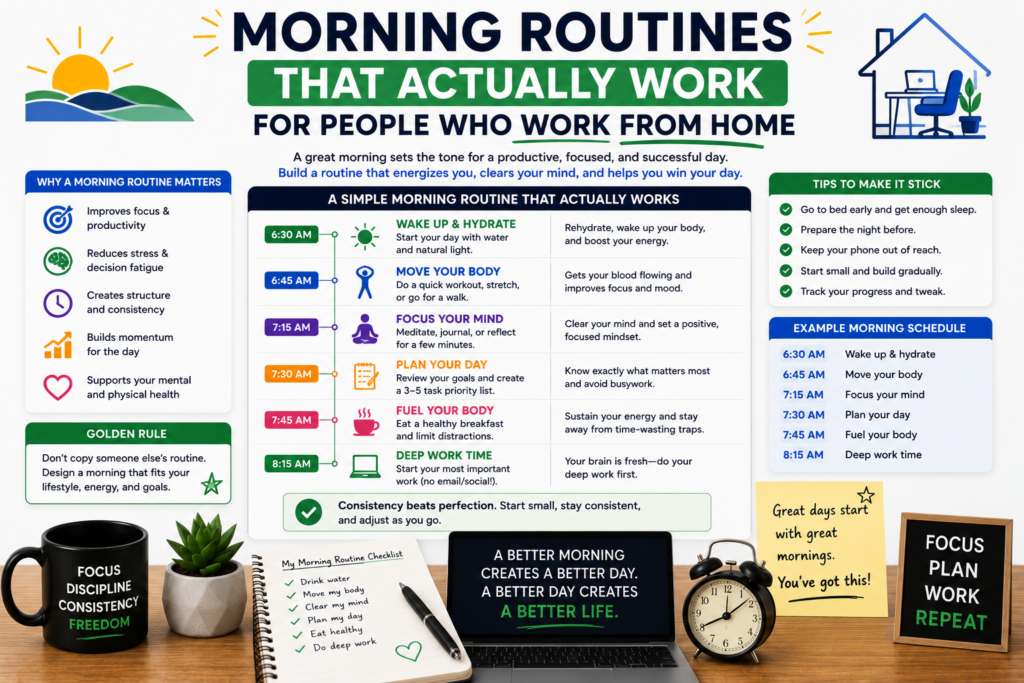
You’ve probably seen the morning routine content. Wake up at 4:30 AM. Meditate for 20 minutes. Journal about your goals. Do a cold plunge. Drink a green smoothie. Exercise for an hour. Read 30 pages of a nonfiction book. All before 7 AM.
That sounds incredible. It’s completely impractical for most people who work from home.
Here’s the reality of remote work mornings: your alarm goes off, and the commute to your desk is twelve steps. There’s no train to catch, no parking lot to fight for, no office door that closes behind you at 9 AM sharp. Without those external forcing functions, your morning can dissolve into a formless stretch of snooze buttons, phone scrolling, and slow-motion coffee drinking that somehow eats up two hours before you’ve accomplished anything.
The morning routines that actually work for remote workers aren’t glamorous. They’re not designed for Instagram or YouTube thumbnails. They’re built around a simple question: How do I get from “just woke up” to “doing real work” with the least friction possible?
This guide breaks down what that looks like in practice.
Why Your Morning Matters More When You Work From Home
In a traditional office, your morning can be sloppy and you’ll still be okay. The commute forces you awake. The office environment flips your brain into work mode. Colleagues, meetings, and a visible clock on the wall keep you moving.
At home, none of that exists. Your morning is the only mechanism standing between a productive day and one that never really gets started.
Research from the American Psychological Association has consistently shown that the first decisions you make in a day shape the ones that follow. This is sometimes called “decision momentum.” A morning spent passively, scrolling your phone in bed, watching the news, drifting from room to room without intention, sets a passive tone for the rest of the day. A morning spent actively, with a few deliberate choices stacked in a specific order, sets the opposite tone.
This doesn’t mean your morning has to be intense. It means it has to be intentional. There’s a difference between relaxing on purpose and drifting without a plan.
The Core Problem: Home Blurs Every Boundary
Before getting into specific routines, it’s worth understanding why mornings are especially difficult for remote workers.
The “just woke up” environment is the same as the “time to work” environment. In an office job, you pass through multiple environmental transitions between waking up and working: bathroom, kitchen, car or train, office lobby, desk. Each transition shifts your mental state. At home, you might literally roll out of bed and open your laptop without changing rooms, clothes, or posture. Your brain receives zero signals that anything has changed.
There’s no external start time. Even if you technically have one, nobody is watching the clock. The difference between starting at 8:00 AM and 8:47 AM is invisible to everyone except you. That flexibility, which is one of remote work’s biggest perks, becomes a trap when there’s no structure around it.
Morning temptations are everywhere. The TV is right there. The couch is right there. Your personal phone is right there. Every comfortable, low-effort option is within arm’s reach, competing against the higher-effort option of sitting down and working.
A good morning routine compensates for all three of these problems. It creates artificial transitions, enforces a consistent start time, and builds a buffer between waking up and facing temptation.
What Makes a Morning Routine “Work” for Remote Workers
Not all routines are created equal. The ones that stick for people who work from home share five characteristics:
1. They’re short enough to protect. If your morning routine takes 90 minutes, one late wake-up destroys it. The most sustainable routines for remote workers run between 30 and 60 minutes. Short enough that you can execute them even on rough mornings, long enough to create a real transition.
2. They include a physical state change. Your body needs to feel different than it did in bed. This can be a shower, exercise, a walk, or even just getting dressed. The physical shift drives a mental shift.
3. They have a defined endpoint. “My morning routine is done when I sit down at my desk with my task list open.” Without a clear finish line, the routine bleeds into the morning and delays actual work.
4. They separate consumption from production. Checking email, reading news, and scrolling social media are consumption activities. They put your brain in reactive mode, responding to other people’s agendas. A good morning routine delays consumption and prioritizes activities that put you in an active, intentional state.
5. They’re boring enough to repeat daily. Flashy routines are exciting on Day 1 and abandoned by Day 12. The best routines feel almost mundane, which is exactly why they work. Consistency beats intensity every time.
Routine Template #1: The Minimalist (30 Minutes)
This is for people who want the shortest possible bridge between waking up and working. No extras, no fluff, just the minimum actions needed to show up mentally present.
6:45 AM — Wake up. No snooze. Place your alarm across the room so you have to physically stand up to turn it off. The act of standing breaks the strongest pull back to sleep.
6:45 – 6:55 AM — Bathroom, water, get dressed. Splash water on your face or take a quick shower. Drink a full glass of water before anything else. Put on real clothes, not work-from-home-in-pajamas clothes. You don’t need a button-down shirt. Clean jeans and a t-shirt is enough. The point is to change out of what you slept in.
6:55 – 7:05 AM — Make coffee or tea, eat something simple. Don’t spend 20 minutes on an elaborate breakfast. Overnight oats, toast, yogurt, a banana, anything that takes under 5 minutes. Eat at the kitchen table, not at your desk. This keeps your desk associated with work, not meals.
7:05 – 7:10 AM — Review your day. Open your task manager, notebook, or calendar. Read your priorities for the day. Pick the single most pressing task, the one you’ll start with. Write it on a sticky note or index card.
7:10 – 7:15 AM — Transition to your workspace. Walk to your desk. Place the sticky note with your first task where you can see it. Close every non-work app and tab. Put your phone face-down or in another room.
7:15 AM — Start working.
Total routine time: 30 minutes. Total decisions: nearly zero. Everything is predetermined, sequential, and mechanical. On a good day, you’ll breeze through it. On a bad day, the mechanical nature carries you through anyway.
Routine Template #2: The Energizer (45 Minutes)
This routine adds a movement component for people who find that physical activity in the morning sharpens their focus for the rest of the day.
6:30 AM — Wake up. No phone for the first 20 minutes. Leave your phone plugged in outside your bedroom or on the far side of the room. The first 20 minutes after waking are when your brain is most susceptible to being hijacked by notifications, news, and social feeds.
6:30 – 6:35 AM — Water and bathroom basics. Full glass of water. Brush teeth. Change into workout clothes (set them out the night before).
6:35 – 6:55 AM — Movement. This doesn’t have to be an intense gym session. Pick one:
- A 20-minute walk around your neighborhood (sunlight exposure in the morning helps regulate your circadian rhythm and improves alertness for hours afterward)
- A bodyweight workout in your living room (push-ups, squats, planks, stretching)
- A 20-minute yoga or mobility session (YouTube has hundreds of free routines at this length)
- A short jog or bike ride
The goal isn’t fitness (though that’s a bonus). The goal is to raise your heart rate, move your body, and create a clear physical break between sleep and work.
6:55 – 7:05 AM — Shower and get dressed. Post-exercise shower wakes you up more than any amount of coffee. Put on clothes you wouldn’t be embarrassed to wear on a video call, even if you have no calls scheduled.
7:05 – 7:10 AM — Breakfast. Something with protein and complex carbohydrates. Eggs and toast. Oatmeal with nuts. A smoothie with protein powder. Avoid sugary cereals or pastries that spike your blood sugar and lead to a mid-morning crash.
7:10 – 7:15 AM — Day planning. Sit down with your calendar and task list. Identify your top three priorities. Assign each one to a specific time block. Decide what you’ll work on first and what “done” looks like for that task.
7:15 AM — Walk to your desk and begin.
Total routine time: 45 minutes. The movement component adds 20 minutes but pays for itself in sharper focus during your first work block. Many remote workers report that a morning walk or workout reduces their procrastination throughout the entire day.
Routine Template #3: The Slow Starter (60 Minutes)
This routine is designed for people who are not morning people. If you need time to ease into the day and you hate feeling rushed, this gives you a full hour of gentle transition before work begins.
6:30 AM — Wake up naturally (or with a gentle alarm). Consider an alarm that simulates sunrise or one that uses gradually increasing sound rather than a jarring buzz. Keep your phone out of reach.
6:30 – 6:45 AM — Quiet time. Sit with your coffee or tea. Look out the window. Do nothing productive. This sounds like wasted time, but for slow starters, it serves a purpose: it satisfies the brain’s desire for a low-effort morning without letting that desire consume the entire morning. You’re giving yourself permission to ease in, on a timer.
6:45 – 6:55 AM — Light reading or listening. Read a few pages of a book (physical, not on your phone). Listen to a calm podcast. Avoid news, social media, and email. The goal is to gently activate your brain without overwhelming it.
6:55 – 7:05 AM — Get ready. Shower, get dressed, prepare a real breakfast. Move through these at a comfortable pace.
7:05 – 7:15 AM — Breakfast at the table. Eat without screens. Let your mind wander. Some of your best ideas will come during these unstructured minutes, because your brain is awake but not yet locked into any specific task.
7:15 – 7:25 AM — Day design session. This is the most structured part of the routine. Open your task list. Review your calendar. Write down your three priorities. Decide on your first task. Visualize yourself actually doing it, where you’ll sit, what you’ll open first, what the output will look like. This mental rehearsal reduces startup friction when you sit down to work.
7:25 – 7:30 AM — Workspace preparation. Walk to your desk. Set up your tools. Close distractions. Put on your work playlist or ambient sound. Place your phone elsewhere.
7:30 AM — Begin your first work block.
Total routine time: 60 minutes. This routine gives slow starters the breathing room they need without sacrificing the day’s first productive hours. The key is that even though the pace is gentle, the routine still has structure, sequence, and a clear endpoint.
The Non-Negotiables: Elements Every Remote Morning Needs
Regardless of which template you use (or build your own), certain elements should be present in every remote worker’s morning:
1. A consistent wake-up time (within a 30-minute window).
Your body runs on a circadian rhythm, an internal clock that regulates alertness, energy, and sleep. When you wake up at 6:30 one day, 8:00 the next, and 7:15 the day after, that clock can’t stabilize. The result is that groggy, foggy feeling that can persist for hours.
You don’t have to wake up early. But you should wake up at roughly the same time every working day. A 30-minute window (say, between 6:30 and 7:00) gives you flexibility without disrupting your rhythm.
2. A delay before touching your phone.
This one change can transform your entire morning. The first 15-30 minutes after waking, your brain is in a transitional state between sleep and full alertness. During this window, you’re highly suggestible and reactive. Checking your phone during this period floods your brain with other people’s priorities, bad news, social comparisons, and dopamine-triggering notifications.
The effect: you start the day in reactive mode, responding to the world instead of directing your own attention. That reactive state can persist for hours.
Set a simple rule: no phone until your morning routine is complete. If you need your phone for an alarm, put it in airplane mode before bed and don’t take it off until you’ve finished your routine.
3. A physical state change.
Your brain uses physical cues to determine what state it should be in. If your body feels the same as it did in bed (warm, horizontal, in pajamas), your brain stays in rest mode.
Change at least two physical variables:
- Temperature (cold water on your face, a shower, stepping outside)
- Clothing (out of sleep clothes, into day clothes)
- Posture (standing, walking, stretching vs. lying down)
- Location (different room from where you slept)
The more physical variables you change, the stronger the “wake up” signal your brain receives.
4. Food and water before work.
Working on an empty stomach feels productive for about 45 minutes, then your blood sugar drops and so does your concentration. Eating a real breakfast (with protein, healthy fats, and complex carbs) gives you sustained energy through your first work block.
Water matters too. After 7-8 hours of sleep, you’re mildly dehydrated. That dehydration impairs cognitive function, reaction time, and mood. A full glass of water before coffee makes a noticeable difference in morning alertness.
5. A task review before opening any apps.
Before you open email, Slack, or any communication tool, spend 2-5 minutes reviewing what you planned to accomplish today. This primes your brain with your priorities so that when messages and requests start coming in, you can evaluate them against what actually matters instead of reacting to everything equally.
This single habit, planning before communicating, is the difference between controlling your day and having your day controlled for you.
What to Do When Your Routine Breaks (And It Will)
You’ll oversleep. You’ll have a sick kid. You’ll stay up too late and feel wrecked in the morning. Your routine will break. The question isn’t whether. It’s how fast you recover.
The “minimum viable morning” strategy:
Define a stripped-down version of your routine that takes 10 minutes or less. This is your emergency protocol for days when everything goes sideways.
Example:
- Get up (1 minute)
- Drink water (1 minute)
- Get dressed (3 minutes)
- Write down your #1 task on a sticky note (1 minute)
- Sit at your desk and start (1 minute)
No exercise. No elaborate breakfast. No journaling. Just the bare minimum actions needed to transition from sleep to work. The purpose of the minimum viable morning isn’t productivity. It’s habit preservation. By executing even a tiny version of your routine, you keep the chain intact. You don’t have to start over from scratch the next day.
The “never miss twice” rule:
One disrupted morning is a blip. Two disrupted mornings is the beginning of a pattern. Make it a personal policy: you can miss your routine once, but never two days in a row. This rule gives you grace for bad days while preventing the slow slide into having no routine at all.
The Sunday reset:
Every Sunday evening, spend 10 minutes preparing for Monday morning. Set out your clothes. Prepare breakfast ingredients. Review your Monday task list. Clean your workspace.
Monday mornings are the hardest mornings of the week for remote workers. The weekend’s unstructured rhythm clashes with the need to suddenly be “on” again. A Sunday reset smooths that transition. It’s not about working on Sunday. It’s about removing friction from Monday.
Morning Mistakes That Sabotage Remote Workers
Knowing what to do is half the equation. Knowing what to avoid is the other half. These are the most common morning habits that quietly destroy remote work productivity:
Checking email in bed. When you open your inbox before getting out of bed, you absorb every problem, request, and fire drill before you’ve had a chance to set your own intentions. You spend your best mental energy reacting to yesterday’s loose ends instead of pushing today’s priorities forward. Make it a hard rule: email waits until after your morning routine.
Skipping the transition and going straight to your desk. It’s tempting to start working immediately, especially when you feel motivated. But skipping the transition means you’re borrowing against your afternoon energy. You haven’t eaten, moved, or fully woken up. The “fast start” feels productive for an hour, then crashes. A 30-minute routine with a proper transition produces more total output than a rushed start that fizzles by 10 AM.
Using the snooze button. Every time you hit snooze, you start a new sleep cycle that you won’t have time to finish. When the alarm goes off again 9 minutes later, you’re groggier than you were the first time. This is called “sleep inertia,” and it can impair cognitive function for up to four hours. If you need more sleep, set your alarm later. If the alarm goes off, get up.
Leaving the morning open-ended. “I’ll start working when I feel ready” is not a routine. It’s a recipe for an 11 AM start time. Your routine needs a hard endpoint, a specific moment when the morning is over and work begins. Without it, the morning stretches like taffy, consuming more and more of the day.
Doomscrolling news or social media. Spending your first waking moments absorbing negative news, political arguments, or social media comparison puts you in a stressed, distracted state before your day has even started. If you must consume news, schedule it for lunch or after work. Your morning attention is too valuable to spend on content that adds anxiety and zero productive value.
Having no breakfast plan. “What should I eat?” is a surprisingly draining decision at 7 AM. When you have to think about breakfast, you lose time and mental energy. Eat the same 2-3 breakfasts on rotation. Prepare what you can the night before. Eliminate the decision entirely.
How to Customize Your Routine to Your Life
The templates above are starting points. Your actual routine should reflect your circumstances, not someone else’s ideal.
If you have kids: Your morning routine might start before they wake up (even 20 minutes of quiet solo time changes the dynamic), or it might integrate them (a morning walk with kids counts as movement and transition). The key is having at least one element that’s just for you and your work readiness, even if it’s only 5 minutes of task planning while they eat cereal.
If you work split hours: Some remote workers don’t do a traditional 9-to-5. If your schedule is 7-11 AM and 4-8 PM, your morning routine needs to get you sharp fast, since you’re hitting deep work almost immediately after waking. The Minimalist template works well here.
If you’re a night owl: Don’t fight your biology. If your best work happens from 10 AM to 6 PM, design a morning routine that starts at 9 AM. The principle stays the same (consistent wake time, physical state change, task review, clear start point), but the clock shifts to match your natural rhythm.
If you exercise in the morning: Your workout can serve as both your physical state change and your transition ritual. After exercise, go straight into your post-workout routine (shower, food, task review, desk) without detours into phone checking or TV.
If you share a workspace with a partner: Coordinate your morning routines so you’re not competing for the same space at the same time. Stagger your start times by 15-30 minutes if possible. If you share a desk, establish who uses it first and when the handoff happens.
The Science Behind Why Morning Routines Work
Understanding the “why” helps you commit to the practice when motivation dips.
Cortisol and the Cortisol Awakening Response (CAR): Within 30-45 minutes of waking, your body experiences a natural spike in cortisol, the hormone associated with alertness and readiness. This is your body’s built-in “wake up and do things” signal. A good morning routine rides this wave, channeling that natural alertness into productive behavior instead of letting it dissipate while you scroll your phone.
Decision fatigue and ego depletion: Every decision you make costs a small amount of mental energy. By the afternoon, you’ve made hundreds of small decisions and your capacity for focused, disciplined work is diminished. Morning routines work partly because they reduce early-day decisions (you already know what to do, in what order), preserving your mental energy for the work itself.
Habit stacking: When you connect a new behavior to an existing one (“after I pour my coffee, I review my task list”), the existing habit serves as an automatic trigger for the new one. Over time, the entire sequence becomes a single automated chain, requiring almost no willpower to execute. Neuroscientists call this “chunking,” where the brain treats a sequence of actions as one unit.
Circadian alignment: Working with your body’s natural alertness patterns instead of against them produces measurably better cognitive output. Morning routines that include light exposure, physical movement, and food at consistent times help synchronize your circadian clock, which improves sleep quality at night and alertness during the day. It becomes a self-reinforcing loop.
A Week-by-Week Plan for Building Your Routine
Trying to install a complete morning routine overnight is a reliable way to abandon it within a week. Build it in layers instead.
Week 1: Lock in wake-up time and the phone delay.
Just two changes. Set a consistent alarm. Don’t touch your phone for the first 15 minutes. That’s it. Do this for seven days. If you fall back into phone checking, don’t beat yourself up. Just restart the clock the next morning.
Week 2: Add the physical state change.
Keep the wake-up time and phone delay from Week 1. Add one physical transition: a shower, a walk, getting dressed, or a quick workout. The specific activity matters less than the consistency.
Week 3: Add the task review.
Before opening any apps, spend 3-5 minutes reviewing your priorities and identifying your first task. This is the bridge between your personal morning and your work morning.
Week 4: Define your start time and workspace ritual.
Set a specific time when you sit down at your desk. Build a 2-minute workspace setup ritual: close tabs, phone away, first task visible. This is the final piece that turns a collection of good habits into a complete, functional morning routine.
After four weeks, the entire routine should feel semi-automatic. Not effortless (bad days will always exist), but familiar enough that you don’t have to think about what comes next.
The Compound Effect of Good Mornings
One good morning doesn’t change your life. But 200 good mornings in a row? That changes everything.
When you start each workday from the same stable platform, focused, fed, intentional, the quality of your work compounds. You make fewer errors because you’re not foggy. You procrastinate less because you’ve already beaten inertia. You end earlier because you started on time. You sleep better because you’re not compensating for a wasted day with late-night work.
Over months, the difference between a remote worker with a morning routine and one without becomes enormous, not because the routine itself is magical, but because consistency removes the daily negotiation with yourself about whether today will be productive. The answer is already decided before you pour your first cup of coffee.
Your morning routine isn’t about optimizing every minute. It’s about removing the question mark from your morning. When the question “Will I actually get started today?” is already answered, everything else gets easier.
Pick a template. Start this week. Adjust as you go. The best morning routine isn’t the most impressive one. It’s the one you’ll still be doing three months from now.