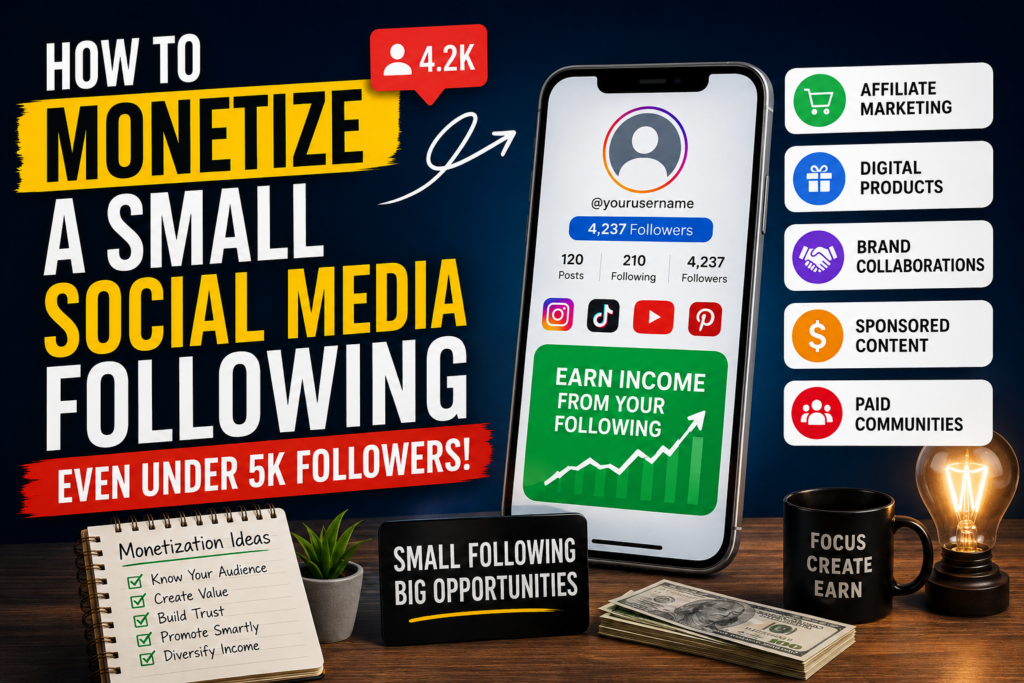
There’s a lie that’s been circulating online for years. It sounds like this: “Grow your audience first, then worry about money later.”
It sounds logical. Patient. Strategic. But for most small creators, that advice translates to months (or years) of free labor with no financial return, chasing a follower count that always feels just out of reach.
Here’s what nobody selling a “grow to 100K” course wants to admit: you don’t need 100K followers to earn real income from social media. You don’t need 50K. You don’t need 10K. Creators with audiences of 1,000 to 5,000 engaged followers are earning hundreds, and sometimes thousands, of dollars per month right now.
The catch? They’re not doing it the way most people assume. They’re not waiting for brand deals to fall in their lap. They’re not relying on platform ad revenue. They’re using strategies that work precisely because their audience is small, focused, and trusting.
This guide shows you exactly how to do the same, step by step, with specific tactics, realistic income expectations, and none of the “just post consistently and the money will come” advice that helps nobody.
Why a Small Following Can Be More Profitable Than a Large One
This sounds counterintuitive, so let’s unpack it with numbers.
Creator A has 50,000 followers. Their engagement rate is 1.2% (typical for larger accounts). That’s about 600 people actively interacting with each post. Their audience is broad, and the followers range from curious lurkers to mildly interested observers. When Creator A promotes a product, maybe 0.3% of their audience buys. That’s 150 potential sales.
Creator B has 3,000 followers. Their engagement rate is 8% (common for small, niche accounts). That’s 240 people actively engaging. The audience is tight-knit. They follow Creator B because they share a very specific interest, and they trust Creator B’s recommendations. When Creator B promotes a product, 3% of their audience buys. That’s 90 potential sales.
Creator A gets more total sales (150 vs. 90), but Creator B has a higher conversion rate and did it with 94% fewer followers. And here’s the part that changes the math completely: Creator B didn’t need to spend two years building to 50K before earning their first dollar.
Small audiences convert at higher rates because of three psychological factors:
Proximity. When an account has 2,000 followers, the creator can respond to comments, answer DMs, and build genuine relationships. That personal connection builds trust that mass-audience creators physically cannot replicate.
Specificity. Small accounts tend to be niche-focused. A creator who talks exclusively about indoor herb gardening attracts people who are deeply interested in indoor herb gardening, not people who half-heartedly follow 500 lifestyle accounts. Niche audiences spend more because recommendations feel personally relevant.
Authenticity. Smaller creators haven’t been “professionalized” yet. Their content feels real, not produced. Their recommendations come across as genuine opinions, not paid scripts. Audiences sense the difference, and they reward it with trust, and with purchases.
The Minimum Viable Audience: How Small Is Too Small?
You can start monetizing with as few as 500 engaged followers. “Engaged” is the operative word. Five hundred people who open your stories, reply to your posts, and send you DMs are worth more than 5,000 ghost followers who scrolled past your content without stopping.
How to gauge whether your audience is engaged enough to monetize:
- Your stories get viewed by 15-30% of your followers. If you have 1,000 followers and 150-300 people watch your stories, that’s strong engagement.
- You receive DMs from followers asking questions, sharing their experiences, or responding to your content.
- Your posts get comments beyond emoji reactions. Real sentences. Real conversations.
- People tag friends in your posts or share them. This signals that your content feels valuable enough to pass along.
- You get asked for recommendations. “What camera do you use?” “Where did you get that?” “What app is that?” These questions are buying signals hiding in plain sight.
If you’re hitting two or three of these markers, your audience is ready. The question isn’t whether you can monetize. It’s which method fits best.
8 Ways to Monetize a Small Social Media Following
1. Sell a Digital Product
This is the single most accessible and highest-margin monetization method for small creators. A digital product costs nothing to reproduce once it’s built, and it scales without additional effort.
What qualifies as a digital product?
- Ebooks and guides ($9-$47)
- Printable planners, trackers, or worksheets ($5-$25)
- Templates (Canva, Notion, spreadsheets) ($10-$50)
- Presets for photos or video (Lightroom, CapCut) ($15-$40)
- Short courses or workshops ($47-$297)
- Swipe files, scripts, or prompt packs ($10-$30)
Why it works with a small audience:
You only need a small percentage of your followers to buy. If you have 2,000 followers and 2% purchase a $27 ebook, that’s 40 sales, which equals $1,080. Run that promotion twice a year with an updated edition, and you’ve earned over $2,000 from a single product.
How to figure out what to create:
Look at the questions your followers keep asking. The DMs you answer repeatedly. The problems you see people struggling with in your comments. Your digital product should package your most-requested knowledge into a format that saves your audience time, effort, or confusion.
Where to sell:
- Gumroad (simplest setup, low fees)
- Stan Store (built for creators, integrates with social bios)
- Payhip (flexible pricing options, 0% fees on higher plans)
- Your own website with a tool like ThriveCart or Lemon Squeezy
Don’t overcomplicate the product. A 15-page ebook that solves one specific problem will outsell a 200-page guide that tries to cover everything. Small audiences want focused solutions, not textbooks.
2. Offer a Paid Service
Your social media content is a live portfolio of your skills, taste, and expertise. Even a modest following can funnel clients to paid services.
Services small creators commonly offer:
- Social media management for small businesses ($500-$2,000/month per client)
- Photography or videography ($200-$2,000 per session)
- Coaching or consulting ($75-$300 per hour)
- Copywriting or content writing ($100-$1,000 per project)
- Design work (logos, brand kits, web design) ($300-$5,000 per project)
- Virtual assistance ($25-$75 per hour)
- Meal planning, fitness programming, or styling ($100-$500 per month)
How to position yourself:
You don’t need to call yourself an expert. You need to show results. If you manage your own social media well and post about what you’ve learned, small business owners in your audience will think, “Can you do that for my business?” That thought is a sale waiting to happen.
Share your process, your behind-the-scenes workflow, your before-and-afters. Show, don’t claim. One creator with 1,800 followers landed three social media management clients at $1,000/month each by posting a single carousel breaking down how she grew a local bakery’s Instagram engagement by 340%.
Pricing tip: New creators tend to underprice their services out of insecurity. A better approach: price based on the value you deliver, not the time it takes. If your social media management helps a business earn an extra $5,000/month, charging $1,000 for that service is reasonable, regardless of whether you have 2,000 followers or 200,000.
3. Affiliate Marketing (Done Right)
Affiliate marketing gets a bad reputation because so many people do it badly: random product links plastered across posts with no context, no personal experience, and no reason for the audience to trust the recommendation.
Done well, affiliate marketing is one of the most natural ways to earn from a small following. You’re already recommending products you love in DMs and comments. Getting paid for those same recommendations is just formalizing what you already do.
How to do affiliate marketing with a small audience:
Recommend products you genuinely use and can speak about with depth. “I’ve used this journal every morning for six months and here’s what changed” converts far better than “Check out this cool journal, link in bio.”
Create content around the recommendation. A single Instagram reel showing your morning routine with the journal, or a TikTok comparing three journals you’ve tried, gives context and builds trust. The affiliate link becomes a natural extension of helpful content, not a billboard.
Focus on higher-ticket or recurring-commission products. If you have a small audience, you need each conversion to count. Recommending a $12 Amazon product at a 4% commission earns you $0.48 per sale. Recommending a $50/month software tool with a 30% recurring commission earns you $15/month per signup, every month they stay subscribed. Ten signups = $150/month in passive income from a single recommendation.
Programs worth exploring for small creators:
- Amazon Associates (low commission but massive product range)
- ShareASale and Impact (wide variety of brands)
- Individual brand programs (many DTC brands run their own affiliate programs with higher commissions)
- Software affiliates (ConvertKit, Canva Pro, Notion, ThriveCart) often pay 20-30% recurring commissions
Realistic income: A creator with 3,000 followers who consistently weaves affiliate recommendations into their content can earn $200-$800/month once they’ve built a library of recommendation-based posts.
4. User-Generated Content (UGC) Creation
UGC is one of the most underexplored income opportunities for small creators. Brands are actively seeking people who can create authentic-looking content for their ads and product pages, and they don’t care about your follower count.
How UGC works:
A brand pays you to create content (photos, videos, testimonials) that looks like it was made by a real customer. The brand then uses this content in their paid ads, website, or email marketing. You don’t need to post anything on your own account.
Why follower count doesn’t matter:
UGC is a production skill, not an influence play. Brands are buying your ability to create content that feels genuine and relatable. A creator with 800 followers who can shoot clean, well-lit product videos is more valuable to brands than an influencer with 50K followers whose content doesn’t convert in ads.
What brands pay for UGC:
- A single UGC video (30-60 seconds): $150-$500
- A package of 3-5 videos: $400-$1,500
- Photos (batch of 5-10): $200-$600
- Monthly retainer for ongoing content: $1,000-$3,000+
How to get started:
- Create a UGC portfolio by filming 3-5 sample videos using products you already own. Show different styles: unboxings, “get ready with me” formats, testimonial-style talking heads, aesthetic product showcases.
- Post your portfolio on a simple website or link-in-bio page.
- Pitch brands directly via email or DM. Focus on small to mid-size DTC brands that run paid social ads (check if they have active Facebook/Instagram ad libraries).
- Join UGC platforms like Billo, Insense, or JoinBrands to get matched with brands.
A creator who lands two UGC deals per month at $300 each earns $600/month with zero dependency on follower count. Scale that to four deals per month as your skills improve, and you’re at $1,200/month.
5. Brand Partnerships and Micro-Influencer Deals
Yes, brands do work with creators under 5,000 followers. The micro-influencer and nano-influencer space has exploded because brands have realized that smaller creators often deliver better ROI than celebrity endorsements.
What brands look for in small creators:
- High engagement rates (5%+ is attractive)
- A clearly defined niche
- Authentic content that doesn’t look overly staged
- An audience that matches the brand’s target customer
- Professionalism in communication and delivery
How to land your first brand deal:
Don’t wait for brands to find you. Create a simple media kit (one page is fine) that includes your follower count, engagement rate, audience demographics (age, location, interests), and 2-3 examples of your best content. Include your rates.
Pitch brands that align with your content. If you post about home office setups, pitch desk accessory brands, monitor companies, or ergonomic chair makers. The more natural the fit, the more likely they’ll say yes.
Start with product-for-post trades. Your first few collaborations might be unpaid (you get the product for free in exchange for content). This isn’t exploitation if you’re strategic about it. Use these early partnerships to build a portfolio of branded content you can show future paying clients.
Pricing for small creators:
A common formula: $100 per 1,000 followers as a baseline, then adjust based on engagement rate, content quality, and usage rights. A creator with 3,000 followers and strong engagement might charge $300-$500 per sponsored post. If the brand wants usage rights to run your content as a paid ad, add 50-100% to your rate.
Where to find opportunities:
- AspireIQ, Grin, and CreatorIQ (influencer platforms where brands browse for creators)
- Brand-specific ambassador programs (many brands have “apply here” pages on their websites)
- Cold outreach via email or Instagram DM (still the most effective method for small creators)
- Hashtags like #gifted, #sponsored, or #brandpartner on Instagram, then look at which brands are already working with small accounts
6. Paid Community or Membership
People will pay for ongoing access to a creator they trust. A paid community doesn’t require thousands of members to be profitable. Even 20-50 paying members at $10-$30/month creates a meaningful income stream.
What a paid community can include:
- Exclusive content not shared on public social media
- Weekly or monthly live Q&A sessions
- A private group chat (Discord, Slack, or a community platform)
- Early access to your products or content
- Accountability groups and challenges
- Direct access to you for questions and feedback
Platforms to host a paid community:
- Patreon (well-known, built-in discovery features)
- Discord (with paid roles using tools like LaunchPass)
- Circle (clean community platform, integrates with courses)
- Substack (if your community revolves around written content)
- Buy Me a Coffee (simple membership tier setup)
- Skool (growing fast, combines community and courses)
Why it works with a small following:
Paid communities convert best among audiences that already feel a strong connection to the creator. That connection is easier to build with a small, engaged following than a large, passive one. If 50 people out of your 2,000 followers join at $15/month, that’s $750/month in recurring revenue.
The key to retention: A paid community only works if members feel they’re getting more value than they’re paying for. Consistency matters more than volume. One thoughtful live session per week and active participation in discussions outperforms a flood of content that nobody asked for.
7. Freelance Content Creation for Brands
This differs from UGC and influencer deals. Here, you’re hired as a freelance content creator, essentially working as part of a brand’s marketing team on a project or retainer basis.
What this looks like:
A local restaurant hires you to shoot and edit weekly Reels for their Instagram. A skincare startup brings you on to create three months of TikTok content. A fitness studio pays you to manage their content calendar and produce posts.
Why your small following is an advantage:
Small creators are often more affordable and more available than larger ones. Small and medium businesses prefer working with local creators who understand their community. And your own social media presence, even if it’s modest, serves as a living resume of your content skills.
How to find these opportunities:
- Post content about your niche and tag local or small businesses
- Reach out directly to businesses whose social media presence is weak or inactive (many will be grateful someone offered to help)
- Join freelancer platforms (Upwork, Contra, Fiverr) and position yourself as a social media content creator
- Network in local business groups, both online and in person
Income potential: $500-$3,000/month per client, depending on scope. Two to three retainer clients can replace a full-time income.
8. Tip Jars and Crowdfunding
The lowest-barrier monetization method. Platforms like Buy Me a Coffee, Ko-fi, and direct tipping features on Instagram, TikTok, and YouTube allow your audience to support you financially with no product or service required.
When this works:
Tip-based income works best for creators who provide free value consistently and have an audience that wants to give back. It rarely replaces a full income on its own, but it can cover tools, software, and content creation costs, which is meaningful for a creator just starting out.
How to encourage tips without begging:
- Add a tasteful link in your bio: “If my content helps you, you can buy me a coffee here”
- Mention it occasionally in stories: “Someone asked how to support the account, here’s the link”
- Offer small perks for supporters (a monthly wallpaper download, a shoutout, or early access to posts)
Realistic income: $50-$300/month for most small creators. Some creators in passionate niches (gaming, art, writing) earn more because their audiences have a strong culture of creator support.
Building the Infrastructure That Makes Money Flow
Picking a monetization method is step one. Building the infrastructure that makes it sustainable is where long-term income comes from.
Your Link-in-Bio Page
Every creator needs a single hub that connects their social audience to their income streams. Tools like Stan Store, Linktree, Beacons, or a simple personal website serve this purpose.
Your link page should include:
- Your highest-priority offer (digital product, service booking, or affiliate recommendation) at the top
- A link to join your email list
- Links to any other monetization channels (community, tip jar, UGC portfolio)
- A brief description of who you are and what you offer
Keep it clean. Five to seven links maximum. Every link should have a purpose tied to income or audience building.
An Email List (Yes, Even for Social Media Creators)
Social media algorithms decide who sees your content. Your email list is the one channel where you control the reach. If Instagram’s algorithm buries your post, it doesn’t matter if you can email your most engaged followers directly.
Start building your list from day one, even if you only have a few hundred followers. Offer a free resource in exchange for an email. A fitness creator might offer a free “7-Day Home Workout Plan.” A cooking creator might offer “10 Weeknight Dinners Under 30 Minutes.” A productivity creator might offer a “Morning Routine Planner.”
When you launch a product, open a service slot, or have a special promotion, your email list becomes your most reliable sales channel.
Tools for small creators: ConvertKit (free up to 10,000 subscribers), MailerLite (free up to 1,000), Beehiiv (free tier with growth tools), or Flodesk (flat-rate pricing regardless of list size).
A Content System That Sells Without Feeling Salesy
The biggest fear small creators have about monetization: “I don’t want to annoy my audience by selling.”
Here’s the framework that makes selling feel natural:
The 80/15/5 rule:
- 80% of your content should be free value: tips, entertainment, education, inspiration
- 15% of your content should build authority and trust: behind-the-scenes, personal stories, results, process breakdowns
- 5% of your content should directly promote your offer: product launches, sale announcements, testimonials, results from past customers
When 95% of your content gives freely, the 5% that asks for a purchase feels earned, not intrusive. Your audience has received so much free value that buying from you feels like a fair exchange.
Pricing Your Offers: A Guide for Small Creators
Pricing is where most new creators freeze. They’re terrified of charging too much and hearing crickets, so they charge too little and undermine their own value.
Pricing Principles for Small Audiences
Price based on the transformation, not the deliverable. A 10-page ebook isn’t worth $27 because it has 10 pages. It’s worth $27 because it saves the buyer 10 hours of research, or helps them avoid a $500 mistake, or teaches them a skill they’ll use for years.
Small audiences can support premium pricing. You don’t have the volume to make $1 products profitable. Twenty sales at $47 ($940) beats 200 sales at $5 ($1,000) in effort, stress, and customer support. And with a small audience, getting 200 sales is harder than getting 20.
Test and adjust. Launch at a price that feels slightly uncomfortable (in the right direction). If it sells out instantly, raise it next time. If it barely moves, adjust your positioning before dropping the price. Often the issue isn’t price but perceived value.
Pricing Benchmarks by Offer Type
| Offer | Price Range | Notes |
|---|---|---|
| Ebook or guide | $9-$47 | Higher end for specialized, actionable content |
| Template pack | $10-$50 | Notion, Canva, spreadsheets |
| Mini-course or workshop | $47-$197 | Video-based, focused on one outcome |
| 1:1 coaching session | $75-$300/hour | Price rises with experience and results |
| Monthly membership | $10-$50/month | Value must justify recurring commitment |
| UGC video | $150-$500/video | Depends on complexity and usage rights |
| Sponsored post | $100-$500 | Based on follower count, engagement, and niche |
A 90-Day Plan to Your First Dollar
Days 1-30: Set the Foundation
Clarify your niche and audience. Who do you help? What specific problem do you address? Write this in one sentence and put it in your bio.
Audit your content. Look at your last 20 posts. Which ones got the most saves, shares, and comments? Those topics are your audience’s buying signals. Create more content in those areas.
Choose one monetization method. Don’t try all eight at once. Pick the one that best matches your skills and audience. For most small creators, a digital product or a service offering is the fastest path to income.
Set up your infrastructure. Create your link-in-bio page. Set up an email list with a lead magnet. Make sure your profile clearly communicates what you offer.
Days 31-60: Build and Pre-Sell
Create your offer. Build your digital product, design your service package, or set up your UGC portfolio. Give yourself a hard deadline. Done beats perfect.
Pre-sell to validate demand. Before finishing your product, announce it to your audience. “I’m building a [product] that helps you [outcome]. It’ll be ready in two weeks. Want early access at 30% off?” If people buy before the product is finished, you know the demand is real.
Create content that naturally leads to your offer. If you’re selling a meal planning template, post content about meal planning tips. If you’re offering coaching, post content that demonstrates your expertise. Every post should make your eventual offer feel like a logical next step.
Grow your email list actively. Mention your free resource in stories, posts, and DMs. Aim for 100-200 email subscribers by the end of this phase.
Days 61-90: Launch and Learn
Launch your offer. Send an email sequence to your list. Post a launch announcement on social media. Share testimonials and results (even your own). Create urgency with a limited-time price or bonus.
Follow up. Most sales happen after the third or fourth touchpoint. Don’t post once and assume the launch failed. Talk about your offer across multiple posts, stories, and emails over a 5-7 day launch window.
Analyze what worked. Which content drove the most clicks? Which emails had the highest open rates? Where did people drop off? Use this data to refine your next launch.
Start planning your second income stream. Once your first monetization method is producing income, layer in a second one. If you launched a digital product, add affiliate links to related tools. If you started with services, begin building a digital product that packages your service knowledge.
Tracking Income and Setting Realistic Goals
Small creator income doesn’t follow a straight line. Expect lumpy months, especially early on. A product launch month might earn $800 while the following month drops to $150. That’s normal.
Month 1-3 goal: Earn your first $1. The amount is irrelevant. The milestone is proving the model works.
Month 3-6 goal: Reach $200-$500/month from one or two income streams.
Month 6-12 goal: Hit $500-$2,000/month by adding a second income stream and growing your audience strategically.
Year 2 goal: $2,000-$5,000/month with a diversified income mix (products, affiliates, services, or brand partnerships).
These numbers assume consistent effort, regular content publishing, and active engagement with your audience. They’re conservative. Creators in high-value niches (finance, tech, business, health) often exceed these benchmarks.
The Niches Where Small Followings Earn the Most
Not all niches monetize equally. Some audiences are worth significantly more per follower than others.
High-value niches for small creators:
- Business and entrepreneurship. Audiences that are building businesses will spend money on tools, courses, and consulting that help them earn more.
- Personal finance and investing. Financial product affiliates pay some of the highest commissions in any category.
- Tech and software. SaaS affiliate programs offer recurring commissions, and tech audiences expect to pay for premium tools.
- Health, fitness, and nutrition. Supplement, equipment, and coaching sales thrive in this space.
- Career development. Resume services, interview coaching, and skill-building courses sell well to motivated professionals.
- Parenting. Parents spend consistently on products that make their lives easier, and they trust peer recommendations over advertising.
- Home improvement and decor. High average order values and strong visual content potential.
Lower-value niches (still possible but harder to monetize with small numbers):
- Entertainment and memes (high engagement, low purchase intent)
- General lifestyle without a specific angle
- News commentary and opinions
- Broad motivational or inspirational content
If you’re in a lower-value niche, consider narrowing your focus. “Motivation” is hard to monetize. “Productivity systems for remote workers” is easier because the audience has a specific problem and budget.
Mistakes That Keep Small Creators Broke
Waiting until you “have enough followers.” There’s no magic number. The creator waiting for 10K could be earning right now with 2K. Every month you delay is income left on the table.
Giving away too much for free. Generosity builds trust, but there’s a line. If you answer every question in DMs, give away your entire process in free posts, and never hold anything back, your audience has no reason to pay. Save your most structured, complete, and actionable guidance for paid products.
Copying what big creators do. A creator with 500K followers earns money from ad revenue and mass-scale brand deals. Those strategies don’t work at 3K. Study creators in the 1K-10K range and model their approach instead.
Posting without a strategy. Random content attracts a random audience. Random audiences don’t buy. Every post should serve one of three purposes: attract new followers, deepen trust with existing ones, or sell something. If a post doesn’t do at least one of these, reconsider publishing it.
Ignoring DMs and comments. At the small-creator stage, your biggest advantage is accessibility. The people reaching out to you are your warmest leads, your future customers, and your most loyal supporters. Respond to every meaningful message. That personal touch is something a 100K account physically cannot offer.
Not tracking your numbers. Know your engagement rate, your click-through rate on link-in-bio, your email open rate, and your conversion rate on offers. You can’t improve what you don’t measure.
What Success Actually Looks Like at the Small-Creator Level
Let’s build a concrete example.
Marcus runs a finance-focused Instagram account aimed at first-generation college graduates managing money for the first time. He has 2,800 followers.
His income breakdown at month 8:
- Digital product: A $19 “First Paycheck Survival Guide” (Notion template + short ebook). He sells 15-25 copies per month = $285-$475
- Affiliate income: He recommends a budgeting app ($12/signup commission) and a high-yield savings account ($50/signup commission). Combined: $150-$300/month
- UGC creation: He films two UGC videos per month for a fintech startup = $500
- Email list: 620 subscribers, 42% open rate, drives most of his product sales
Total monthly income: $935-$1,275
Marcus doesn’t have a blue checkmark. He’s never gone viral. His highest-performing reel got 12,000 views, and most get 800-1,500. But he has a focused niche, an engaged audience, and multiple income streams that compound month over month.
That’s the playbook. It’s not glamorous. It won’t trend on Twitter. But it pays the bills, and it grows.
Your Audience Is Already Big Enough
The follower count on your profile is a vanity metric. The number that matters is how many people trust you enough to take action on your words, whether that’s buying a product, signing up for a service, or clicking a link you recommend.
If even 100 people trust you that much, you have the foundation for real income. If 500 do, you have a business. If 2,000 do, you have options most traditional employees don’t.
Stop waiting for a number on a screen to give you permission to earn. The audience you have right now is enough. The only question is what you’ll offer them.
Open a Google Doc. Write down the one thing your followers ask you about most. That’s your first product. Build it this week. Price it fairly. Share it with the people already paying attention.
Your small following isn’t a limitation. It’s the starting line.