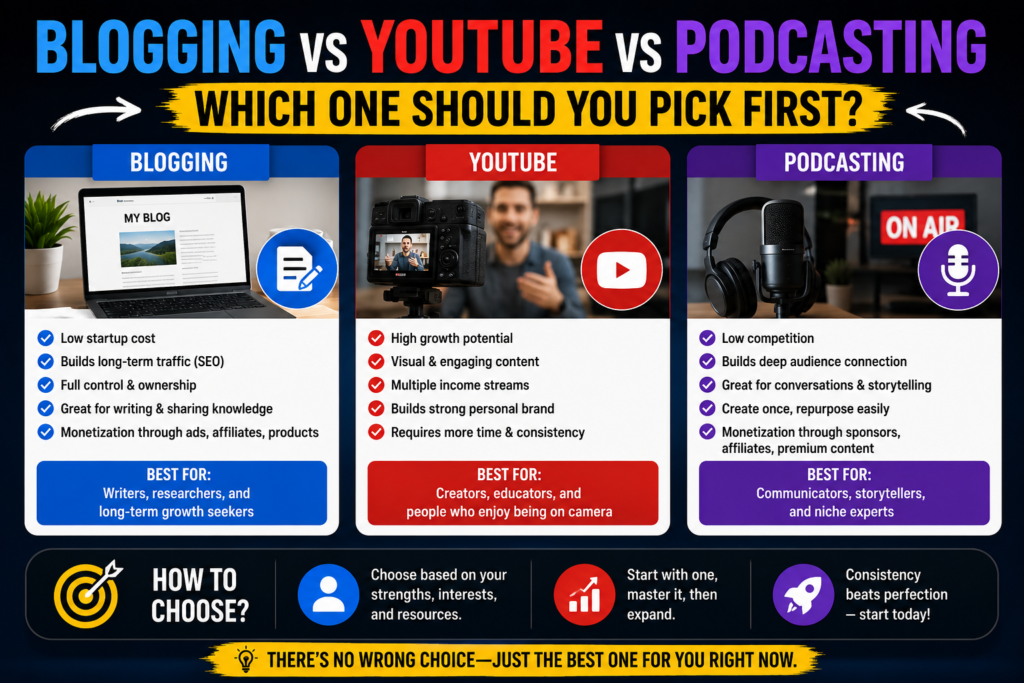
Three platforms. Three completely different skill sets. Three audiences that consume content in completely different ways.
If you’ve decided to build an online presence, create content, or turn your knowledge into income, you’ve probably found yourself stuck in this exact comparison. Blogging, YouTube, and podcasting all work. People are making real money on all three. And the internet is full of creators who swear their platform is the one you should choose.
The truth? There is no universally “best” platform. There’s only the best platform for you, based on your skills, your lifestyle, your goals, and the specific audience you want to reach.
This guide puts all three side by side with real numbers, honest trade-offs, and practical frameworks so you can stop researching and start creating. By the end, you’ll know exactly which one deserves your time first.
The Fundamental Difference Between All Three
Before comparing the details, you need to understand what makes each platform structurally different, because this changes everything about how you create, how you grow, and how you earn.
Blogging is text-based, search-driven, and asynchronous. You write articles. People find them through Google (mostly), read them at their own pace, and leave. The relationship between you and your reader is functional. They came for information, and you delivered it. Blogging is the quietest of the three formats, but it has the longest shelf life and the most passive income potential per piece of content.
YouTube is video-based, algorithm-driven, and visual. You create videos. People find them through YouTube search, suggested videos, and the homepage feed. YouTube has a stronger parasocial dynamic than blogging. Viewers feel like they know you (even on faceless channels, they recognize your voice and style). Video content demands more production effort but creates deeper audience connection.
Podcasting is audio-based, relationship-driven, and intimate. You record conversations or monologues. People find them through podcast directories (Apple Podcasts, Spotify), word of mouth, and social media. Podcasting creates the deepest audience relationship of the three because listeners spend 30 to 60+ minutes with your voice in their ears, often during commutes, workouts, or chores. That level of intimacy builds trust faster than any other medium.
Understanding these structural differences is the foundation for everything that follows.
Time Investment: How Much Does Each One Actually Take?
Let’s get specific about the real time commitment for each platform, from idea to published content.
Blogging: Time Per Piece
- Research: 1 to 3 hours
- Writing: 2 to 5 hours (for a 1,500 to 3,000 word article)
- Editing and formatting: 30 minutes to 1 hour
- Finding/creating images: 15 to 30 minutes
- SEO optimization (titles, meta descriptions, internal links): 15 to 30 minutes
- Total per post: 4 to 10 hours
Recommended publishing frequency: 1 to 3 posts per week
Weekly time commitment: 4 to 30 hours depending on post length, complexity, and publishing frequency
What most people underestimate: The writing itself is only half the work. Keyword research, formatting, image optimization, and on-page SEO take significant time, and skipping them means your post won’t rank in Google.
YouTube: Time Per Video
- Topic research and scripting: 2 to 4 hours
- Recording (on-camera or voiceover): 30 minutes to 2 hours
- Editing: 3 to 8 hours (the biggest time sink for most creators)
- Thumbnail creation: 30 minutes to 1 hour
- Title and description optimization: 15 to 30 minutes
- Total per video: 6 to 16 hours
Recommended publishing frequency: 1 to 2 videos per week
Weekly time commitment: 6 to 32 hours
What most people underestimate: Editing. If you’ve never edited video before, your first few videos will take 2 to 3 times longer than the estimates above. The learning curve is steep but flattens significantly after 10 to 15 videos.
Podcasting: Time Per Episode
- Guest research and outreach (if interview-based): 1 to 2 hours
- Outline or prep notes: 30 minutes to 1 hour
- Recording: 30 to 90 minutes (usually equal to the episode length)
- Editing and audio cleanup: 1 to 3 hours
- Show notes and publishing: 30 minutes to 1 hour
- Total per episode: 3 to 8 hours
Recommended publishing frequency: 1 episode per week
Weekly time commitment: 3 to 8 hours
What most people underestimate: Guest coordination. If you’re running an interview show, scheduling guests, sending prep materials, rescheduling cancellations, and managing follow-ups can consume as much time as the production itself.
The Time Verdict
Podcasting is the fastest to produce on a per-episode basis. Blogging sits in the middle. YouTube takes the longest per piece of content. But raw production time isn’t the full picture. You need to factor in the return you get per hour invested, which brings us to the next section.
Startup Costs: What You Need to Spend
Blogging Startup Costs
- Domain name: $10 to $15/year
- Web hosting: $3 to $30/month (Bluehost, SiteGround, Cloudways, or similar)
- WordPress theme: $0 (free themes work fine) to $60 (premium theme, one-time purchase)
- Writing tools: $0 (Google Docs is free) to $20/month (Grammarly Premium, Surfer SEO)
- Stock images: $0 (Unsplash, Pexels) to $15/month (Shutterstock subscription)
- Total to get started: $50 to $200
YouTube Startup Costs
- Camera: $0 (your smartphone is good enough to start) to $500+ (a dedicated camera)
- Microphone: $30 to $100 (USB mic like the Blue Yeti or Fifine K669)
- Lighting: $0 (natural window light) to $50 (a ring light or LED panel)
- Editing software: $0 (CapCut, DaVinci Resolve) to $23/month (Adobe Premiere Pro)
- Thumbnail design tool: $0 (Canva free tier)
- Total to get started: $0 to $200 (faceless channels can start for literally nothing)
Podcasting Startup Costs
- Microphone: $60 to $130 (Audio-Technica ATR2100x or Samson Q2U are popular starter mics)
- Headphones: $20 to $50
- Recording software: $0 (Audacity, GarageBand, or Riverside.fm’s free tier)
- Podcast hosting: $0 to $15/month (Spotify for Podcasters is free; Buzzsprout and Transistor are paid)
- Editing software: $0 (Audacity) to $20/month (Descript, which makes editing as easy as editing a text document)
- Pop filter: $10
- Total to get started: $90 to $225
The Cost Verdict
All three platforms can be started for under $200, which makes cost a non-factor in the decision. Blogging is the cheapest if you’re willing to use free themes and tools. YouTube can be started for zero dollars with a smartphone and free editing software. Podcasting has a slightly higher minimum investment because audio quality matters from day one (listeners will tolerate amateur video, but they won’t tolerate amateur audio).
How Fast Can You Grow? Realistic Timelines
This is where the platforms diverge dramatically.
Blogging Growth Timeline
Month 1–3: Almost no traffic. Google doesn’t trust new websites. Your posts won’t rank for competitive terms, and you’ll be lucky to get 50 to 200 organic visitors per month. This is the “Google Sandbox” period, and it’s where most new bloggers quit.
Month 4–6: Your earliest posts start to gain traction in search results. You might see 500 to 2,000 monthly visitors if you’re targeting the right keywords and publishing consistently.
Month 6–12: Growth accelerates. Older posts climb in rankings. New posts rank faster because Google trusts your domain more. 5,000 to 20,000 monthly visitors is realistic for a blog with 50+ well-optimized posts.
Month 12–24: If you’ve been consistent, 20,000 to 100,000+ monthly visitors is achievable. Some bloggers reach this faster; many take longer. It depends entirely on niche competition, content quality, and SEO execution.
The hard truth about blogging growth: Blogging is the slowest platform to gain traction. The first 6 months often feel like screaming into a void. But the compounding effect is powerful. A blog post that ranks on page one of Google can generate traffic for 3 to 5 years with minimal updates. No other platform offers that kind of passive, long-term return on a single piece of content.
YouTube Growth Timeline
Month 1–2: Slow, but not as dead as a new blog. YouTube gives new videos some initial exposure to test whether viewers engage. You might get 100 to 1,000 views across your first 8 to 10 videos, primarily from search.
Month 3–4: If your content matches what viewers want (strong retention and click-through rates), the algorithm starts suggesting your videos to a broader audience. 1,000 to 5,000 monthly views is typical for a channel that’s publishing consistently and improving.
Month 4–8: Compounding starts. Your video library grows, older videos continue accumulating views, and the algorithm gets better at matching your content with the right viewers. Many channels reach 1,000 subscribers in this window.
Month 8–12: With 40 to 80+ videos, growth can accelerate significantly. 10,000 to 50,000+ monthly views and 1,000 to 5,000 subscribers is achievable for a channel that has found its niche and consistently delivers strong content.
The hard truth about YouTube growth: YouTube rewards quality and engagement above all else. One viral video can do more for your channel than 30 mediocre ones. The algorithm is your best friend when it works in your favor and your worst enemy when it doesn’t. But unlike blogging, YouTube can deliver explosive growth in a short period if a video catches fire.
Podcasting Growth Timeline
Month 1–3: This is the toughest phase. Podcast discovery is the weakest of all three platforms. Apple Podcasts and Spotify don’t have strong recommendation algorithms like YouTube, and there’s no equivalent to Google Search for podcast content. You’ll rely heavily on personal networks, social media promotion, and guest swaps to get your first 50 to 200 downloads per episode.
Month 3–6: If you’re publishing weekly and promoting each episode, 200 to 500 downloads per episode is a realistic target. Growth comes primarily from word of mouth, social sharing, being a guest on other podcasts, and consistency.
Month 6–12: 500 to 2,000 downloads per episode puts you in the top 20% of all podcasts (most podcasts don’t make it past 7 episodes, which skews the averages in your favor if you stick with it). Growth is slow but steady, and listener loyalty tends to be very high.
Month 12+: Established podcasts with strong audiences can reach 5,000 to 10,000+ downloads per episode. At this level, sponsorship opportunities open up significantly.
The hard truth about podcasting growth: Podcasting has the weakest discovery mechanism of the three. People rarely browse for new podcasts the way they browse YouTube or Google. Growth depends heavily on marketing outside the podcast itself. You need to be active on social media, appear on other podcasts, or have another platform (a blog, a YouTube channel, or a social media presence) that funnels listeners to your show.
The Growth Verdict
YouTube has the strongest built-in discovery engine and can grow the fastest, but it demands the most production effort. Blogging starts the slowest but compounds the hardest over time. Podcasting grows at a moderate pace but relies on you to drive your own discovery, since podcast platforms won’t do it for you.
Income Potential: How Much Can You Actually Make?
Let’s talk money, with real numbers, not hypothetical projections.
Blogging Income Streams
Display ads (Google AdSense, Mediavine, Raptiv): This is the primary income source for most bloggers. You get paid when visitors see or click ads on your site.
- AdSense pays roughly $2 to $10 RPM (revenue per 1,000 page views) for most niches
- Mediavine (requires 50,000 monthly sessions) pays $15 to $40+ RPM
- Raptiv (requires 100,000 monthly page views) pays $15 to $50+ RPM
A blog with 50,000 monthly visitors on Mediavine might earn $750 to $2,000/month from ads alone.
Affiliate marketing: You recommend products and earn commissions when readers buy through your links. Affiliate income varies wildly by niche:
- Finance bloggers can earn $50 to $200+ per referral for credit cards, investing platforms, or insurance
- Tech bloggers earn 3% to 8% commissions on electronics through Amazon Associates
- Software bloggers earn 20% to 40% recurring commissions from SaaS affiliate programs
Sponsored posts: Brands pay you to write about their products. Rates depend on traffic and niche: $100 to $500 for small blogs, $1,000 to $10,000+ for established blogs with strong domain authority.
Digital products and courses: Many bloggers sell ebooks, templates, printables, or online courses. Margins are extremely high (90%+) since there’s no physical product cost.
Realistic blogging income timeline:
- Month 1–6: $0 to $50
- Month 6–12: $50 to $500
- Year 2: $500 to $5,000/month
- Year 3+: $2,000 to $20,000+/month (top performers)
YouTube Income Streams
Ad revenue (YouTube Partner Program): You earn money from ads shown before, during, and after your videos. Requires 1,000 subscribers and 4,000 watch hours.
RPM by niche:
- Finance and business: $10 to $30+
- Technology: $8 to $20
- Education: $5 to $15
- Lifestyle and entertainment: $2 to $8
- Gaming: $2 to $7
A channel with 100,000 monthly views in the finance niche might earn $1,000 to $3,000/month from ads.
Sponsorships: Brands pay you to feature their product in your video. This becomes the largest income source for most YouTubers once their channel grows.
- 10,000 subscribers: $200 to $1,000 per sponsorship
- 50,000 subscribers: $1,000 to $5,000 per sponsorship
- 100,000+ subscribers: $5,000 to $25,000+ per sponsorship
Affiliate marketing: Same as blogging, but through video descriptions and pinned comments. Conversion rates from YouTube tend to be higher than from blog posts because video builds stronger trust.
Merchandise and digital products: Selling branded merch, courses, templates, or presets. Works best once you have a loyal audience.
Realistic YouTube income timeline:
- Month 1–4: $0
- Month 4–8: $0 to $100 (affiliate commissions before monetization)
- Month 8–12: $100 to $1,000 (after joining the Partner Program)
- Year 2: $500 to $5,000/month
- Year 3+: $2,000 to $30,000+/month (top performers)
Podcasting Income Streams
Sponsorships and ads: This is the primary income source for most podcasters. Sponsors pay based on downloads per episode.
Standard rates:
- Pre-roll (15-second ad at the start): $15 to $25 CPM (cost per thousand downloads)
- Mid-roll (60-second ad in the middle): $20 to $50 CPM
- Post-roll (ad at the end): $10 to $15 CPM
Translation: If your episode gets 1,000 downloads and you have a mid-roll sponsor, you earn $20 to $50 per episode. At 5,000 downloads per episode with two sponsors, you’re earning $200 to $500 per episode.
Most podcast ad networks (Podcorn, AdvertiseCast, Midroll) require a minimum of 500 to 5,000 downloads per episode to qualify.
Listener support (Patreon, Buy Me a Coffee): Offer bonus episodes, early access, or behind-the-scenes content in exchange for monthly contributions. Even a small, dedicated audience can generate meaningful income this way. A podcast with 1,000 engaged listeners might have 30 to 50 Patreon supporters at $5 to $10/month, generating $150 to $500/month.
Affiliate marketing: Mention products during your show and include affiliate links in show notes.
Courses, coaching, and consulting: Podcasting builds authority and trust. Many podcasters leverage that trust to sell high-ticket services. A consultant who hosts a niche podcast can charge premium rates because their show positions them as an authority.
Live events and speaking: Established podcasters get invited (and paid) to speak at conferences and industry events.
Realistic podcasting income timeline:
- Month 1–6: $0
- Month 6–12: $0 to $200 (small sponsorships, listener support)
- Year 2: $200 to $2,000/month
- Year 3+: $1,000 to $15,000+/month (top performers)
The Income Verdict
Blogging offers the most passive income potential. Once a post ranks, it earns money while you sleep with almost no ongoing maintenance. YouTube has the highest overall earning ceiling because sponsorship rates for video are significantly higher than for text or audio. Podcasting monetizes slower but builds the deepest trust, which makes it powerful for selling high-ticket products, services, and consulting.
Skill Requirements: What Are You Good At?
Each platform rewards a different set of skills. Be honest with yourself about where your strengths lie.
Blogging Rewards
- Strong writing ability. You need to explain complex ideas clearly, tell compelling stories in text, and hold attention without visuals or audio to lean on.
- SEO knowledge. Understanding how Google works, how to do keyword research, and how to structure content for search rankings is non-negotiable for blog growth.
- Research skills. Good blog posts require depth, accuracy, and original angles. Surface-level content doesn’t rank anymore.
- Patience. You’ll write dozens of posts before you see meaningful traffic. If you need quick feedback to stay motivated, blogging will test you.
YouTube Rewards
- Visual storytelling. Even on faceless channels, you need to think visually. Every scene, cut, and transition should serve the story or explanation.
- On-camera presence or voice performance. You’re either performing on camera or narrating. Both require energy, clarity, and a sense of pacing.
- Technical editing skills. Video editing is a learnable skill, but it takes time to develop. The gap between a well-edited video and a poorly edited one is immediately obvious to viewers.
- Design sense. Thumbnails matter immensely. You need to understand color, contrast, typography, and visual hierarchy at a basic level.
Podcasting Rewards
- Conversational ability. Can you talk for 30 to 60 minutes and keep it interesting? Can you ask good questions and listen actively? Podcasting is, at its core, the art of conversation.
- Interviewing skills (for interview shows). Great podcast interviews require preparation, genuine curiosity, and the ability to follow unexpected threads while keeping the conversation on track.
- Audio editing basics. Podcast editing is simpler than video editing, but you still need to cut dead air, remove filler words, balance audio levels, and add intros/outros.
- Networking ability. Podcasting growth depends heavily on relationships. You need to build connections with guests, other podcasters, and communities in your niche.
The Skill Verdict
If you’re a strong writer who enjoys research: blogging. If you’re visual, creative, and willing to learn editing: YouTube. If you’re a natural communicator who thrives in conversation: podcasting.
Lifestyle Fit: What Does Your Daily Life Look Like?
This might be the most overlooked factor in the decision, and for many people, it should be the deciding one.
Blogging Fits You If
- You have chunks of quiet, focused time to write (early mornings, late nights, weekends)
- You’re an introvert or prefer working alone
- You want to work at your own pace without time pressure
- You travel frequently (blogging requires only a laptop and internet)
- You have a day job and can only create content in short, irregular windows (you can write 200 words here, 500 words there, and piece an article together over several days)
YouTube Fits You If
- You have access to a quiet space for recording (or can create a faceless channel with screen recordings)
- You can dedicate larger blocks of time for filming and editing sessions
- You enjoy the creative process of visual production
- You’re comfortable with a longer production cycle per piece of content
- You don’t mind being on camera, or you’re willing to go faceless
Podcasting Fits You If
- You’re comfortable talking out loud (even if you’re introverted, many introverts make great podcasters because they prepare thoroughly and ask thoughtful questions)
- You can commit to a weekly schedule (podcast audiences expect consistency more than any other platform’s audience)
- You enjoy connecting with people and building relationships
- You have access to a quiet recording space
- You want a lower production burden per episode compared to video
The Lifestyle Verdict
Blogging offers the most flexibility. You can write anytime, anywhere, in fragments. Podcasting requires dedicated recording time but has a lighter editing burden than video. YouTube demands the most structured production time and the longest per-piece commitment.
Content Longevity: How Long Does Each Piece Last?
This is a factor most beginners overlook entirely, and it has massive implications for your long-term return on investment.
Blogging: The Longest Shelf Life
A well-optimized blog post can rank on Google for 3 to 7 years. Some posts rank for a decade with periodic updates. A single article that ranks for a competitive keyword can generate thousands of dollars in ad revenue and affiliate commissions over its lifetime, all from work you did once.
Blogs compound aggressively. A blog with 200 posts is not just 200 posts. It’s 200 individual doorways that search traffic can flow through simultaneously, 24 hours a day.
YouTube: Long Shelf Life with Compounding
YouTube videos have a strong shelf life, though not quite as long as blog posts. A well-optimized video can generate views for 2 to 5 years through search and suggested videos. Tutorial and “how-to” content tends to have the longest lifespan.
YouTube compounds in a way that’s similar to blogging: every video in your library is a potential entry point for a new subscriber. Channels with 100+ videos have a massive advantage over channels with 10 because the algorithm has more content to recommend.
Podcasting: Shortest Shelf Life
Podcast episodes have the shortest content lifespan of the three. Most downloads happen within the first 7 to 14 days of publishing. After that, episodes get very little new traffic unless someone binges your entire back catalog (which does happen, but less predictably).
There are exceptions: interview episodes with notable guests can continue attracting downloads as new listeners discover the guest through other channels. And evergreen educational episodes can have a longer tail than topical or news-based content.
Podcasting is the closest to a “treadmill” model: you need to keep publishing consistently to maintain your audience. Stop publishing for a month, and your downloads will drop significantly. With blogging and YouTube, your existing content continues working for you during breaks.
The Longevity Verdict
Blogging wins for passive, long-term content value. YouTube is a close second. Podcasting requires the most consistent publishing effort to maintain momentum.
Platform Risk: What Could Go Wrong?
Every platform carries risk. Here’s what you should know about each one.
Blogging Risks
- Google algorithm updates can tank your traffic overnight. A site getting 50,000 monthly visitors can drop to 5,000 after a core update if Google decides your content no longer meets their quality standards.
- SEO is a moving target. What works today may not work in two years. You need to stay current with best practices and adapt.
- AI-generated content is flooding the internet. Google is getting better at filtering low-quality AI content, but the sheer volume of competition in many niches is increasing.
Risk mitigation: Build an email list from day one. Your email subscribers are yours regardless of what Google does. Diversify traffic sources (Pinterest, social media, YouTube) so you’re not 100% dependent on organic search.
YouTube Risks
- Algorithm dependence. YouTube’s algorithm can promote your content or bury it. You have limited control over which outcome you get.
- Policy changes. YouTube periodically changes monetization requirements, ad policies, and content guidelines. Channels that rely on borderline content can get demonetized with little warning.
- Burnout. Video production is demanding. Many YouTubers burn out within 2 to 3 years because of the constant pressure to produce high-quality visual content on a weekly schedule.
- Copyright strikes. Using copyrighted music, footage, or images can result in claims or strikes against your channel.
Risk mitigation: Build an email list and a presence on at least one other platform. Diversify income beyond YouTube ad revenue (affiliate marketing, products, sponsorships).
Podcasting Risks
- Platform fragmentation. Your podcast lives on Apple Podcasts, Spotify, Google Podcasts (deprecated), Amazon Music, and dozens of other apps. None of them offer the algorithmic distribution that YouTube provides.
- Discovery problem. It’s getting harder to grow a podcast organically because the discovery mechanisms are weak compared to Google Search or YouTube recommendations.
- Sponsorship dependency. If your primary income comes from sponsors, losing a major sponsor can create a significant revenue gap.
- Audience fatigue. The podcast market is increasingly crowded. Listeners have more choices than ever, and standing out requires consistently strong content.
Risk mitigation: Own your audience through an email list. Use your podcast to funnel listeners to platforms you control (your website, your email list, your community). Diversify income beyond sponsorships.
The Risk Verdict
All three platforms carry significant risk if you build entirely on rented land. The universal risk mitigation strategy is the same: build an email list. Your email subscribers are the only audience you truly own, regardless of which content platform you use.
The Multi-Platform Question: Should You Do More Than One?
Eventually, yes. But not at the start.
The biggest mistake new creators make is trying to blog, make YouTube videos, and launch a podcast all at the same time. They end up doing all three poorly instead of doing one well.
Start with one platform. Master it. Build an audience. Generate income. Then expand.
The ideal expansion path depends on where you start:
If you start with a blog → add YouTube. You already know how to research topics and write scripts (blog posts are basically video scripts in long form). Repurpose your top-performing articles into videos. Your blog’s SEO authority can drive traffic to your YouTube channel, and your YouTube channel can drive backlinks and traffic to your blog.
If you start with YouTube → add a blog. Transcribe your videos (or rewrite them as articles) and publish them on your own website. This captures Google search traffic that YouTube might miss, builds domain authority, and gives you a platform you own.
If you start with a podcast → add a blog or YouTube. Podcasting has the weakest discovery, so adding a platform with stronger search visibility (blogging or YouTube) helps funnel new listeners to your show. Many podcasters record video of their podcast sessions and publish them on YouTube, getting two pieces of content from one recording session.
The compound effect of multi-platform: Once you’re on two or more platforms, they feed each other. Blog readers become YouTube subscribers. YouTube viewers become podcast listeners. Podcast listeners join your email list. Each platform amplifies the others, creating a growth flywheel that’s much more powerful than any single channel alone.
But that flywheel only works when each individual platform is strong. Build your engine one cylinder at a time.
Decision Framework: A Practical Way to Choose
If you’re still not sure, walk through these five questions. Your answers will point you clearly at one platform.
Question 1: What Do You Enjoy Consuming?
The content you love consuming is usually the content you’ll be best at creating. If you spend hours reading long-form articles and deep-dive blog posts, you’ll probably enjoy writing them. If you watch YouTube for hours, you understand pacing, editing, and visual storytelling intuitively. If you listen to podcasts during every commute and workout, you already have an ear for what makes audio content compelling.
Create the kind of content you wish existed in your niche, in the format you naturally gravitate toward as a consumer.
Question 2: What’s Your Strongest Skill Right Now?
Not the skill you want to develop. The skill you already have.
- Strong writer → Blog
- Good on camera or have a compelling voice → YouTube
- Great conversationalist or interviewer → Podcast
You’ll develop new skills along the way, but starting with your strength reduces friction and increases your chances of sticking with it through the difficult early months.
Question 3: How Much Time Can You Commit Per Week?
- 3 to 5 hours/week → Podcasting (one episode per week)
- 5 to 10 hours/week → Blogging (1 to 2 posts per week)
- 8 to 15+ hours/week → YouTube (1 to 2 videos per week)
If you’re working a full-time job and can only carve out a few hours per week, podcasting or blogging are more realistic than YouTube. Video production simply takes longer.
Question 4: How Patient Are You?
- Very patient (can wait 6 to 12 months for results) → Blogging
- Moderately patient (want to see some traction in 2 to 4 months) → YouTube
- Somewhere in between → Podcasting (growth is steady but slow, without the dramatic “dead zone” that blogging has in the first 6 months)
Question 5: What’s Your Primary Goal?
- Build passive income with minimal ongoing effort: Blogging. A blog with 100+ ranked posts generates income whether you publish new content or not.
- Build a personal brand and audience quickly: YouTube. Video creates the strongest connection fastest, and the algorithm can accelerate your growth in ways that blogging and podcasting can’t match.
- Build deep authority and trust in a professional niche: Podcasting. Long-form audio conversations position you as a thought leader and create unmatched audience loyalty.
- Sell products or services: Any platform works, but blogging and YouTube tend to drive more direct sales because they’re searchable. Someone Googling “best CRM for small business” or searching YouTube for “CRM comparison” has buying intent. Podcast listeners have trust, but they’re usually not in active buying mode during an episode.
- Build a media business (content is the product): YouTube has the highest ceiling. The combination of ad revenue, sponsorships, and merchandise creates the most lucrative media business model for individual creators.
What the Data Says: Creator Income by Platform
Here are real statistics on creator earnings across platforms to give you a grounded perspective.
Blogging:
- Bloggers with 1 to 2 years of experience earn a median of $1,000 to $2,000/month
- Bloggers with 3+ years earn a median of $3,000 to $10,000/month
- Top 10% of bloggers earn $10,000+/month
- The most profitable blog niches: finance, insurance, health, technology, and B2B software
YouTube:
- The average YouTuber with 10,000 to 50,000 subscribers earns $500 to $3,000/month
- Channels with 100,000+ subscribers average $2,000 to $15,000/month from ad revenue alone (before sponsorships)
- Sponsorship income often exceeds ad revenue by 2x to 5x for channels with engaged audiences
- The most profitable YouTube niches: finance, technology, business, and education
Podcasting:
- Podcasts with 1,000 downloads per episode earn $200 to $500/month from sponsorships
- Podcasts with 5,000+ downloads per episode earn $1,000 to $5,000/month
- Podcasts with 25,000+ downloads per episode earn $5,000 to $25,000+/month
- The most profitable podcast niches: business, marketing, finance, technology, and health
These numbers come with a massive asterisk: income varies wildly based on niche, audience engagement, monetization strategy, and dozens of other factors. Use them as rough benchmarks, not guarantees.
The Platform Comparison At a Glance
| Factor | Blogging | YouTube | Podcasting |
|---|---|---|---|
| Startup cost | $50–$200 | $0–$200 | $90–$225 |
| Time per piece | 4–10 hours | 6–16 hours | 3–8 hours |
| Time to first income | 6–12 months | 4–8 months | 6–12 months |
| Discovery mechanism | Google Search | YouTube Algorithm + Search | Weak (word of mouth, social) |
| Content lifespan | 3–7+ years | 2–5 years | 1–4 weeks (mostly) |
| Audience depth | Low to medium | Medium to high | Very high |
| Passive income potential | Very high | High | Low to medium |
| Scalability ceiling | High | Very high | Medium |
| Burnout risk | Low to medium | High | Medium |
| Skill floor for beginners | Medium (writing, SEO) | High (editing, design, scripting) | Low to medium (talking, basic editing) |
What If You Choose Wrong?
Here’s the reassuring truth: you can’t really choose wrong.
Every skill you build on one platform transfers to the others. Writing blog posts teaches you to script YouTube videos and structure podcast episodes. Editing YouTube videos teaches you pacing and storytelling that improves your writing and your podcast delivery. Podcasting teaches you conversational clarity that makes your writing more natural and your on-camera presence more relaxed.
The worst outcome isn’t picking the wrong platform. The worst outcome is spending so long comparing platforms that you never start creating. Six months from now, you could have 25 blog posts, 40 YouTube videos, or 24 podcast episodes. Or you could still be reading comparison articles and watching “which platform should I choose” videos.
Pick the one that excites you most, that matches your current skills, and that fits into your actual schedule. Give it 6 months of consistent effort. Evaluate your results. Adjust your strategy or expand to a second platform.
That’s the entire playbook. The rest is execution.
Which platform are you leaning toward right now, and what’s the single biggest thing making you hesitate? Your answer to that question usually reveals exactly what you need to address before you start.